
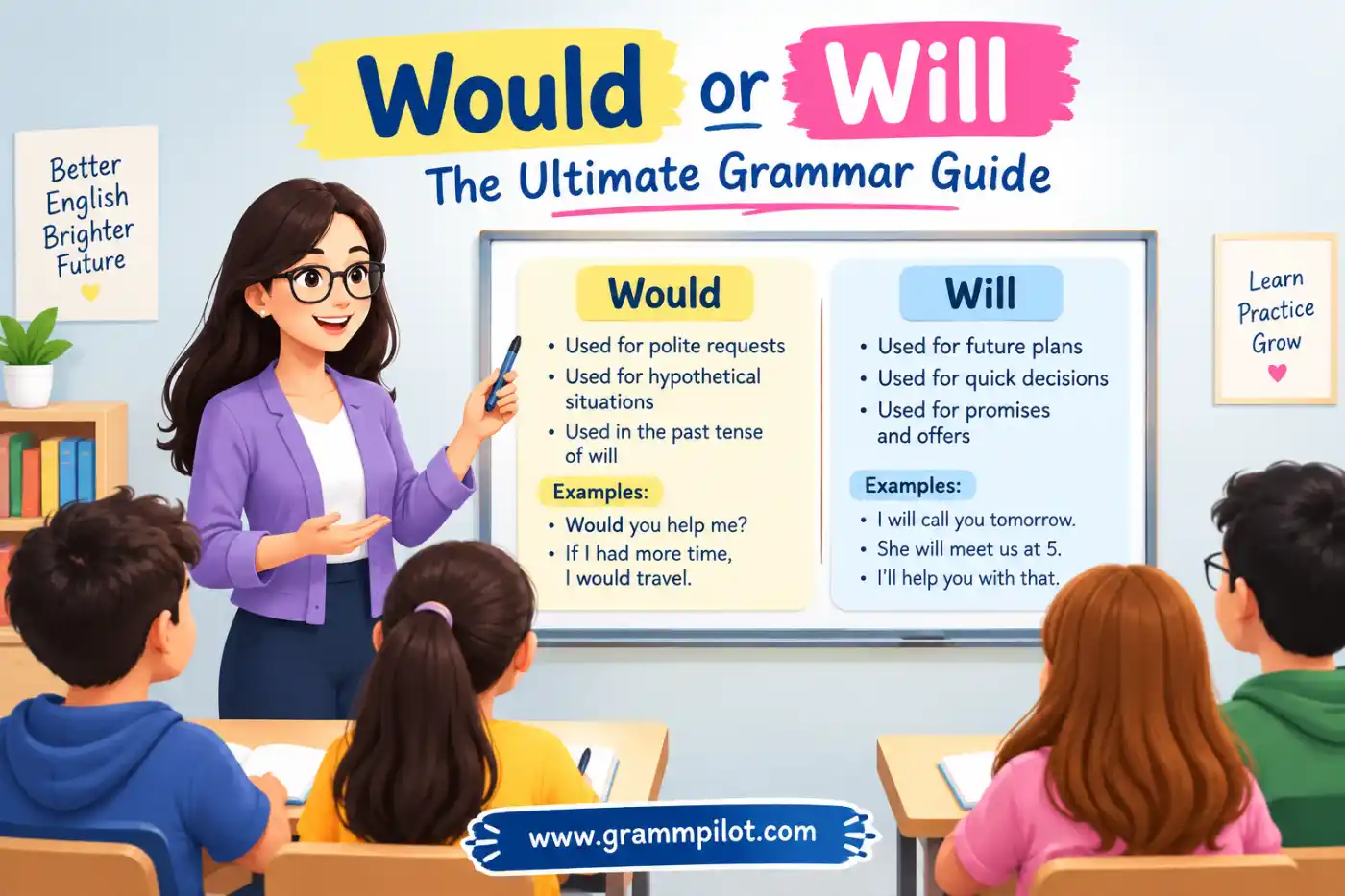
Writing an email, finishing an essay, or sending a quick text can sometimes make you stop over one tiny word. You may know exactly what you want to say, but then you wonder: Would or Will? Both words can talk about future actions, but they don’t always express the same idea. Will usually presents an action as expected, planned, decided, or strongly intended. Would can describe an imagined situation, a polite request, a preference, or something that was future from a past point of view.
Quick answer: Use will for a straightforward future action, prediction, decision, or promise. Use would for hypothetical situations, polite requests, preferences, reported future actions, and certain repeated past actions.
The difference becomes much easier once you look at the purpose behind each sentence. This guide covers their meanings, origins, grammar patterns, examples, common mistakes, alternatives, regional usage, and practical choices for emails, essays, resumes, texts, and everyday speech.
What do will and would mean?
Will and would are modal auxiliary verbs. They work with another verb to communicate ideas such as future time, intention, willingness, possibility, condition, or politeness.
Consider these two sentences:
I will help you.
I would help you if I had time.
The first statement gives a direct commitment. The second introduces a condition.
That small change creates a major difference in meaning.
What does will mean?
Will commonly points toward the future.
I will call you tonight.
It can also express a prediction: The package will arrive tomorrow.
Sometimes it shows determination: I will finish this project today.
It may also communicate willingness: I will help you carry those boxes.
So will isn’t limited to one meaning. Context determines exactly what the speaker intends.
What does would mean?
Would has several common functions.
It can introduce an imagined result:
I would travel more if I had extra money.
It can soften a request:
Would you close the window?
It can express preference:
I would rather stay home.
It can report a future action from a past viewpoint:
She said she would call later.
It can also describe repeated behavior in the past:
When we were young, we would play outside every afternoon.
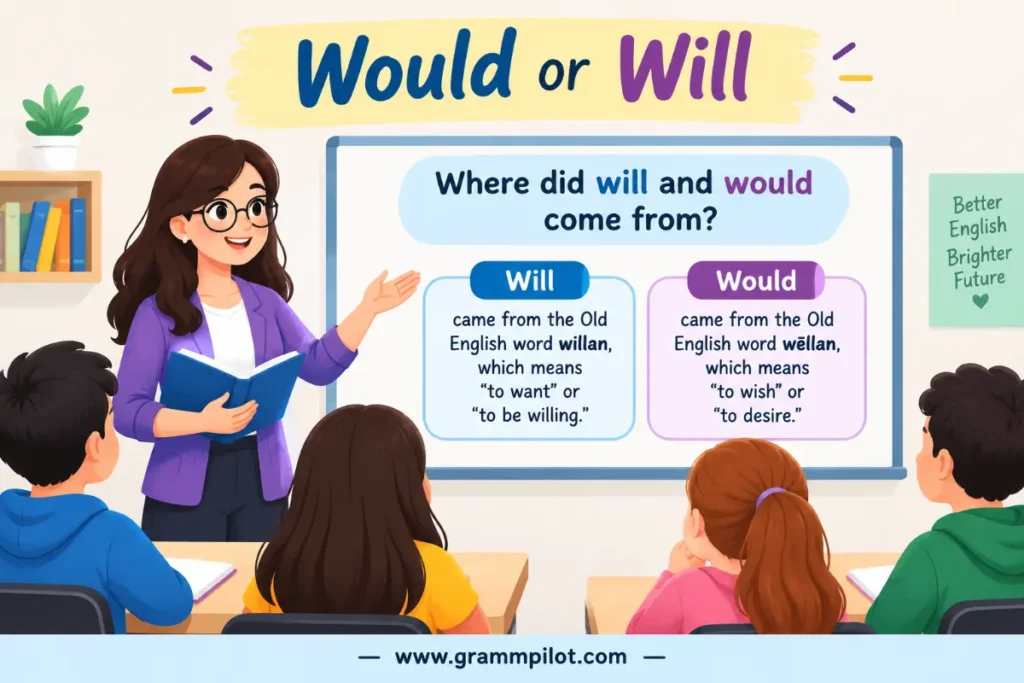
Where did will and would come from?
The history of these two words helps explain their relationship.
Will developed from an Old English verb connected with wanting, wishing, and intending. That older connection can still be felt in modern expressions involving determination or willingness.
For example: I will do it.
This can sound stronger than a simple prediction. Depending on the situation, it may communicate determination. Would developed as the historical past form associated with will. English later expanded its uses, so it no longer functions only as a past-tense form.
Look at this example: I would buy the house if I could afford it.
The sentence isn’t describing a past event.
Instead, the speaker is imagining a situation.
Now consider: Would you like some coffee?
Again, the sentence refers to the present. That’s why learning only the rule “would is the past of will” can create confusion. The relationship is real, but modern English gives would several additional jobs.
Would or Will: When should you use will?
Use will when you’re making a direct statement about the future.
I will meet you at six.
It works well for decisions, predictions, promises, and commitments.
Will for future plans
We will discuss the issue tomorrow.
The speaker presents the discussion as a future event.
Will for predictions
The new policy will affect small businesses.
The speaker predicts a future result.
Will for decisions
That box is heavy. I will carry it.
The decision is made while speaking.
Will for promises
I will send the documents tonight.
The sentence can function as a commitment.
Will for willingness
I will help you with the assignment.
Here, the word can suggest that the speaker is willing to help.
Would or Will: When should you use would?
Use would when the sentence creates a condition, imagined situation, polite distance, preference, or past viewpoint.
Would for hypothetical situations
I would buy a new laptop if I had enough money.
The purchase depends on a condition.
Would for polite requests
Would you send me the updated file?
The request is indirect and courteous.
Would for preferences
I would rather take the train.
The speaker states a preference.
Would in reported speech
James said he would arrive later.
The future action is being described from a past viewpoint.
Would for repeated past actions
Every winter, my family would visit my grandparents.
The visits happened repeatedly.
Would or Will: Is would simply the past tense of will?
Would can serve as the past counterpart of will in reported speech, but it isn’t always about the past.
This distinction matters.
Direct statement: Maria said, “I will call you.”
Reported statement: Maria said she would call me.
Here, would represents the future from Maria’s earlier point of view.
Now look at: I would help you if I knew how.
That’s a hypothetical present situation.
There is no past event involved.
One more example makes the point: Would you like another cup of tea?
This is a present-time offer.
The easiest approach is to identify the function of would instead of automatically translating it as past tense.
Would or Will: How does will express certainty?
Will often makes a future statement sound direct and confident.
The train will arrive at eight.
The speaker expects that event to happen.
Still, will doesn’t guarantee absolute certainty.
Consider: I think the team will win.
The phrase I think shows that the statement is a prediction.
Compare that with: The team might win.
The second sentence expresses more uncertainty.
A useful general pattern is:
Will = expected or presented future
Might = possible future
This doesn’t mean every use of will is certain. It simply shows how the modal often affects the speaker’s level of confidence.
How does would work in conditional sentences?
One of the most important uses of would appears in conditional sentences.
A common structure is: If + past form, would + base verb
For example: If I had more free time, I would learn Spanish.
The speaker doesn’t currently have the extra time.
Another example: If she studied harder, she would improve her grades.
The result depends on the condition.
You can also make the sentence longer: If the company reduced unnecessary costs, it would have more money for new projects.
The key idea remains the same: the result is presented as dependent on an imagined or less certain condition.
What’s the difference between the first and second conditional?
The first conditional usually discusses a possible future result.
If it rains, we will stay home.
Rain is treated as a realistic possibility.
The second conditional creates a hypothetical frame.
If it rained every day, we would stay home.
The speaker imagines a situation rather than simply describing a likely event.
Consider another pair:
If I get the job, I will move to Dallas.
This sounds like a realistic plan.
If I got the job, I would move to Dallas.
This sounds more hypothetical.
The distinction often depends on how the speaker views the situation.
How does will show intention?
Will can express a strong intention or commitment.
I will finish the report tonight.
The speaker sounds determined.
Another example:
We will contact you by Friday.
In a business setting, this can communicate a clear commitment.
It can also be spontaneous:
The doorbell is ringing. I’ll get it.
The shortened form I’ll is very common in conversation.
The exact tone depends on context, but the basic idea is an action viewed as directly connected to the future.
How does would show willingness?
Would can express willingness when a condition or imagined situation is involved.
I would help if I had the information.
The speaker is willing, but a condition prevents the action.
Another example:
She would gladly accept the invitation.
This indicates that accepting would be her choice under the relevant circumstances.
Notice the difference:
I will help.
This is a direct commitment.
I would help if I could.
This is conditional willingness.
Does would make a request more polite?
Often, yes.
Compare:
Will you send me the report?
Would you send me the report?
Both can be polite. The second usually creates more distance and therefore sounds softer.
Other common examples include:
Would you please close the door?
Would you mind waiting here?
The structure is especially useful in workplaces, customer service, formal emails, and other situations where a softer request is helpful.
However, don’t assume will is rude.
A friendly:
Will you help me with this?
can sound completely natural.
Tone comes from the whole sentence, the relationship between speakers, and the situation.
How does would express preference?
The structure would rather is used to show preference.
I would rather stay home tonight.
She would rather walk than drive.
We would rather wait until Monday.
In casual speech, the contraction is common:
I’d rather stay home.
You can compare two options: I’d rather read than watch television.
The speaker is choosing one option over another.
This use isn’t simply a past version of will. It is a standard modern expression of preference.
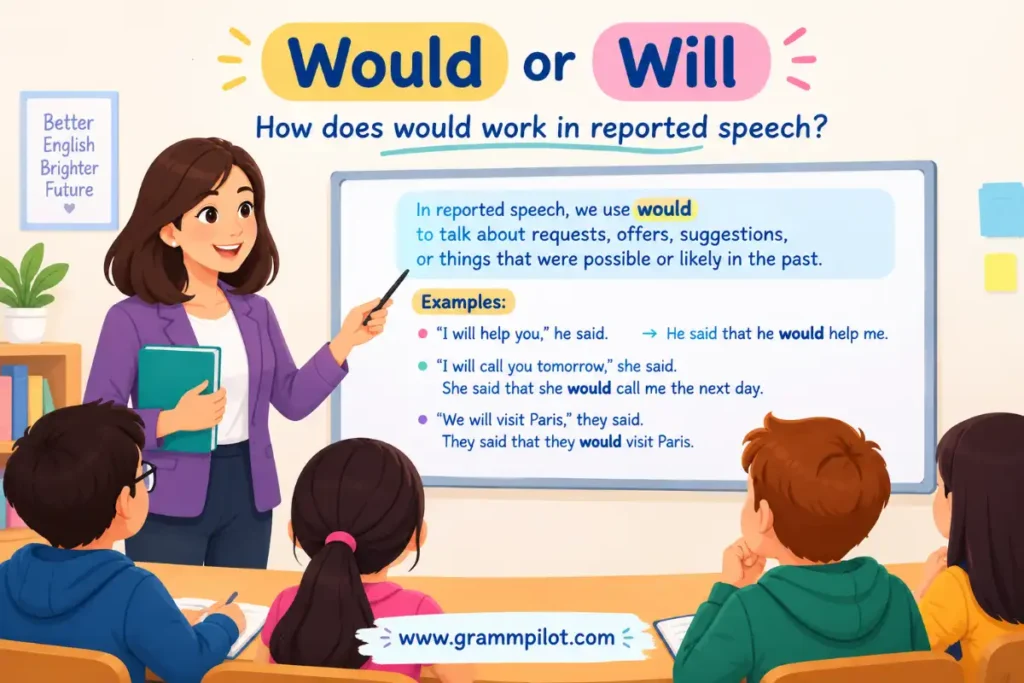
How does would work in reported speech?
When someone reports a past statement about the future, would often replaces will.
Direct speech: Daniel said, “I will finish the project.”
Reported speech: Daniel said he would finish the project.
Another example:
Direct speech: She said, “I will call tomorrow.”
Reported speech: She said she would call the next day.
The original speaker was talking about the future. Once that statement is reported from a past viewpoint, would fits naturally. This is commonly called future in the past.
Why doesn’t would always indicate past time?
Because grammar and meaning aren’t always one-to-one.
Consider: I would buy that car if it were cheaper.
The sentence describes a current hypothetical situation.
Another example: Would you like some dessert?
This is a present-time offer.
Now compare: He said he would come.
This one does involve a past viewpoint. So would can point to the past in one structure while serving a different grammatical function in another.
Can would describe repeated actions in the past?
Yes.
Would can describe actions that happened repeatedly in earlier periods.
Every summer, we would visit our cousins.
The visits happened again and again.
Another example:
When I was in college, I would study at the library every Saturday.
This means the library visits were a regular habit.
This use is close to used to:
When I was young, I used to ride my bike every afternoon.
When I was young, I would ride my bike every afternoon.
Both can work.
However, would usually describes repeated actions, not permanent states.
Is would the same as used to?
Not exactly. Both can describe past habits, but used to has a wider range.
You can say: I used to live in Seattle.
That describes a past state.
You can also say: I used to play baseball.
That describes a repeated activity.
With would, the repeated action works: Every weekend, we would play baseball.
But this is not natural: I would live in Seattle.
If you’re describing where you once lived, used to is the better choice.
A useful rule is:
Used to works for past states and repeated actions.
Would works especially well for repeated past actions.
What’s the difference between would and could?
Would usually focuses on what someone would do or choose.
Could often focuses on ability or possibility.
Compare:
I would go if I had time.
The sentence describes what the speaker would choose.
I could go if I had time.
This says going would be possible.
Another pair:
She would help you.
This can suggest willingness.
She could help you.
This can suggest ability.
A simple question can help:
Would = What would happen or what would someone choose?
Could = What is possible or what is someone able to do?
What’s the difference between would and should?
Would commonly expresses hypothetical actions, preferences, and polite requests.
Should commonly expresses advice, expectation, or responsibility.
Compare:
I would call her if I were you.
This describes a hypothetical choice.
You should call her.
This gives advice.
Another comparison:
The package should arrive tomorrow.
The speaker expects it to arrive.
The package would arrive tomorrow if the roads were clear.
The second sentence introduces a condition.
Both modals can discuss future ideas, but their meanings aren’t interchangeable.
What are useful alternatives to will and would?
There isn’t one universal synonym for either word. The best substitute depends on the meaning you’re trying to express.
| Word or phrase | Meaning | Tone | Example |
|---|---|---|---|
| Shall | Future or suggestion | Formal | Shall we begin? |
| Going to | Planned future | Everyday | I’m going to call her. |
| Plan to | Future intention | Neutral | I plan to apply. |
| Expect to | Anticipated action | Neutral | I expect to arrive soon. |
| Be likely to | Probable event | Neutral | Prices are likely to rise. |
| Definitely | Strong certainty | Neutral | He’ll definitely attend. |
| Certainly | Strong confidence | Formal | We will certainly respond. |
| Perhaps | Possible event | Neutral | Perhaps she’ll join us. |
| Maybe | Possible event | Casual | Maybe we’ll go. |
| Could | Possibility or ability | Neutral | We could leave early. |
| Used to | Past habit or state | Neutral | I used to live there. |
| Was going to | Past plan | Neutral | I was going to call. |
| Planned to | Past intention | Neutral | We planned to visit. |
| Intended to | Past intention | Formal | He intended to resign. |
| Wanted to | Past desire | Neutral | She wanted to stay. |
| Preferred to | Chosen option | Formal | They preferred to wait. |
| Would like to | Polite desire | Neutral | I’d like to speak. |
| Would rather | Preference | Neutral | I’d rather stay. |
| Be willing to | Readiness | Neutral | I’m willing to help. |
| Be prepared to | Readiness | Formal | We’re prepared to act. |
| Be certain to | Strong expectation | Formal | She is certain to succeed. |
These alternatives aren’t interchangeable in every sentence.
For instance:
I will call you.
can become:
I’m going to call you.
when you’re describing a plan.
But I’m going to call you doesn’t always carry exactly the same feeling as I will call you.
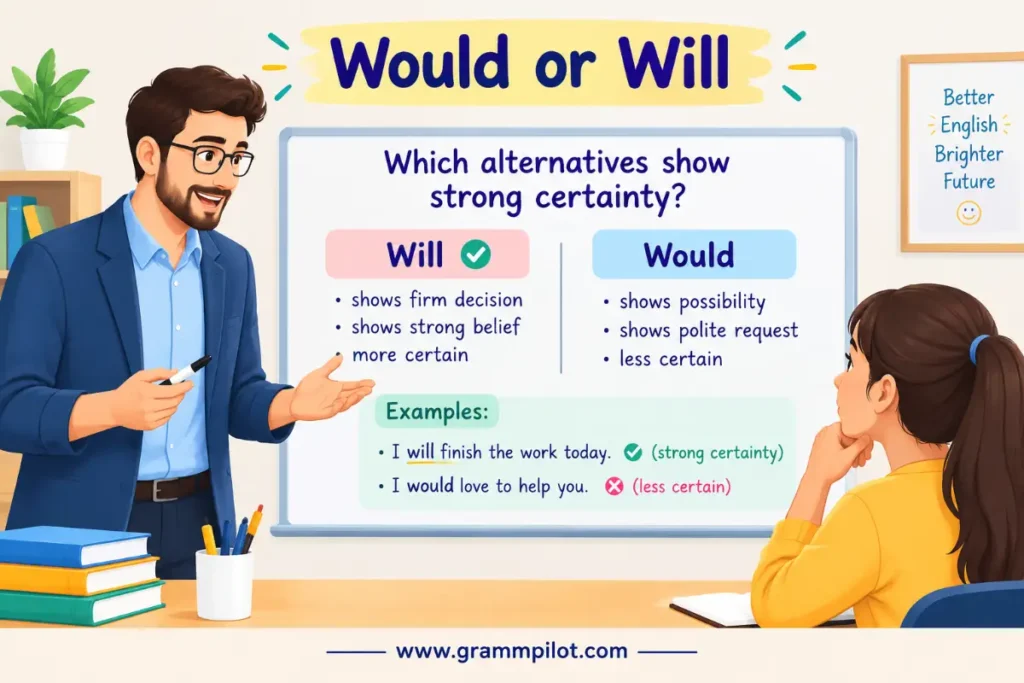
Which alternatives show strong certainty?
When you want to communicate strong confidence, consider:
- Definitely
- Certainly
- Surely
- Absolutely
- Without doubt
- Clearly
- Guaranteed
Examples:
She will definitely arrive on time.
The company will certainly review the proposal.
The results will surely improve.
Strong wording should match the evidence. If you’re unsure, absolute language can make a sentence sound exaggerated.
Which alternatives show weaker certainty?
For uncertainty, these expressions can work:
- Might
- Could
- Maybe
- Perhaps
- Possibly
- There is a chance
- It is possible that
- Is likely to
Examples:
She might arrive later.
Perhaps we’ll see him tomorrow.
There is a chance that the meeting will change.
These choices help you show how confident you are.
Should you use will or would on a resume?
A resume should usually focus on concrete actions and achievements rather than hypothetical abilities.
Instead of: I would manage a team of five employees.
if the job involved actual management, write: Managed a team of five employees.
For future goals, a direct expression can work: Plan to lead cross-functional projects.
Another option is: Seeking opportunities to lead cross-functional projects.
Avoid unnecessary conditional language when you’re describing something you’ve actually accomplished.
Should you use will or would in an essay?
Both can be useful in academic writing.
Use will when presenting a confident prediction: The policy will affect future employment patterns.
Use would when discussing a hypothetical consequence: The policy would affect employment patterns if the proposed changes were adopted.
That difference tells the reader if you’re making a prediction or exploring a possible scenario.
Another example: Without additional funding, the program would struggle to continue.
The condition is understood even though the sentence doesn’t begin with if.
Should you use will or would in a text?
Texting usually favors simple, natural language.
Will you be home later?
sounds completely normal.
Would you be home later?
can sound unusual unless you’re asking about a hypothetical situation or using a special context.
For polite offers, however, would is natural:
Would you like to come over?
Would you like some food?
For ordinary plans: I’ll call you later.
is the natural choice.
Should you use will or would in an email?
Both are useful in professional messages.
For commitments:
I will send the revised document by Friday.
For polite requests:
Would you please review the attached file?
For formal intentions:
I would like to discuss the proposal with you.
This gives you several ways to control tone.
A direct commitment can use will, while a softer request can use would.
Should you use will or would when speaking?
Both are extremely common in spoken English.
I’ll see you tomorrow.
is a normal future statement.
I’d help if I could.
expresses a hypothetical situation.
Would you like some coffee?
is a conventional offer.
Will you help me?
can be a straightforward request.
Speech also relies heavily on tone, facial expression, and context. The same grammatical form can feel friendly, serious, impatient, or formal depending on how it is spoken.
What are 12 real-life examples of will?
Here are examples across different situations.
1. Work: I will send the final report before lunch.
2. School: The teacher will explain the assignment tomorrow.
3. Travel: Our flight will leave at seven.
4. Family: I’ll call Mom after dinner.
5. Weather: The rain will probably stop soon.
6. Shopping: I will pay for the groceries.
7. Customer service: We will contact you within two business days.
8. Decision-making: I’ll take the blue shirt.
9. Promise: I will never forget your help.
10. Sports: The team will play again on Saturday.
11. Planning: We will meet outside the library.
12. Determination: I will finish this book tonight.
Each example presents the action as a future event, decision, prediction, promise, or intention.
What are 12 real-life examples of would?
Here are examples showing different uses.
1. Hypothetical: I would buy the house if I had enough money.
2. Polite request: Would you close the door?
3. Preference: I would rather walk home.
4. Offer: Would you like some tea?
5. Reported speech: She said she would call later.
6. Conditional result: The plan would work with more funding.
7. Repeated past action: Every Sunday, we would visit our grandparents.
8. Conditional willingness: I would help if I knew what to do.
9. Imagined choice: He would choose the smaller apartment.
10. Polite workplace question: Would you be able to attend the meeting?
11. Preference: They would rather wait until morning.
12. Past expectation: We knew the journey would take several hours.
Notice how varied these uses are. That’s why context matters so much.
Will vs. would in conditional meaning
Here’s another useful comparison:
| Situation | Better choice | Example |
|---|---|---|
| Realistic future | Will | If I finish early, I will call. |
| Hypothetical situation | Would | If I had time, I would call. |
| Past report | Would | She said she would call. |
| Direct promise | Will | I will call tonight. |
| Polite request | Would | Would you call me later? |
| Past repeated action | Would | We would call every Sunday. |
| Preference | Would | I’d rather call tomorrow. |
The table gives you a quick reference, but the surrounding context should always guide the final choice.
What are the most common mistakes?
Using will after a hypothetical if clause
Incorrect: If I had enough money, I will buy the car.
Correct: If I had enough money, I would buy the car.
The second conditional uses would for the imagined result.
Using would for every future action
Incorrect in an ordinary direct context: I would meet you tomorrow.
Better: I will meet you tomorrow.
Or: I’m going to meet you tomorrow.
The original version needs a special context, such as a condition or past viewpoint, to sound complete.
Thinking would always means past
Incorrect assumption: Would = past
Better understanding: Would can indicate past viewpoint, but it can also express hypothetical meaning, politeness, preference, and repeated past actions.
Confusing would with could
I would go if I had time.
This describes a choice.
I could go if I had time.
This describes possibility.
Using would instead of used to for a past state
Less natural: I would be shy when I was young.
Better: I used to be shy when I was young.
For repeated actions, though, would works well: When I was young, I would play outside every afternoon.
When should you avoid will?
Avoid will when the grammar clearly requires a hypothetical result.
If she knew the answer, she would tell us.
not:
If she knew the answer, she will tell us.
Also, in reported speech after a past reporting verb, would often replaces will: He said he would return.
The choice follows the viewpoint of the sentence.
When should you avoid would?
Avoid would when you’re simply stating a direct future fact without a condition or other reason.
I will email you tomorrow.
is clear.
I would email you tomorrow.
usually makes the reader expect an additional condition.
For example: I would email you tomorrow if I had access to the file.
Now the use of would makes sense.
What are the antonyms of will and would?
There isn’t one universal opposite for either word because both have several meanings.
For a future statement: She will attend.
The negative is: She won’t attend.
For a hypothetical action: I would help.
The negative is: I wouldn’t help.
For preference: I would rather stay.
The contrasting idea might be: I would rather leave.
So the opposite depends on the meaning being expressed.
What are the quickest tips for choosing the right word?
Use these simple checks before you finish your sentence.
- Choose will for a direct future statement.
- Choose will for a firm promise or decision.
- Choose would for a hypothetical result.
- Choose would for many polite requests.
- Choose would for preferences such as would rather.
- Choose would in reported future statements after past reporting verbs.
- Use would for repeated past actions when the context supports it.
- Use used to for past states.
- Don’t automatically treat would as past tense.
- Check the condition when you see if.
- Ask if you’re describing reality, possibility, preference, or imagination.
- Read the whole sentence instead of choosing the modal in isolation.
Conclusion
Understanding Would or Will comes down to recognizing the speaker’s purpose. Will is the natural choice for direct future statements, predictions, decisions, promises, and firm intentions. Would becomes useful when the meaning involves a condition, imagined result, polite request, preference, reported future, or repeated past action. The two words are closely related, but they create different perspectives. If the action is presented directly as something that is expected or intended to happen, will is usually the right choice. If the sentence creates distance through a condition, imagined situation, past viewpoint, or polite expression, would is often the better fit. Once you notice that difference, choosing between them becomes much more natural.
Frequently Asked Questions
1. Is will or would better for the future?
Will is usually better for a straightforward future statement. Would is more appropriate when the future is hypothetical, conditional, or viewed from a past perspective.
2. Is would the past tense of will?
Would can function as the past form of will in reported speech, but it also has several present and hypothetical uses.
3. Can I use would for a future plan?
Would usually needs a condition or another special context for a future plan. For a direct plan, will or going to is normally clearer.
4. What’s another way to say would?
Depending on the meaning, alternatives include used to, planned to, intended to, might, could, would like to, and was going to.
5. Is would more polite than will?
Would often makes a request sound softer and less direct. Still, will can be accurately polite when the tone and context are appropriate.
6. Should I use would or will after if?
Will commonly follows a present-tense condition for a realistic future result, while would usually follows a past-form condition in a hypothetical sentence.
7. How can I remember the difference between will and would?
Think of will as a direct future or firm intention, while would often adds a condition, imagined situation, past viewpoint, preference, or polite distance.