
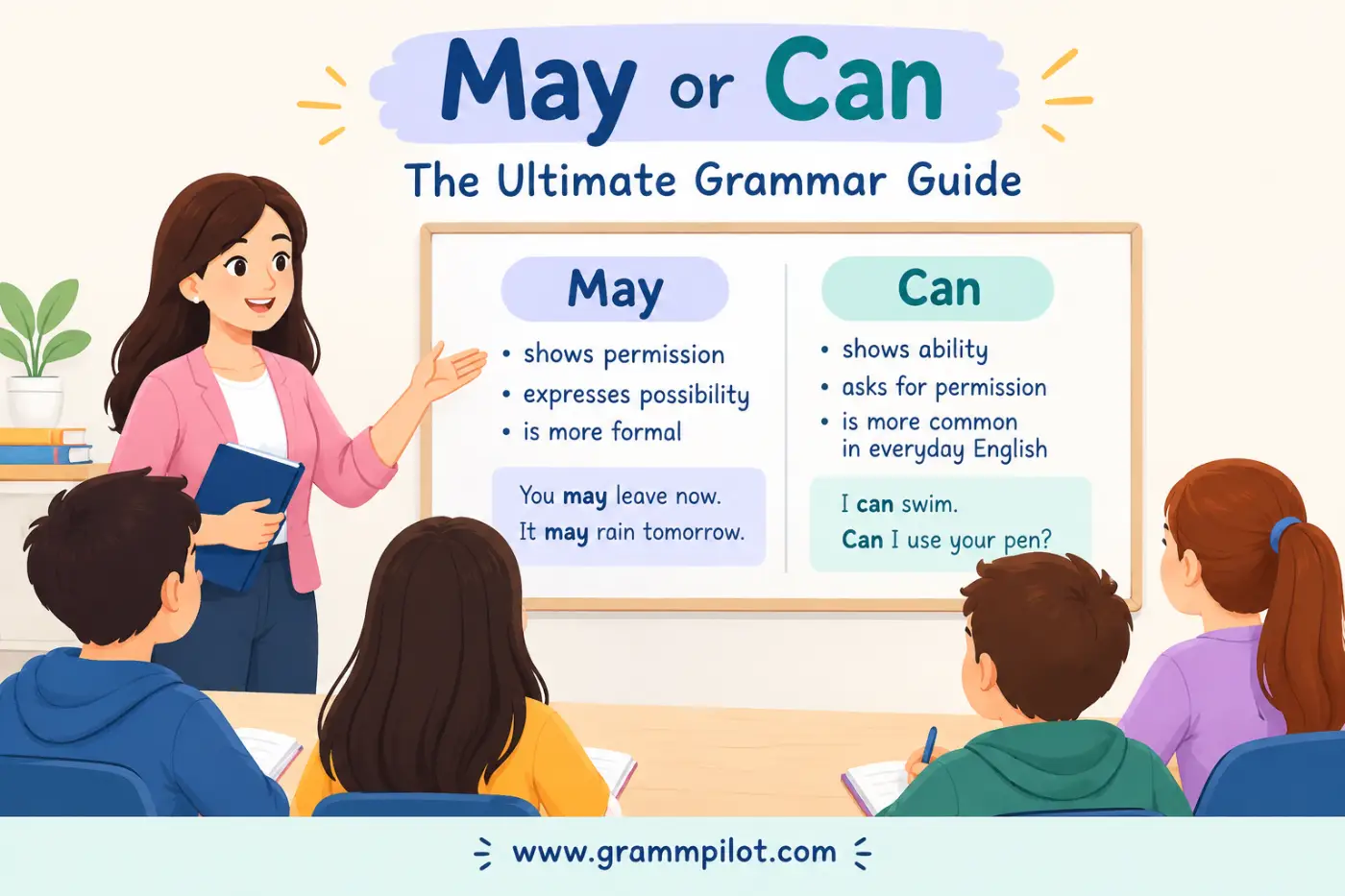
You’re writing an email to your teacher, asking a coworker for help, or sending a quick text, and you stop at one small question: May or Can? Both words can appear in questions about permission, but they don’t always mean the same thing. The confusion usually comes from an old grammar rule: “Use may for permission and can for ability.” That rule is useful, but it doesn’t tell the whole story. In modern American English, can is very common when people ask for permission in everyday situations.
Answer box: May and can can both ask for permission, but may is usually more formal and polite, while can is more common in casual American English. Can also expresses ability, which may normally does not.
The right choice depends on what you mean, who you’re speaking to, and how formal the situation is. This guide explains the history and meaning of both words, compares their uses, covers everyday and professional contexts, explores related expressions, and gives you plenty of real examples.
Want to strengthen your grammar skills? Explore [Would or Will].
What do may and can mean?
May and can are both modal verbs, but they have different core meanings.
May commonly expresses:
- Permission
- Possibility
- Formal requests
- Formal instructions
Can commonly expresses:
- Ability
- Permission
- Possibility in some contexts
- Informal requests
Consider these examples: May I leave early today?
The speaker is asking for permission. Can I leave early today?
The speaker is also asking for permission.
Now compare: I can swim.
This means the person has the ability to swim.
You normally cannot replace can with may: I may swim.
That means something different. It suggests that swimming is a possibility or future plan. This is the most important distinction to remember: can has an ability meaning that may doesn’t normally have.
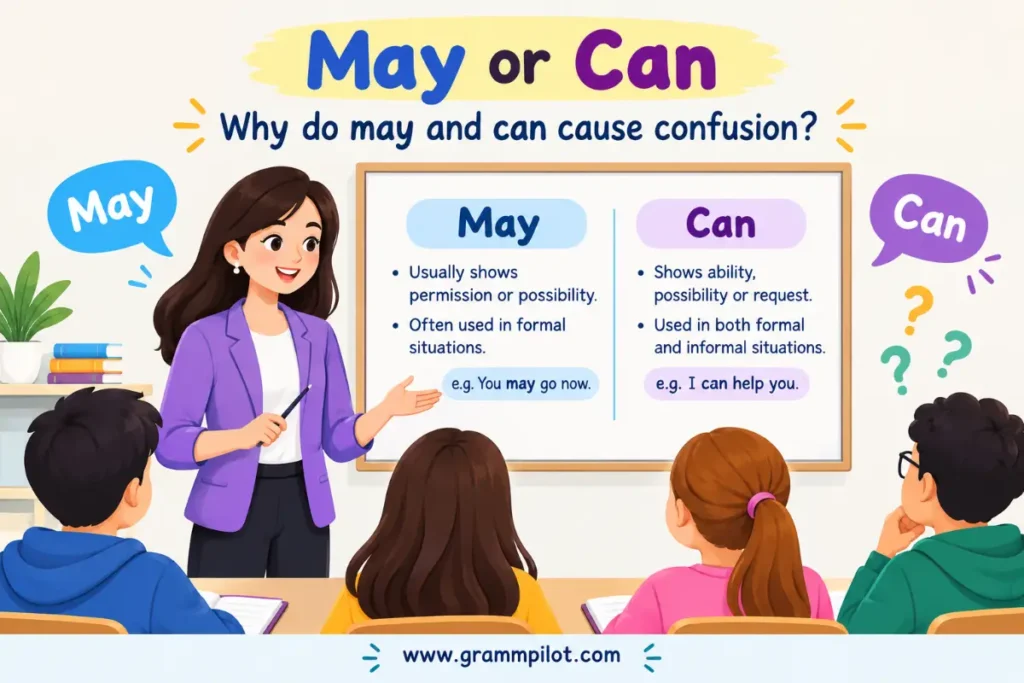
May or Can: Why do may and can cause confusion?
The confusion comes from the fact that English uses can for permission in everyday speech.
Many students learn this traditional rule:
May = permission
Can = ability
That rule isn’t completely wrong. It simply describes a more formal distinction.
In modern English, people regularly say:
Can I use your phone?
Can we sit here?
These questions are natural and widely accepted.
The same situations can be expressed with may:
May I use your phone?
May we sit here?
The difference is mostly tone and context. May I borrow your pen? sounds more formal or carefully polite. Can I borrow your pen? sounds natural and conversational. Neither sentence is automatically wrong.
May or Can: When should you use may for permission?
Use may when you want to ask for or give permission in a formal, polite, or official setting.
For example: May I speak with the manager?
This sounds respectful and professional.
You might hear it in:
- Schools
- Offices
- Customer service
- Formal meetings
- Public announcements
- Official instructions
- Respectful requests
May can be use to grant permission:
You may begin the exam now.
Students may leave after completing the test.
Visitors may enter through the main door.
In these sentences, may means that an action is allowed.It doesn’t describe someone’s ability.
May or Can: When should you use can for permission?
Use can when speaking naturally in everyday situations.
For example:
Can I borrow your charger?
Can I sit here?
These sentences are completely normal in American English.
You might use can with:
- Friends
- Family
- Classmates
- Coworkers
- People you know well
- Everyday service situations
The word makes the request sound relaxed. That doesn’t automatically make it rude. Politeness also depends on your tone, relationship, and the situation.
Is can grammatically correct for permission?
Yes. Can is widely used for permission in modern English. The traditional distinction between can and may is based on their earlier and more formal meanings. In ordinary conversation, native speakers often use can when asking whether something is allowed.
For example: Can I come in?
This is one of the most natural permission questions in everyday English.
If someone responds: Sure, come in.
there is nothing grammatically wrong with the original question. Some teachers still prefer may in formal writing or traditional grammar exercises. In those situations, following the expected style can be helpful. The key is to understand both forms instead of assuming that one is always correct and the other is always wrong.
Can may express ability?
No, not in the ordinary modern sense of physical or learned ability.
For ability, use can.
I can drive.
She can speak Spanish.
They can solve difficult problems.
He can play the guitar.
Replacing can with may changes the meaning: I may drive.
This does not mean “I know how to drive.” It means driving is possible or something the speaker might do.
Compare these carefully: I can drive.
Meaning: I have the ability.
I may drive.
Meaning: It is possible that I will drive. The distinction is simple once you focus on the intended meaning.
Can may express possibility?
Yes. May commonly expresses possibility.
It may rain tonight. She may arrive late. This decision may affect the schedule.
The word doesn’t guarantee that the event will happen. It simply identifies it as a possible outcome. Can can also express possibility, but it often has a different flavor.
For example: Mistakes can happen.
This means mistakes are possible in general. The weather can change quickly here. This describes a general possibility or tendency.
Compare that with: The weather may change this afternoon.
Now the sentence refers to a particular possibility. This distinction becomes useful in careful writing.
What’s the difference between may and can for possibility?
The difference is often about the type of possibility being discussed.
May commonly refers to a particular possible event. “The package may arrive tomorrow” .
The speaker is discussing one expected delivery.
Can often describes general possibility or capability.
Packages can arrive late during the holiday season.
That sentence describes something that can happen generally.
Another pair makes the difference clearer: This road can become dangerous in winter.
This describes a general condition.
This road may become dangerous tonight.
This predicts a possible specific event. The two words overlap, but context determines which one fits better.
May or Can: Where did may and can come from?
The history of these words helps explain their modern uses.
May comes from Old English and developed from a verb connected with having the ability or power to do something. Over time, it gained important meanings related to permission and possibility. Can also has Old English roots. It developed from a verb meaning to know or be able to do something. Its connection with ability remains strong today. This history explains why can naturally expresses ability. The permission use of can developed over time because permission and ability can overlap in everyday situations.
If someone asks: Can I leave?
the literal historical idea might suggest ability, but the intended modern meaning is usually: Am I allowed to leave?
English frequently allows words to develop new uses through ordinary speech. That’s why modern usage can’t always be explained by a single traditional grammar rule.
Is may more polite than can?
May can sound more polite because it is traditionally associated with formal requests.
For example: May I speak with you for a moment?
sounds careful and respectful. However, politeness isn’t controlled by one word.
You can make a very polite request with can: Can I please ask you something?
Your tone matters. So don’t think of may as automatically polite and can as automatically rude.
A better rule is: May sounds more formal; can sounds more natural in everyday conversation.
May or can in American English
In American English, can is extremely common for permission.
People regularly say:
Can I get some help?
Can I use this chair?
These forms are normal in casual speech.
May remains common in formal requests: May I have your name?
The difference is mainly one of register and meaning. If you’re talking to a close friend, can will usually sound more natural. If you’re writing a formal request, may may be the better choice.
How is the usage different in British English?
British English also uses can for permission in everyday speech.
For example: Can I go now?
is completely normal.
May I go now?
is more formal.
There can be differences in style, social setting, and personal preference, but the basic distinction remains useful in both American and British English. Neither variety requires speakers to use may every time they ask for permission. Regional English can also differ in how formal certain expressions feel.
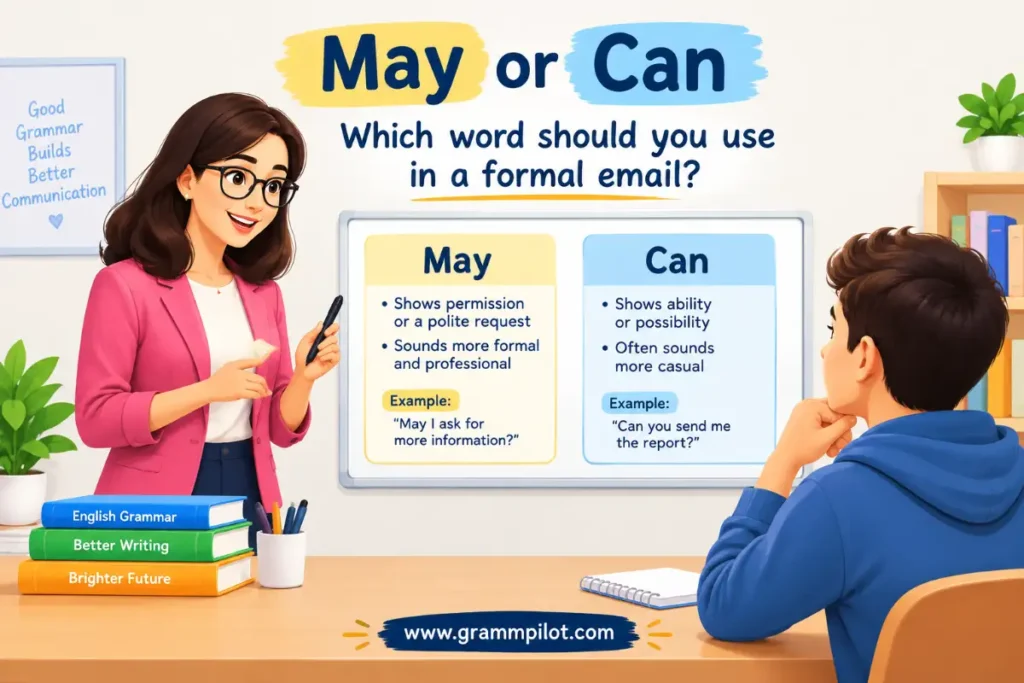
Which word should you use in a formal email?
May is often the better choice when you’re making a formal request.
For example: May I request an extension for the project?
That sounds professional.
You could also write: Could I request an extension for the project?
This is another polite option.
Can I get an extension?
is grammatically possible, but it sounds more casual. For a professional email, your choice should match the relationship and purpose.
Example for a formal email
May I ask whether the meeting can be moved to Thursday?
This sounds respectful without being overly complicated.
Example for a casual email
Can we move the meeting to Thursday?
This is natural when you’re writing to a coworker you know well.
Which word works best in a resume?
Resumes usually don’t need may or can unless you’re describing abilities or possible job requirements.
For ability, can is the natural choice in ordinary language.
For example: Can manage multiple projects under tight deadlines.
However, resume writing often removes the subject and modal for stronger phrasing: Managed multiple projects under tight deadlines.
That’s more direct.
When describing a skill, use strong action language:
- Managed
- Designed
- Created
- Led
- Organized
- Analyzed
- Developed
Don’t weaken a proven skill with unnecessary uncertainty.
If you’re describing a job requirement, may can work: The role may require occasional travel.
Here, the word expresses a possible requirement.
Which word should you use in an essay?
Both can be useful in an essay, depending on meaning. Use can when discussing general ability or a general possibility.
Regular exercise can improve overall fitness. This presents a general relationship.
Use may when making a cautious claim about a particular result.
Regular exercise may improve sleep quality.
This sounds more cautious.
Academic writing often needs careful language because evidence doesn’t always support absolute claims.
Compare:
The policy will solve the problem.
This sounds definite.
The policy may reduce the problem.
This is more cautious.
The second version may be more appropriate if the evidence isn’t conclusive.
Which word sounds better in texting?
Can is usually the natural choice for casual texting.
Examples:
Can I call you?
Can we meet later?
Using may isn’t incorrect, but it can sound more formal: May I call you?
That might feel unusually careful between close friends. For everyday texting, can is usually the better fit.
Which word should you use when speaking?
In ordinary conversation, can is often the most natural option for permission.
You might say:
Can I sit here?
Can we go now?
Use may when you want a more formal tone:
May I have a moment of your time?
May I ask your opinion?
Neither form is inherently better.
The situation decides.
May vs. can in the classroom
Teachers may use both words depending on the level of formality.
A teacher might say: You may begin the test.
This is a formal instruction.
A student might ask: Can I sharpen my pencil?
This is an ordinary request for permission.
A traditional teacher may prefer: May I sharpen my pencil?
Both forms communicate the same basic request. The second sounds more formal.
May vs. can at work
Workplace communication often depends on your relationship with the person.
With a close coworker: Can you send me the report?
is natural.
For a formal request: May I ask you to review the report?
sounds more polished.
There’s also an important difference between can as ability and can as a request.
Can you finish this today?
may ask about ability or willingness.
May I finish this tomorrow?
asks for permission. These meanings should not be confused.
Can you use can to ask about ability?
Yes. This is one of its most important uses.
Can you swim?
This asks whether someone has the ability to swim.
Can you drive?
This asks about driving ability.
Can she speak French?
This asks about language ability.
You cannot normally replace these with may without changing the meaning.
May you swim?
doesn’t ask whether someone knows how to swim. It sounds unusual and doesn’t express ordinary ability.
Can you use may to ask about ability?
No. May is not the normal modal for ability.
If you’re asking whether someone is capable of doing something, use can or sometimes could.
Can you lift this box?
asks about ability.
Could you lift this box?
can ask about ability or function as a polite request.
May you lift this box?
doesn’t work as a normal ability question.
This is one area where the two modals are clearly different.
May or Can: What are the best synonyms for may and can?
The alternatives depend on the intended meaning.
| Word or phrase | Meaning | Tone | Example |
|---|---|---|---|
| Could | Possible or able | Neutral | Could I leave early? |
| Might | Possible | Neutral | It might rain. |
| Perhaps | Possibly | Neutral | Perhaps she will come. |
| Possibly | Could happen | Neutral | She could possibly help. |
| Probably | Likely | Neutral | He’ll probably arrive soon. |
| Be capable of | Have ability | Formal | He is capable of solving it. |
| Be possible | Could happen | Neutral | A delay is possible. |
| Have a chance to | Have an opportunity | Neutral | You have a chance to win. |
| Be free to | Have permission | Neutral | You’re free to leave. |
| Be authorized to | Have official permission | Formal | Staff are authorized to enter. |
| Be permitted | Be allowed | Formal | Guests are permitted to enter. |
| Be likely to | Probably happen | Neutral | Prices are likely to rise. |
| Could possibly | Possible | Neutral | It could possibly work. |
| There is a chance | Something may happen | Neutral | There is a chance of rain. |
| Know how to | Have learned an ability | Everyday | She knows how to swim. |
| Be good enough to | Have sufficient ability | Casual | He’s good enough to compete. |
| Be permitted | Officially allowed | Formal | Employees are permitted to enter. |
| Be able to | Have ability | Everyday | I am able to help. |
| Be possible for | Be within possibility | Neutral | It may be possible for us to help. |
| Have access to | Be allowed or able to use | Neutral | Members have access to the facility. |
These alternatives shouldn’t be swapped automatically. For instance, could can replace can in some permission questions, but it also has meanings involving past ability and possibility.
What are the alternatives by level of certainty?
If you’re talking about possibility, some expressions generally sound more confident than others.
A rough progression is: Certain → very likely → probably → may/could → might → possibly → unlikely
For example: She will arrive at noon.
This is definite.
She’ll probably arrive at noon.
The speaker expects it.
She may arrive at noon.
The arrival is possible.
She might arrive at noon.
The statement sounds more tentative.
She may possibly arrive at noon.
This is grammatical but can feel repetitive because both may and possibly express uncertainty.
Good writing usually chooses one clear expression instead of piling several together.
What are the differences by part of speech?
The main words in this comparison are modal verbs, but related expressions belong to other grammatical categories.
Modal verbs
May and can are modal auxiliary verbs.
She may arrive.
She can swim.
Adverbs
Maybe, perhaps, possibly, and probably are adverbs.
Maybe she will arrive.
Perhaps she will arrive.
She will probably arrive.
Adjectives
Possible, likely, and capable are adjectives.
A delay is possible.
She is capable of leading the team.
Nouns
Possibility, ability, permission, and chance are nouns.
There is a possibility of rain.
He has the ability to solve the problem.
She received permission to leave.
Knowing these categories helps prevent awkward sentence construction.
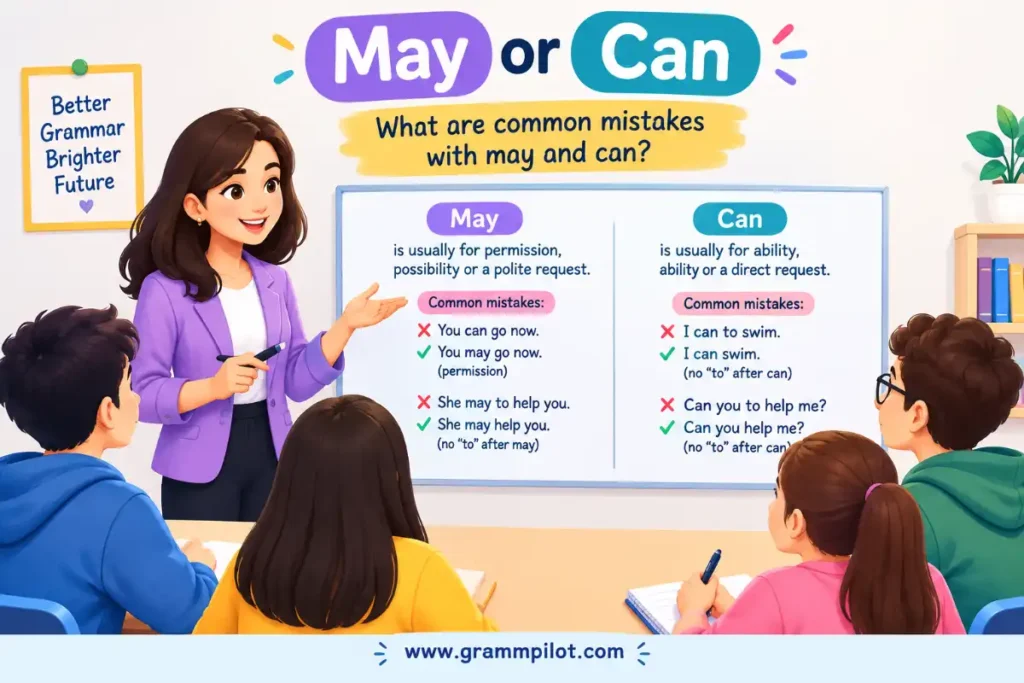
What are common mistakes with may and can?
Mistake 1: Saying can is always wrong for permission
This is one of the most common misunderstandings.
Can I borrow your book?
is normal modern English.
May I borrow your book?
is also correct and more formal.
Mistake 2: Thinking may always means permission
It doesn’t.
It may rain tonight.
Here, may expresses possibility.
Mistake 3: Using may for ability
Incorrect for ordinary ability:
I may swim.
if your intended meaning is “I know how to swim.”
Better:
I can swim.
Mistake 4: Using can when you mean future possibility
Consider:
The package may arrive tomorrow.
This predicts a possible future event.
The package can arrive tomorrow.
can suggest that tomorrow is an available or possible delivery time, but the meaning isn’t exactly the same.
For a specific uncertain prediction, may is usually clearer.
Mistake 5: Assuming formality determines correctness
A casual sentence isn’t automatically incorrect because it uses can.
Can I come in?
is natural.
May I come in?
is more formal.
The difference is largely about register.
Mistake 6: Forgetting context
A single word can change the meaning of a sentence.
You may leave.
Permission.
You may leave soon.
Possibility.
The surrounding words matter.
When should you not use may?
Don’t use may when you need to express ordinary ability.
Instead of:
She may speak three languages.
if you mean she has the skill, write:
She can speak three languages.
Use may if you mean it is possible that she speaks three languages:
She may speak three languages.
The context changes everything.
When should you not use can?
Don’t use can when you need to give formal permission and want a clearly official tone.
For example, a policy might say:
Employees may access the building after 6 p.m.
rather than:
Employees can access the building after 6 p.m.
The second sentence isn’t necessarily ungrammatical, but the first sounds more like an official authorization.
Likewise, can may be less suitable when you are deliberately making a cautious prediction.
The results may change.
is usually clearer than:
The results can change.
if you’re referring to a particular future outcome.
What are the antonyms of may and can?
There isn’t one universal antonym for either modal because each has several meanings.
For may as possibility, useful contrasts include:
- Definitely
- Certainly
- Will
- Impossible
- Cannot
Example: The plan may work.
Contrast:The plan will work.
or: The plan cannot work.
For can as ability, the negative form is often cannot or can’t.
She can swim.
She can’t swim.
For permission:
You may enter.
You may not enter.
The exact opposite depends on what the original modal means.
What should you remember when choosing between them?
Use these quick rules:
- Can commonly expresses ability.
- May commonly expresses possibility.
- Both can express permission.
- May sounds more formal for permission.
- Can sounds more natural in casual conversation.
- Use may for a formal request such as May I…?
- Use can for ordinary ability questions such as Can you swim?
- Use may when discussing a specific uncertain event.
- Can can describe general possibility.
- Don’t assume can is wrong when it means permission.
- Don’t use may when you mean physical or learned ability.
- Let the situation determine the level of formality.
How can you choose the right word quickly?
Start by asking what the sentence is really saying.
If you’re talking about ability, choose can.
I can cook.
If you’re talking about permission, both can work, but choose may for a more formal tone.
May I leave early?
Choose can for everyday speech.
Can I leave early?
If you’re talking about possibility, may is often a good choice for a particular event.
The train may be late.
If you’re describing a general possibility, can may fit better.
Trains can be delayed during storms.
This quick test will solve most everyday cases.
May vs. can: a simple side-by-side guide
| Situation | Better choice | Example |
|---|---|---|
| Ability | Can | I can drive. |
| Formal permission | May | May I leave? |
| Casual permission | Can | Can I leave? |
| Specific possibility | May | It may rain tonight. |
| General possibility | Can | Roads can become icy. |
| Formal instruction | May | Visitors may enter. |
| Casual request | Can | Can you help me? |
| Possible future event | May | She may arrive later. |
| Learned skill | Can | He can play piano. |
| Formal academic possibility | May | The change may affect results. |
Conclusion
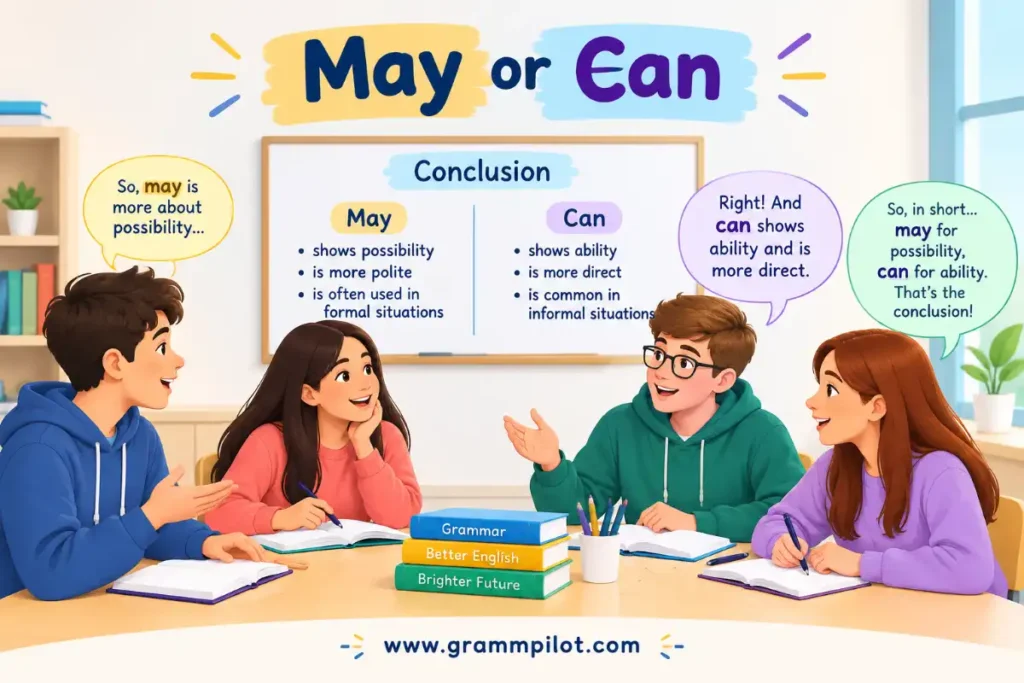
Choosing between May or Can becomes much easier when you focus on meaning rather than memorizing a strict rule. Use can when you’re talking about ability, such as knowing how to swim, drive, or solve a problem. Both words can ask for permission, but may usually gives the request a more formal tone, while can is common in everyday American English. For possibility, may often works well when you’re discussing a particular uncertain event, whereas can can describe something that is generally possible. The best choice depends on what you mean and how formal the situation is. Once you notice that difference, these two small words become much easier to use naturally.
Frequently Asked Questions
1. Is may or can correct for asking permission?
Both can be correct. May is more formal, while can is very common in everyday American English.
2. Is can I grammatically correct?
Yes. Can I…? is a standard modern way to ask for permission in casual and everyday English.
3. Is may more polite than can?
May can sound more formal and respectful, but can isn’t automatically rude. Politeness also depends on tone and context.
4. What’s another way to say may or can?
Depending on the meaning, alternatives include could, might, be able to, be allowed to, be permitted to, and possibly.
5. Can may be used for ability?
No. May normally doesn’t express ability. Use can when you mean that someone has the skill or capacity to do something.
6. Which is better in formal writing, may or can?
May is often preferable when expressing formal permission or a cautious possibility. Can is appropriate when describing ability or a general possibility.
7. Is “May I?” more formal than “Can I?”
Yes. May I…? generally sounds more formal, while Can I…? is more natural in everyday conversation.