
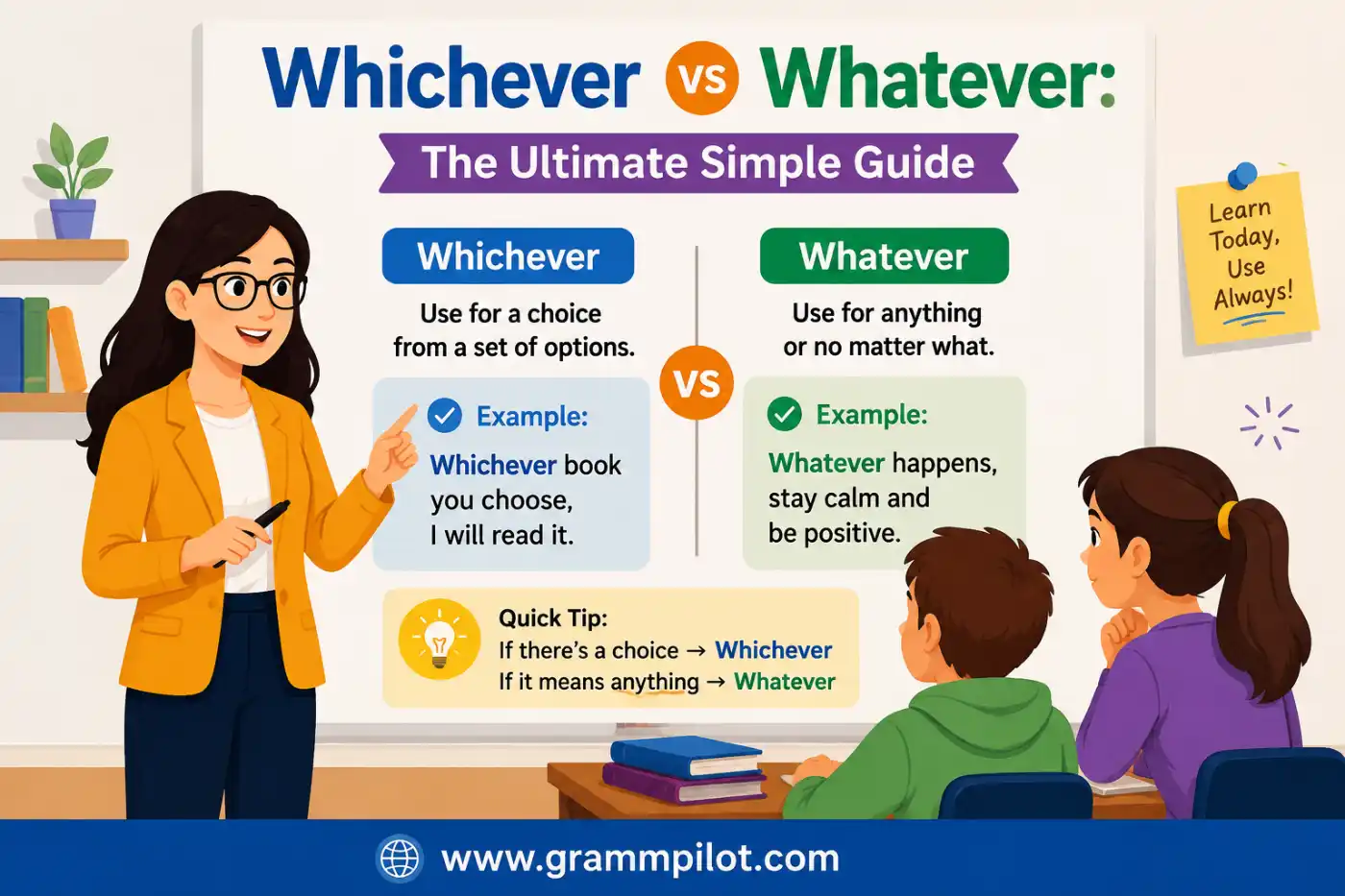
When you’re writing an email, essay, resume, or text, you may pause over a sentence like, “Choose ___ option you prefer.” Should you use whichever vs whatever? Both words can refer to a choice, but they don’t always mean the same thing. The easiest way to remember the difference is to look at the type of choice. Whichever usually refers to a choice from a known or limited group. Whatever is broader and can refer to almost anything, without suggesting a specific set of choices.
Answer box: Use whichever when choosing one option from a known or limited set. Use whatever when the choice is open-ended or the specific thing doesn’t matter.
The distinction becomes clearer when you look at real sentences. This guide explains the meanings, origins, grammar, synonyms, regional usage, common mistakes, and the best choice for emails, essays, resumes, texts, and everyday speech.
If you’re building a collection of useful similes and comparisons, don’t miss [Similes for Autumn].
What is the difference between whichever and whatever?
Whichever means “any one of the available choices” or “the one from a particular group that you choose.”
Whatever means “anything or everything of the type mentioned” or “no matter what.”
Compare these sentences:
- “Choose whichever color you like.”
- “Eat whatever you want.”
In the first sentence, the speaker has a group of colors in mind. The listener can choose one of them. In the second sentence, the choice is much more open. The speaker isn’t limiting the listener to a particular set of foods.
A simple rule is:
Whichever = one choice from a group.
Whatever = any thing, with little or no limit.
This isn’t an absolute rule because both words can appear in more complex sentences. Still, it’s a useful starting point.
Whichever vs Whatever: When should you use whichever?
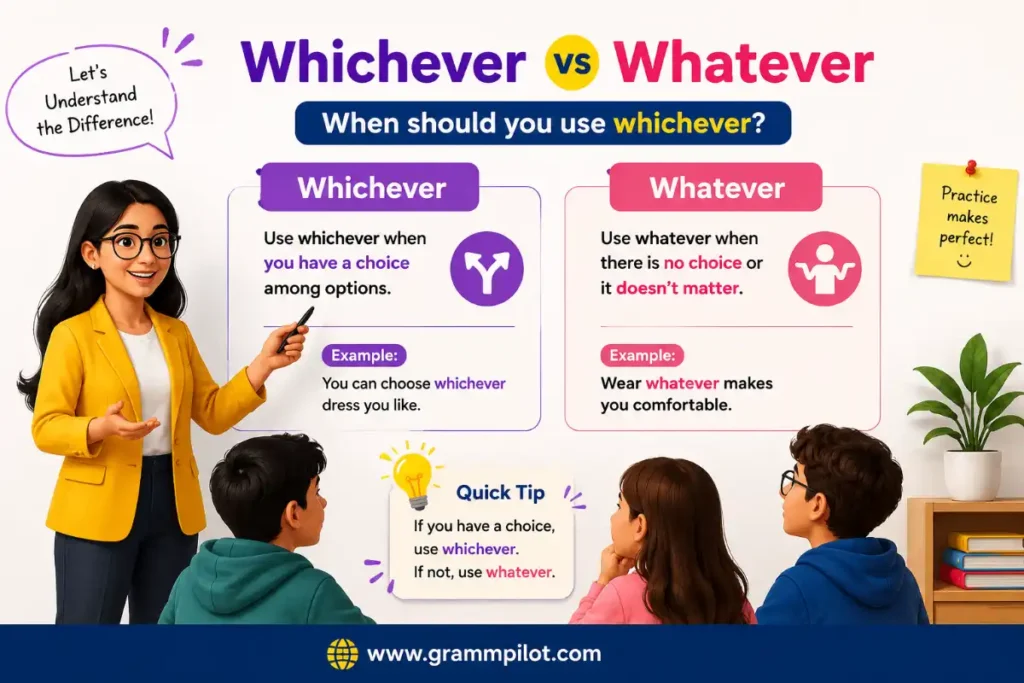
Use whichever when you are talking about one option from a known, available, or implied group.
For example:
- “Take whichever seat is available.”
- “Choose whichever dress you prefer.”
- “Use whichever method works best.”
- “Pick whichever route is faster.”
The speaker expects there to be several possible choices. You don’t necessarily have to name the choices. The group can be understood from context.
Imagine you’re standing in a restaurant with three desserts on the table. You might say: “Take whichever dessert you want.”
The choices are visible and limited.
You could also say: “Whichever answer you choose, explain your reasoning.”
Here, whichever refers to one answer from a set of possible answers.
Whichever vs Whatever: When should you use whatever?
Use whatever when the choice is open-ended, unrestricted, or not important to the speaker.
Examples include:
- “Buy whatever you need.”
- “Eat whatever you want.”
- “Ask whatever question you have.”
- “Bring whatever you think we’ll need.”
The speaker isn’t necessarily thinking about a fixed list.If you tell a friend, “Order whatever you want,” you’re giving them broad freedom. The exact item doesn’t matter. That’s the main idea behind whatever: the specific thing is unrestricted, unknown, or unimportant.
Why does whichever sound more limited?
The word whichever contains which. “Which” normally asks someone to choose from alternatives. For example: “Which shirt do you want?” The speaker has several shirts in mind.
Adding -ever creates whichever, which means roughly: “Any one of the choices you have.”
Compare:
- which → asks about a choice
- whichever → any one choice from the available group
This connection helps explain why whichever often feels more limited than whatever.
Why does whatever sound broader?
Whatever contains what. “What” usually asks about an unspecified thing.
For example: “What do you want?”
The speaker isn’t necessarily presenting a fixed list. Add -ever, and you get whatever.“Whatever you want.” That creates a broad or unrestricted meaning.
So the basic relationship is:
| Word | Basic question | Result |
|---|---|---|
| Which | Which one? | Whichever |
| What | What thing? | Whatever |
This isn’t the entire grammar story, but it’s a helpful memory tool.
Whichever vs Whatever: Where did whichever come from?
Whichever is formed from which + ever. The word which has a long history in English and has traditionally been used to identify or select something from alternatives. The addition of -ever broadens the choice while still keeping the idea of selection. So whichever developed the sense of “any one of the alternatives.”
That’s why it works naturally with words such as:
- option
- route
- answer
- method
- color
- seat
- choice
- version
For example: “Use whichever option is easiest.”
The word points to one item within an available group.
Whichever vs Whatever: Where did whatever come from?
Whatever is formed from what + ever. The word what is used when the identity or nature of something is unknown or unspecified. Adding -ever gives it a broad sense.
That produces meanings such as:
- anything that
- no matter what
- any thing at all
- the thing that doesn’t matter which
For example: “Take whatever you need.”
The speaker isn’t limiting the listener to a small, named group. Over time, whatever also developed informal uses that express indifference or dismissal.
For example: “Whatever.” In casual conversation, this can mean something like “I don’t care” or “It doesn’t matter to me.” That use is quite different from the normal grammatical use.
Is whichever a pronoun, determiner, or adjective?
Whichever can function in more than one grammatical role. Whichever as a determiner It can come before a noun “Choose whichever book you want.” Here, whichever determines which book is being selected.
Other examples:
- “Take whichever bus arrives first.”
- “Choose whichever color matches.”
- “Use whichever tool is available.”
Whichever as a pronoun
It can stand by itself “Choose whichever you prefer.”
Here, the noun is understood from context.
It could mean “Choose whichever option you prefer.”
This makes whichever flexible in everyday English.
Is whatever a pronoun, determiner, or adjective?
Whatever can also perform different grammatical roles.
Whatever as a determiner
It can come before a noun.
“Take whatever book you want.”
Other examples:
- “Bring whatever equipment you have.”
- “Choose whatever method works.”
- “Use whatever excuse you like.”
Whatever as a pronoun
It can stand alone. “Take whatever you need.” Here, the word represents an unspecified thing or things.
Whatever as an informal interjection
It can also appear by itself: “Whatever!” This use often expresses indifference, annoyance, or dismissal. The tone depends heavily on context and voice
What is the simplest way to remember whichever vs whatever?
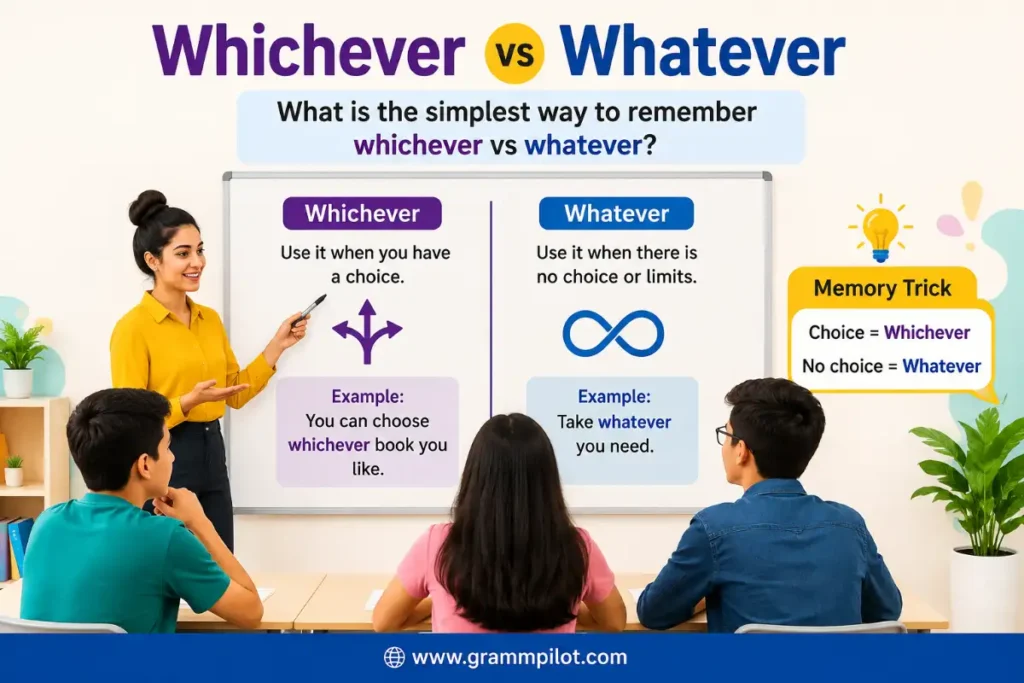
Think about whether you have a menu or an open field. If there is a menu of choices, whichever often fits “Pick whichever dessert you want.” If the possibilities are wide open, whatever often fits. “Eat whatever you want.”
Another useful test is to replace the word with:
- any one of these → whichever
- anything at all → whatever
For example: “Choose whichever you like.”
Could mean: “Choose any one of these.”
Now try: “Choose whatever you like.”
That sounds more open: “Choose anything you like.”
Master synonym and related-word list
Not every item below is a perfect synonym. Some are close alternatives, paraphrases, informal expressions, or phrases that work in similar contexts.
Simple alternatives
| Word or phrase | Meaning | Tone | Example |
|---|---|---|---|
| whichever | Any one from a group | Neutral | “Choose whichever works.” |
| whatever | Anything of the kind mentioned | Neutral | “Take whatever you need.” |
| any | One or more without a specific preference | Neutral | “Choose any seat.” |
| either | One of two choices | Neutral | “Either option is fine.” |
| any one | One item from a group | Neutral | “Pick any one.” |
| any of these | One or more from a known group | Neutral | “Choose any of these.” |
| any option | Any available choice | Neutral | “Select any option.” |
| any choice | Any possible selection | Neutral | “Make any choice.” |
Everyday alternatives
| Word or phrase | Meaning | Tone | Example |
|---|---|---|---|
| anything | Any thing without restriction | Everyday | “Bring anything you need.” |
| any one you want | Any single choice | Casual | “Take any one you want.” |
| whatever you like | Anything preferred | Casual | “Wear whatever you like.” |
| anything you want | Any desired thing | Casual | “Order anything you want.” |
| any one of them | One item from a group | Everyday | “Pick any one of them.” |
| any of them | Any member of a group | Everyday | “You can choose any of them.” |
| the one you prefer | The preferred choice | Neutral | “Take the one you prefer.” |
| the option you want | Selected option | Neutral | “Choose the option you want.” |
Formal alternatives
| Word or phrase | Meaning | Tone | Example |
|---|---|---|---|
| any applicable option | Any option that applies | Formal | “Select any applicable option.” |
| any available option | Any option currently offered | Formal | “Choose any available option.” |
| the preferred option | The option considered best | Formal | “Select the preferred option.” |
| any suitable option | Any option that meets needs | Formal | “Use any suitable option.” |
| an alternative of your choice | Any selected alternative | Formal | “Choose an alternative of your choice.” |
| any permissible choice | Any allowed choice | Formal | “Select any permissible choice.” |
| any item meeting the criteria | Any item that qualifies | Technical | “Use any item meeting the criteria.” |
| the selected alternative | The alternative chosen | Formal | “Proceed with the selected alternative.” |
Casual or slang-related alternatives
| Word or phrase | Meaning | Tone | Example |
|---|---|---|---|
| whatever | Anything; sometimes indifference | Casual | “Whatever works.” |
| anything goes | Almost any choice is acceptable | Casual | “For this party, anything goes.” |
| your call | You decide | Casual | “Morning or evening—your call.” |
| up to you | You may decide | Casual | “Dinner is up to you.” |
| your choice | You decide | Casual | “It’s your choice.” |
| doesn’t matter which | Any choice is acceptable | Casual | “It doesn’t matter which one.” |
| any one is fine | All choices are acceptable | Casual | “Any one is fine with me.” |
| whatever you want | Broad freedom to choose | Casual | “Get whatever you want.” |
These alternatives aren’t interchangeable in every sentence. For example, either normally refers to two choices, while whichever can refer to three, four, or many choices.
How does whichever compare with any?
Whichever and any can sometimes express the same idea, but whichever often makes the available choices more visible.
Compare:
“Choose any seat.”
“Choose whichever seat you want.”
The first sentence means any seat is acceptable. The second suggests there are particular seats available and you’re choosing one from them.
In many cases, both are correct. The difference is subtle.
| Whichever | Any |
|---|---|
| Often highlights a selection | Often gives general permission |
| Suggests available alternatives | Can be broader |
| “Choose whichever route.” | “Choose any route.” |
| Often feels more choice-focused | Often feels more unrestricted |
How does whatever compare with anything?
These two are much closer.
“Take whatever you need.”
“Take anything you need.”
Both can mean that the listener has broad freedom.
However, whatever can sound more natural when it introduces a clause: “Whatever you choose, I’ll support you.”
You can’t simply replace it with anything in that sentence without changing the structure. Whatever also has special uses that anything doesn’t.
For example: “Whatever happens, stay calm.”
This means: “No matter what happens, stay calm.”
Whichever vs Either: What’s the difference?
Either usually refers to two choices. Whichever can refer to two or more choices.
Compare “You can choose either dress.”
This normally suggests two dresses.
Now: “Choose whichever dress you like.”
There could be two dresses, five dresses, or twenty dresses.
| Word | Typical number of choices | Example |
|---|---|---|
| either | Two | “Choose either option.” |
| whichever | Two or more | “Choose whichever option you prefer.” |
| whatever | Open-ended | “Choose whatever you want.” |
This is an important distinction for precise writing.
Whatever vs Any: What’s the difference?
Whatever is often broader and can sound more unrestricted than any.
Compare:
“Choose any dessert.”
“Choose whatever dessert you want.”
Both allow freedom, but the second has a stronger sense of personal choice. Another example: “Bring any book.”
This can mean any book will do. “Bring whatever book you want.” This focuses more on the person’s freedom to decide. The difference is often one of emphasis rather than strict grammar.
Whichever vs Whatever: Which one sounds more natural?
It depends on the sentence.
Limited choices
Use whichever: “Choose whichever plan fits your budget.”
There are specific plans under consideration.
Open choice
Use whatever: “Choose whatever you think is best.”
The listener has broad freedom.
Known group
Use whichever: “Take whichever jacket is yours.”
The speaker expects a particular group of jackets.
No important restriction
Use whatever: “Wear whatever makes you comfortable.”
The speaker isn’t limiting the clothing choice.
Can whichever and whatever be used in the same sentence?
Yes. A sentence can contain both words when they perform different jobs. For example: “Choose whichever route you want, and take whatever supplies you need.” Here, whichever route refers to available routes. Whatever supplies is broader. The listener can bring any supplies they consider necessary.
Another example: “Whichever team wins can choose whatever prize they want.”
The teams are a known group, so whichever works. The prize choice is broader, so whatever works.
What does “whichever one” mean?
Whichever one means any one from a group of choices.
For example: “Take whichever one you like.”
The word one represents an understood noun.
It could mean:
- whichever shirt
- whichever book
- whichever seat
- whichever option
You don’t always need one.
Both are possible:
“Choose whichever you prefer.”
“Choose whichever one you prefer.”
The second version emphasizes the individual item.
What does “whatever one” mean?
Whatever one can also be grammatical, but it has a somewhat different feel. For example: “Take whatever one you want.” This can mean any one you want, but in many contexts whichever one sounds more natural when the speaker has a known set of items in mind.
Compare:
“There are five cakes here. Take whichever one you want.”
This strongly suggests a defined group.
“Go into the store and buy whatever one you want.”
This is possible, but whatever you want may sound more natural if the available choices are open-ended.
Which word should you use in a resume?
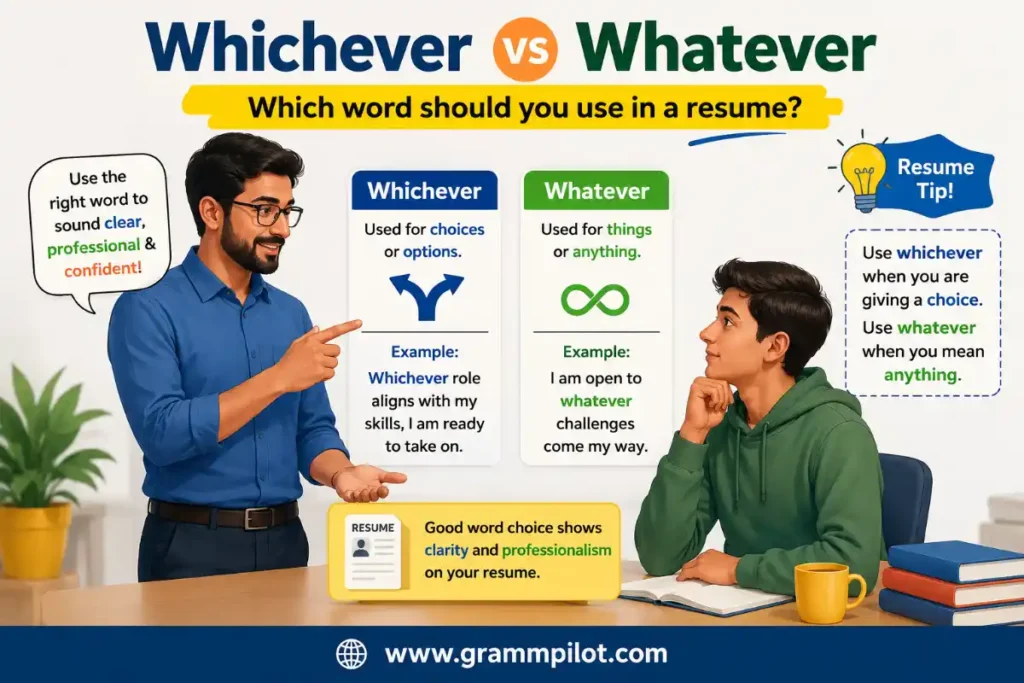
Use whichever when discussing defined options
A resume may use whichever when explaining flexible processes or choices.
Example: “Applicants may select whichever certification pathway best matches their goals.”
This suggests that the organization offers specific pathways.
Use whatever sparingly
Whatever can sound too casual or vague in a resume.
Instead of: “I can handle whatever tasks come up.”
a stronger professional sentence might be: “I can handle a wide range of tasks and priorities.”
The problem isn’t that whatever is grammatically wrong. It’s that professional writing often benefits from greater precision.
Best resume choice
When you need a formal tone, replace vague uses of whatever with specific language.
Good: “Adapted to changing project requirements.”
Better than: “Adapted to whatever the project required.”
The second is understandable, but the first sounds more professional.
How does whatever compare with anything?
Whichever in an essay
Whichever works well when discussing alternatives. “Students may choose whichever topic best supports their argument.” This is clear and precise.
Whatever in an essay
Whatever is also grammatical, but academic writing often benefits from specifying what you mean.
Casual: “Whatever method a researcher uses, accurate data is important.”
Formal: “Regardless of which method a researcher uses, accurate data is important.”
The second version can sound more academic.
Still, don’t avoid whatever completely. It is a normal English word and can be useful in formal writing when the meaning is precise.
Which word should you use in texting?
Texting is where whatever appears very often.
Examples: “Whatever works for you.”
“Eat whatever you want.”
“Bring whatever you need.”
Whichever is also common:
“Take whichever one you want.”
“Pick whichever color looks best.”
In casual messages, both are natural. The choice depends mainly on whether you’re talking about a defined set or a broad range.
Whichever vs Whatever: Which word should you use in an email?
For a professional email, both words are acceptable when used accurately.
Use whichever for a defined set: “Please select whichever appointment time works best for you.”
Use whatever for an open choice: “Please bring whatever documents you have available.”
If the email is formal, consider whether a more precise phrase would be clearer.
Instead of: “Send whatever you have.”
you might write: “Please send any documents currently available.”
That sounds more professional without changing the basic meaning.
Whichever vs Whatever: Which word should you use when speaking?
Both are extremely common in speech.
Whichever often sounds natural when you’re pointing to choices “Take whichever one you like.”
Whatever is natural when giving someone freedom: “Do whatever you want.”
Speech also makes the emotional meaning of whatever clearer.
Compare:
“Whatever you need, I’ll help.”
with: “Whatever.”
The first is neutral and helpful. The second can sound dismissive or annoyed. Tone matters.
15 original examples using whichever
Here are examples from different situations.
- “Choose whichever chair is most comfortable.”
- “You can take whichever bus arrives first.”
- “Select whichever file contains the latest version.”
- “Use whichever password manager your company approves.”
- “Pick whichever dessert you’d like.”
- “Whichever team scores first may gain confidence.”
- “I’ll support whichever decision the group makes.”
- “Take whichever path looks safest.”
- “Choose whichever shirt matches the jacket.”
- “Whichever answer you select, explain why.”
- “Use whichever example makes the idea clearer.”
- “You may attend whichever session fits your schedule.”
- “Whichever candidate wins will face a difficult first year.”
- “Take whichever seat is still empty.”
- “Choose whichever plan gives you the best value.”
Notice the recurring idea: there is an available group of alternatives.
15 original examples using whatever
- “Eat whatever you want for dinner.”
- “Bring whatever supplies you think we’ll need.”
- “Ask whatever questions come to mind.”
- “Wear whatever makes you comfortable.”
- “You can choose whatever topic interests you.”
- “Take whatever time you need.”
- “I’ll help you with whatever problem you’re facing.”
- “Whatever happens, stay calm.”
- “Use whatever materials are available.”
- “Buy whatever fruit is freshest.”
- “She can study whatever subject she enjoys.”
- “Bring whatever documents you can find.”
- “Whatever you decide, let me know.”
- “He’ll eat whatever is served.”
- “Choose whatever seems most practical.”
Here, the choices aren’t presented as a clearly defined small group.
Whichever vs Whatever: What are the most common mistakes?
Mistake 1: Using whichever for a completely open choice
Awkward: “Whichever food exists in the world, choose it.”
Better: “Choose whatever food you want.”
The second sentence clearly expresses an unrestricted choice.
Mistake 2: Using whatever when a defined set matters
Suppose a teacher gives students three topics.
Natural: “Choose whichever topic interests you.”
Less precise: “Choose whatever topic interests you.”
The second sentence isn’t necessarily ungrammatical, but whichever better highlights the limited set of topics.
Mistake 3: Confusing whichever with either
If there are only two choices, either may be more direct. “Either answer is acceptable.”
If there are several: “Whichever answer you choose, explain your reasoning.”
Mistake 4: Treating whatever as always informal
Whatever is not automatically informal.
Consider: “Whatever the outcome, the study will provide useful information.”
That sentence can appear in formal writing.
The word becomes informal when it’s used as a dismissive response: “Whatever.”
Context matters.
Mistake 5: Assuming whichever and whatever are interchangeable
Sometimes they are close.
Sometimes changing the word changes the meaning. “Choose whichever dress you like.”
suggests a known selection of dresses.
“Choose whatever dress you like.”
sounds more open-ended. The difference may be subtle, but it can matter.
When should you avoid “whatever”?
Avoid whatever when it creates unwanted vagueness. For example: “I completed whatever tasks were assigned.” This is grammatical, but a resume might be stronger with: “I completed all assigned tasks.”
Or: “I completed assigned administrative and customer-service tasks.”
Specific language gives the reader more useful information. Also avoid using whatever as a dismissive response in professional situations. “Whatever.” can sound rude, irritated, or uninterested.
A better professional response is:
or: “I’m happy to follow your preference.”
When should you avoid “whichever”?
Avoid whichever when there isn’t a meaningful set of alternatives.
For example:n“Whichever you want to eat from the entire world.”
This is possible only in a very unusual context. If the choice is completely open, whatever is usually more natural: “Eat whatever you want.” Also, don’t use whichever simply because it sounds more formal. It isn’t a more sophisticated version of whatever. The words express different ideas.
What are the antonyms of whichever vs whatever?
These words don’t have perfect one-word antonyms.
Still, several expressions can express the opposite idea.
For whichever, possible contrasts include:
- a specific one
- the exact one
- this particular option
- that particular choice
- the designated option
Whatever contrasts include:
- a specific thing
- one particular item
- the exact choice
- a predetermined option
- the required item
For example: “Choose whichever option you want.”
contrasts with: “Choose the specific option listed on the form.”
The first allows selection. The second restricts it.
Quick comparison chart “Whichever vs Whatever”
| Feature | Whichever | Whatever |
|---|---|---|
| Main idea | Any one from a group | Anything or no matter what |
| Choice type | Usually defined or limited | Usually broad or open |
| Related question | Which? | What? |
| Common noun after it | Yes | Yes |
| Can stand alone | Yes | Yes |
| Refers to a regionally defined set | Often | Less specifically |
| Can express “no matter” meaning | Yes | Yes |
| Can be dismissive alone | Rarely | Yes |
| Works in formal writing | Yes | Yes |
| Usually informal? | No | Not necessarily |
How do “whichever” and “whatever” work with clauses?
Both words can introduce clauses.
Whichever + clause “Whichever route you take, you’ll arrive by noon.”
This means that any route from the relevant choices will lead to the result.
Another example: “Whichever candidate wins, the policy will change.”
The outcome applies regardless of which candidate is selected.
Whatever + clause “Whatever you decide, I’ll support you.”
This means the speaker’s support applies regardless of the decision.
Another example: “Whatever happens, don’t panic.”
This means: “No matter what happens, don’t panic.”
This is an important use of whatever.
What does “whatever you prefer” mean?
Whatever you prefer gives someone broad freedom to choose according to personal preference.
For example: “We can meet online or in person—whatever you prefer.”
This is common in everyday English. If you’re choosing from a clearly defined list, whichever you prefer can also work: “We offer three meeting times. Choose whichever you prefer.” The second sentence highlights the available times.
What does “whichever you prefer” mean?
It means choose the one you prefer from the available alternatives.
Example: “There are two appointment times. Pick whichever you prefer.”
The phrase doesn’t mean “anything in the universe.” It refers to the relevant choices. This is why whichever is especially common in instructions and decision-making.
How can you choose correctly every time?
Use this five-step test.
Step 1: Identify the choices
Ask: “Is there a specific group of options?”
If yes, whichever is often appropriate.
Step 2: Check whether the choice is open
Ask: “Can the person choose almost anything?”
If yes, whatever is often better.
Step 3: Ask whether “which” fits
Try replacing the word with which one.
If that works naturally, whichever may be the right choice.
Step 4: Ask whether “what” fits
Try replacing it with what thing or anything that.
If that works, whatever may be better.
Step 5: Check the tone
If you’re writing professionally, make sure whatever isn’t creating unnecessary vagueness or sounding dismissive.
A simple memory trick “Whichever vs Whatever”
Remember:
WHICH → WHICHEVER → a choice from choices
WHAT → WHATEVER → an open-ended thing
You can also remember:
Whichever asks “which one?”
Whatever asks “what thing?”
This won’t solve every advanced grammar question, but it handles most everyday situations.
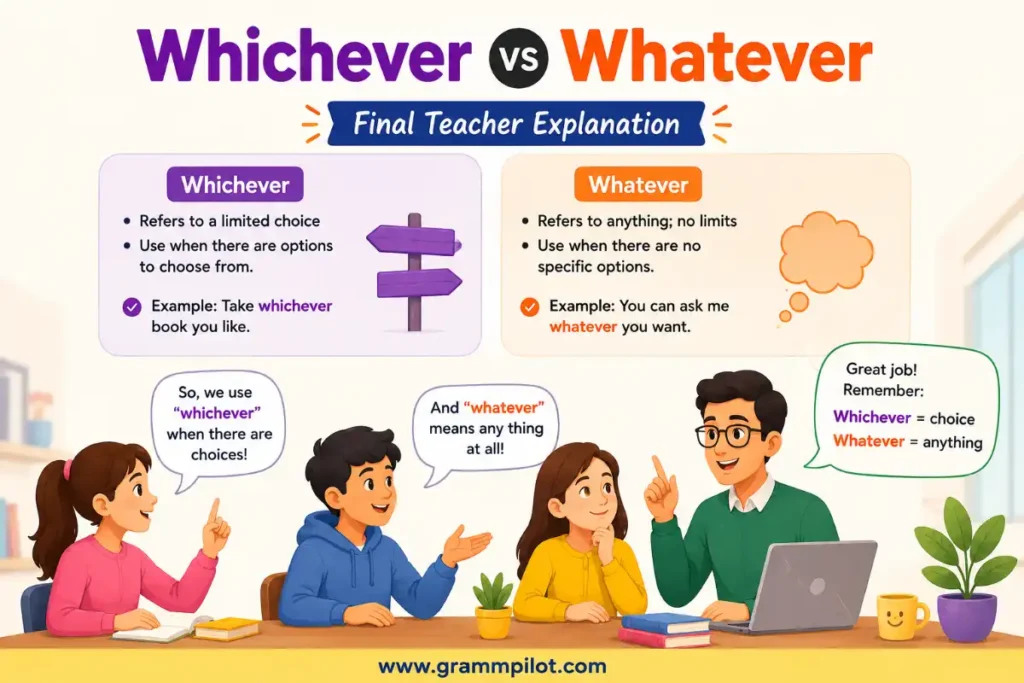
Final teacher explanation “Whichever vs Whatever”
Whichever vs whatever are both words of choice, but they don’t create the same kind of choice.
Whichever usually points to one option from a known or limited group. Think of several shirts, routes, answers, plans, or seats. You’re selecting one.
Whatever is broader. It can mean any thing, anything that fits, or no matter what happens. It often gives someone greater freedom.
There’s also a grammatical clue: whichever is connected to which, while whatever is connected to what. That makes their basic meanings easier to remember. If you’re unsure, ask whether the choices are defined or open-ended. Defined choices usually favor whichever. Open-ended choices usually favor whatever.
Conclusion
The key to Whichever vs Whatever is understanding the size and type of the choice. Whichever normally points to one option from a known or limited group, such as a list of routes, seats, answers, or appointment times. Whatever gives broader freedom and can refer to anything that fits the situation or to an outcome regardless of what happens.
You can make the distinction quickly by connecting whichever with “which one” and whatever with “what thing” or “anything.” Also remember that whatever isn’t automatically informal; it can work perfectly well in serious writing when the meaning is clear. Once you focus on context rather than memorizing isolated rules, these two words become much easier to use confidently.
Frequently Asked Questions
1. What is the main difference between whichever vs whatever?
Whichever usually refers to one choice from a known or limited group, while whatever is broader and can refer to almost anything.
2. Is whichever more formal than whatever?
No, neither word is simply a more formal version of the other. They have different meanings, although whatever can sound casual in some expressions.
3. Can whichever vs whatever mean the same thing?
Sometimes they can be close in meaning, especially when the speaker is giving someone freedom to choose. Whichever usually suggests a defined group, while whatever tends to sound more open-ended.
4. What’s another way to say whatever?
Common alternatives include anything, anything you want, whatever you prefer, no matter what, and any option that works, depending on the sentence.
5. Is “whichever one you want” grammatically correct?
Yes, “whichever one you want” is grammatically correct and means any one item from the relevant group that you choose.
6. Which is correct: whichever vs whatever?
Both are correct, but they fit different contexts. Use whichever for one option from a relevant group and whatever for a broader or unrestricted choice.
7. Can whatever mean “no matter what”?
Yes, whatever can mean “no matter what,” as in “Whatever happens, stay calm.” This use focuses on an outcome or condition rather than a simple choice.