
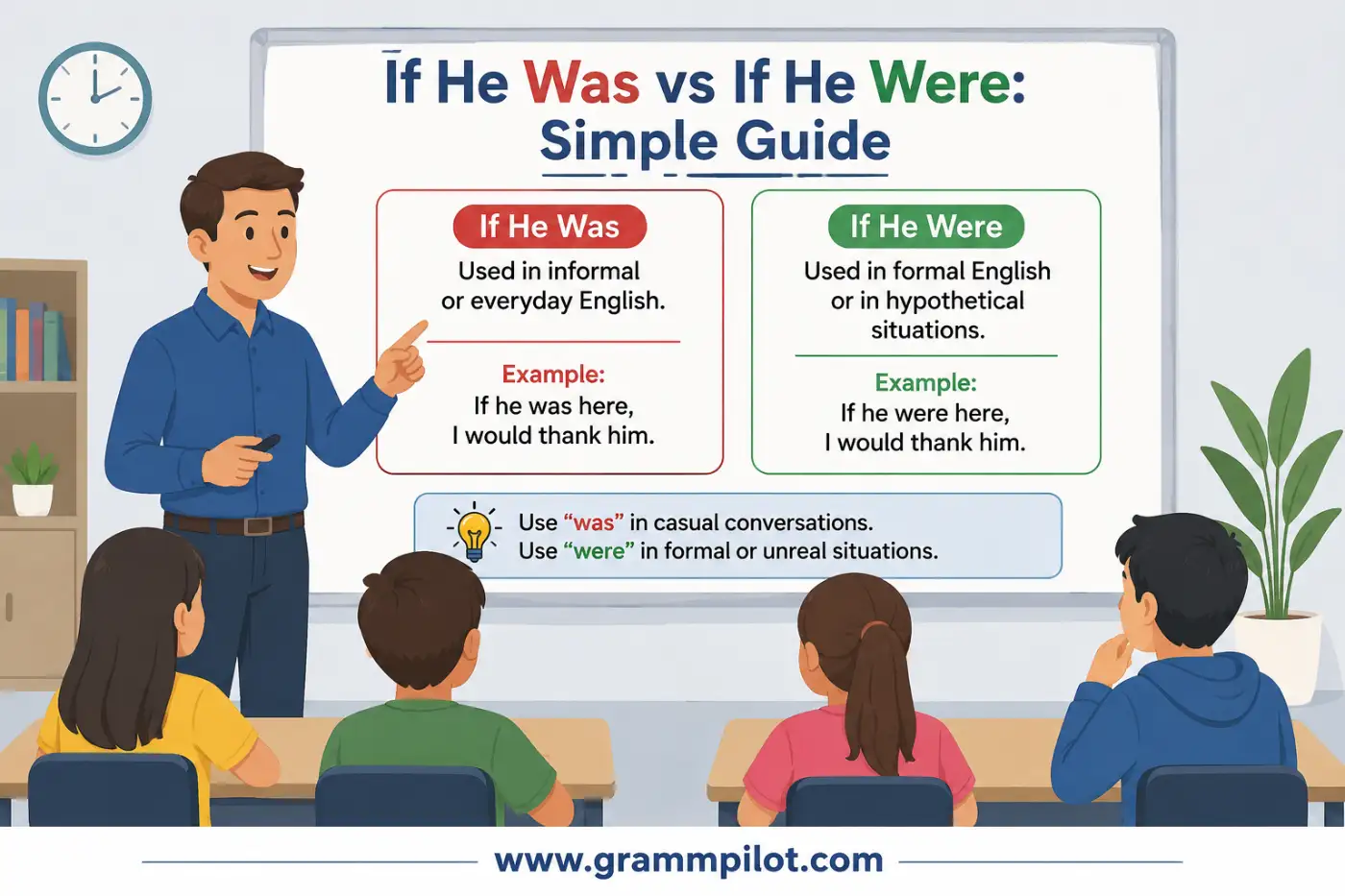
Have you ever stopped while writing an email, school essay, or even a text message because you couldn’t decide between If He Was vs If He Were? You’re not alone. Many English learners and even native speakers pause at this grammar choice because both versions sound correct in different situations. The confusion comes from the fact that English has different grammar rules for real situations and imaginary ones. Without knowing that difference, it’s easy to pick the wrong form. Once you understand the rule, choosing the correct expression becomes much easier. If He Was or If He Were is one of the most searched grammar questions because it appears in conversations, books, songs, exams, and professional writing. You’ll hear both forms in daily speech, but they don’t always mean the same thing.
Quick Answer: Use “if he was” when talking about something that really happened or might have happened. Use “if he were” when talking about imaginary, unlikely, or impossible situations.
By the end of this guide, you’ll know when each form is correct, why English uses two different versions, common mistakes to avoid, dozens of real examples, useful comparisons, and simple memory tricks that make this grammar point easy to remember.
Having trouble remembering which word fits? See our guide to [Entwined vs Intertwined].
What Does If He Was vs If He Were Mean?
The question If He Was or If He Were is really about choosing the correct verb form after the word if. Although both expressions begin the same way, they describe different kinds of situations.
- If he was usually refers to something real or possible.
- If he were usually refers to something imaginary, unlikely, or contrary to fact.
That small change from was to were changes the meaning of the whole sentence.
Compare these examples.
- If he was at the meeting, I didn’t see him.
- If he were at the meeting, he would know the answer.
The first sentence suggests that he may actually have attended. The second sentence imagines a situation that is not true. Understanding this difference is the key to mastering If He Was or If He Were.
Why Do People Confuse If He Was vs If He Were?
Many people hear both forms every day.
Friends often say “If he was there, I missed him.”
Teachers might say: “If he were here, he would help us.”
Since both sound natural, it’s easy to assume they’re interchangeable. They aren’t.
The choice depends on whether you’re talking about:
- a real event
- an uncertain fact
- an imagined situation
- a wish
- advice
- a hypothetical condition
That’s why grammar books spend so much time explaining If He Was or If He Were.
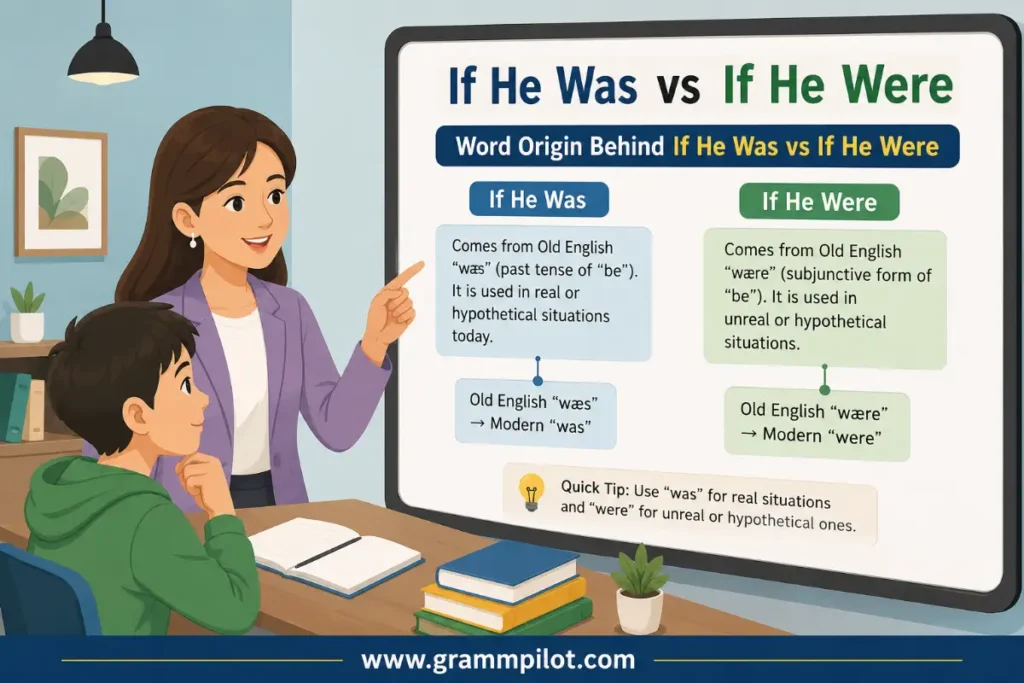
Word Origin Behind If He Was vs If He Were
Most grammar articles explain the rule but skip the history. Knowing where these words came from makes the difference easier to understand.
Where Does “If” Come From?
The word if comes from Old English gif, meaning “on the condition that.”
For hundreds of years, English speakers have used if to introduce conditions.
Some conditions describe reality.
Others describe imagination.
That distinction still exists today.
Where Does “Was” Come From?
Was is the past tense form of the verb to be.
It developed from older Germanic languages and has been part of English for well over a thousand years.
Today, was normally describes:
- past facts
- real events
- possible situations
- things that actually happened
Examples include:
- He was tired yesterday.
- She was late for class.
- If he was busy, I understand.
Where Does “Were” Come From?
Originally, were was simply another past-tense form of to be.
Over time, English gave it another important job.
It became the traditional form used in the subjunctive mood.
The subjunctive is used for:
- wishes
- imaginary situations
- impossible conditions
- unlikely events
- advice
- recommendations
That’s why grammar teachers often prefer if he were in hypothetical sentences.
Even though everyday conversation sometimes replaces it with was, formal English still keeps this distinction.
Learning this history makes If He Was or If He Were much less confusing because each form developed for a different purpose.
What Is the Difference Between If He Was vs If He Were?
The easiest way to remember the rule is to ask one question.
Is the situation real or imaginary?
If it’s real or could easily be true, use was.
If it’s imaginary or contrary to reality, use were.
| Situation | Correct Form | Example |
|---|---|---|
| Real past event | If he was | If he was sick, he stayed home. |
| Possible situation | If he was | If he was driving, he’ll arrive soon. |
| Imaginary situation | If he were | If he were taller, he’d play basketball. |
| Impossible condition | If he were | If he were a bird, he could fly. |
| Advice | If he were | If I were him, I’d apologize. |
This simple chart answers most questions about If He Was or If He Were.
Is If He Was vs If He Were a Grammar Rule or Just a Preference?
Many people wonder whether this is an actual grammar rule or simply a style choice.
The answer depends on the type of English you’re using.
In Formal English
Formal writing follows the traditional grammar rule.
That means:
- use was for real situations
- use were for hypothetical situations
Examples:
✅ If he was upset, he didn’t show it.
✅ If he were upset, he would probably leave.
Editors, teachers, and standardized tests usually expect this distinction.
In Everyday Conversation
Spoken English is more relaxed.
Many native speakers say:
- If he was here…
- If I was you…
These expressions are common in casual conversation.
However, many style guides still recommend were for imaginary situations, especially in writing.
Knowing the difference helps you sound more polished.
When Should You Use If He Was?
Choose if he was whenever you’re discussing something that happened, may have happened, or could realistically be true.
Think of it as the form for facts or possible facts.
Examples include:
- If he was asleep, don’t wake him.
- If he was working yesterday, he’ll receive overtime pay.
- If he was the person who called, I’ll return the message.
- If he was honest with us, everything makes sense.
- If he was feeling sick, staying home was the right choice.
Notice that each sentence refers to a situation that could genuinely be true.
Nothing is imaginary.
When Should You Use If He Were?
Use if he were whenever you’re imagining a different reality.
These sentences often include words like:
- would
- could
- might
- should
The event isn’t real.
Instead, you’re exploring an idea.
Examples:
- If he were here, everyone would celebrate.
- If he were older, he could drive.
- If he were my neighbor, I’d invite him over.
- If he were the manager, things would change.
- If he were rich, he would travel the world.
Every sentence imagines a reality that doesn’t currently exist.
That’s why were is the correct choice.
Why Does English Keep Both Forms?
Some learners wonder why English doesn’t simply use was for everything.
The answer is clarity.
Using two different forms lets readers know whether you’re discussing reality or imagination before they even finish the sentence.
Compare these examples.
If he was late, he missed the train.
This suggests that he may actually have been late.
If he were late, he would miss the train.
Now you’re imagining what would happen in that situation.
One word changes the entire meaning.
That small distinction explains why grammar experts continue teaching the difference between If He Was or If He Were.
If He Was vs If He Were Synonyms and Related Expressions
Although If He Was or If He Were is a unique grammar choice rather than a vocabulary word, several expressions create similar meanings depending on the context.
The sections below group these related expressions so you can choose the most natural one in speaking and writing.
Simple Everyday Alternatives
| Expression | Meaning | Tone | Example |
|---|---|---|---|
| If he is | Refers to a present possibility | Neutral | If he is ready, let’s leave. |
| If he was | Refers to a possible past fact | Neutral | If he was busy, I understand. |
| If he were | Imagines another reality | Formal | If he were here, we’d begin. |
| In case he was | Refers to a precaution about the past | Everyday | I called in case he was waiting. |
| Assuming he was | Accepts something as possibly true | Neutral | Assuming he was correct, we changed the plan. |
| Suppose he was | Introduces a possible situation | Conversational | Suppose he was telling the truth. |
| Suppose he were | Introduces an imagined situation | Formal | Suppose he were president. |
| Imagine he was | Encourages thinking about a past event | Casual | Imagine he was right all along. |
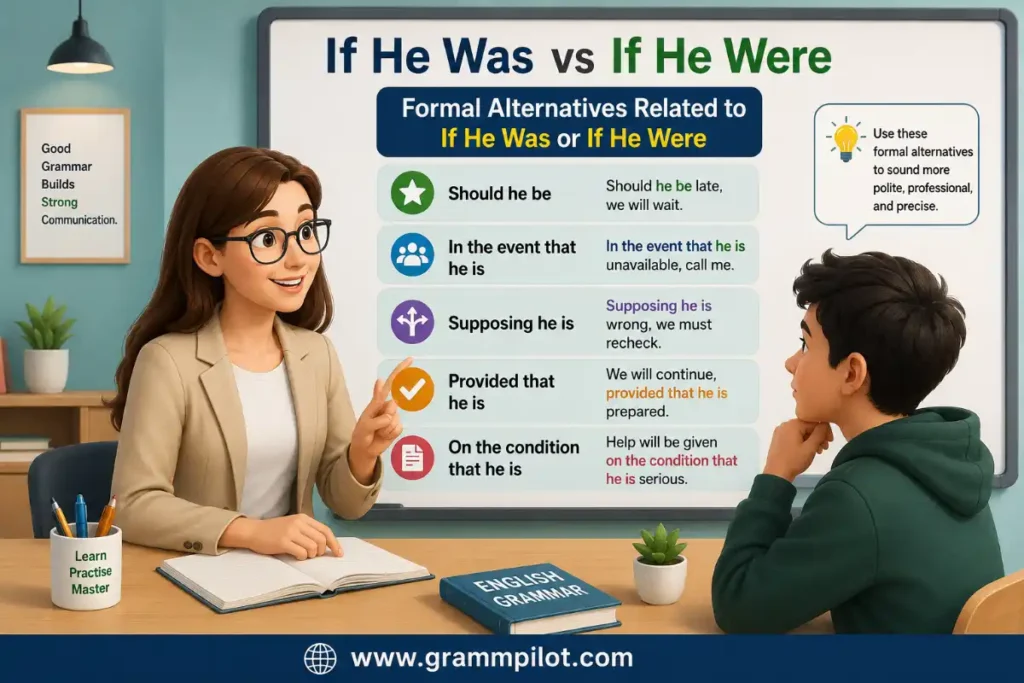
Formal Alternatives Related to If He Was or If He Were
The following expressions often appear in academic writing, business communication, literature, and professional English. They don’t replace the grammar rule, but they express similar conditional ideas.
| Expression | Meaning | Tone | Example |
|---|---|---|---|
| Provided that he was | If a condition was true | Formal | Provided that he was informed, the meeting could begin. |
| Provided that he were | Imaginary condition | Very Formal | Provided that he were eligible, he would qualify. |
| On the condition that he was | States a real condition | Formal | He could attend on the condition that he was invited. |
| On the condition that he were | Imaginary requirement | Formal | The plan would succeed on the condition that he were available. |
| Assuming that he was | Accepts a likely fact | Formal | Assuming that he was correct, the report needs updating. |
| Assuming that he were | Imagines another possibility | Formal | Assuming that he were selected, the project would continue. |
| In the event that he was | Refers to a possible real event | Business | Contact me in the event that he was delayed. |
| If indeed he was | Adds emphasis to uncertainty | Formal | If indeed he was responsible, the issue must be addressed. |
Conversational Alternatives
Daily conversations often sound less formal. Native speakers naturally use several expressions that carry similar meanings.
| Expression | Meaning | Tone | Example |
|---|---|---|---|
| Maybe he was | Possible past event | Casual | Maybe he was too tired to answer. |
| Perhaps he was | Possible explanation | Neutral | Perhaps he was confused. |
| What if he was | Raises a possibility | Casual | What if he was telling the truth? |
| What if he were | Imagines another reality | Casual | What if he were our coach? |
| Say he was | Introduces an example | Informal | Say he was late. What happens next? |
| Say he were | Imaginary example | Informal | Say he were the owner. What would change? |
| Let’s pretend he was | Fictional past scenario | Casual | Let’s pretend he was the winner. |
| Let’s pretend he were | Hypothetical situation | Casual | Let’s pretend he were the captain. |
Literary and Creative Alternatives
Writers often choose more descriptive wording instead of repeating the same structure.
| Expression | Meaning | Tone | Example |
|---|---|---|---|
| Imagine if he were | Imagines another world | Literary | Imagine if he were invisible. |
| Were he to | Formal inversion | Literary | Were he to arrive early, we’d begin. |
| Had he been | Refers to an unreal past | Formal | Had he been available, he would have joined us. |
| If ever he was | Emphasizes a real possibility | Literary | If ever he was determined, it was that day. |
| As though he were | Describes appearance | Literary | He smiled as though he were fearless. |
| As if he were | Imaginary comparison | Common | He acts as if he were famous. |
By now you’ve seen more than 30 related expressions connected with If He Was or If He Were. Each one fits a different writing style, audience, or purpose.
Synonyms by Intensity for If He Was or If He Were
Not every conditional expression carries the same level of certainty. Some describe situations that are very likely. Others imagine something almost impossible.
The table below moves from the weakest level of imagination to the strongest.
| Level | Expression | Example |
|---|---|---|
| Very likely | If he was | If he was home, he heard us. |
| Likely | Assuming he was | Assuming he was correct, we agreed. |
| Possible | Suppose he was | Suppose he was mistaken. |
| Uncertain | What if he was | What if he was joking? |
| Imaginary | If he were | If he were here, we’d celebrate. |
| Highly unlikely | Suppose he were | Suppose he were invisible. |
| Impossible | If he were a bird | If he were a bird, he could fly. |
| Completely fictional | Imagine if he were | Imagine if he were a superhero. |
This scale helps you understand why If He Was or If He Were isn’t just about grammar. It’s also about showing how real or unreal an idea feels.
Parts of Speech Related to If He Was or If He Were
Although If He Was or If He Were is a grammar pattern instead of a single word, it combines several parts of speech.
| Word | Part of Speech | Function |
|---|---|---|
| If | Conjunction | Introduces a condition |
| He | Pronoun | Refers to a person |
| Was | Verb (past tense) | Describes a real or possible condition |
| Were | Verb (subjunctive/past form) | Describes an imagined condition |
Understanding these parts makes the rule easier to remember.
Is If He Was or If He Were Different in American and British English?
This is another question many learners ask.
The short answer is not very much.
Both American and British English teach the same traditional grammar rule.
- If he was usually refers to something real or possible.
- If he were usually refers to an imaginary situation.
There are, however, small differences in everyday speech.
American English
Casual conversation in the United States often replaces were with was.
Examples you might hear include:
- If I was you…
- If he was here…
- If she was taller…
These are common in speech, but formal writing still prefers were in hypothetical situations.
British English
British English generally keeps the traditional subjunctive a little more often, especially in formal writing.
You’ll frequently read:
- If he were alive…
- If I were you…
- If she were here…
Modern British conversation still uses was sometimes, but grammar books continue to recommend were for imaginary conditions.
So regardless of where you write, learning the distinction between If He Was or If He Were will improve your grammar.
Which Is Better in Different Situations?
The best choice depends on where you’re writing or speaking.
If He Was vs If He Were in a Resume
Resumes usually avoid conditional sentences because they focus on facts.
Still, you might mention conditions in a cover letter.
Correct example:
If he was the hiring manager I spoke with, I’d like to thank him.
Hypothetical example:
If he were reviewing my application today, I would highlight my leadership experience.
Notice how the meaning changes.
If He Was vs If He Were in an Essay
Academic writing normally follows traditional grammar.
Use were for hypothetical ideas.
Example:
If he were the main character, the story would end differently.
Use was for real possibilities.
Example:
If he was absent that day, the teacher should have marked attendance accordingly.
Following this rule makes essays sound polished.
If He Was vs If He Were in an Email
Professional emails should be clear and grammatically correct.
Example of a real condition:
If he was copied on the email, he’ll already have the information.
Example of an imaginary condition:
If he were available tomorrow, we could schedule the meeting.
Small grammar choices create a stronger professional impression.
If He Was vs If He Were in Text Messages
Texting is more relaxed.
Friends commonly write:
- If he was joking 😂
- If I was you…
These aren’t unusual.
Even so, using were in hypothetical situations still shows strong grammar.
If He Was vs If He Were in Speaking
Everyday conversation is flexible.
Many native speakers don’t consciously think about the rule.
You’ll hear both forms naturally.
Formal speeches, presentations, interviews, and classroom discussions usually follow the traditional distinction.
That makes If He Was or If He Were worth learning, even if casual speech sometimes bends the rule.
A Simple Memory Trick for If He Was vs If He Were
Many students memorize one easy question.
“Did it really happen?”
If the answer is yes or maybe, choose was.
If the answer is no, choose were.
Another helpful trick is this:
- Reality = Was
- Imagination = Were
This shortcut works in most situations and helps you decide quickly without memorizing long grammar rules.
If He Was vs If He Were in Real-Life Example Sentences
The fastest way to master If He Was or If He Were is by seeing it in everyday situations. Notice how the meaning changes depending on whether the speaker is talking about a real possibility or an imaginary one.
School Examples
- If he was absent yesterday, he’ll need the class notes.
- If he were the class president, he’d organize more events.
- If he was the student who asked that question, he deserves an answer.
- If he were my lab partner, we’d finish the project early.
Workplace Examples
- If he was in the office this morning, he probably saw your email.
- If he were the department manager, he’d approve the budget.
- If he was responsible for the report, let’s ask him about it.
- If he were leading the meeting, everyone would stay focused.
Family Examples
- If he was at Grandma’s house, he should be home soon.
- If he were my brother, I’d help him without asking.
- If he was feeling tired, he made the right choice by resting.
- If he were older, he’d understand the situation better.
Travel Examples
- If he was on the earlier flight, he has already landed.
- If he were traveling with us, the trip would be even more fun.
- If he was delayed by traffic, he’ll arrive shortly.
- If he were driving, we could leave right now.
Everyday Conversations
- If he was telling the truth, we owe him an apology.
- If he were telling the truth, everyone would believe him.
- If he was busy yesterday, I understand why he didn’t answer.
- If he were free this weekend, we’d invite him over.
- If he was the person at the door, I didn’t recognize him.
- If he were here right now, he’d know exactly what to do.
These examples show why understanding If He Was or If He Were matters in daily communication.
If He Was vs If He Were vs. If I Was or If I Were
This is one of the most common grammar comparisons.
Although the subject changes, the rule stays the same.
| If I Was | If I Were |
|---|---|
| Refers to something real or possible | Refers to something imaginary or impossible |
| If I was late, I’m sorry. | If I were you, I’d apologize. |
| Talks about a real event | Talks about a hypothetical situation |
| Common in everyday speech | Preferred in formal grammar |
The famous expression “If I were you” follows the same rule as If He Was or If He Were because it imagines a situation that isn’t real.
If He Was vs If He Were vs. As If He Was vs As If He Were
These expressions look similar, but they aren’t always used the same way.
| As If He Was | As If He Were |
|---|---|
| Suggests something may have been true | Suggests something clearly isn’t true |
| Less common in formal writing | Preferred for imaginary comparisons |
| As if he was hiding something. | As if he were the owner. |
| May describe uncertainty | Describes an unreal comparison |
Examples:
✅ He acted as if he were the boss.
✅ She smiled as if he were her best friend.
These comparisons use the subjunctive because the situation isn’t actually true.
If He Was vs If He Were vs. Had He Been
Advanced writers sometimes replace an “if” clause with an inverted structure.
Compare these sentences.
| Standard Form | Inverted Form |
|---|---|
| If he had been ready, we’d have started. | Had he been ready, we’d have started. |
| If he had been invited, he’d have come. | Had he been invited, he’d have come. |
| If he had been informed, he wouldn’t have worried. | Had he been informed, he wouldn’t have worried. |
This structure sounds more formal.
You’ll often find it in books, academic writing, and professional documents.
Common Mistakes with If He Was vs If He Were
Many learners repeat the same errors because both expressions sound natural.
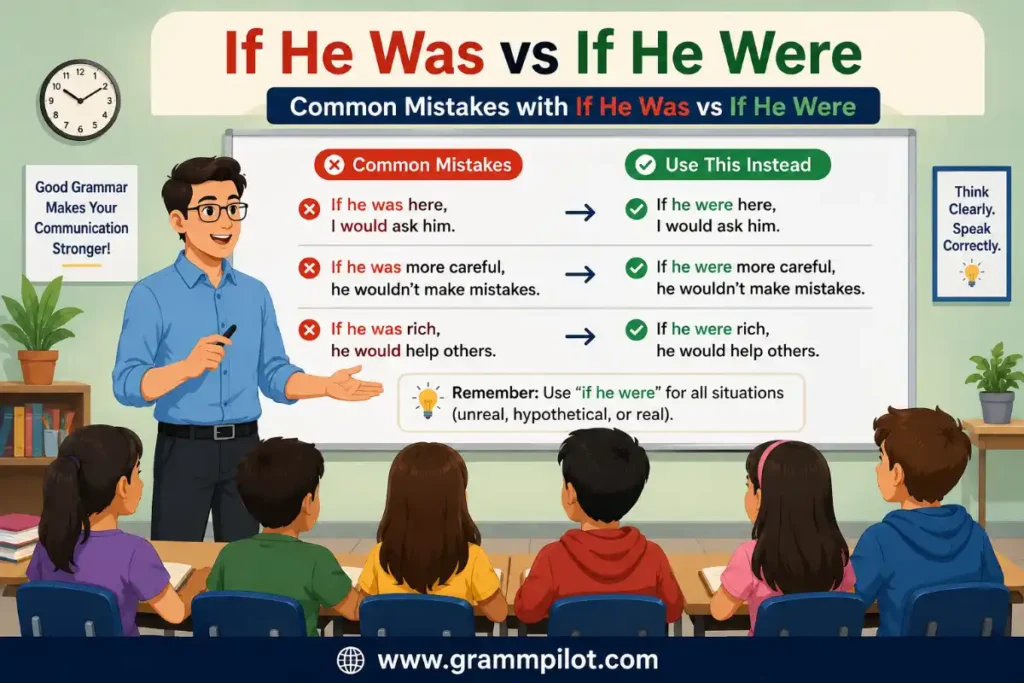
Mistake 1: Using Was for an Impossible Situation
❌ If he was Superman, he’d save everyone.
✅ If he were Superman, he’d save everyone.
Since he isn’t Superman, the sentence is hypothetical.
Mistake 2: Using Were for a Real Past Event
❌ If he were late yesterday, he missed the bus.
✅ If he was late yesterday, he missed the bus.
This sentence discusses something that may actually have happened.
Mistake 3: Copying Informal Speech into Formal Writing
Many people write exactly as they speak.
Casual conversation often ignores the traditional rule.
Formal writing should keep the distinction clear.
Mistake 4: Thinking Were Always Sounds More Correct
Some learners overcorrect.
They replace every was with were.
That creates new mistakes.
Always ask yourself whether the situation is real or imagined.
Mistake 5: Forgetting the Rest of the Sentence
Look for clue words like:
- would
- could
- might
- should
These often signal a hypothetical condition that needs were.
When NOT to Use If He Was vs If He Were
Some sentences don’t need either expression.
Avoid using them when there’s no conditional idea.
Examples:
❌ He was tired yesterday.
Correct because there’s no if.
❌ He were happy today.
Incorrect because were isn’t used that way in modern standard English.
Instead, write:
✅ He was happy today.
Don’t force a conditional structure into a sentence that simply states a fact.
Antonyms and Opposite Ideas
Because If He Was vs If He Were is a grammar pattern rather than a vocabulary word, it doesn’t have true antonyms.
Instead, English often expresses the opposite idea by removing the condition.
Examples include:
| Conditional | Direct Statement |
|---|---|
| If he was there… | He was there. |
| If he were here… | He is here. |
| If he was ready… | He was ready. |
| If he were taller… | He is taller. (if true) |
The opposite of a conditional statement is usually a direct factual statement.
Quick Tips for Choosing If He Was vs If He Were
Remember these simple guidelines whenever you’re unsure.
- Ask whether the situation is real or imaginary.
- Choose was for real or possible events.
- Choose were for imaginary or unlikely situations.
- Look for words like would, could, or might.
- Read the whole sentence instead of focusing on one word.
- Formal writing follows the traditional grammar rule more closely.
- Casual conversations sometimes use was where formal grammar prefers were.
- If you’re writing for school, business, or publication, use the standard rule.
- Practice with complete sentences instead of memorizing isolated rules.
- The more examples you read, the more natural the correct choice becomes.
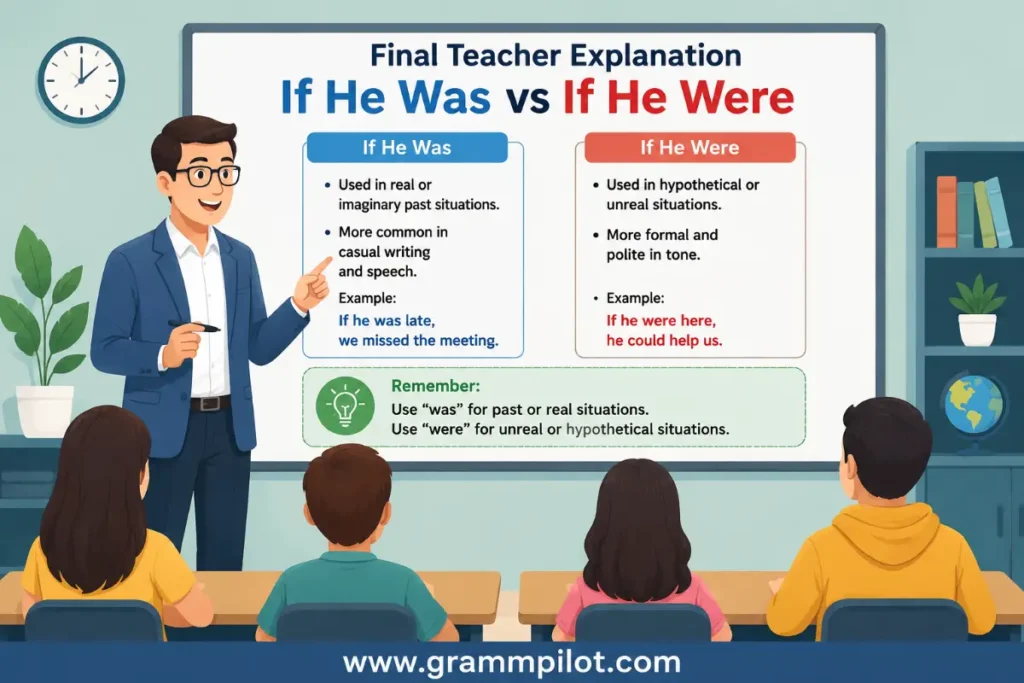
Final Teacher Explanation of If He Was vs If He Were
Students often search for one rule that works every time. Fortunately, this grammar point is easier than it first appears. Imagine two boxes. The first box is labeled Reality. Anything that actually happened, probably happened, or could have happened belongs there.
That box uses was. The second box is labeled Imagination.Anything that isn’t true, probably won’t happen, or exists only in your thoughts belongs there. That box uses were. Instead of memorizing dozens of grammar rules, simply decide which box your sentence belongs in. Once you build that habit, choosing between If He Was vs If He Were becomes much easier. You’ll also notice that your essays, emails, presentations, and conversations sound more natural because you’re matching the grammar to the meaning rather than guessing.
Conclusion
Understanding If He Was or If He Were becomes much easier once you focus on the meaning instead of memorizing complicated grammar rules. Use was when you’re talking about something that really happened or could have happened. Choose were when you’re describing an imaginary, unlikely, or impossible situation. That single idea explains most examples you’ll see in books, conversations, school assignments, and professional writing.
The next time you hesitate, ask yourself one simple question: Is this real or imagined? If it’s real or possible, was is usually the right choice. If it’s hypothetical, were is the better option. Keep practicing with real sentences, and you’ll soon use If He Was or If He Were naturally and confidently without stopping to think.
Frequently Asked Questions
1. Which is correct: If He Was vs If He Were?
Both are correct, but they are used in different situations. If He Was or If He Were depends on whether you’re describing a real possibility or an imaginary one. Use was for real or possible events, and use were for hypothetical situations.
2. Why do people say “if he were” instead of “if he was”?
People use if he were because it follows the traditional subjunctive rule for imaginary, unlikely, or impossible situations. This form is still preferred in formal English, academic writing, and professional communication.
3. Is “if he was” grammatically correct?
Yes. If he was is grammatically correct when you’re talking about something that actually happened or might have happened.
Example:
- If he was at the meeting, he probably heard the announcement.
4. Is “if he were” old-fashioned?
No. While casual conversation sometimes uses was, were is still standard in formal English. You’ll often see it in books, newspapers, academic writing, speeches, and exams.
5. What’s another way to say “if he were”?
Depending on the sentence, you could use expressions such as:
- Suppose he were
- Imagine he were
- Were he to
- Assuming he were
Each expression has a slightly different tone, but they all introduce a hypothetical idea.
6. Is “If I Were You” the same grammar rule?
Yes. The famous expression “If I were you” follows exactly the same rule as If He Was or If He Were. Since you can never actually become another person, the situation is imaginary, so were is the correct choice.
7. How can I remember If He Was or If He Were easily?
A simple memory trick is:
- Real or possible = Was
- Imaginary or impossible = Were
Ask yourself whether the situation could really happen. The answer usually tells you which form to choose.