
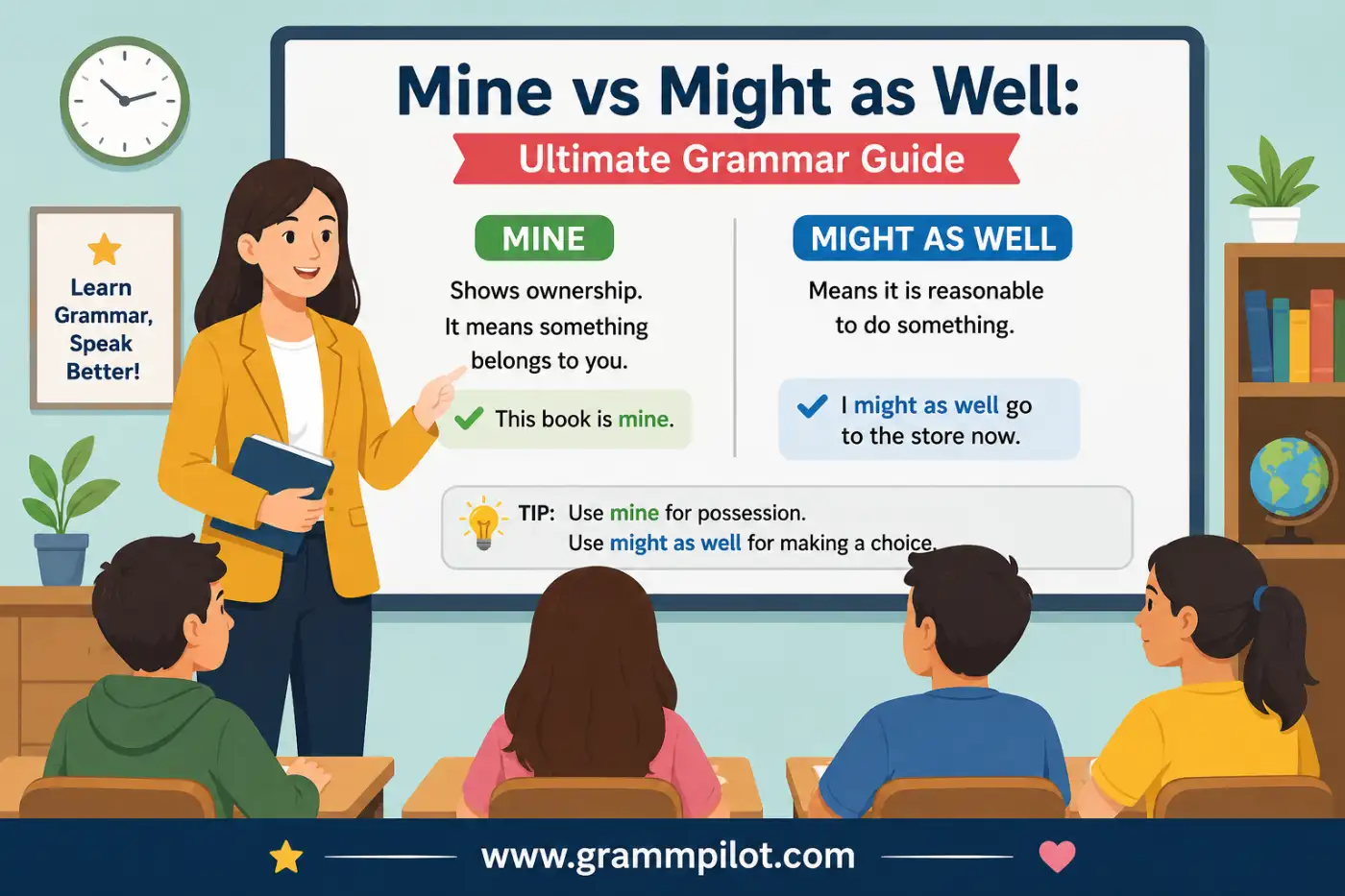
Have you ever typed a text, email, school essay, or social media post and stopped to wonder whether you should write Mine vs Might as Well? You’re not alone. Many people hear the phrase in conversation and spell it the way it sounds, which leads to one of the most common English mistakes. If you’ve searched for Mine as Well or Might as Well, you’re probably trying to figure out which expression is correct. The good news is that the answer is simple once you know where the phrase comes from and what it really means.
Answer Box
“Might as well” is the correct English expression. “Mine as well” is a spelling mistake caused by similar pronunciation. Use “might as well” to mean that something is the best or most reasonable choice when there are no better options.
In this guide, you’ll learn why people confuse these phrases, where the expression came from, how to use it correctly, common mistakes to avoid, and plenty of real-life examples.
This is one of several grammar rules that can cause confusion. Learn more in [If He Was or If He Were].
Mine vs Might as Well: Which One Is Correct?
The correct expression is might as well. The phrase mine as well is almost always incorrect.
Examples:
- ✅ We might as well leave now.
- ✅ You might as well ask the teacher.
- ✅ I might as well finish the project today.
Incorrect examples:
- ❌ We mine as well leave now.
- ❌ You mine as well ask the teacher.
- ❌ I mine as well finish the project today.
The confusion happens because might and mine can sound similar in fast speech.
Mine vs Might as Well: What Does “Might as Well” Mean?
The expression might as well means:
- it’s the best choice available
- there’s no better option
- you have little to lose
- doing it makes sense
It often suggests that one choice is just as good as any other.
Examples:
- We have extra time, so we might as well take a walk.
- Nobody is using the computer. You might as well use it.
- Since we’re already here, we might as well stay for dinner.
The phrase does not express excitement. Instead, it expresses a practical decision.
Mine vs Might as Well: Why Is “Mine as Well” Wrong?
The word mine is a possessive pronoun. It means something belongs to me.
Examples:
- That book is mine.
- The blue backpack is mine.
- This idea is mine.
It has nothing to do with making suggestions or choosing between options.
That’s why these sentences are incorrect:
- ❌ Mine as well go now.
- ❌ We mine as well stay.
- ❌ You mine as well call her.
The correct word is might, not mine.
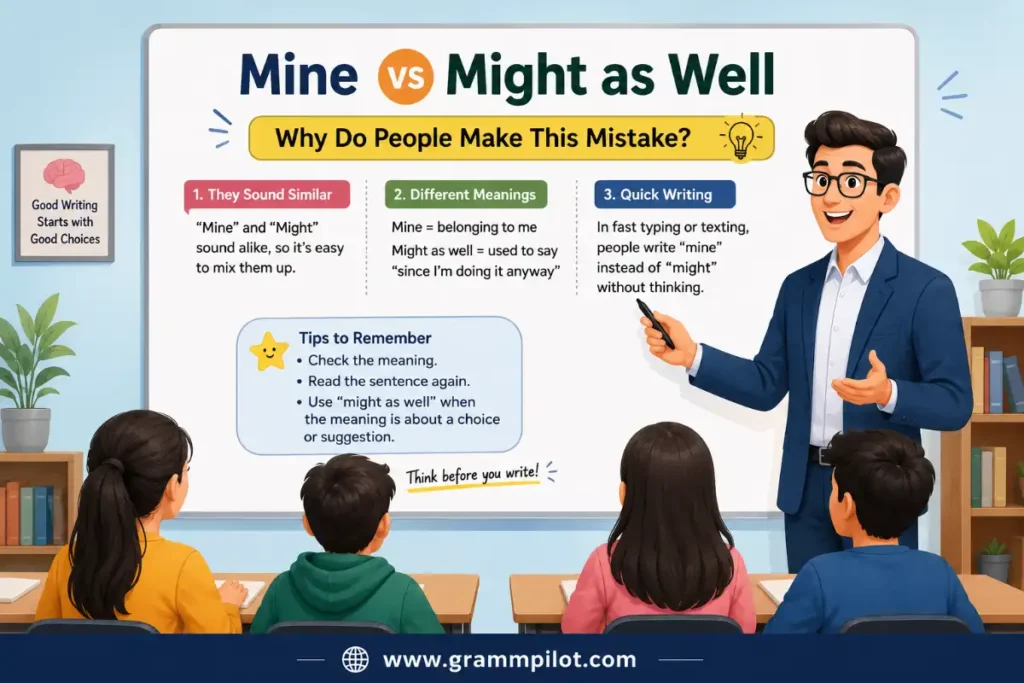
Why Do People Make This Mistake?
This mistake usually comes from hearing the phrase instead of reading it. When native speakers talk quickly, might as well often sounds like:
- mite-uhz-well
- mightswell
- mighta well
Some listeners mistakenly hear mine as well.
This is called an eggcorn—a common mistake where people replace unfamiliar words with familiar ones that sound similar.
Other examples include:
- for all intensive purposes ❌
- for all intents and purposes ✅
- nip it in the butt ❌
- nip it in the bud ✅
- escape goat ❌
- scapegoat ✅
- mine as well ❌
- might as well ✅
Mine vs Might as Well: Word Origin and Plain-English Meaning
Many articles explain which phrase is correct, but few explain where it came from. The word might comes from Old English miht, meaning power, ability, or possibility. Over time, might became a modal verb used to talk about possibility, polite suggestions, and reasonable choices. The phrase might as well developed to express the idea that one action is just as reasonable as any other. Today, native speakers use it every day.
Examples:
- We might as well begin.
- You might as well try.
- I might as well help.
The word mine, on the other hand, comes from Old English mīn, meaning belonging to me.
It has no grammatical connection to this expression.
Mine vs Might as Well: When Should You Use “Might as Well”?
Use might as well when:
- there isn’t a better choice
- something seems reasonable
- you have nothing to lose
- you’re making a practical suggestion
Examples:
- We finished our work, so we might as well relax.
- It’s raining, so we might as well stay inside.
- Since you’re already online, you might as well send the email.
- Nobody else wants the tickets, so we might as well take them.
- The store closes soon, so we might as well leave now.
In each sentence, the action makes sense because no better option exists.
Mine vs Might as Well: Can “Might as Well” Show Disappointment?
Yes. Sometimes the phrase suggests reluctant acceptance.
Examples:
- I might as well clean my room.
- We might as well cancel the trip.
- You might as well tell the truth now.
The speaker isn’t excited. They’re simply accepting what seems like the most practical choice.
Mine vs Might as Well: Is “Might as Well” Formal or Informal?
The expression works in almost every type of English.
You’ll hear it in:
- everyday conversations
- business meetings
- emails
- newspapers
- television shows
- books
- classrooms
Examples:
Conversation: We might as well order pizza.
Business email: We might as well schedule the meeting for Monday.
Essay: The researchers might as well consider another explanation.
It sounds natural in both spoken and written English.
Mine vs Might as Well: Common Situations Where You’ll Hear It
This expression appears in many everyday situations.
Examples include:
- deciding where to eat
- choosing a movie
- planning a trip
- finishing homework
- sending an email
- making a phone call
- leaving work
- waiting for a friend
- completing a project
- studying before an exam
People use might as well whenever one option seems like the most sensible decision.
Mine vs Might as Well: A Simple Memory Trick
Here’s an easy way to remember the correct phrase.
Ask yourself: Are you talking about ownership?
If yes, use mine.
Example: That notebook is mine.
If you’re talking about making a reasonable choice, use might as well.
Example: We might as well leave now.
A simple sentence can help you remember: Mine shows ownership. Might as well shows the best choice.
Once you remember that difference, you’ll never confuse the two expressions again.
Mine vs Might as Well: Master Synonym List
Learning Mine as Well or Might as Well becomes easier when you know similar expressions. In many situations, another phrase may sound more natural depending on the tone and context.
Simple Synonyms
| Word or Phrase | Meaning | Tone | Example |
|---|---|---|---|
| Should | The best thing to do | Simple | We should leave now. |
| Could | A possible choice | Simple | You could ask your teacher. |
| May | Allowed or possible | Simple | You may stay here. |
| Ought to | The right action | Simple | You ought to apologize. |
| Better | More suitable | Simple | We’d better hurry. |
| Can | Able to do something | Simple | You can join us. |
| Need to | Required to do something | Simple | I need to finish this. |
| Have to | Necessary to do | Simple | We have to leave early. |
Mine vs Might as Well: Everyday Alternatives
| Word or Phrase | Meaning | Tone | Example |
|---|---|---|---|
| Why not | A friendly suggestion | Everyday | Why not try again? |
| Go ahead | Start doing it | Everyday | Go ahead and call him. |
| Give it a try | Try once | Everyday | Give it a try today. |
| No harm in | Nothing bad will happen | Everyday | There’s no harm in asking. |
| Worth a try | Reasonable to attempt | Everyday | It’s worth a try. |
| Best choice | Most sensible option | Everyday | This seems like the best choice. |
| Makes sense | A logical decision | Everyday | It makes sense to wait. |
| Just do it | Stop delaying | Everyday | Just do it now. |
For This Difference: Formal Synonyms
| Word or Phrase | Meaning | Tone | Example |
|---|---|---|---|
| It is advisable | Recommended action | Formal | It is advisable to review the report. |
| It would be reasonable | Logical choice | Formal | It would be reasonable to continue. |
| It is appropriate | Suitable action | Formal | It is appropriate to respond today. |
| It is practical | Sensible decision | Formal | It is practical to begin early. |
| It would be wise | Smart choice | Formal | It would be wise to save copies. |
| Recommended | Officially suggested | Formal | This approach is recommended. |
| Preferable | Better option | Formal | The earlier meeting is preferable. |
| Sensible | Showing good judgment | Formal | That is a sensible decision. |
Mine vs Might as Well: Informal and Casual Alternatives
| Word or Phrase | Meaning | Tone | Example |
|---|---|---|---|
| Why bother waiting? | No reason to delay | Casual | Why bother waiting? |
| Let’s do it | Start now | Casual | Let’s do it today. |
| Go for it | Take the chance | Informal | Go for it—you’ll do great. |
| Since we’re here | Already in the situation | Casual | Since we’re here, let’s eat. |
| Mighta | Spoken form of might | Slang | We mighta stayed longer. |
| Get it over with | Finish an unpleasant task | Informal | Let’s get it over with. |
| Take the chance | Try the opportunity | Informal | Take the chance while you can. |
These alternatives help you express similar ideas without repeating the same wording.
Mine vs Might as Well: Synonyms by Intensity
Some expressions sound like gentle suggestions. Others show stronger advice.
| Mild | Moderate | Strong |
|---|---|---|
| Could | Should | Had better |
| May | Ought to | Must |
| Perhaps | Might as well | Need to |
| Maybe | Best choice | Have to |
| Consider | Makes sense | Definitely should |
| Worth trying | Practical | Absolutely should |
| If you like | Reasonable | No other choice |
| Why not | Wise | Essential |
Choose the expression that matches the strength of your message.
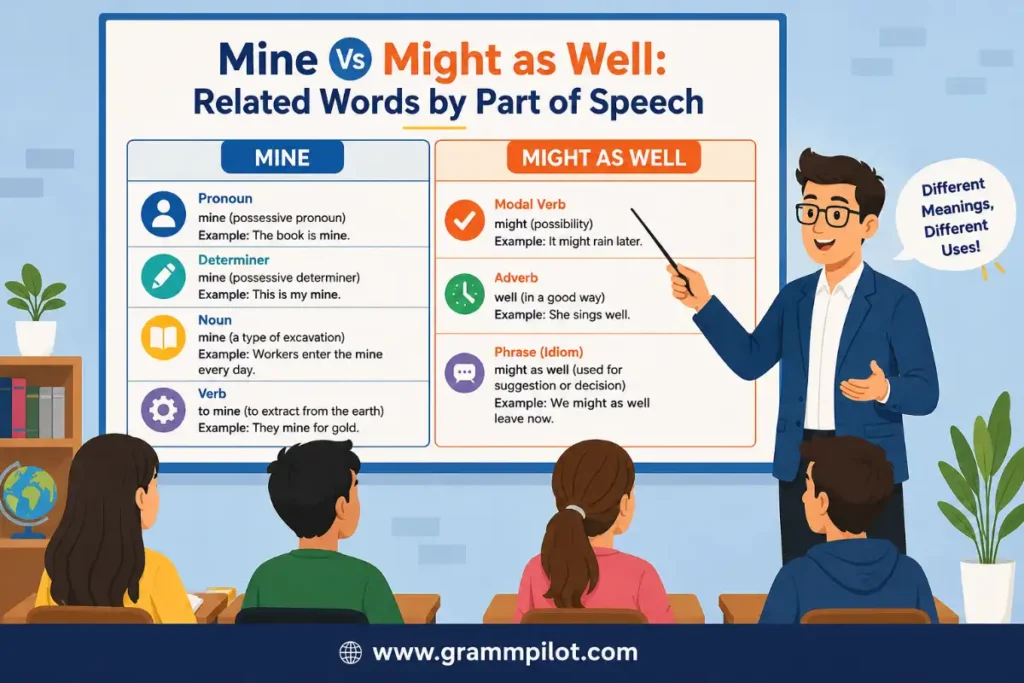
Mine vs Might as Well: Related Words by Part of Speech
Knowing related vocabulary helps you write naturally without repeating the same expression.
Modal Verbs
- Might
- May
- Could
- Should
- Can
- Must
- Would
- Ought to
Verbs
- Choose
- Decide
- Try
- Begin
- Continue
- Accept
- Finish
- Start
- Consider
- Proceed
Nouns
- Choice
- Decision
- Option
- Suggestion
- Recommendation
- Opportunity
- Possibility
- Reason
- Judgment
- Action
Adjectives
- Practical
- Sensible
- Wise
- Reasonable
- Logical
- Suitable
- Appropriate
- Helpful
- Smart
- Acceptable
Using different word forms keeps your writing smooth and varied.
Mine as Well or Might as Well: Is There a Difference Between American and British English?
There is almost no difference. Both American English and British English use might as well. Neither variety accepts mine as well as standard English.
Examples used in both countries include:
- We might as well leave now.
- You might as well ask first.
- They might as well stay another day.
Although accents differ, the grammar stays exactly the same. The pronunciation may sound slightly different, but the spelling never changes.
Mine as Well or Might as Well: Which Expression Works Best in Different Situations?
The answer is simple. Always choose might as well because it is the only correct expression.
Mine as Well or Might as Well in a Resume
A resume should sound professional and direct.
Example: We might as well is rarely used in resumes because the phrase sounds conversational.
Instead, write:
- Recommended an improved workflow.
- Suggested a practical solution.
Mine as Well or Might as Well in an Essay
Academic writing usually avoids conversational expressions.
Example: The researchers might as well consider an alternative explanation.
A more formal sentence could be: The researchers should consider an alternative explanation.
Mine as Well or Might as Well in an Email
Business emails often include polite suggestions.
Example: We might as well schedule the meeting for Friday.
This sounds natural without being too informal.
Mine as Well or Might as Well in Text Messages
The expression is extremely common in texting.
Examples:
- We might as well order pizza.
- I might as well head home now.
- You might as well come with us.
Short, natural sentences fit casual conversations.
Mine as Well or Might as Well in Speaking
Native speakers use this expression every day.
Examples:
- We might as well leave.
- You might as well ask.
- I might as well finish it now.
You’ll hear it in conversations far more often than in formal documents.
Mine as Well or Might as Well: Which Expression Should You Choose?
Here’s a quick guide.
| Situation | Best Choice |
|---|---|
| School essay | Might as well (or a more formal alternative) |
| Business email | Might as well |
| Resume | Usually avoid; choose a stronger action verb |
| Text message | Might as well |
| Everyday conversation | Might as well |
| Blog writing | Might as well |
| Social media | Might as well |
| Formal report | Consider should, recommended, or it is advisable |
The rule is easy to remember.
“Might as well” is correct English. “Mine as well” is simply a spelling mistake caused by pronunciation.
Mine as Well or Might as Well: Original Example Sentences
The best way to understand Mine as Well or Might as Well is to read the correct expression in real situations. Notice how might as well always fits naturally, while mine as well never does.
- We might as well leave before the traffic gets worse.
- Since you’re already here, you might as well stay for lunch.
- I might as well finish the report tonight.
- They might as well take the earlier train.
- We might as well order dessert because we’re celebrating.
- You might as well ask the manager directly.
- She might as well apply for the scholarship.
- If the store is open, we might as well buy everything now.
- He might as well call his parents before the trip.
- We might as well watch the rest of the movie.
- The kids might as well play outside while the weather is nice.
- I might as well clean the kitchen before the guests arrive.
- They might as well accept the invitation.
- You might as well save your work before closing the laptop.
- We might as well start early and avoid the rush.
Each sentence shows a practical decision rather than excitement or certainty.
Mine as Well or Might as Well: Before-and-After Examples
These comparisons make the correct form easy to remember.
| Incorrect | Correct |
|---|---|
| We mine as well leave now. | We might as well leave now. |
| I mine as well finish this today. | I might as well finish this today. |
| You mine as well ask first. | You might as well ask first. |
| They mine as well stay here. | They might as well stay here. |
| We mine as well try again. | We might as well try again. |
| She mine as well call him. | She might as well call him. |
| I mine as well go home. | I might as well go home. |
| You mine as well tell the truth. | You might as well tell the truth. |
Only the sentences on the right are standard English.
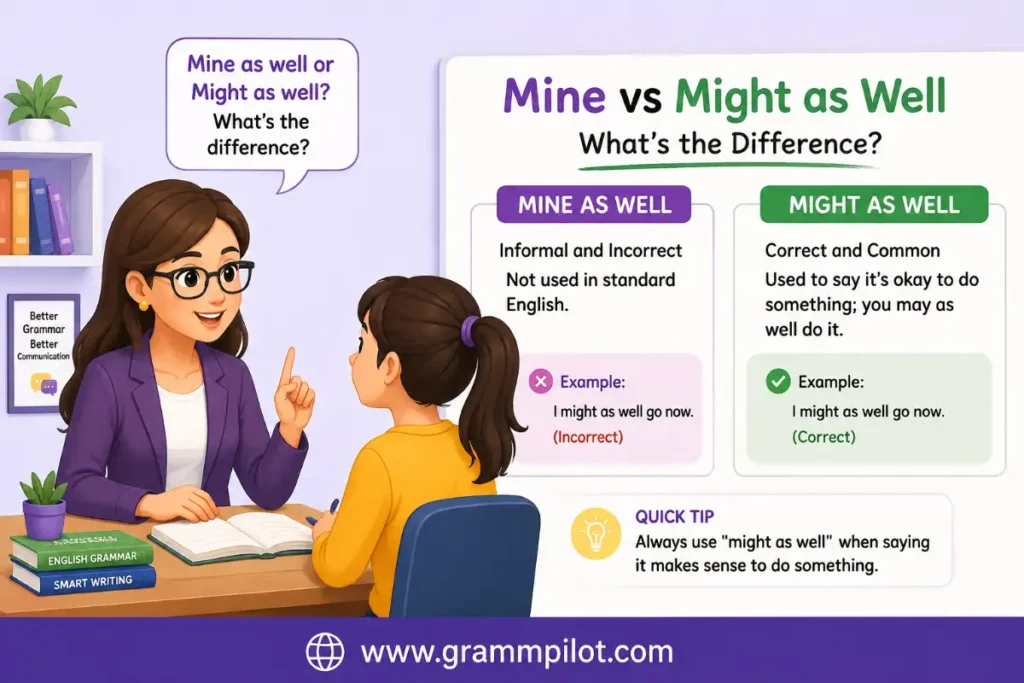
Mine as Well or Might as Well: What’s the Difference?
The difference is simple.
| Mine as Well | Might as Well |
|---|---|
| Incorrect expression | Correct expression |
| Created by mishearing the phrase | Standard English idiom |
| Not accepted in writing | Accepted everywhere |
| Uses the wrong word | Uses the correct modal verb |
| Avoid in all contexts | Use in speech and writing |
Remember that mine refers to ownership.
Might is a modal verb used to express possibility or a sensible choice.
Mine as Well or Might as Well: “Might as Well” vs “Should”
These expressions are similar, but they are not identical.
| Might as Well | Should |
|---|---|
| Suggests there’s no better option | Gives advice |
| Often sounds casual | Can sound stronger |
| Focuses on practicality | Focuses on what is right |
| Common in conversation | Common in both speech and writing |
Examples:
- We might as well leave now because everyone else has gone.
- We should leave now because it’s getting late.
The first sentence suggests convenience.
The second gives advice.
Mine as Well or Might as Well: “Might as Well” vs “May as Well”
Some learners confuse these expressions.
May as well is sometimes heard in informal conversation, but might as well is far more common and is considered the standard expression.
Examples:
- We might as well begin.
- We may as well begin.
Both can be understood, but most grammar guides recommend might as well.
Mine as Well or Might as Well: Common Mistakes
Here are the mistakes learners make most often.
Mistake 1: Writing “Mine as Well”
❌ Mine as well leave now.
✅ Might as well leave now.
This is the most common error.
Mistake 2: Confusing “Mine” with “Might”
Remember that mine shows possession.
Examples:
- This backpack is mine.
- That phone is mine.
It cannot replace might.
Mistake 3: Spelling by Sound
Many people write what they hear. Native speakers often pronounce might as well very quickly. Reading more English helps prevent this mistake.
Mistake 4: Using the Expression for Certainty
❌ We might as well win the game.
This sounds unnatural if you mean the victory is certain.
Better: We will probably win the game.
Use might as well when discussing the most sensible choice.
Mistake 5: Using It in Very Formal Writing
Although correct, the expression sounds conversational.
Formal writing often prefers:
- should
- it is advisable
- it is recommended
- it would be appropriate
Mine as Well or Might as Well: When Should You Avoid It?
Avoid mine as well in every situation. It is not considered correct English. You may also choose another expression if your writing is highly formal.
Instead of: We might as well continue the experiment.
A formal report could say: It would be advisable to continue the experiment.
Both sentences are correct.
The tone is different.
Mine as Well or Might as Well: Antonyms
These expressions communicate the opposite idea.
| Word or Phrase | Meaning |
|---|---|
| Shouldn’t | Not a good idea |
| Mustn’t | Not allowed |
| Avoid | Stay away from |
| Refrain | Choose not to do |
| Stop | End the action |
| Decline | Politely refuse |
| Refuse | Say no |
| Ignore | Pay no attention |
| Cancel | Decide not to continue |
| Wait | Delay action |
These words express hesitation or rejection instead of a practical suggestion.
Mine as Well or Might as Well: Quick Tips for Choosing the Right Expression
Keep these simple tips in mind.
- Always write might as well.
- Never replace might with mine.
- Remember that mine means ownership.
- Use the expression when one option seems most sensible.
- Read your sentence aloud.
- If you mean “there’s no better choice,” might as well is probably correct.
- Avoid spelling the phrase the way it sounds.
- Use more formal alternatives in academic reports when needed.
- Practice with everyday conversations.
- Learn the whole phrase instead of translating it word by word.
Mine as Well or Might as Well: A Simple Memory Trick
Here’s an easy trick.
Ask yourself this question: Am I talking about something I own?
If the answer is yes, use mine.
- That notebook is mine.
If you’re suggesting a reasonable action, use might as well.
- We might as well leave now.
A simple sentence can help you remember forever: Mine means “belongs to me.” Might as well means “this is the best choice.”

Conclusion
Understanding Mine as Well or Might as Well is simple once you know the difference between these two words. The correct expression is might as well, which is used when something seems like the most choice or when there are no better options. The phrase mine as well is only a spelling mistake caused by similar pronunciation.
Whenever you write an email, essay, message, or professional document, remember that mine shows ownership while might as well shows a reasonable decision. Learning the meaning behind the phrase will help you avoid this common mistake and make your English sound more natural. With regular practice, choosing the correct expression will become automatic.
Frequently Asked Questions
1. Is Mine as Well or Might as Well the correct phrase?
Might as well is the correct phrase. Mine as well is a common spelling mistake caused by the similar sound of the two words.
2. What does “might as well” mean?
Might as well means that something is the most reasonable choice when there are no better options. It can also mean that trying something has little risk.
3. Why do people write “mine as well”?
People write mine as well because might as well can sound similar when spoken quickly. The mistake happens because people spell the phrase based on sound instead of meaning.
4. What’s another way to say “might as well”?
Other ways to say might as well include should probably, why not, it makes sense to, it’s worth trying, or it’s a good idea to, depending on the situation.
5. Can I use “might as well” in formal writing?
Yes, you can use it in formal writing, but some situations may need a more professional alternative such as it would be advisable or it is recommended.
6. Is “may as well” the same as “might as well”?
May as well can have a similar meaning, but might as well is more common and widely accepted in everyday English.
7. How can I remember the difference between mine and might?
Remember that mine shows ownership, like “This book is mine.” Might as well shows a practical choice, like “We might as well start now.”