
Have you ever paused while writing an email, essay, resume, or text because you weren’t sure about to write Much Needed vs Much-Needed? This small punctuation choice confuses many English learners and native speakers alike. Both forms look similar, but they are not always used in the same way. If you’ve searched for Much Needed or Much-Needed, you’re probably wondering which version is correct and when you should add the hyphen. The answer depends on where the phrase appears in a sentence, not on if one version is “better” than the other.
Answer Box
Both “much needed” and “much-needed” are correct. Use “much-needed” with a hyphen before a noun as a compound adjective. Use “much needed” without a hyphen after the noun or after a linking verb.
In this guide, you’ll learn the grammar rule, the history of the phrase, why the hyphen matters, when to use each form, common mistakes to avoid, and plenty of real examples to help you write with confidence.
Expand your knowledge of common expressions with [Mine as Well or Might as Well].
Much Needed vs Much-Needed: Which One Is Correct?
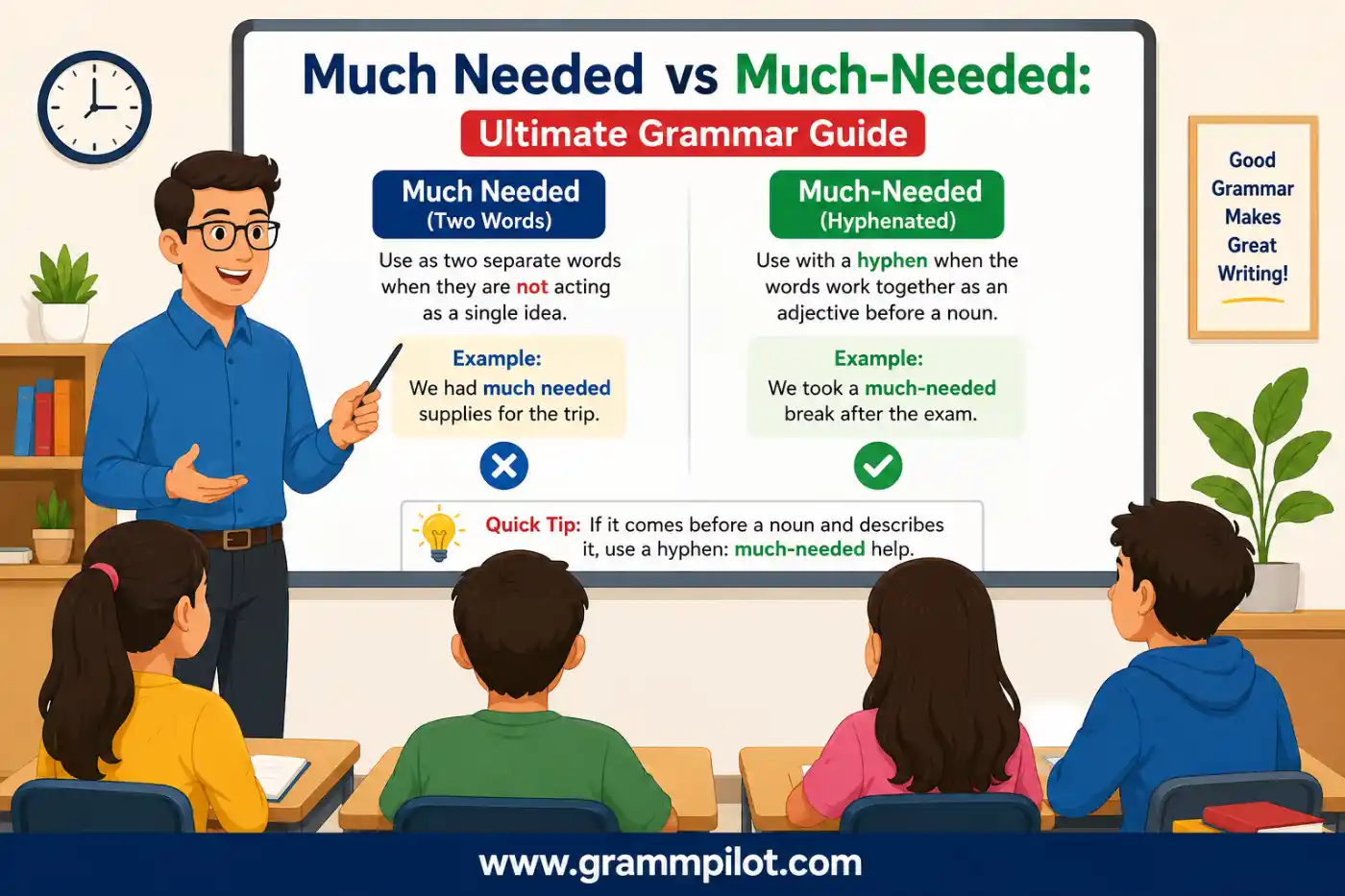
The short answer is simple. Both forms are correct. The correct choice depends on how the phrase is used in the sentence. Use much-needed when it comes before a noun and works as a compound adjective.
Examples:
- We finally got a much-needed break.
- She took a much-needed vacation.
- The town received much-needed funding.
Here, the hyphen joins the two words because together they describe the noun. Use much needed without a hyphen when the phrase comes after the noun or after a linking verb.
Examples:
- The break was much needed.
- Your support is much needed.
- The vacation was much needed.
Both versions are correct, but each has its own place.
Much Needed vs Much-Needed: Why Do People Get Confused?
The confusion comes from English compound adjectives. Sometimes two words work together to describe a noun. When they appear before the noun, they often take a hyphen.
Examples:
- a well-known author
- a full-time job
- a long-term plan
- a much-needed solution
However, when the same words appear after the noun, the hyphen usually disappears.
Examples:
- The author is well known.
- The job is full time.
- The plan is long term.
- The solution is much needed.
Many learners see both versions online and assume one must be wrong. In reality, both follow normal English grammar.
Much Needed vs Much-Needed: The Basic Grammar Rule
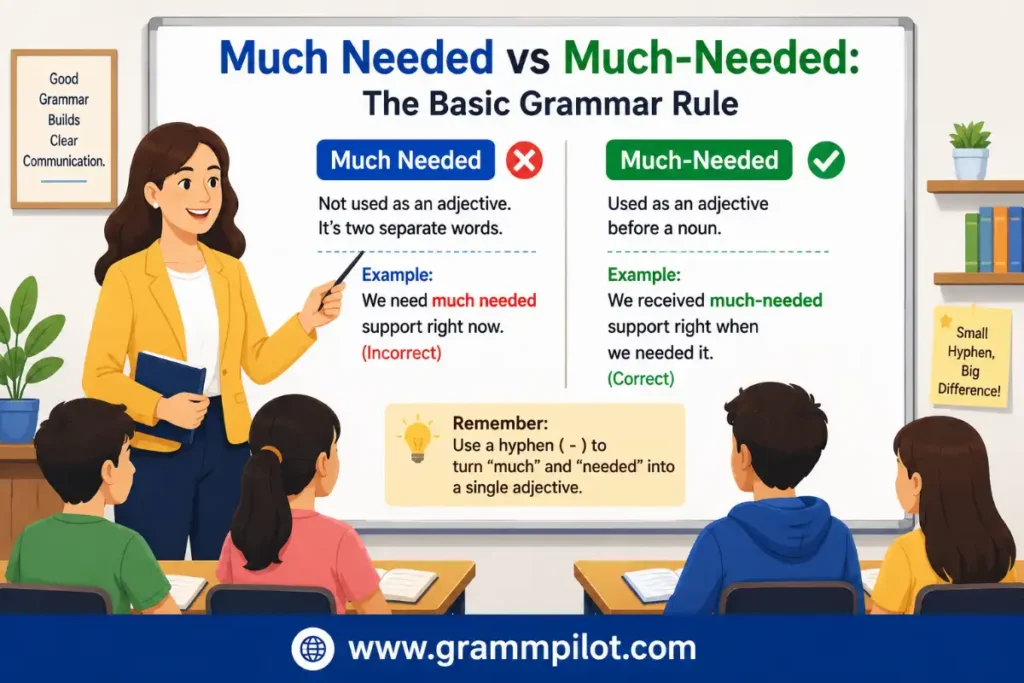
The easiest way to remember the rule is this: Before a noun → use the hyphen.
Examples:
- a much-needed change
- a much-needed reminder
- a much-needed improvement
- a much-needed opportunity
- After a noun or linking verb → no hyphen.
Examples:
- The change was much needed.
- The reminder was much needed.
- The improvement is much needed.
- The opportunity was much needed.
Think about what the phrase is doing.
If it directly describes the noun before you reach that noun, use the hyphen.
If it follows the noun, leave the hyphen out.
Much Needed vs Much-Needed: Word Origin and Plain-English Meaning
Many grammar guides explain the punctuation but skip the history behind the phrase. The word much comes from Old English mycel, meaning great, large, or to a high degree. The word needed comes from the verb need, which has roots in Old English nēodian, meaning to require, to lack, or to be necessary.
Together, the phrase means:
- greatly needed
- strongly required
- very necessary
- important at the present time
Examples:
- The city needed more doctors.
- The children received much-needed supplies.
- Her advice was much needed.
The meaning stays the same if you use the hyphen or not. Only the grammar changes.
Much Needed vs Much-Needed: What Does the Phrase Mean?
The phrase describes something that is truly necessary or greatly appreciated. It often suggests that something has been missing for a while.
Examples:
- a much-needed rest
- a much-needed rainstorm
- a much-needed vacation
- a much-needed update
In each example, the thing being described is not just helpful. It is important or necessary. Without it, a person or situation would continue to struggle.
Much Needed vs Much-Needed: Why Does the Hyphen Matter?
Hyphens make reading easier. They show that two words belong together.
Compare these examples.
Without a compound adjective: We received needed supplies.
With a compound adjective: We received much-needed supplies.
The second sentence immediately tells readers that the supplies were greatly needed. The hyphen connects the two words into one clear description. That’s why editors often recommend using it before nouns.
Much Needed vs Much-Needed: When Should You Use “Much-Needed”?
Choose the hyphenated form whenever it comes before a noun.
Examples include:
- a much-needed vacation
- a much-needed break
- a much-needed change
- a much-needed correction
- a much-needed improvement
- a much-needed reminder
- a much-needed solution
- a much-needed upgrade
Each phrase acts like one adjective. The hyphen helps readers understand the connection.
When Should You Use “Much Needed”?
Use the open form after the noun or after a linking verb.
Examples:
- The vacation was much needed.
- Your advice is much needed.
- The funding was much needed.
- Their help was much needed.
- The repairs are much needed.
Notice that the phrase no longer comes before the noun. Because of that, the hyphen is unnecessary.
Is One More Formal?
No. Both forms are accepted in formal and informal English. The important thing is choosing the correct structure. You’ll find both versions in:
- newspapers
- books
- business writing
- school essays
- websites
- professional emails
Good writers don’t choose one form all the time. They choose the form that fits the sentence.
Common Situations Where You’ll See the Phrase
This expression appears in many everyday situations.
Examples include:
- much-needed sleep after a long trip
- much-needed rain during a drought
- much-needed funding for schools
- much-needed repairs to a bridge
- much-needed encouragement before an exam
- much-needed medical supplies
- much-needed support for families
- much-needed vacation after months of work
These examples show why the phrase is so common. It expresses both importance and relief.
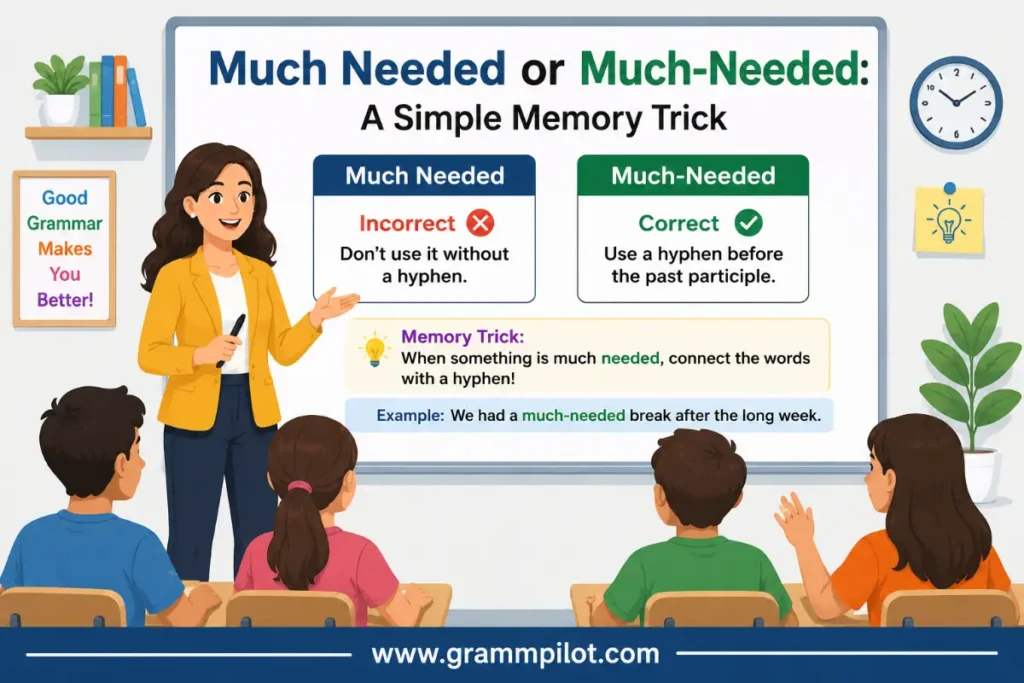
Much Needed vs Much-Needed: A Simple Memory Trick
Here’s an easy way to remember the rule.
Ask yourself one question: Does the phrase come before the noun?
If the answer is yes, use the hyphen.
- a much-needed break
- a much-needed meal
- a much-needed solution
If the answer is no, leave the hyphen out.
- The break was much needed.
- The meal was much needed.
- The solution was much needed.
A simple sentence can help you remember: Before the noun, join the words. After the noun, separate them.
Much Needed or Much-Needed: Master Synonym List
When learning Much Needed or Much-Needed, it’s useful to know similar words and phrases. Sometimes another expression fits your sentence better depending on the context.
Simple Synonyms
| Word | Meaning | Tone | Example |
|---|---|---|---|
| Needed | Required | Simple | We needed more time. |
| Necessary | Required for a purpose | Simple | Water is necessary for life. |
| Important | Having great value | Simple | This is an important meeting. |
| Essential | Absolutely needed | Simple | Sleep is essential for health. |
| Helpful | Giving assistance | Simple | Your advice was helpful. |
| Useful | Serving a purpose | Simple | This guide is useful. |
| Valuable | Worth a lot | Simple | She shared valuable information. |
| Welcome | Gladly received | Simple | Your help was welcome. |
This Phrase : Everyday Alternatives
| Word | Meaning | Tone | Example |
|---|---|---|---|
| Timely | Happening at the right time | Everyday | We received timely support. |
| Just in time | Arriving when needed | Everyday | The bus came just in time. |
| Long-awaited | Expected for a long time | Everyday | It was a long-awaited vacation. |
| Accurate | Exactly right | Everyday | That was the accurate solution. |
| Right on time | At the correct moment | Everyday | The package arrived right on time. |
Much Needed or Much-Needed: Formal Synonyms
| Word | Meaning | Tone | Example |
|---|---|---|---|
| Critical | Extremely important | Formal | Critical funding arrived today. |
| Vital | Essential for success | Formal | Clean water is vital. |
| Beneficial | Producing good results | Formal | Exercise is beneficial. |
| Required | Officially necessary | Formal | Identification is required |
Much Needed vs Much-Needed: Synonyms by Intensity
Some words suggest something is only slightly needed, while others show that it is absolutely essential.
| Mild | Moderate | Strong |
|---|---|---|
| Helpful | Needed | Essential |
| Useful | Important | Vital |
| Timely | Valuable | Indispensable |
| Convenient | Significant | Life-saving |
| Practical | Required | Absolutely necessary |
Choosing the right word depends on how strongly you want to express the need.
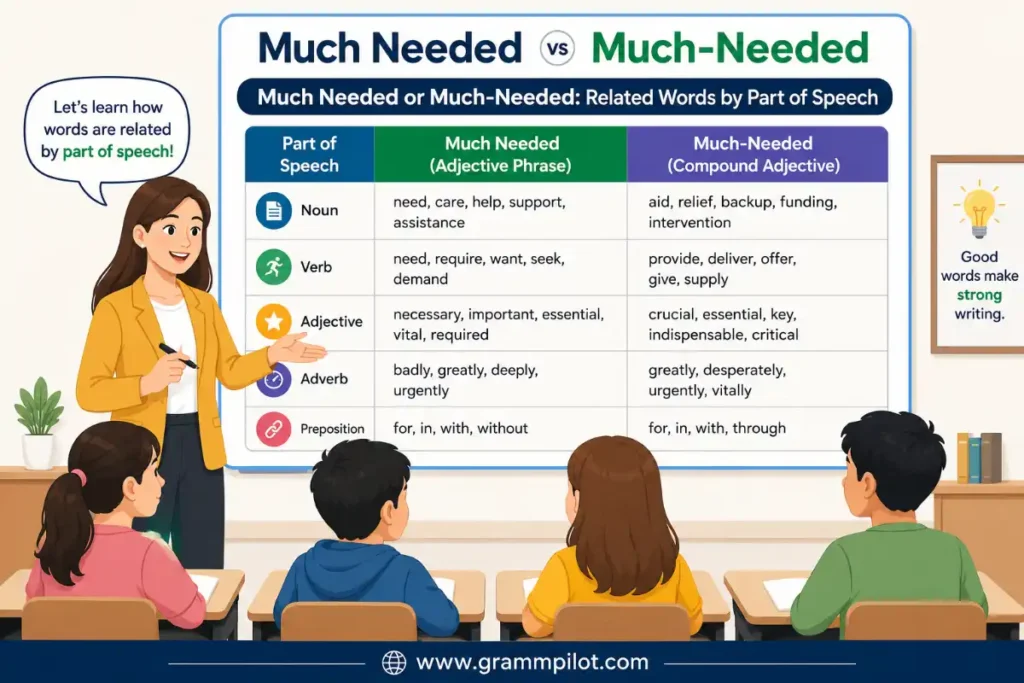
Much Needed or Much-Needed: Related Words by Part of Speech
Using different parts of speech keeps your writing varied and engaging.
Adjectives
- Needed
- Necessary
- Essential
- Important
- Helpful
- Useful
- Critical
- Vital
- Valuable
- Beneficial
Nouns
- Need
- Necessity
- Requirement
- Importance
- Value
- Benefit
- Relief
- Support
- Assistance
- Improvement
Verbs
- Need
- Require
- Help
- Support
- Improve
- Provide
- Supply
- Assist
- Strengthen
- Restore
These related words let you express similar ideas without repeating the same phrase too often.
Much Needed or Much-Needed: Is There a Difference Between American and British English?
Very little. Both American and British English follow the same hyphenation rule.
Before the noun:
- a much-needed change
- a much-needed vacation
After the noun:
- The change was much needed.
- The vacation was much needed.
Both styles appear in newspapers, books, government publications, and business writing in the US and the UK. Some publishers have their own style guides, but the grammar rule remains the same.
Much Needed or Much-Needed: Which Form Works Best in Different Situations?
The best choice depends on where the phrase appears.
Much Needed or Much-Needed in a Resume
Resumes usually describe achievements.
Example: Introduced a much-needed reporting system.
The hyphen is correct because the phrase comes before the noun system.
Much Needed or Much-Needed in an Essay
School essays often use both forms.
Examples:
- The community received much-needed support.
- The support was much needed after the storm.
Both sentences are correct because each follows the grammar rule.
Much Needed or Much-Needed in an Email
Professional emails should be clear.
Example: Thank you for the much-needed update.
Or: Your update was much needed.
Choose the form that matches the sentence structure.
Much Needed or Much-Needed in Text Messages
Text messages usually keep things short.
Examples:
- That break was much needed!
- We finally got a much-needed day off.
Both sound natural.
Much Needed or Much-Needed in Speaking
Native speakers regularly use both forms.
Examples:
- We needed a much-needed vacation.
- That vacation was much needed.
The difference isn’t pronunciation.
It’s only the sentence structure.
Much Needed or Much-Needed: Which Form Should You Choose?
Here’s a quick guide.
| Situation | Best Choice |
|---|---|
| Before a noun | Much-needed |
| After a linking verb | Much needed |
| Resume | Much-needed |
| Essay | Either, depending on position |
| Business email | Either, depending on position |
| Text message | Either, depending on position |
| Everyday conversation | Either, depending on position |
| News article | Follow the grammar rule |
| Academic writing | Follow the grammar rule |
| Professional writing | Follow the grammar rule |
A simple rule makes the choice easy:
If the phrase comes before the noun, use the hyphen. If it comes after the noun, leave the hyphen out.
Much Needed or Much-Needed: Original Example Sentences
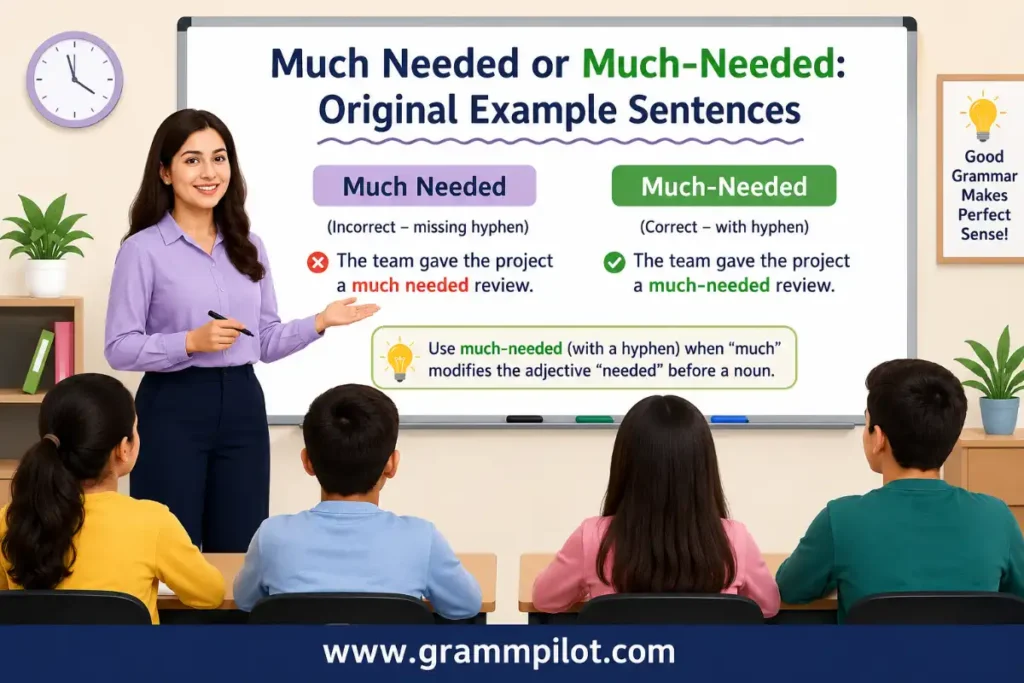
The easiest way to master Much Needed or Much-Needed is by seeing both forms used in real situations. Notice how the hyphen depends on the position of the phrase, not its meaning.
Examples with Much-Needed
- We finally enjoyed a much-needed vacation after months of hard work.
- The hospital received much-needed medical supplies.
- She took a much-needed break before the final exam.
- The city approved a much-needed bridge repair.
- They announced a much-needed policy change.
- Our team welcomed a much-needed victory.
- The garden received much-needed rain during the dry season.
- The teacher offered much-needed encouragement to the students.
- The company introduced a much-needed software update.
- The community celebrated a much-needed improvement in public services.
Examples with Much Needed
- The vacation was much needed after a stressful year.
- Your advice is much needed right now.
- The extra funding was much needed by the school.
- Their support was much needed during the project.
- The rain was much needed after weeks without water.
- Her encouragement was much needed before the competition.
- The repairs were much needed to keep the bridge safe.
- The meeting was much needed to solve the problem.
- A little patience is much needed in this situation.
- The update was much needed by all users.
Every sentence follows the same simple rule:
- Before the noun → much-needed
- After the noun or linking verb → much needed
Much Needed or Much-Needed: Before-and-After Examples
Changing the hyphen can make your sentence grammatically correct.
| Incorrect or Less Suitable | Correct |
|---|---|
| We needed a much needed break. | We needed a much-needed break. |
| The break was much-needed. | The break was much needed. |
| She enjoyed a much needed vacation. | She enjoyed a much-needed vacation. |
| The vacation was much-needed. | The vacation was much needed. |
| They announced a much needed update. | They announced a much-needed update. |
| The update was much-needed. | The update was much needed. |
| We received much needed supplies. | We received much-needed supplies. |
| The supplies were much-needed. | The supplies were much needed. |
The meaning stays the same.
Only the punctuation changes.
Much Needed or Much-Needed: What’s the Difference?
Both expressions mean greatly needed.
The only difference is grammar.
| Much-Needed | Much Needed |
|---|---|
| Used before a noun | Used after a noun or linking verb |
| Compound adjective | Predicate adjective |
| Hyphen required | No hyphen needed |
| Describes the following noun | Describes the subject |
| Common in headlines and titles | Common in complete sentences |
Examples:
- We needed a much-needed solution.
- The solution was much needed.
Both sentences are correct.
Much Needed or Much-Needed: Needed vs Necessary
These words are similar but not identical.
| Needed | Necessary |
|---|---|
| Often used in everyday English | Slightly more formal |
| Sounds conversational | Sounds more official |
| Common in speech | Common in academic writing |
| Expresses requirement | Expresses essential importance |
Examples:
- We needed more volunteers.
- More volunteers were necessary.
Both are correct, but the tone is slightly different.
Much Needed or Much-Needed: Common Mistakes
Many learners repeat the same punctuation mistakes.
Mistake 1: Forgetting the Hyphen Before a Noun
❌ We enjoyed a much needed vacation.
✅ We enjoyed a much-needed vacation.
Mistake 2: Keeping the Hyphen After the Noun
❌ The vacation was much-needed.
✅ The vacation was much needed.
Mistake 3: Hyphenating Every Time
Some writers always use the hyphen.
That’s incorrect.
Remember the position of the phrase.
Mistake 4: Never Using the Hyphen
Others never use it.
That is also incorrect.
Compound adjectives before nouns normally take a hyphen.
Mistake 5: Confusing Meaning with Grammar
Some people think the hyphen changes the meaning.
It doesn’t.
It only changes how the phrase functions in the sentence.
Much Needed or Much-Needed: When Should You Avoid Each Form?
Avoid much-needed after a linking verb.
Incorrect: The support was much-needed.
Correct: The support was much needed.
Avoid much needed before a noun.
Incorrect: We received much needed supplies.
Correct: We received much-needed supplies.
The rule is based on sentence structure, not style.
Much Needed or Much-Needed: Antonyms
Knowing opposite words improves your vocabulary.
| Word | Meaning |
|---|---|
| Unnecessary | Not needed |
| Optional | Not required |
| Unimportant | Of little importance |
| Needless | Not required |
| Excessive | More than needed |
| Extra | Additional but not essential |
| Nonessential | Not vital |
| Irrelevant | Not connected or needed |
| Trivial | Of little value |
| Unwanted | Not desired |
These words describe situations where something is not required.
Much Needed or Much-Needed: Quick Tips for Choosing the Right Form
Keep these tips in mind.
- Look at the word that follows the phrase.
- If a noun comes next, use the hyphen.
- If the phrase follows is, was, were, are, or another linking verb, remove the hyphen.
- Read the sentence aloud.
- Think about the phrase that describes the noun directly.
- Follow the same pattern in formal and informal writing.
- Don’t guess based on appearance.
- Practice with everyday examples.
- Remember that both forms are correct.
- Focus on the sentence structure.
Much Needed or Much-Needed: A Simple Memory Trick
Here’s an easy trick you’ll remember.
Think of the hyphen as a bridge.
When the phrase needs to reach forward and describe the next noun, the bridge joins the two words.
- a much-needed vacation
- a much-needed opportunity
- a much-needed reminder
Once the noun has already appeared, the bridge is no longer needed.
- The vacation was much needed.
- The opportunity was much needed.
- The reminder was much needed.
Remember this simple sentence: Before the noun, build the bridge. After the noun, remove the bridge.
Conclusion
Understanding Much Needed or Much-Needed is easier once you know one simple grammar rule. Both forms are correct, but they are used in different positions within a sentence. Use much-needed with a hyphen before a noun because it works as a compound adjective. Use much needed without a hyphen after a noun or a linking verb. Following this rule will make your writing look polished and grammatically correct.
If you’re writing an email, school essay, business report, blog post, or social media caption, choosing the right form helps your message read more naturally. If you’re ever unsure, look at the word that follows the phrase. With a little practice, Much Needed or Much-Needed will become one of the easiest grammar rules to remember and apply with confidence.
Frequently Asked Questions
1. Which is correct: much needed or much-needed?
Both are correct. Use much-needed before a noun, such as a much-needed break. Use much needed after a noun or linking verb, such as The break was much needed.
2. Do I always need a hyphen in Much Needed or Much-Needed?
No. The hyphen is only needed when the phrase comes before a noun and acts as a compound adjective.
3. Is “a much needed vacation” correct?
It should be written as a much-needed vacation because the phrase comes before the noun vacation.
4. What’s another way to say “much needed”?
Depending on the context, you can use essential, necessary, vital, greatly needed, long-awaited, timely, or important.
5. Is “The help was much needed” correct?
Yes. This sentence is correct because the phrase comes after the noun and linking verb, so no hyphen is used.
6. Is the rule the same in American and British English?
Yes. Both American and British English follow the same hyphenation rule for much-needed and much needed.
7. How can I remember Much Needed or Much-Needed?
Think of this simple rule: Before the noun, use the hyphen. After the noun, leave it out. This works in almost every situation.