
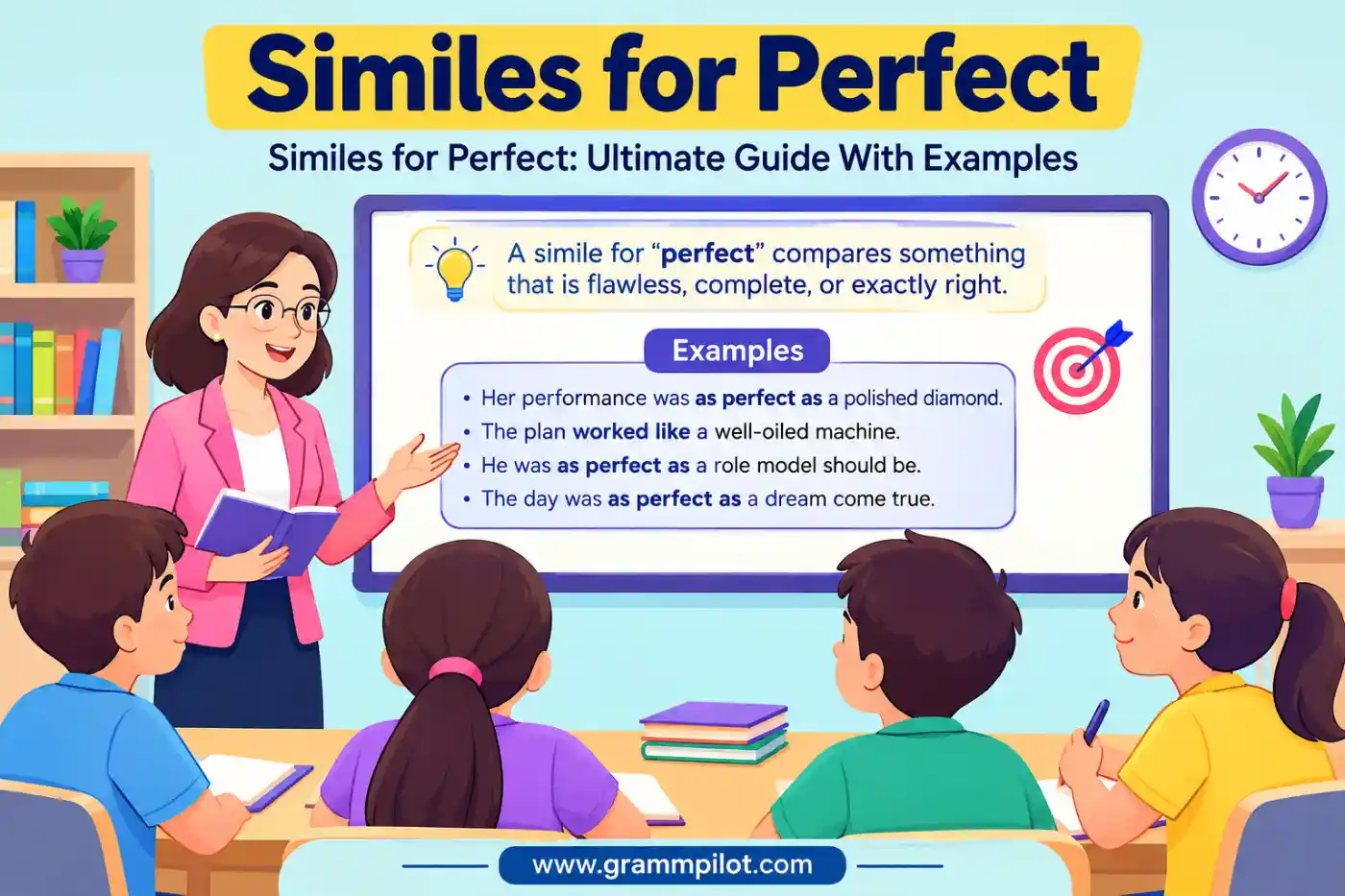
Have you ever written an essay, email, text message, or story and wanted a better way to describe something that seemed flawless? That’s where Similes for Perfect can make your writing more vivid and memorable. Instead of repeating the word perfect, you can use creative comparisons that paint a clear picture. Many students, writers, and English learners search for Similes for Perfect because they want their writing to sound more natural and expressive. A good simile helps readers imagine exactly how excellent, complete, or beautiful something is.
Answer Box
Similes for Perfect compare something flawless or excellent to another familiar thing using the words “like” or “as.” They make writing more descriptive, engaging, and easier to picture.
Whether you’re writing a school assignment, speech, poem, story, or social media post, the right simile can make your words stand out. This guide explains what these similes mean, where they come from, how to use them correctly, and how to choose the best one for every situation.
For another collection of creative expressions, explore [Similes for Alone].
Similes for Perfect: What Are They?
Similes for Perfect are comparisons that describe something as flawless, complete, beautiful, or excellent by using the words like or as.
Instead of saying: The painting was perfect.
You could write:
- The painting was as flawless as a polished diamond.
- The cake looked like a picture from a cookbook.
- Her performance was as smooth as silk.
These comparisons help readers imagine the quality instead of simply reading the word perfect. A simile always compares two different things in an easy-to-understand way.
Examples include:
- as perfect as a pearl
- as smooth as silk
- like a masterpiece
- as bright as a new star
These expressions make writing more colorful while keeping the meaning clear.
Similes for Perfect: What Does “Perfect” Really Mean?
Before learning different comparisons, it’s helpful to understand the word itself.
Perfect means:
- having no mistakes
- complete in every way
- exactly right
- excellent
- flawless
- ideal
People use the word in many situations.
For example:
- a perfect score
- a perfect vacation
- a perfect solution
- a perfect performance
- a perfect meal
- a perfect day
In everyday English, people sometimes use perfect simply to mean very good, even when something isn’t truly flawless.
That’s why similes often communicate the idea more effectively.
Similes for Perfect: Word Origin and Plain-English Meaning
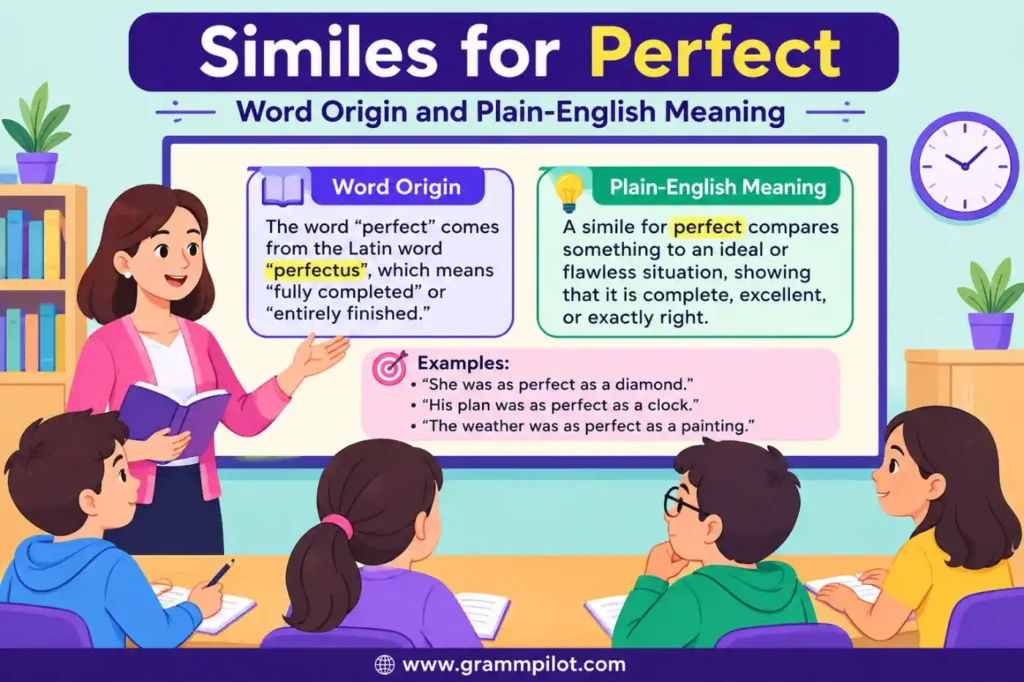
Many articles skip the history behind the word, but it helps explain why it has such a strong meaning. The word perfect comes from the Latin word perfectus, which means finished, completed, or fully made. Later, it entered English with the meaning of something that could not be improved. The word simile comes from the Latin word similis, meaning similar or like. When you combine the two ideas, Similes for Perfect become comparisons that help readers imagine something complete, beautiful, or without flaws.
For example:
- as flawless as crystal
- like a completed puzzle
- as smooth as glass
- like a work of art
Each comparison creates a mental picture that is stronger than using perfect alone.
Similes for Perfect: Why Do Writers Use Them?
Readers remember images much better than plain descriptions.
Compare these sentences.
Plain sentence
- The garden was perfect.
With a simile
- The garden was as beautiful as a blooming spring meadow.
The second sentence gives readers something they can picture.
Writers use similes because they:
- make descriptions more vivid
- improve storytelling
- create stronger emotions
- help readers imagine scenes
- avoid repeating the same adjectives
- make essays and speeches more engaging
You’ll find similes in:
- novels
- poems
- children’s books
- speeches
- classroom essays
- greeting cards
- advertisements
- everyday conversations
Similes for Perfect: How Does a Simile Work?
Every simile has three basic parts.
| Part | Example |
|---|---|
| Person, place, or thing | The performance |
| Comparison word | as |
| Image | as smooth as silk |
Another example:
| Part | Example |
|---|---|
| Person | My teacher |
| Comparison word | like |
| Image | like a master artist |
The comparison helps readers picture the idea more clearly.
Similes for Perfect: Why Are Similes Better Than Saying “Perfect”?
Imagine you’re describing a birthday cake.
Version one: The cake was perfect.
Version two: The cake was as beautiful as a wedding centerpiece.
Which sentence helps readers imagine the cake?
Most people choose the second one because it creates a stronger visual image.
Good similes:
- make writing memorable
- improve creative descriptions
- add personality
- avoid overusing common words
- help readers connect with your message
That’s why teachers often encourage students to use similes in descriptive writing.
Similes for Perfect: When Should You Use Them?
You can use these comparisons in many kinds of writing.
Common examples include:
- school essays
- speeches
- poems
- stories
- thank-you cards
- emails
- social media captions
- journals
- presentations
- creative writing assignments
Examples:
- Her answer was as clear as crystal.
- The wedding was like a fairy tale.
- His timing was as exact as a clock.
Each sentence paints a clearer picture than simply saying something was perfect.
Similes for Perfect: Can You Create Your Own Similes?
Absolutely. Many of the strongest comparisons are original. Think about things that people naturally connect with perfection.
Ideas include:
- diamonds
- pearls
- stars
- rainbows
- snowflakes
- polished mirrors
- sunsets
- masterpieces
- blooming flowers
- calm lakes
Then connect your image with as or like.
Examples:
- as flawless as fresh snow
- like a masterpiece hanging in a museum
- as polished as a new mirror
- like the final piece of a puzzle
- as bright as the morning sun
Creative similes often make your writing stand out.
Similes for Perfect: What Makes a Good Simile?
Not every comparison works well.
A strong simile should be:
- easy to understand
- meaningful
- natural
- memorable
- suitable for the audience
Compare these examples.
Good: She looked as graceful as a swan.
Better: His speech flowed as smoothly as a quiet river.
Poor: The project was as perfect as a screwdriver.
The last example feels confusing because most people don’t connect screwdrivers with perfection. Readers understand comparisons more easily when they use familiar images.
Similes for Perfect: Common Themes Used in Comparisons
Writers often choose images that naturally represent beauty, excellence, or completeness.
Nature
- sunshine
- mountains
- rivers
- flowers
- rainbows
- stars
- snow
Art
- masterpieces
- paintings
- sculptures
- music
Precious Objects
- diamonds
- pearls
- gold
- crystal
Everyday Objects
- mirrors
- clocks
- puzzles
- books
Positive Experiences
- dream vacations
- joyful celebrations
- peaceful mornings
- unforgettable sunsets
These themes help readers instantly understand the comparison.
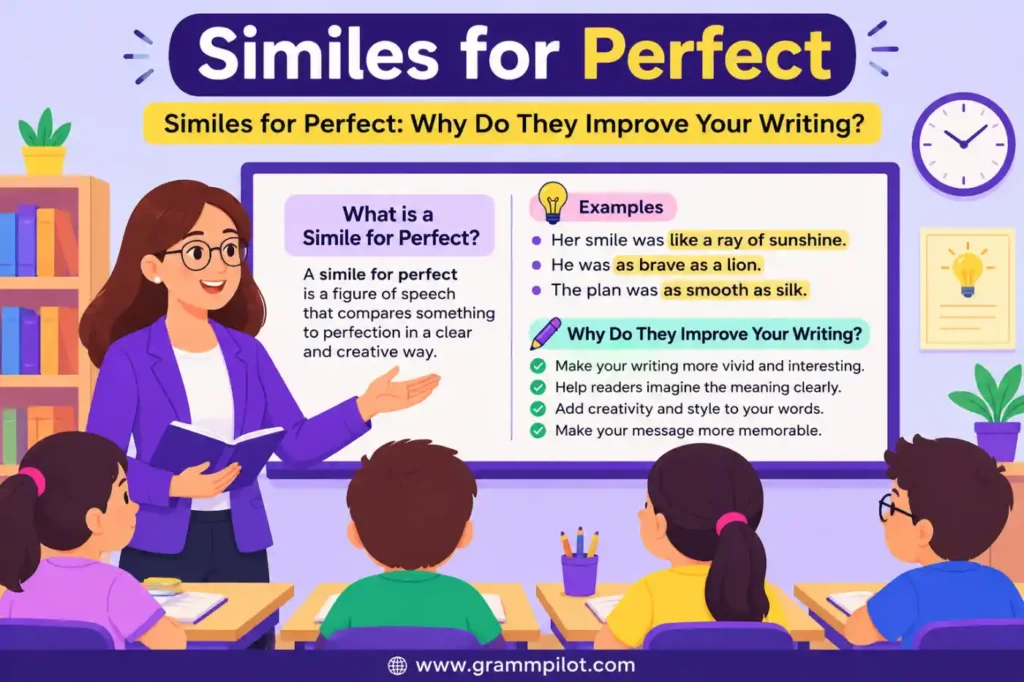
Similes for Perfect: Why Do They Improve Your Writing?
Readers enjoy writing that helps them imagine what they are reading.
Compare these examples.
- The meal was perfect.
- The meal was as delicious as grandma’s favorite recipe.
Another example:
- The performance was perfect.
- The performance was like a masterpiece brought to life.
The second sentence in each pair is richer and more memorable. That’s why Similes for Perfect appear so often in stories, poems, speeches, novels, and descriptive essays.
Similes for Perfect: Master List of the Best Similes
Learning Similes for Perfect is easier when you have a collection of ready-to-use comparisons. Some are simple enough for everyday conversations, while others work better in essays, speeches, or creative writing.
Simple Similes for Perfect
| Simile | Meaning | Tone | Example |
|---|---|---|---|
| As perfect as a pearl | Flawless and beautiful | Simple | Her necklace looked as perfect as a pearl. |
| As smooth as silk | Very smooth or effortless | Simple | His presentation was as smooth as silk. |
| As clear as crystal | Easy to understand | Simple | The instructions were as clear as crystal. |
| Like a finished puzzle | Complete in every detail | Simple | The plan fit together like a finished puzzle. |
| As bright as a star | Outstanding | Simple | Her smile was as bright as a star. |
| Like a dream | Wonderful and ideal | Simple | The vacation felt like a dream. |
| As neat as a pin | Very tidy | Simple | His desk was as neat as a pin. |
| Like a masterpiece | Beautifully done | Simple | The painting looked like a masterpiece. |
Everyday Similes for Perfect
| Simile | Meaning | Tone | Example |
|---|---|---|---|
| As fresh as morning dew | Clean and refreshing | Everyday | The garden looked as fresh as morning dew. |
| Like sunshine after rain | Exactly what was needed | Everyday | Her advice was like sunshine after rain. |
| As calm as a quiet lake | Peaceful and balanced | Everyday | The room felt as calm as a quiet lake. |
| Like new | In excellent condition | Everyday | The repaired bike looked like new. |
| As straight as an arrow | Very accurate | Everyday | His throw was as straight as an arrow. |
| Like clockwork | Perfectly timed | Everyday | Everything happened like clockwork. |
| As steady as a rock | Reliable | Everyday | She remained as steady as a rock. |
| Like the missing puzzle piece | An ideal fit | Everyday | His idea was like the missing puzzle piece. |
Formal Similes for Perfect
| Simile | Meaning | Tone | Example |
|---|---|---|---|
| As flawless as a diamond | Without faults | Formal | Her performance was as flawless as a diamond. |
| Like a work of art | Beautifully created | Formal | The building looked like a work of art. |
| As precise as a laser | Extremely accurate | Formal | The engineer was as precise as a laser. |
| Like a well-written symphony | Perfectly organized | Formal | The presentation flowed like a well-written symphony. |
| As polished as a mirror | Finished beautifully | Formal | His speech was as polished as a mirror. |
| Like a royal masterpiece | Exceptional quality | Formal | The design looked like a royal masterpiece. |
| As exact as mathematics | Completely accurate | Formal | The measurements were as exact as mathematics. |
| Like a perfectly tuned orchestra | Every part worked together | Formal | The team performed like a perfectly tuned orchestra. |
Creative and Informal Similes for Perfect
| Simile | Meaning | Tone | Example |
|---|---|---|---|
| Like magic | Surprisingly wonderful | Casual | The solution worked like magic. |
| As sweet as homemade pie | Wonderfully satisfying | Casual | Dessert was as sweet as homemade pie. |
| Like a fairy tale | Beautiful and unforgettable | Casual | The wedding felt like a fairy tale. |
| As colorful as a rainbow | Bright and attractive | Casual | The artwork was as colorful as a rainbow. |
| Like a picture in a magazine | Extremely attractive | Casual | The room looked like a picture in a magazine. |
| As beautiful as a sunset | Stunning | Casual | The view was as beautiful as a sunset. |
| Like a brand-new car | Fresh and flawless | Casual | His shoes looked like a brand-new car. |
| As complete as a full circle | Nothing missing | Casual | Their plan was as complete as a full circle. |
These examples show that Similes for Perfect can describe beauty, accuracy, success, balance, and excellence in many different ways.
Similes for Perfect: Similar Words by Intensity
Not every word that means perfect carries the same strength.
| Mild | Moderate | Strong |
|---|---|---|
| Good | Excellent | Perfect |
| Nice | Outstanding | Flawless |
| Fine | Superb | Impeccable |
| Well done | Exceptional | Faultless |
| Accurate | Remarkable | Ideal |
| Complete | Brilliant | Magnificent |
| Polished | Spectacular | Exquisite |
| Successful | Extraordinary | Phenomenal |
Choose the word that best matches the situation instead of always using perfect.
Similes for Perfect: Related Words by Part of Speech
Knowing related vocabulary helps you write more naturally.
Nouns
- Perfection
- Excellence
- Quality
- Beauty
- Precision
- Accuracy
- Success
- Achievement
- Ideal
- Masterpiece
Verbs
- Perfect
- Improve
- Polish
- Refine
- Complete
- Finish
- Achieve
- Master
- Excel
- Accomplish
Adjectives
- Perfect
- Flawless
- Ideal
- Excellent
- Outstanding
- Impeccable
- Polished
- Superb
- Complete
- Beautiful
These words work well with Similes for Perfect in both formal and creative writing.
Similes for Perfect: Are They Different in American and British English?
Most Similes for Perfect are understood the same way in American and British English because they rely on familiar images.
Examples commonly used in both include:
- As smooth as silk.
- As clear as crystal.
- Like clockwork.
- As bright as a star.
- Like a masterpiece.
Some cultural comparisons may differ. American writers may compare something to apple pie or baseball, while British writers might compare it to afternoon tea or a well-kept garden. Even with these small differences, readers in both countries understand the meaning.
Similes for Perfect: Which Simile Works Best in Different Situations?
The best comparison depends on what you’re writing.
Similes for Perfect in a School Essay
Teachers usually prefer familiar comparisons.
Examples:
- The solution was as clear as crystal.
- Her artwork was like a masterpiece.
Simple comparisons are easier for readers to understand.
Similes for Perfect in a Story
Creative writing allows more imagination.
Examples:
- The castle stood like a jewel shining beneath the stars.
- His plan fit together like the final piece of a puzzle.
These comparisons help readers picture the scene.
Similes for Perfect in an Email
Professional emails should use straightforward language.
Example: Your presentation was as polished as a mirror.
Avoid overly dramatic comparisons in business communication.
Similes for Perfect in a Speech
Speeches benefit from memorable images.
Examples:
- Our team worked like a perfectly tuned orchestra.
- Every volunteer performed as steadily as a lighthouse in a storm.
Strong images help listeners remember your message.
Similes for Perfect in Everyday Conversation
Simple expressions sound the most natural.
Examples:
- Everything went like clockwork.
- The cake looked like a picture in a magazine.
- Her answer was as clear as crystal.
These comparisons fit naturally into daily conversations.
Similes for Perfect: Which Simile Should You Choose?
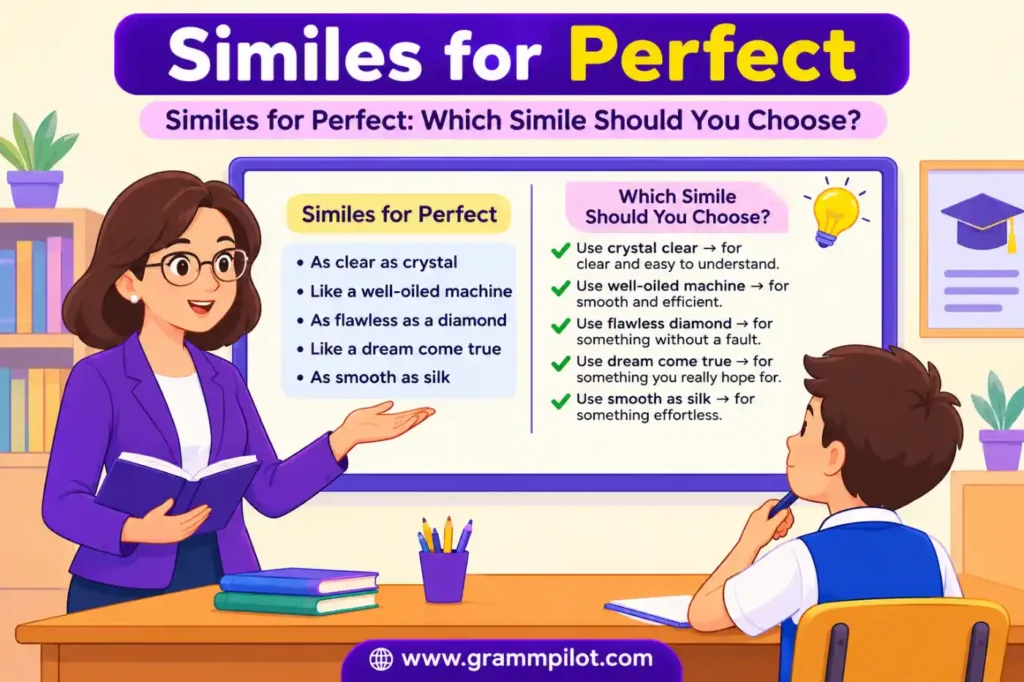
The right simile depends on the idea you want to express.
| Situation | Best Simile |
|---|---|
| Beautiful artwork | Like a masterpiece |
| Smooth performance | As smooth as silk |
| Clear explanation | As clear as crystal |
| Excellent teamwork | Like a perfectly tuned orchestra |
| Perfect timing | Like clockwork |
| Beautiful scenery | As beautiful as a sunset |
| Accurate work | As precise as a laser |
| Reliable person | As steady as a rock |
| Complete solution | Like the missing puzzle piece |
| Flawless appearance | As flawless as a diamond |
Using familiar images makes your comparisons stronger and easier to remember.
Similes for Perfect: Original Example Sentences
The best way to understand Similes for Perfect is to see them in real situations. These examples show how a simple comparison can make your writing more vivid and memorable.
- Her wedding dress was as flawless as a diamond.
- The cake looked like a picture from a bakery window.
- His speech flowed as smoothly as silk.
- The garden was as beautiful as a spring meadow.
- Our vacation felt like a dream come true.
- The teacher’s explanation was as clear as crystal.
- His timing worked like clockwork.
- The painting looked like a museum masterpiece.
- The lake was as calm as polished glass.
- Her handwriting was as neat as a pin.
- The dancer moved as gracefully as a swan.
- Their teamwork worked like a perfectly tuned orchestra.
- The final puzzle piece fit like it was made for the spot.
- His answer was as exact as mathematics.
- The sunrise looked as beautiful as a painting.
- The baby’s smile was like sunshine after a rainy day.
- The polished floor shined like a mirror.
- The performance ended like the perfect final note of a song.
- Her recipe turned out as dependable as grandma’s favorite meal.
- The presentation was as polished as fine crystal.
Each comparison creates a picture instead of simply repeating the word perfect.
Similes for Perfect: Before-and-After Examples
Look at how a simile improves an ordinary sentence.
| Plain Sentence | Improved with a Simile |
|---|---|
| The cake was perfect. | The cake was as beautiful as a wedding centerpiece. |
| His work was perfect. | His work was as polished as a mirror. |
| The view was perfect. | The view was as breathtaking as a mountain sunrise. |
| The answer was perfect. | The answer was as clear as crystal. |
| Her performance was perfect. | Her performance was like a masterpiece brought to life. |
| The room looked perfect. | The room looked like a page from a home magazine. |
| The team played perfectly. | The team worked like a perfectly tuned orchestra. |
| The solution was perfect. | The solution fit like the final piece of a puzzle. |
The second version in each pair is more descriptive and easier to remember.
Similes for Perfect: “As Smooth as Silk” vs. “As Clear as Crystal”
These two similes are both popular, but they describe different qualities.
| As Smooth as Silk | As Clear as Crystal |
|---|---|
| Focuses on smoothness. | Focuses on clarity. |
| Often describes movement or speech. | Often describes explanations or ideas. |
| Suggests ease and elegance. | Suggests easy understanding. |
Examples:
- Her presentation was as smooth as silk.
- His instructions were as clear as crystal.
Choose the one that matches your meaning.
Similes for Perfect: “Like Clockwork” vs. “Like a Masterpiece”
These comparisons also highlight different ideas.
| Like Clockwork | Like a Masterpiece |
|---|---|
| Means everything happened perfectly on time. | Means something was created beautifully. |
| Often describes schedules or systems. | Often describes art, writing, or performances. |
| Focuses on reliability. | Focuses on beauty and quality. |
Examples:
- Every train arrived like clockwork.
- The sculpture looked like a masterpiece.
Using the correct comparison makes your writing more precise.
Similes for Perfect: Common Mistakes
Many writers make the same mistakes when creating similes.
Mistake 1: Comparing to Something That Doesn’t Fit
❌ The project was as perfect as a hammer.
✅ The project was as complete as a finished puzzle.
Readers should immediately understand the comparison.
Mistake 2: Mixing Too Many Images
❌ The sunset was as smooth as silk and like a diamond and as bright as music.
✅ The sunset was as beautiful as a painting.
Keep one clear image in each sentence.
Mistake 3: Using Similes in Every Sentence
Too many comparisons can make writing feel crowded.
Instead, mix simple descriptions with similes.
Mistake 4: Using a Simile in Formal Reports
Business reports, scientific papers, and legal documents usually need direct language.
Instead of writing: The results were like a dream.
Write: The results were excellent.
Mistake 5: Repeating the Same Simile
Avoid using as smooth as silk throughout an entire essay. Use different comparisons to keep readers interested.
Similes for Perfect: When Should You Avoid Using Them?
Although Similes for Perfect improve many kinds of writing, they aren’t suitable everywhere.
Avoid them in:
- legal agreements
- scientific research
- technical manuals
- engineering reports
- medical documents
- financial statements
These types of writing require facts instead of creative descriptions.
Similes work best in:
- stories
- speeches
- poems
- personal blogs
- school essays
- children’s books
- greeting cards
- social media posts
Similes for Perfect: Antonyms
Learning opposite words builds a stronger vocabulary.
| Word | Opposite Meaning |
|---|---|
| Imperfect | Has flaws |
| Faulty | Contains mistakes |
| Broken | Damaged |
| Incomplete | Not finished |
| Messy | Untidy |
| Rough | Not smooth |
| Uneven | Not balanced |
| Defective | Not working properly |
| Poor | Low quality |
| Ordinary | Not special |
Knowing opposites helps you understand what perfect really means.
Similes for Perfect: Quick Tips for Choosing the Best Simile
Keep these simple ideas in mind.
- Match the comparison to your topic.
- Use images readers recognize.
- Keep your similes short and natural.
- Avoid mixing several comparisons in one sentence.
- Don’t repeat the same simile throughout your writing.
- Choose positive images for positive situations.
- Read your sentence aloud to see if it sounds natural.
- Pick comparisons that match the emotion you want to express.
- Use familiar images in school writing.
- Save your most creative comparisons for stories and speeches.
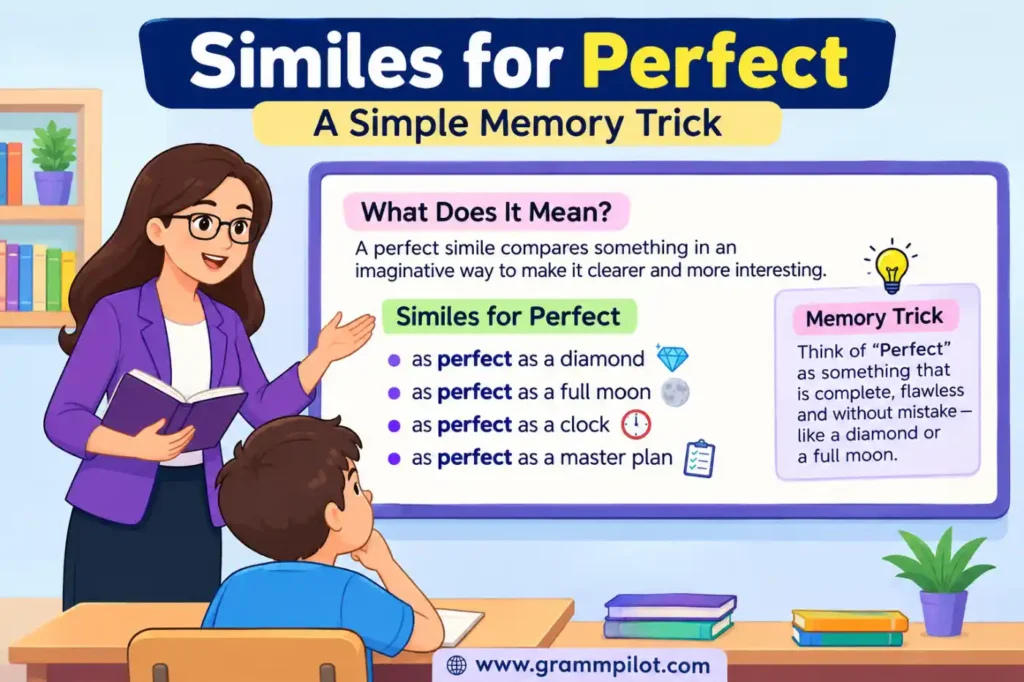
Similes for Perfect: A Simple Memory Trick
Think about things people naturally connect with perfection.
Many people imagine:
- diamonds
- stars
- masterpieces
- crystal
- polished mirrors
- blooming flowers
- peaceful sunsets
- completed puzzles
Ask yourself one question:
What object or experience reminds people of beauty, excellence, or completion?
That answer becomes your simile.
Examples:
- like a masterpiece
- as flawless as a diamond
- as clear as crystal
- like clockwork
- as smooth as silk
- as beautiful as a sunset
This simple approach helps you create your own Similes for Perfect instead of relying on the same comparisons every time.
Conclusion
Using Similes for Perfect is one of the easiest ways to make your writing more engaging and descriptive. Instead of repeating the word perfect, you can compare people, places, ideas, or objects to familiar images such as as smooth as silk, as clear as crystal, or like a masterpiece. These comparisons help readers picture exactly what you mean and make your sentences more memorable.
Whether you’re writing a school essay, speech, story, email, or social media caption, the right simile can make your message stand out. Choose comparisons that fit the situation, keep them natural, and don’t overuse them. With regular practice, you’ll build a stronger vocabulary and use Similes for Perfect confidently in both creative and everyday writing.
Frequently Asked Questions
1. What are Similes for Perfect?
Similes for Perfect are comparisons that describe something flawless, beautiful, or excellent by using the words like or as. They help readers create a clear mental picture.
2. What is the best simile for perfect?
There isn’t one best simile for every situation. Popular choices include as smooth as silk, as clear as crystal, as flawless as a diamond, and like a masterpiece.
3. What’s another way to say something is perfect?
You can use words such as flawless, ideal, excellent, impeccable, outstanding, superb, or exceptional. A simile often makes the description even more vivid.
4. Can I use similes in school essays?
Yes. Similes make essays more interesting when they support your ideas naturally. Choose comparisons that are easy for readers to understand.
5. Are similes and metaphors the same?
No. A simile compares two things using like or as, while a metaphor says one thing is another without those comparison words.
6. Can I create my own similes?
Absolutely. Think of something people associate with beauty, excellence, or completeness, then connect it with like or as. Original similes often make your writing more memorable.
7. Why do writers use Similes for Perfect?
Writers use Similes for Perfect because they create stronger images, reduce repetition, and help readers understand descriptions more clearly.