
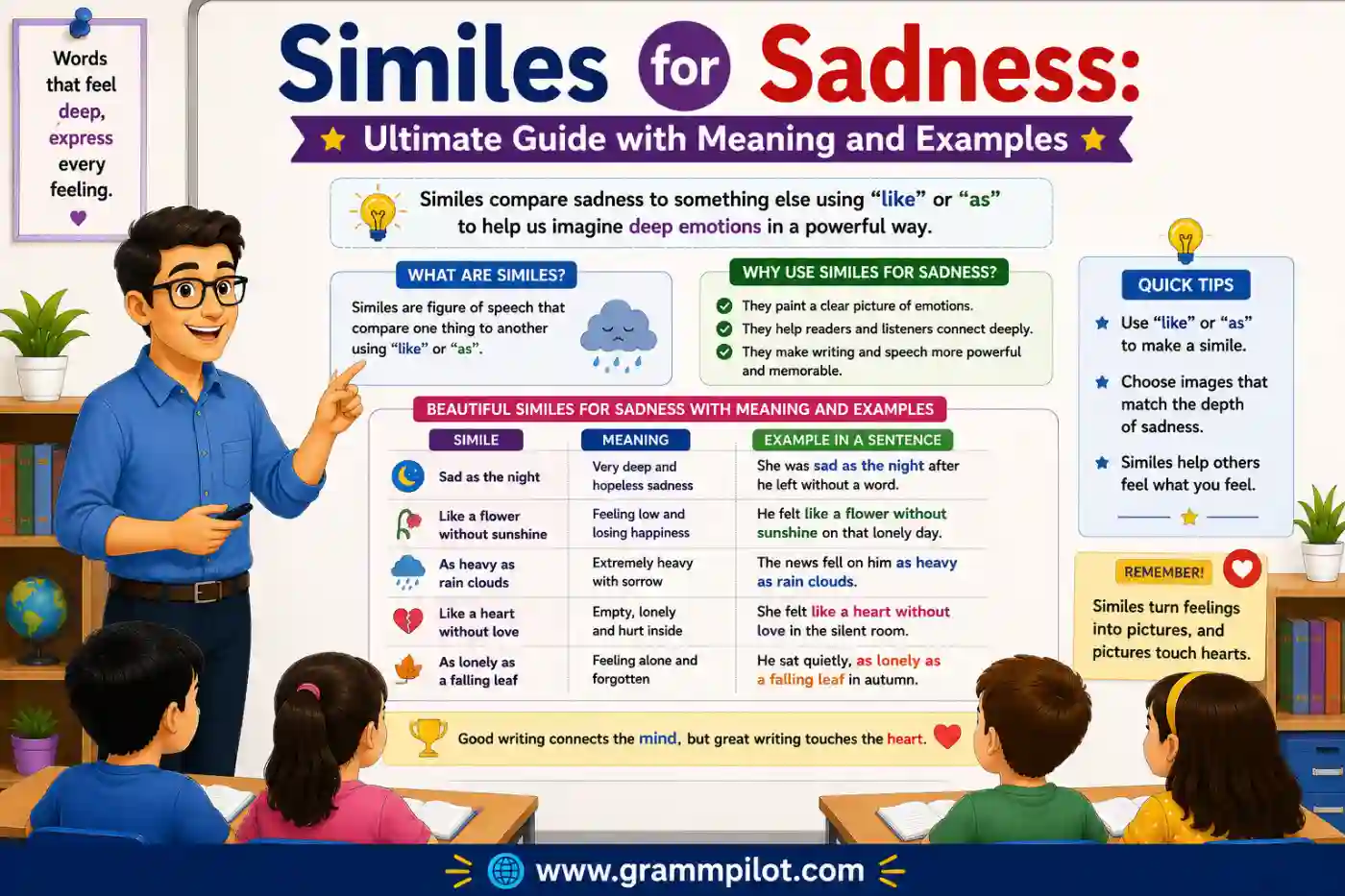
Have you ever been writing a story, journal entry, school essay, or even a heartfelt text message and struggled to describe someone’s sadness? Simply saying a person was “sad” often doesn’t capture the depth of the emotion. That’s where Similes for Sadness can make a big difference. They help readers picture feelings more clearly by comparing sadness to familiar people, objects, or situations. Similes for Sadness use the words like or as to compare sadness with something else. These comparisons add emotion, improve storytelling, and make your writing more memorable. Whether you’re writing fiction, poetry, speeches, or everyday conversations, the right simile can turn a simple sentence into one that stays with the reader.
Answer Box:
Similes for Sadness are comparisons that describe feelings of sorrow, disappointment, loneliness, or heartbreak by using like or as. They create vivid mental images and help readers understand emotions more deeply.
In this guide, you’ll learn the meaning and origin of Similes for Sadness, discover over 120 creative examples, understand where to use them, explore different emotional shades, and learn practical tips that will make your writing more expressive.
If you often second-guess your spelling, [Gluing vs Glueing] is worth reading.
What Does “Sadness” Mean?
Before exploring Similes for Sadness, it’s important to understand the meaning of the word itself.
Sadness is a natural human emotion that people experience after a loss, disappointment, failure, or difficult event. Sometimes it lasts only a few moments, while other times it can stay for much longer.
People often feel sadness when:
- They lose someone they love.
- A close friendship ends.
- They fail an important test.
- They miss their family.
- Their favorite pet dies.
- They remember painful memories.
- They feel lonely or rejected.
Because sadness appears in so many situations, writers often use Similes for Sadness to describe different emotions instead of repeating the same word again and again.
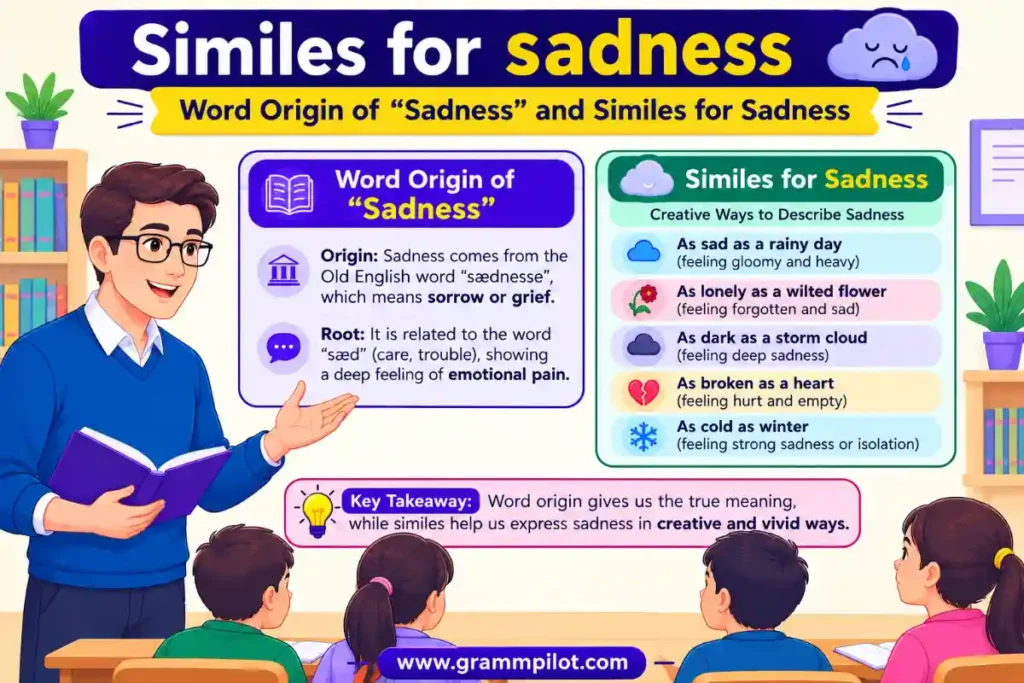
Word Origin of “Sadness” and Similes for Sadness
Understanding where a word comes from helps you appreciate how its meaning has developed over time. The English word sad comes from the Old English word sæd, which originally meant full or satisfied. Over many centuries, its meaning gradually changed until it described someone who felt serious, heavy-hearted, or unhappy. Eventually, the noun sadness became the common word for feelings of sorrow or grief. The word simile comes from the Latin word similis, meaning similar or like. A simile compares two different things by using like or as. Together, Similes for Sadness create meaningful comparisons that help readers picture emotional experiences in a stronger and more memorable way.
Why Use Similes for Sadness?
Many writers simply repeat words like sad, unhappy, or upset. While those words are correct, they don’t always help readers feel the emotion.
Compare these examples.
Simple sentence
She looked sad.
Better sentence
She looked as lonely as a bird without a nest.
Here’s another example.
Simple sentence
He felt sad after moving away.
Better sentence
He felt like a tree standing alone in an empty field.
The second versions create clearer pictures because readers can imagine the emotion instead of only reading about it.
Using Similes for Sadness helps you:
- Create stronger emotional descriptions.
- Improve stories and essays.
- Add depth to poems.
- Make characters feel more realistic.
- Avoid repeating the same emotional words.
- Help readers connect with your writing.
- Express different levels of sorrow.
Where Are Similes for Sadness Commonly Used?
You’ll often find Similes for Sadness in many forms of writing.
Creative Writing
Authors use emotional comparisons to make readers connect with characters.
Example: She sat like a flower without sunlight, waiting for better days.
Poetry
Poets often use images from nature to describe sorrow.
Example: His heart was as quiet as falling snow.
School Essays
Students use similes to make descriptive writing more interesting.
Example: The abandoned house looked as lonely as an empty island.
Storytelling
Stories become more emotional when sadness is shown through comparisons.
Example: He walked away like a shadow disappearing at sunset.
Everyday Conversation
People sometimes use simple comparisons when talking about emotions.
Example: “She looked as sad as a rainy day.”
What Makes a Good Simile for Sadness?
Not every comparison creates a strong emotional image. The best Similes for Sadness usually have these qualities.
Easy to Understand
Readers should immediately recognize the comparison.
Example: As sad as a rainy day.
Emotionally Meaningful
The comparison should match the feeling being described.
Example: Like a forgotten letter in an old drawer.
Easy to Visualize
Choose images that people can picture easily.
Example: As lonely as a single star in the night sky.
Natural to Read
The simile should fit smoothly into the sentence instead of sounding forced.
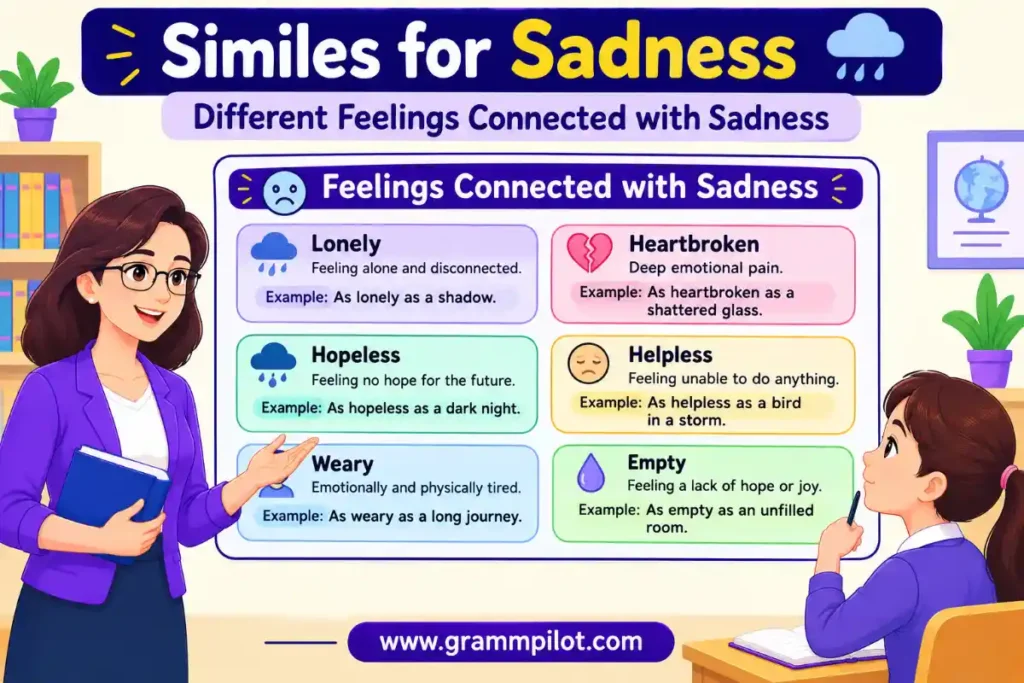
Different Feelings Connected with Sadness
Sadness is not always the same. Sometimes it’s quiet, while other times it’s overwhelming.
| Feeling | Description | Example Situation |
|---|---|---|
| Disappointment | Things didn’t go as planned | Losing a competition |
| Loneliness | Feeling alone | Moving to a new city |
| Heartbreak | Emotional pain | Ending a relationship |
| Regret | Wishing you had done something differently | Missing an opportunity |
| Grief | Deep sorrow after loss | Losing a loved one |
| Hopelessness | Feeling that nothing will improve | Facing repeated failures |
| Homesickness | Missing home | Living far from family |
| Melancholy | Quiet, thoughtful sadness | Remembering old memories |
Understanding these emotions helps you choose the most appropriate Similes for Sadness instead of using the same comparison every time.
How Similes for Sadness Improve Your Writing
Imagine reading a story where every emotional moment simply says someone was sad.
The girl was sad. The father was sad. The dog looked sad. The ending was sad. The repeated description quickly becomes dull.
Now compare these sentences.
The girl stood like a flower without rain. The father stared out the window as silently as winter trees. The dog waited like an empty swing moving in the wind. The ending felt as heavy as dark clouds before a storm. These descriptions create stronger emotional pictures because they use Similes for Sadness naturally and creatively.
120+ Similes for Sadness with Meanings and Examples
The best Similes for Sadness help readers understand emotions without using long explanations. Some comparisons describe quiet sorrow, while others express heartbreak, loneliness, disappointment, or grief. The examples below cover many different situations, making it easier to choose the right comparison for your writing.
| Simile | Meaning | Best Used For | Example |
|---|---|---|---|
| As sad as a rainy day | Feeling gloomy | Everyday writing | The afternoon felt as sad as a rainy day. |
| As sad as a wilted flower | Lost happiness | Nature, poetry | She looked as sad as a wilted flower. |
| Like a forgotten photograph | Feeling ignored | Personal writing | She felt like a forgotten photograph. |
| As sad as an empty chair | Missing someone | Family stories | The dining room felt as sad as an empty chair. |
| Like a tree without leaves | Feeling empty | Nature writing | She stood like a tree without leaves. |
| As sad as a broken song | Lost joy | Music | The melody sounded as sad as a broken song. |
| Like a lonely star | Feeling isolated | Creative writing | He felt like a lonely star in the night sky. |
| As sad as a silent violin | Quiet heartbreak | Poetry | Her voice became as sad as a silent violin. |
| Like a forgotten toy | Feeling unwanted | Children’s stories | The little bear sat like a forgotten toy. |
| As sad as a fading sunset | Gentle sorrow | Nature | The evening looked as sad as a fading sunset. |
| As sad as winter trees | Quiet sadness | Seasonal writing | The park looked as sad as winter trees. |
| Like a letter never opened | Unfulfilled hopes | Emotional writing | She felt like a letter never opened. |
These classic Similes for Sadness work well in stories, essays, poems, speeches, and personal writing.
Similes for Sadness Grouped by Emotion
Different situations call for different kinds of comparisons. Grouping Similes for Sadness by emotion makes it easier to choose the right one.
Similes for Loneliness
Loneliness is one of the most common forms of sadness.
- As lonely as a bird without a flock.
- Like a single candle in a dark room.
- As lonely as an empty bench in winter.
- Like a shell washed onto the shore.
- As lonely as the last leaf on a tree.
- Like a traveler with no destination.
- As lonely as a quiet street at midnight.
- Like an island in the middle of the sea.
- As lonely as a forgotten path.
- Like a kite without the wind.
Example: After moving away, Noah felt as lonely as an island in the middle of the sea.
Similes for Heartbreak
Heartbreak often carries deeper emotional pain.
- As sad as a shattered mirror.
- Like a rose losing its petals.
- As sad as an unfinished love story.
- Like a cracked heart.
- As sad as a melody without music.
- Like a book missing its final chapter.
- As sad as a farewell at the train station.
- Like a torn photograph.
- As sad as a bridge to nowhere.
- Like an empty promise.
These Similes for Sadness fit emotional stories and reflective writing.
Similes for Disappointment
Not all sadness comes from loss. Sometimes it comes from unmet expectations.
- As sad as a balloon losing its air.
- Like a cake that never rose.
- As sad as missing the last bus.
- Like an empty gift box.
- As sad as a cancelled celebration.
- Like finishing second by one point.
- As sad as rain on a picnic.
- Like a movie ending too soon.
- As sad as a broken trophy.
- Like an unanswered invitation.
These comparisons describe everyday disappointments in a relatable way.
Similes for Grief
Grief is one of the deepest forms of sadness, so the comparisons should reflect that emotional weight.
- As sad as a silent church.
- Like an old oak after a storm.
- As sad as the final page of a diary.
- Like a river that has stopped flowing.
- As sad as an empty family table.
- Like a clock that no longer ticks.
- As sad as forgotten footsteps.
- Like winter without spring.
- As sad as a home without laughter.
- Like a song that will never be sung again.
Choose these Similes for Sadness when writing about serious emotional experiences.
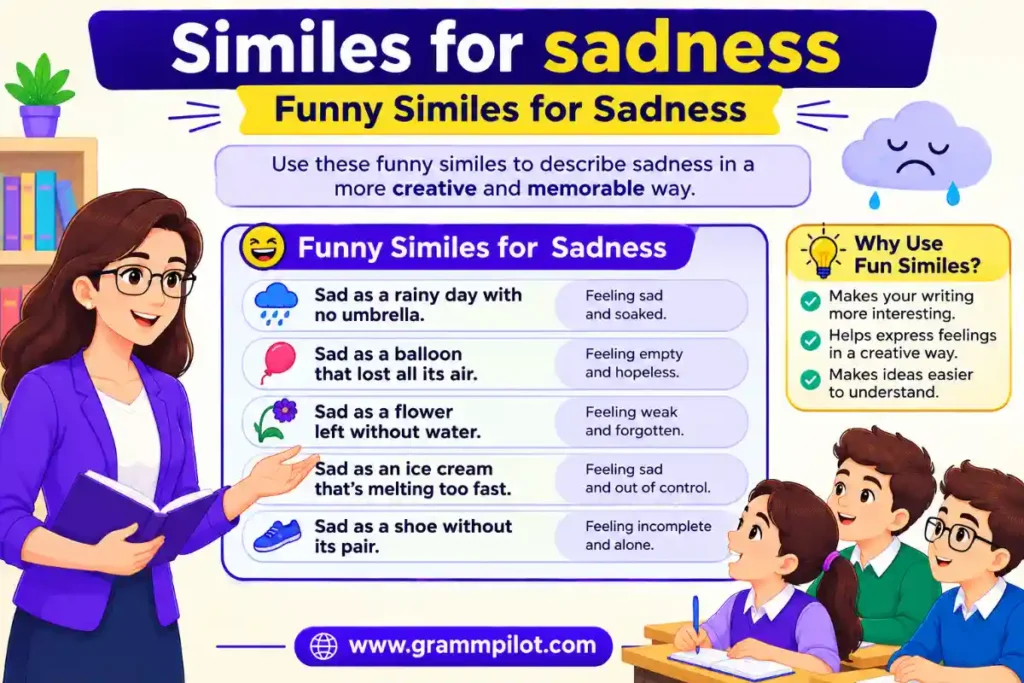
Funny Similes for Sadness
Not every sad moment has to sound serious. Gentle humor can make certain situations more relatable.
- As sad as an ice cream falling off the cone.
- Like a cookie with no chocolate chips.
- As sad as a phone with one percent battery.
- Like popcorn without butter.
- As sad as a pizza without cheese.
- Like a birthday without cake.
- As sad as an empty cookie jar.
- Like a balloon that won’t float.
- As sad as losing the TV remote.
- Like a teddy bear left on the shelf.
These playful Similes for Sadness are perfect for lighthearted stories and classroom activities.
Original Example Sentences Using Similes for Sadness
Reading complete sentences makes it easier to understand how Similes for Sadness fit naturally into everyday English.
- The empty classroom felt as sad as a rainy afternoon after graduation.
- Lily sat like a flower waiting for sunshine.
- His smile faded like a candle in the wind.
- The old photograph looked as sad as forgotten memories.
- Ethan walked home like a bird with a broken wing.
- The abandoned playground stood as sad as an empty stage.
- Her voice sounded as sad as a silent violin.
- The farewell felt like autumn leaves drifting away.
- Grandma’s empty rocking chair looked as sad as winter trees.
- The little puppy waited like a child searching for home.
- The quiet room felt as sad as a sky without stars.
- His heart seemed like a book missing its ending.
Using different Similes for Sadness throughout your writing keeps descriptions fresh and emotionally engaging.
Tips for Choosing the Best Similes for Sadness
A good comparison should fit the feeling you’re trying to express.
Ask yourself these questions before choosing one.
- Is the sadness mild or overwhelming?
- Does the comparison match the character’s age?
- Will readers understand the image immediately?
- Does it fit the tone of the story or essay?
- Is it original without sounding confusing?
The strongest Similes for Sadness are simple, meaningful, and easy to picture. When readers can imagine the comparison instantly, your writing becomes much more powerful.
Best Similes for Sadness by Writing Context
Choosing the right comparison depends on where you’re using it. Some Similes for Sadness fit creative stories, while others sound better in school essays or everyday conversations. Matching the simile to the situation makes your writing sound natural and meaningful.
Best Similes for Sadness in School Essays
When writing for school, choose comparisons that are clear and easy to understand.
Good examples include:
- As sad as a rainy day
- As sad as a wilted flower
- Like a lonely bird
- As sad as autumn leaves
- Like an empty playground
Example: The old park looked as sad as an empty playground after the festival ended.
Best Similes for Sadness in Stories
Stories often allow more imaginative descriptions.
Popular Similes for Sadness include:
- Like a bird with a broken wing
- As sad as a forgotten melody
- Like a tree without leaves
- As sad as a fading sunset
- Like a river that lost its way
Example: The prince wandered through the castle like a bird with a broken wing, unable to find hope.
Best Similes for Sadness in Poetry
Poetry often uses nature and gentle imagery to express emotion.
Examples include:
- As sad as falling snow
- Like a lonely moon
- As sad as a silent forest
- Like the last star before dawn
- As sad as waves leaving the shore
These Similes for Sadness create peaceful but emotional images.
Best Similes for Sadness in Everyday Conversation
Daily conversations usually sound better with familiar comparisons.
Examples include:
- As sad as a rainy day
- As sad as a puppy left alone
- Like a balloon losing air
- As sad as missing the last bus
- Like a child who lost a favorite toy
These comparisons are simple and easy for listeners to understand.
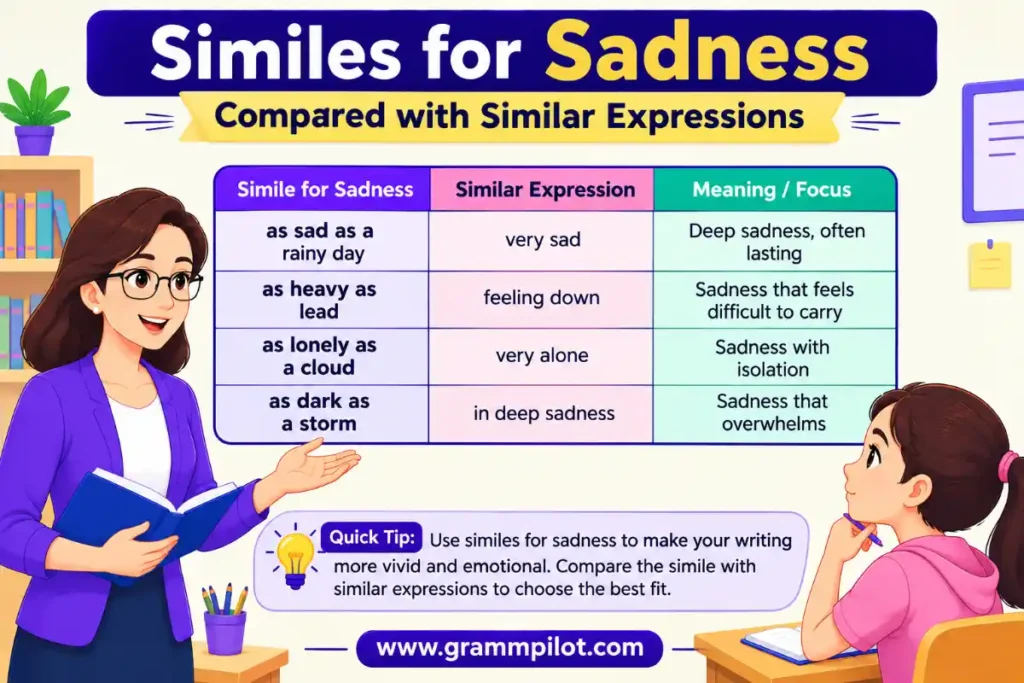
Similes for Sadness Compared with Similar Expressions
Some Similes for Sadness describe different levels of emotion. Choosing the right one depends on what you want readers to feel.
| Simile | Best Meaning | Example |
|---|---|---|
| As sad as a rainy day | Gentle sadness | The afternoon felt as sad as a rainy day. |
| Like a bird with a broken wing | Feeling helpless | He walked like a bird with a broken wing. |
| As sad as a wilted flower | Lost happiness | She looked as sad as a wilted flower. |
| Like an empty chair | Missing someone | The dining room felt like an empty chair. |
| As sad as winter trees | Quiet sorrow | The garden looked as sad as winter trees. |
Although each comparison expresses sadness, each creates a slightly different emotional picture.
Similes for Sadness vs. Metaphors About Sadness
Many people confuse similes with metaphors because both compare two things.
The difference is simple.
| Simile | Metaphor |
|---|---|
| Uses like or as | Doesn’t use like or as |
| She felt like a bird with a broken wing. | She was a broken-winged bird. |
| His heart was as heavy as stone. | His heart was stone. |
If your sentence uses like or as, it belongs to the group of Similes for Sadness.
Common Mistakes When Using Similes for Sadness
Even strong writers sometimes make small mistakes when using comparisons. Knowing these errors will help your writing sound smoother.
Choosing a Comparison That Doesn’t Fit
The comparison should match the emotion.
Weak
As sad as a rainbow.
Rainbows usually suggest hope and happiness, so the image feels confusing.
Better
As sad as a rainy day.
Using Too Many Similes Together
Adding several Similes for Sadness in one sentence makes writing feel crowded.
Less Effective
She looked as sad as a rainy day, as sad as autumn leaves, as sad as a lonely bird, and as sad as a silent night.
Better
She looked as sad as a rainy day.
One strong comparison is usually enough.
Repeating the Same Simile
Readers lose interest if the same comparison appears again and again.
Instead of repeating as sad as a rainy day, mix in other Similes for Sadness throughout your writing.
Making Comparisons Too Complicated
Simple comparisons often create stronger emotional images than long or confusing ones.
Antonyms of Sadness
Learning opposite emotions helps writers create stronger contrast.
| Word | Meaning |
|---|---|
| Happiness | Feeling joyful |
| Joy | Great pleasure |
| Delight | Deep satisfaction |
| Cheerfulness | Bright mood |
| Excitement | Strong positive emotion |
| Hope | Expecting good things |
| Contentment | Peaceful satisfaction |
| Bliss | Complete happiness |
Using opposite emotions alongside Similes for Sadness helps build emotional balance in stories.
Quick Tips for Choosing the Right Similes for Sadness
Keep these tips in mind whenever you write.
- Match the comparison to the emotion.
- Use familiar images that readers recognize.
- Keep the simile short and natural.
- Avoid forcing unusual comparisons.
- Read the sentence aloud before finishing.
- Use different comparisons instead of repeating one favorite.
- Think about your audience before choosing a poetic or humorous image.
These habits will help you use Similes for Sadness confidently in every type of writing.
Practice Sentences
Complete each sentence with your own Similes for Sadness.
- The empty room felt as sad as __________.
- Her smile faded like __________.
- The old photograph looked as sad as __________.
- He walked away like __________.
- My heart felt as sad as __________.
Sample Answers
- A rainy afternoon.
- A candle in the wind.
- A forgotten memory.
- A bird with a broken wing.
- Winter without sunshine.
Practice helps you remember Similes for Sadness and use them naturally in future writing.
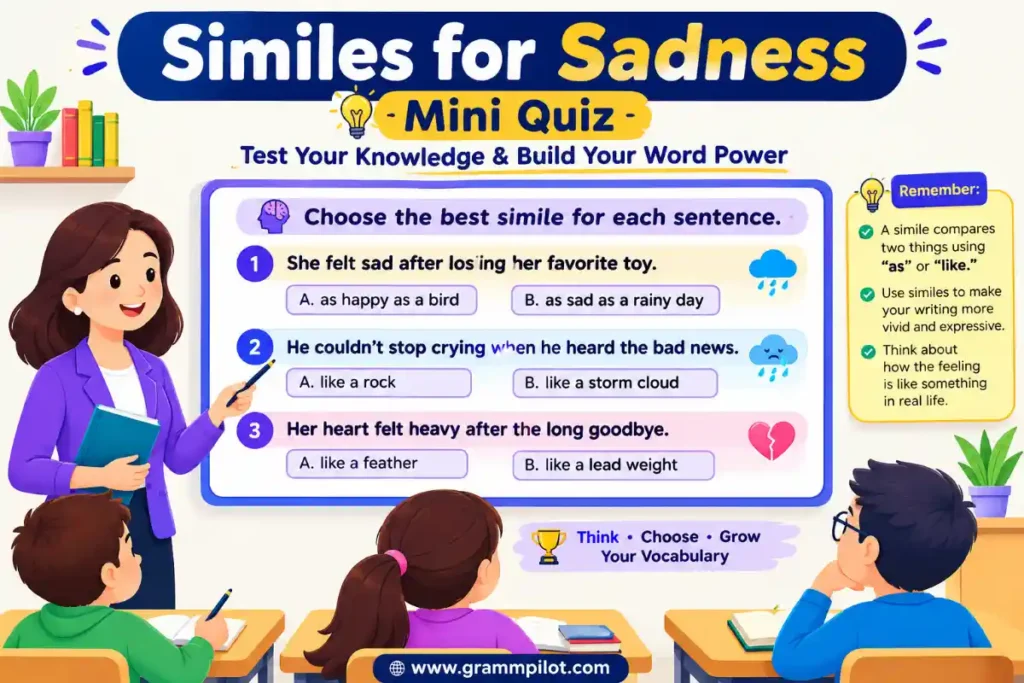
Mini Quiz
1. Which simile best describes loneliness?
A. As sad as an empty playground
B. As bright as the sun
C. As fast as lightning
Answer: A
2. Which comparison best fits heartbreak?
A. Like a broken-winged bird
B. Like fresh popcorn
C. Like a racing car
Answer: A
3. Which sentence uses a simile correctly?
A. Her heart was sadness.
B. Her heart felt like a bird with a broken wing.
C. Her sadness bird flew away.
Answer: B
These simple exercises will help you understand Similes for Sadness more clearly and improve your descriptive writing skills.
Conclusion
Similes for Sadness help transform simple emotional descriptions into vivid and memorable writing. Instead of repeatedly using words like sad or unhappy, you can create stronger imagery with thoughtful comparisons that show exactly how a person feels. Whether you’re describing heartbreak, loneliness, disappointment, or quiet reflection, the right simile helps readers connect with the emotion on a deeper level.
Keep practicing Similes for Sadness in your essays, stories, poems, and daily writing. As you build your collection of comparisons, you’ll become more confident at expressing emotions with clarity, creativity, and impact. Strong descriptive language doesn’t just tell readers about sadness—it helps them truly feel it.
Frequently Asked Questions
1. What are Similes for Sadness?
Similes for Sadness are comparisons that use like or as to describe feelings of sorrow, loneliness, disappointment, or grief. They make emotions easier to imagine and add depth to your writing.
2. What is the most common simile for sadness?
One of the most common Similes for Sadness is “as sad as a rainy day.” Other popular examples include “like a bird with a broken wing,” “as sad as a wilted flower,” and “as lonely as an empty playground.”
3. Can I use Similes for Sadness in school assignments?
Yes. Similes for Sadness are excellent for essays, stories, poems, and creative writing because they help readers understand emotions through clear and memorable comparisons.
4. What’s another way to describe sadness with a simile?
You can say as sad as winter trees, like a candle fading in the wind, as lonely as a single star, as sad as a forgotten photograph, or like an empty chair at the table, depending on the emotion you want to express.
5. What’s the difference between a simile and a metaphor?
A simile compares two things by using like or as, while a metaphor makes a direct comparison without those words.
Simile: She felt as sad as a rainy day.
Metaphor: She was a rainy day.
6. Are Similes for Sadness only used in poetry?
No. Similes for Sadness are useful in stories, novels, speeches, personal journals, blogs, school assignments, and even everyday conversations whenever you want to describe emotions more vividly.
7. How can I create my own Similes for Sadness?
Think about an image that naturally represents sorrow, loneliness, or disappointment. Then compare it using like or as. The best comparisons are simple, easy to picture, and appropriate for the situation.