
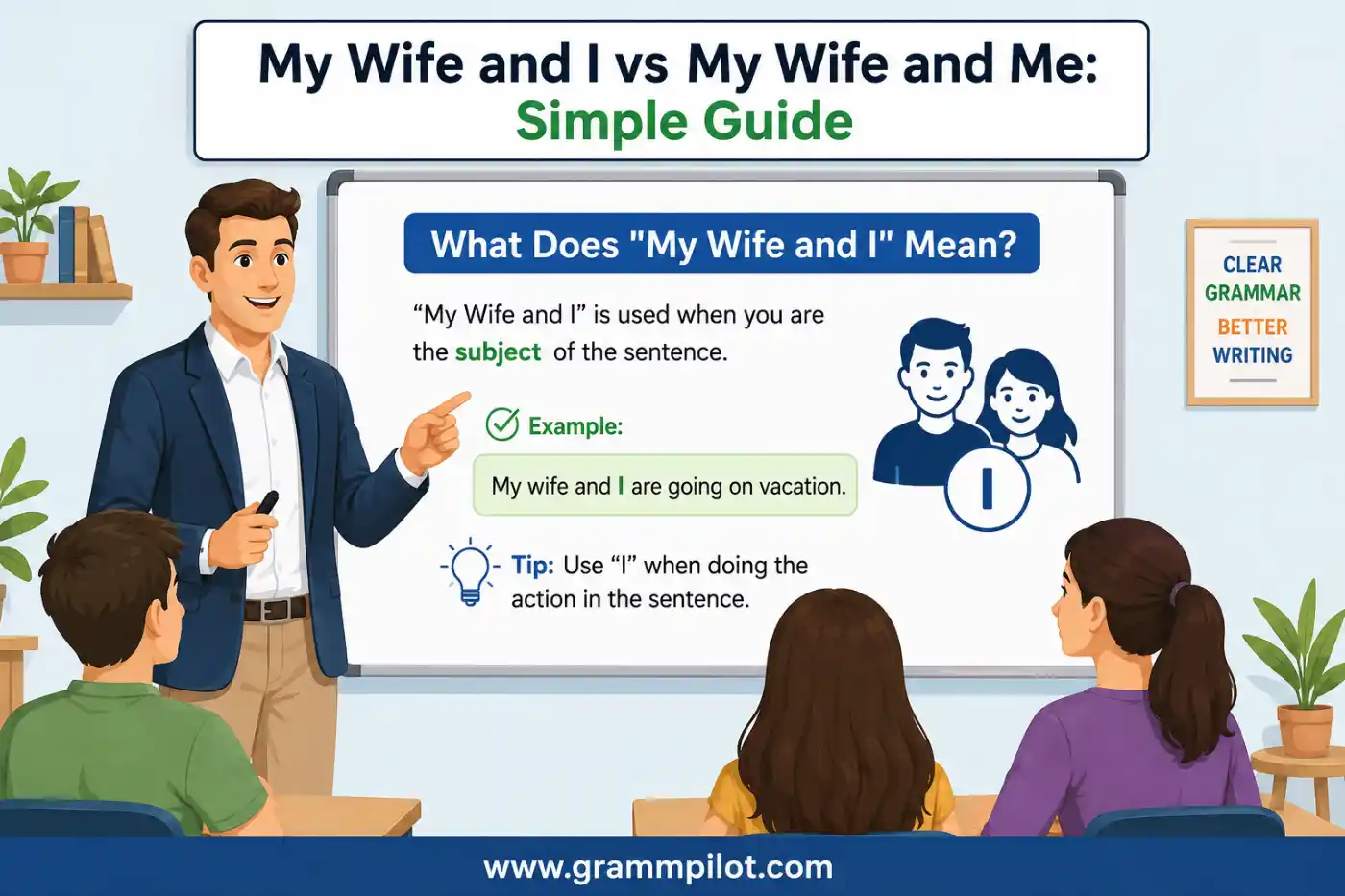
Have you ever been writing an email, essay, social media post, or even a text message and stopped to wonder about you should write My Wife and I vs My Wife and Me? You’re not alone. Many native English speakers make this mistake because both phrases sound natural in different situations. Choosing the correct phrase isn’t about sounding fancy. It’s about knowing if the words are acting as the subject or the object in a sentence. Once you understand this simple rule, you’ll rarely get it wrong again.
Answer Box:
Use “my wife and I” when the phrase is the subject of the sentence. Use “my wife and me” when the phrase is the object of a verb or preposition. A quick test is to remove “my wife and” from the sentence and see if “I” or “me” sounds correct.
In this guide, you’ll learn the simple grammar rule, the history behind these pronouns, plenty of examples, common mistakes, and practical tips to help you choose the correct phrase every time.
If this rule seems confusing, you may also want to read [No Difference vs No Different].
What Does “My Wife and I” Mean?
My wife and I refers to you and your wife together when both of you are doing the action in a sentence.
Examples:
- My wife and I enjoy hiking every weekend.
- My wife and I visited our grandparents.
- My wife and I are planning a vacation.
In each sentence, my wife and I is the subject because it performs the action.
Think of it this way: Who is doing the action?
If the answer is my wife and I, then this is usually the correct choice.
What Does “My Wife and Me” Mean?
My wife and me refers to you and your wife when someone or something else is acting upon you.
Examples:
- The teacher invited my wife and me.
- They gave my wife and me free tickets.
- She spoke to my wife and me after the meeting.
Here, my wife and me is receiving the action instead of performing it.
Ask yourself: Who is receiving the action?
If the answer is my wife and me, this phrase is usually correct.
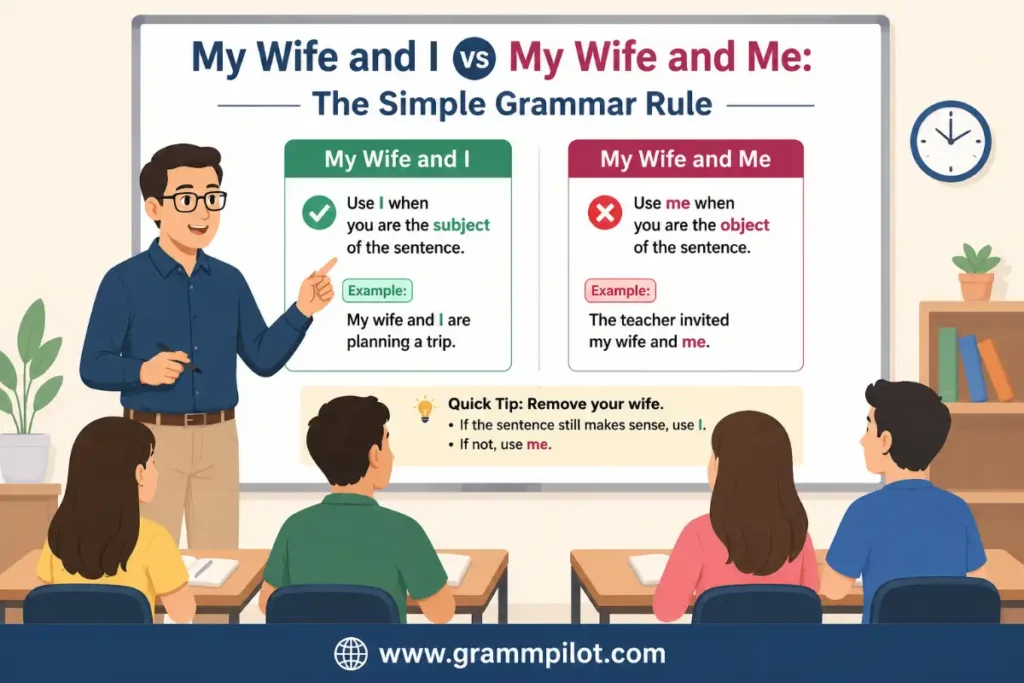
My Wife and I vs My Wife and Me: The Simple Grammar Rule
The easiest way to remember the difference is this:
- I = Subject
- Me = Object
That’s all you need to remember.
Use “My Wife and I”
Use this phrase when it comes before the verb and performs the action.
Examples:
- My wife and I love traveling.
- My wife and I cooked dinner.
- My wife and I watched the movie.
Use “My Wife and Me”
Use this phrase after a verb or a preposition when receiving the action.
Examples:
- Our neighbors invited my wife and me.
- The manager congratulated my wife and me.
- She sat beside my wife and me.
The Easy Removal Trick
One of the best grammar tricks is removing “my wife and” from the sentence. If the sentence still sounds correct with I, use my wife and I. If it sounds correct with me, use my wife and me.
Example 1
“My wife and I went shopping.”
Remove my wife and.
Correct: “I went shopping.“
Example 2
“They invited my wife and me.”
Remove my wife and.
Correct: “They invited me.”
Example 3
Incorrect: “They invited my wife and I.”
Remove my wife and.
“They invited I.”
This immediately sounds wrong.
Therefore: “They invited my wife and me.” is correct.
Word Origin of “I” and “Me”
Many grammar guides explain the rule but never explain where these words came from. The pronoun I comes from Old English ic, one of the oldest words in the English language. It has always been used as the subject of a sentence. The word me comes from Old English mec and me, which were used when someone received an action. Although English has changed greatly over hundreds of years, this difference has remained almost the same.
That’s why we still use:
- I opened the door.
- She called me.
The rule hasn’t changed for centuries.
My Wife and I vs My Wife and Me: Why Do So Many People Get It Wrong?
Many people believe “my wife and I” always sounds more polite. Because of this, they use it everywhere—even when it’s incorrect.
For example: ❌ The waiter served my wife and I.
People often choose I because they think it sounds formal. However, grammar doesn’t depend on sounding formal.
The correct sentence is: ✅ The waiter served my wife and me.
This mistake is common enough that you’ll hear it from television hosts, athletes, actors, and even politicians.
Why Does This Grammar Rule Matter?
Using the correct pronoun makes your writing clearer and more professional.
It also helps in:
- school essays
- business emails
- job applications
- presentations
- conversations
- social media posts
Most readers won’t notice when you use the correct phrase. But many will notice when it’s wrong. Learning this one grammar rule improves every type of writing.
Common Situations Where People Get Confused
Here are some everyday examples.
Family Events
“My wife and I attended the wedding.”
“The photographer took pictures of my wife and me.”
Restaurants
“My wife and I ordered pizza.”
“The waiter brought food to my wife and me.”
School
“My wife and I volunteered at the school.”
“The principal thanked my wife and me.”
Work
“My wife and I started a small business.”
“Our clients recommended my wife and me.”
Quick Test: Which One Sounds Right?
Try answering these yourself.
- My wife and ___ went hiking.
Answer:
I
- The coach congratulated my wife and ___.
Answer:
Me
- My wife and ___ are buying a new house.
Answer:
I
- The neighbors invited my wife and ___ to dinner.
Answer: Me
If removing “my wife and” gives you I naturally, choose my wife and I. If it gives you me, choose my wife and I
My Wife and I vs My Wife and Me: Which Phrase Should You Choose?
Use this simple chart whenever you’re unsure.
| Situation | Correct Phrase |
|---|---|
| Doing the action | My wife and I |
| Receiving the action | My wife and me |
| Before the main verb | My wife and I |
| After a verb | My wife and me |
| After a preposition | My wife and me |
| Starting a sentence | Usually my wife and I |
| End of a sentence after a verb | Usually my wife and me |
This one rule solves almost every situation.
Master List of Related Grammar Terms and Expressions
There are no true synonyms for “my wife and I” or “my wife and me” because these are grammar patterns rather than vocabulary words. However, there are many related pronouns and expressions that follow the same grammar rules.
Simple Grammar Terms
| Word or Phrase | Meaning | Tone | Example |
|---|---|---|---|
| I | Subject pronoun | Simple | I enjoy reading. |
| Me | Object pronoun | Simple | She called me yesterday. |
| We | Subject pronoun for two or more people | Simple | We finished the project. |
| Us | Object pronoun for two or more people | Simple | They invited us. |
| You | Subject or object pronoun | Simple | You did a great job. |
| He | Subject pronoun | Simple | He arrived early. |
| Him | Object pronoun | Simple | I saw him yesterday. |
| She | Subject pronoun | Simple | She teaches English. |
Everyday Grammar Expressions
| Expression | Meaning | Tone | Example |
|---|---|---|---|
| My husband and I | Subject phrase | Everyday | My husband and I love camping. |
| My husband and me | Object phrase | Everyday | They welcomed my husband and me. |
| My friend and I | Subject phrase | Everyday | My friend and I play soccer. |
| My friend and me | Object phrase | Everyday | She invited my friend and me. |
| My brother and I | Subject phrase | Everyday | My brother and I fixed the bike. |
| My brother and me | Object phrase | Everyday | Dad helped my brother and me. |
| My sister and I | Subject phrase | Everyday | My sister and I baked cookies. |
| My sister and me | Object phrase | Everyday | The teacher praised my sister and me. |
Formal Grammar Terms
| Word or Phrase | Meaning | Tone | Example |
|---|---|---|---|
| Subject | Performs the action | Formal | My wife and I are leaving. |
| Object | Receives the action | Formal | She thanked my wife and me. |
| Subject pronoun | Pronoun used as the subject | Formal | I, he, she, we |
| Object pronoun | Pronoun used as the object | Formal | Me, him, her, us |
| Personal pronoun | Refers to a person | Formal | I called her yesterday. |
| Compound subject | Two or more subjects joined together | Formal | Jack and I traveled together. |
| Compound object | Two or more objects joined together | Formal | They invited Sarah and me. |
| Prepositional object | Object after a preposition | Formal | Between my wife and me |
Informal Examples
| Expression | Meaning | Tone | Example |
|---|---|---|---|
| Me and my wife* | Common in speech but nonstandard | Informal | Me and my wife went shopping. |
| The two of us | Refers to both people | Informal | The two of us enjoy cooking. |
| Both of us | Refers to two people together | Informal | Both of us agreed. |
| Us two | Informal expression | Informal | They saw us two downtown. |
| Together | Acting as one group | Informal | We worked together all day. |
| Side by side | Together | Informal | We stood side by side. |
| Both | Refers to two people | Informal | Both were excited. |
| All of us | Refers to everyone | Informal | All of us celebrated. |
Note: Me And My Wifeis common in casual conversation but is considered incorrect in formal English. Standard English prefers “second phrase or “my wife and me,” depending on the sentence.
My Wife and I vs My Wife and Me: Related Words by Grammar Function
Instead of intensity, grammar topics are best grouped by their function.
| Function | Words |
|---|---|
| Subject Pronouns | I, he, she, we, they |
| Object Pronouns | Me, him, her, us, them |
| Possessive Pronouns | Mine, yours, ours, theirs |
| Reflexive Pronouns | Myself, yourself, himself, herself |
| Demonstrative Pronouns | This, that, these, those |
Knowing the function makes it easier to choose the correct pronoun.
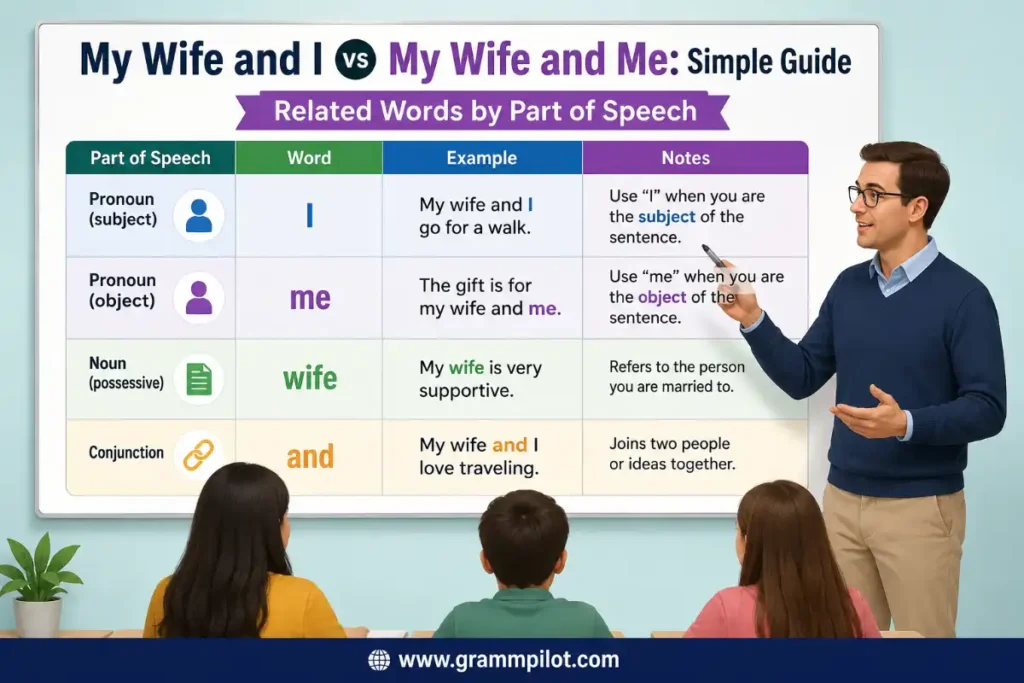
Related Words by Part of Speech”My Wife and I vs My Wife and Me”
Understanding the part of speech helps explain why I and me cannot replace each other.
| Part of Speech | Examples |
|---|---|
| Pronoun | I, me, we, us |
| Noun | Wife, husband, friend, teacher |
| Verb | Invite, thank, call, visit |
| Preposition | To, with, for, between |
| Conjunction | And, or, but |
Examples:
Pronoun
I called my friend.
She invited me.
Noun
My wife enjoys gardening.
Verb
The manager thanked everyone.
Preposition
The gift was for my wife and me.
Do American and British English Use Different Rules For Difference My Wife and I vs My Wife and Me?
No. American English and British English follow exactly the same grammar rule.
Both use:
- My wife and I are leaving.
- They invited my wife and me.
There is no regional difference in standard grammar. The only difference is that casual speech sometimes ignores the rule.
For example: “Me and my wife went shopping.”
You may hear this in everyday conversation in both the United States and the United Kingdom, but it is not considered standard English in formal writing.
My Wife and I vs My Wife and Me: Which Phrase Fits Best in Different Situations?
The correct choice depends on the grammar of the sentence, not the situation. Still, some contexts deserve extra attention.
Best Choice for a Resume
Resumes should always use correct grammar.
Example: “My wife and I managed a successful family business.”
Another example: “The company recognized my wife and me for volunteer work.”
Correct grammar makes your resume look more professional.
Best Choice for an Essay
Essays require standard written English.
Examples: “My wife and I visited several historical sites during our research.”
“The professor interviewed my wife and me after the presentation.”
Following the subject-object rule keeps academic writing accurate.
Best Choice for Text Messages
Text messages are usually informal.
People sometimes write: “Me and my wife are coming.”
Although common in casual conversation, the standard form is: “My wife and I are coming.”
Friends may not notice the difference, but using the correct form is still a good habit.
Best Choice for Emails
Business emails should always follow standard grammar.
Examples: “The organizer welcomed my wife and me warmly.”
Correct grammar helps create a professional impression.
Best Choice for Speaking
Many native speakers accidentally say: “Me and my wife…”
because it feels natural in conversation.
However, in interviews, presentations, speeches, or formal conversations, it’s better to say: “My wife and I…”
when you’re the subject.
If someone else is acting on you, use: “My wife and me.”
My Wife and I or My Wife and Me:Which Form Should You Choose?
Use this quick reference whenever you’re unsure.
| Situation | Correct Form |
|---|---|
| Subject of the sentence | My wife and I |
| Object of a verb | My wife and me |
| After a preposition | My wife and me |
| Formal writing | Follow the subject/object rule |
| School assignments | Use standard grammar |
| Business emails | Use standard grammar |
| Casual texting | Standard grammar is still recommended |
| Public speaking | Always choose the grammatically correct form |
Remember one simple trick: remove “my wife and” from the sentence. If I sounds correct, use my wife and I. If me sounds correct, use my wife and me.
Real-Life Example Sentences”My Wife and I vs My Wife and Me”
The best way to master this grammar rule is to see it used in real situations. These examples show when to use my wife and I and when to use my wife and me.
Examples Using “My Wife and I”
- My wife and I enjoy traveling every summer.
- My wife and I volunteered at the local food bank.
- My wife and I are planning to buy our first home.
- My wife and I watched the sunset together.
- My wife and I attended our friend’s wedding.
- My wife and I cooked dinner for the family.
- My wife and I started learning Spanish.
- My wife and I adopted a rescue dog.
- My wife and I exercise every morning.
- My wife and I celebrated our anniversary last weekend.
Examples Using “My Wife and Me”
- The manager congratulated my wify and me.
- Our neighbors invited my wife and me for dinner.
- She sent my wife and me a thank-you card.
- The teacher spoke with my wife and me after class.
- They offered my wife and me free tickets.
- The photographer took pictures of my wife and me.
- Our friends surprised my wife and me with a gift.
- The guide showed my wife and me around the museum.
- The company recognized my wife and me for our volunteer work.
- The doctor explained everything to my wife and me.
Different Differences: “My Wife and I” vs “My Wife and Me
This is the comparison most people search for.
| My Wife and I | My Wife and Me |
|---|---|
| Subject of the sentence | Object of the sentence |
| Performs the action | Receives the action |
| Uses the pronoun I | Uses the pronoun me |
| Comes before the main verb in most cases | Often comes after a verb or preposition |
Examples:
✅ My wife and I visited New York.
✅ The hotel welcomed my wife and me.
A simple question helps: Who is doing the action?
If it’s you and your wife, choose my wife and I. If someone else is acting on you, choose my wife and me.
“John and I” vs. “John and Me”
The same rule applies to every pair of people.
| John and I | John and Me |
|---|---|
| John and I finished the report. | The manager praised John and me. |
| John and I went fishing. | She invited John and me. |
| John and I play tennis every week. | The coach spoke to John and me. |
If you understand this comparison, you’ll also understand my wife and I versus my wife and me.
“My Husband and I” vs. “My Husband and Me”
The rule doesn’t change based on the relationship.
| My Husband and I | My Husband and Me |
|---|---|
| My husband and I love hiking. | They thanked my husband and me. |
| My husband and I bought a new car. | She spoke with my husband and me. |
| My husband and I enjoy cooking together. | The waiter served my husband and me. |
If it’s wife, husband, friend, brother, or sister, the grammar stays exactly the same.
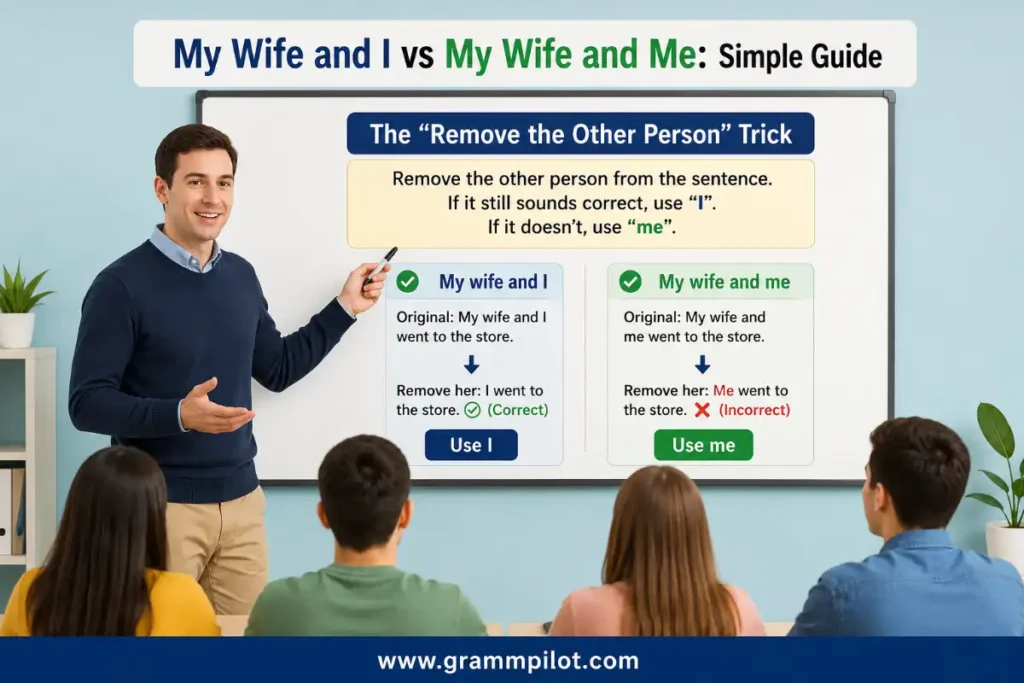
The “Remove the Other Person” Trick
This is the easiest way to check your sentence.
Sentence: “My wife and I are going shopping.”
Remove my wife and.
Correct: “I am going shopping.”
Now try this one.
“They invited my wife and me.”
Remove my wife and.
Correct: “They invited me.”
Now look at the incorrect version.
“They invited my wife and I.”
Remove my wife and.
“They invited I.”
That sounds wrong immediately. This trick works almost every time.
Common Mistakes People Make
Many English learners—and even native speakers—make these mistakes.
Mistake 1: Using “I” Everywhere
Incorrect: ❌ They called my wife and I.
Correct: ✅ They called my wife and me.
Remember, called needs an object.
Mistake 2: Using “Me” as the Subject
Incorrect: ❌ My wife and me went shopping.
Correct: ✅ My wife and I went shopping.
The subject performs the action.
Mistake 3: Thinking “I” Sounds More Polite
Some people always choose I because they think it sounds more formal.
Example: ❌ Please sit beside my wife and I.
Correct: ✅ Please sit beside my wife and me.
Grammar matters more than sounding formal.
Mistake 4: Forgetting About Prepositions
Words such as:
- to
- for
- with
- between
- beside
- near
- among
usually require me, not I.
Examples
Correct:
“The gift is for my wife and me.”
“The seats are beside my wife and me.”
My Wife and I vs My Wife and Me: When Should You NOT Use These Phrases?
Sometimes neither phrase is the best choice.
For example, if you’re speaking only about yourself, simply say: “I finished the report.”
Not: “My wife and I finished the report.”
if your wife wasn’t involved. Likewise, don’t add another person just to sound polite. Use only the people who actually belong in the sentence.
Common Grammar Pattern
Here’s a quick reference.
| Sentence Pattern | Correct Choice |
|---|---|
| ___ went home. | My wife and I |
| She called ___. | My wife and me |
| ___ enjoy traveling. | My wife and I |
| The teacher thanked ___. | My wife and me |
| ___ are excited. | My wife and I |
| He sat beside ___. | My wife and me |
This simple pattern covers most everyday situations.
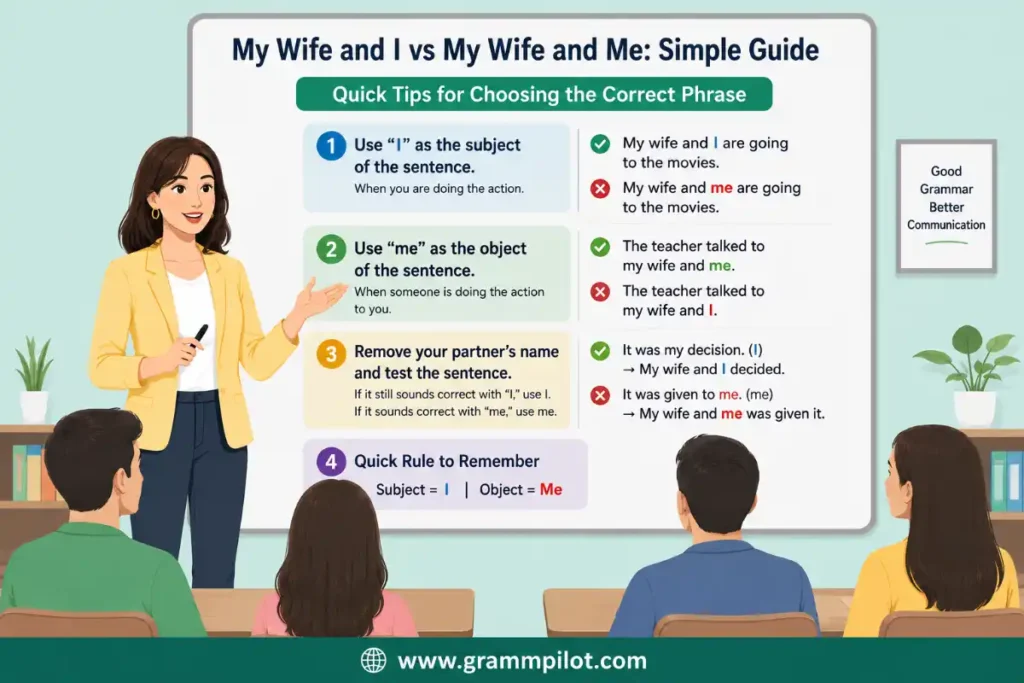
Quick Tips for Choosing the Correct Phrase
- Ask who is doing the action.
- Use I when the phrase is the subject.
- Use me when the phrase receives the action.
- Remove “my wife and” to test the sentence.
- After prepositions like to, for, with, and between, use me.
- Don’t choose I just because it sounds more formal.
- Read the sentence aloud. Incorrect grammar often sounds awkward.
- Practice with short sentences before trying longer ones.
- Remember that the same rule works with my husband, my friend, my brother, and any other person.
- When in doubt, use the removal trick—it solves almost every grammar question.
Mastering this one grammar rule will help you write more confidently in emails, essays, business documents, social media posts, and everyday conversations. Once you recognize the difference between a subject and an object, choosing the correct phrase becomes quick and natural.
Conclusion
Choosing between {My Wife and I or My Wife and Me} becomes easy once you understand one simple grammar rule. Use my wife and I when the phrase is the subject doing the action, and use my wife and me when it is the object receiving the action.
The more you practice, the more natural this rule will become.If you’re writing an email, an essay, a social media post, or speaking in everyday conversations, using the correct phrase will make your English sound clearer, more accurate, and more professional.
Frequently Asked Questions
1. Is it correct to say “my wife and I” or “my wife and me”?
It depends on the sentence. Use my wife and I when the phrase is the subject, and use my wife and me when it is the object. This is the easiest way to remember My Wife and I or My Wife and Me.
2. How do I know about to use “I” or “me”?
Remove “my wife and” from the sentence. If I sounds correct, choose my wife and I. If me sounds correct, choose my wife and me.
3. Why do so many people say “my wife and I” incorrectly?
Many people think I always sounds more polite or formal. However, grammar depends on if the phrase is the subject or the object, not on which word sounds more formal.
4. Can I say “me and my wife”?
In casual conversation, many native speakers say “me and my wife.” However, it is considered nonstandard in formal English. In writing and professional situations, use my wife and I or my wife and me, depending on the grammar.
5. What’s another easy trick to remember the rule?
The easiest trick is the removal test. Remove “my wife and” from the sentence and see if I or me sounds natural. This simple test works in almost every situation.
6. Do American and British English follow the same rule?
Yes. American English and British English follow exactly the same grammar rule. There is no difference in standard usage between the two.
7. Can I use this rule with other people besides my wife?
Absolutely. The same rule works with my husband, my friend, my brother, my sister, John, Sarah, or anyone else. Simply decide if the phrase is the subject or the object of the sentence.