
Have you ever been writing an essay, story, email, or even a text message and felt that the word problem sounded too plain? That’s where Similes for Problems can help. A good simile paints a clearer picture and helps readers understand how difficult, confusing, or frustrating a situation really is. Instead of simply saying someone has a problem, you can compare that problem to something people already understand. This makes your writing more colorful, memorable, and engaging.
Answer Box:
Similes for problems compare a challenge, difficulty, or obstacle to something familiar by using the words “like” or “as.” They help readers clearly imagine how easy, hard, or frustrating a problem is.
In this guide, you’ll learn what similes for problems are, where the word problem comes from, the different kinds of problems they describe, and dozens of useful comparisons that can improve your writing and speaking
This rule connects closely with the grammar explained in [My Wife and I or My Wife and Me].
What Are Similes for Problems?
A simile is a figure of speech that compares two different things using the words like or as. When talking about problems, a simile compares a challenge to something people already recognize. The comparison helps readers picture the situation instead of simply reading the word problem.
For example:
- As difficult as climbing a mountain.
- Like finding a needle in a haystack.
- As confusing as a maze.
- Like carrying a heavy backpack.
Each simile creates a stronger mental image than simply saying, “It was a hard problem.” That’s why similes are common in books, speeches, blogs, and everyday conversations.
What Does “Problem” Mean?
A problem is something that needs to be solved.
It can be:
- a difficult situation
- a challenge
- an obstacle
- a mistake
- a question with no easy answer
- something that causes worry
Problems appear in every part of life.
For example:
- school problems
- work problems
- family problems
- money problems
- health problems
- computer problems
- relationship problems
Not every problem is huge. Some are small and disappear quickly. require patience, teamwork, and creative thinking.
Word Origin of “Problem”
Many articles skip the history of a word, but understanding its origin helps you remember its meaning.
The word problem comes from the ancient Greek word problema, which meant something put forward or a task to solve.
Later, it entered Latin and eventually became part of English.
Although its meaning has expanded over time, the main idea has stayed the same.
A problem is something that stands in your way until you solve it.
That’s why teachers give students math problems.
Engineers solve technical problems.
Doctors solve medical problems.
Families solve everyday problems together.
Why Use Similes Instead of Just Saying “Problem”?
Imagine reading these two sentences.
“The project was difficult.”
Now compare it with this.
“The project was like climbing a mountain.”
The second sentence helps readers picture the challenge. They immediately imagine something difficult that requires time and effort. That’s the power of similes.
They:
- create stronger mental images
- make stories more interesting
- improve descriptive writing
- add emotion
- help readers remember your message
- reduce repetition
Instead of using the word problem over and over, you can describe the challenge in a more creative way.
Similes for Problems: What Makes a Good Simile for Problems?
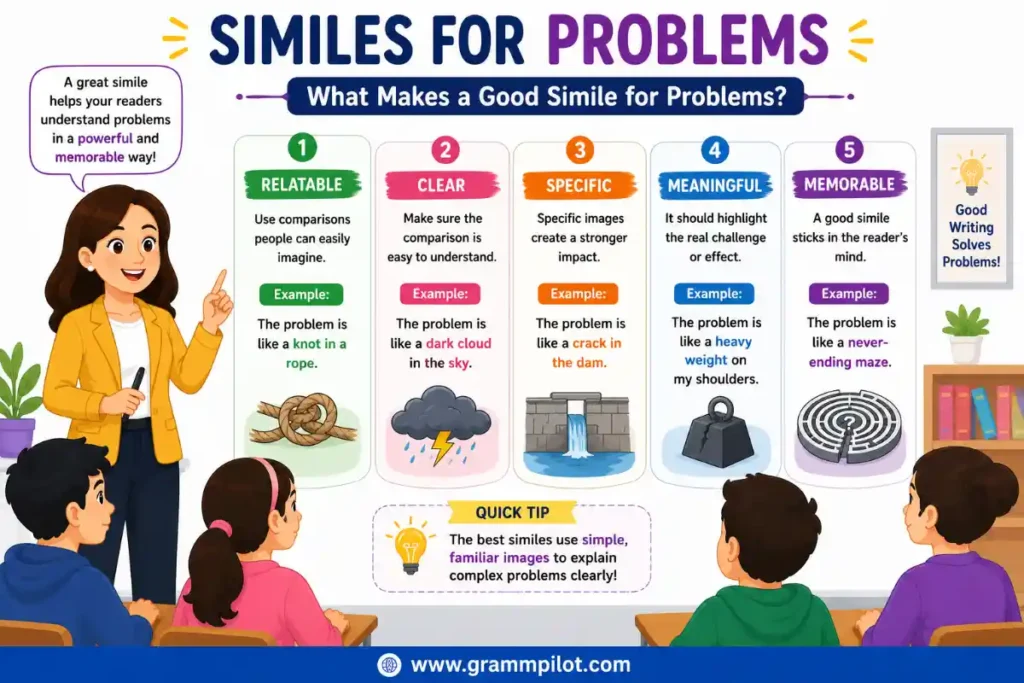
A good simile compares a problem with something people already know is difficult, confusing, slow, or frustrating. The comparison should feel natural.
Good examples include: ✅ Like finding a needle in a haystack.
Most people understand how difficult that would be: ✅ As confusing as a maze.
A maze represents uncertainty and getting lost: ✅ Like carrying a heavy backpack.
Readers immediately imagine a burden. Poor similes compare problems with things that don’t naturally represent difficulty.
For example: ❌ Like eating ice cream.
Unless you’re writing humor, this comparison doesn’t communicate a challenge. The best similes create a clear picture with only a few words.
Similes for Problems: Most Popular Similes for Problems
These are some of the best-known similes used in English.
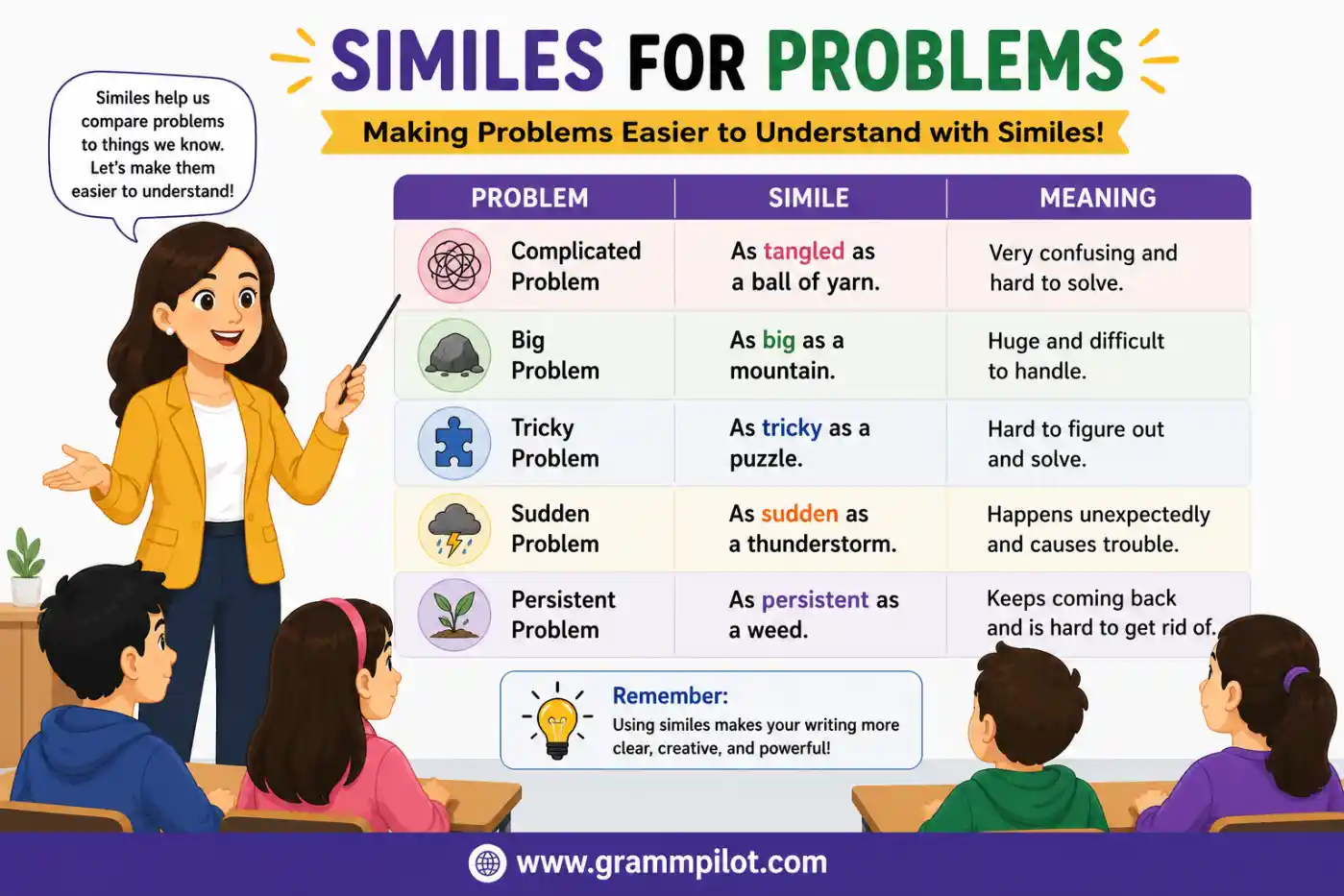
| Simile | Meaning | Common Use |
|---|---|---|
| Like finding a needle in a haystack | Extremely difficult | Everyday speech |
| As difficult as climbing a mountain | Very challenging | Writing and speaking |
| Like walking through a storm | Facing hardship | Stories |
| As confusing as a maze | Hard to understand | Conversation |
| Like carrying a heavy backpack | Feeling burdened | Everyday English |
| As tangled as a ball of yarn | Complicated | Informal writing |
| Like hitting a brick wall | Making no progress | Conversation |
| As stubborn as a locked door | Hard to solve | Stories |
| Like untangling headphones | Frustrating | Casual speech |
| As endless as the ocean | Seems impossible to finish | Creative writing |
These comparisons work because readers can easily imagine the situation.
Similes for Difficult Problems
Some problems require patience and determination. These similes describe major challenges.
As Difficult as Climbing a Mountain
One of the most common comparisons.
Example: “Starting a new business felt as difficult as climbing a mountain.”
Like Finding a Needle in a Haystack
Used for something extremely hard to find or solve.
Example: “Finding the missing document was like finding a needle in a haystack.”
Like Solving a Giant Puzzle
Shows that many small pieces must fit together.
Example: “Planning the event was like solving a giant puzzle.”
As Hard as Breaking Stone
Suggests a task that takes great effort.
Example: “Learning the new software felt as hard as breaking stone.”
Similes for Confusing Problems
Some challenges are confusing instead of difficult. These comparisons describe uncertainty.
As Confusing as a Maze
A maze has many wrong turns.
Example: “The tax forms were as confusing as a maze.”
Like Reading a Book Without Page Numbers
Everything feels out of order.
Example: “The instructions were like reading a book without page numbers.”
As Mixed Up as a Bowl of Spaghetti
Everything is tangled together.
Example: “The project files looked as mixed up as a bowl of spaghetti.”
Like Following Invisible Footprints
You don’t know where to go.
Example: “Trying to understand the rules was like following invisible footprints.”
Similes for Stressful Problems
Some situations create worry and pressure. These similes help describe those feelings.
Like Carrying a Heavy Backpack
A burden that weighs you down.
Example: “His financial worries felt like carrying a heavy backpack every day.”
Like Walking Through a Storm
Suggests ongoing hardship.
Example: “The family felt like they were walking through a storm.”
As Heavy as an Anchor
Shows emotional weight.
Example: “Guilt sat on her heart as heavy as an anchor.”
Like Standing on Thin Ice
Suggests uncertainty and danger.
Example: “Negotiating the contract felt like standing on thin ice.”
Similes for Problems That Never Seem to End
Some challenges seem endless.
These comparisons express that feeling.
- As endless as the ocean.
- Like running on a treadmill.
- Like chasing the horizon.
- As long as a winding road.
- Like climbing endless stairs.
Example: “Fixing the old house felt like climbing endless stairs.”
Master Synonym List for “Problem”
Using the word problem repeatedly can make your writing sound repetitive. Choosing the right synonym keeps your sentences interesting while matching the exact situation.
Not every synonym means the same thing. Some describe a small inconvenience, while others describe a serious difficulty or crisis.
Simple Words
| Word | Meaning | Tone | Example |
|---|---|---|---|
| Problem | Something that needs to be solved | Simple | We solved the problem together. |
| Issue | A matter that needs attention | Simple | There is an issue with the printer. |
| Trouble | Difficulty or worry | Simple | He got into trouble at school. |
| Difficulty | Something hard to do | Simple | She had difficulty understanding the lesson. |
| Challenge | A task that tests your ability | Simple | Learning a language is a challenge. |
| Obstacle | Something that blocks progress | Simple | The fallen tree became an obstacle. |
| Hurdle | A small barrier | Simple | Money was the biggest hurdle. |
| Setback | A delay or disappointment | Simple | The injury was a temporary setback. |
Everyday Words
| Word | Meaning | Tone | Example |
|---|---|---|---|
| Complication | Something that makes a situation harder | Everyday | A traffic accident caused another complication. |
| Mess | A confusing situation | Everyday | The room became a mess. |
| Headache | Something annoying | Everyday | Fixing the computer became a headache. |
| Bump in the road | A small difficulty | Everyday | Every project has a few bumps in the road. |
| Snag | A small unexpected problem | Everyday | We hit a snag during construction. |
| Roadblock | Something stopping progress | Everyday | Lack of funding became a roadblock. |
| Predicament | A difficult situation | Everyday | She found herself in a difficult predicament. |
| Dilemma | A difficult choice | Everyday | Choosing between the two jobs was a dilemma. |
Formal Words
| Word | Meaning | Tone | Example |
|---|---|---|---|
| Concern | Something causing worry | Formal | Safety remains a major concern. |
| Challenge | A demanding task | Formal | Climate change is a global challenge. |
| Complication | An additional difficulty | Formal | Medical complications delayed recovery. |
| Constraint | A limiting factor | Formal | Budget constraints affected the project. |
| Barrier | Something preventing progress | Formal | Language was a communication barrier. |
| Crisis | A very serious problem | Formal | The company faced a financial crisis. |
| Adversity | Severe hardship | Formal | She overcame great adversity. |
| Impediment | Something that slows progress | Formal | Poor planning became an impediment. |
Informal and Slang Words
| Word | Meaning | Tone | Example |
|---|---|---|---|
| Pain | Something annoying | Informal | This homework is a pain. |
| Hassle | A minor inconvenience | Informal | Parking downtown is a hassle. |
| Nightmare | A very difficult experience | Informal | Moving house was a nightmare. |
| Pickle | An awkward situation | Informal | I’m in a real pickle now. |
| Sticky situation | A difficult position | Informal | They found themselves in a sticky situation. |
| Jam | A difficult situation | Informal | Thanks for helping me out of that jam. |
| Tough spot | Difficult circumstances | Informal | He’s in a tough spot right now. |
| Can of worms | A situation with many hidden problems | Informal | Opening that file started a can of worms. |
These words help you express different levels of difficulty without repeating problem.
Synonyms by Intensity
Some situations are only mildly difficult, while others are serious emergencies.
| Intensity | Synonyms |
|---|---|
| Very Mild | Bump, snag, inconvenience, hiccup |
| Mild | Issue, trouble, hurdle, setback |
| Moderate | Problem, challenge, obstacle, dilemma |
| Strong | Complication, roadblock, barrier, predicament |
| Very Strong | Crisis, adversity, disaster, catastrophe |
Examples:
“We had a small hiccup during the presentation.”
“The budget cuts became a major obstacle.”
“The earthquake created a humanitarian crisis.”
Choosing the correct intensity makes your writing more accurate.
Synonyms by Part of Speech “Similes for Problems”
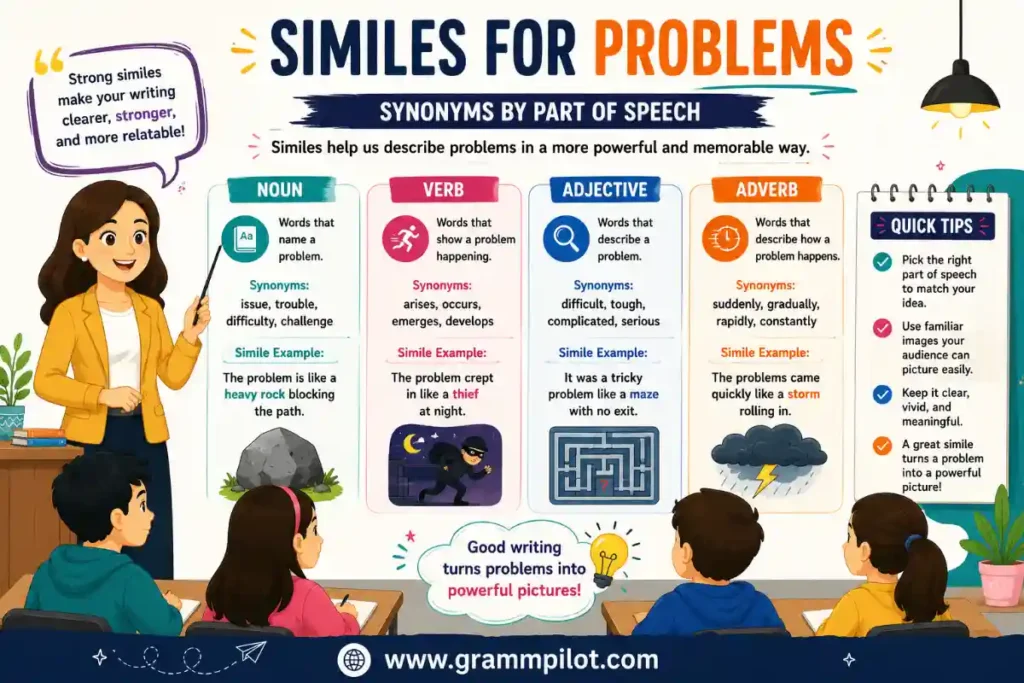
The idea of a problem appears in different forms.
| Part of Speech | Examples |
|---|---|
| Noun | problem, issue, challenge, obstacle, crisis |
| Verb | struggle, hinder, block, complicate, prevent |
| Adjective | difficult, troublesome, problematic, challenging, complicated |
| Adverb | problematically, unsuccessfully, poorly |
Examples:
Noun
The problem was solved quickly.
Verb
Heavy rain complicated the journey.
Adjective
It was a challenging decision.
Adverb
The project progressed poorly because of delays.
Using different parts of speech makes your writing smoother.
Are There Differences Between American and British English?
Most words related to problem have the same meanings in both American and British English.
Words such as:
- problem
- issue
- obstacle
- challenge
- difficulty
- dilemma
are used naturally in both varieties of English. Some informal expressions, however, are more common in one region than another.
In American English, people often say:
- hassle
- headache
- roadblock
In British English, you may hear:
- sticky situation
- pickle
- bit of bother
Even so, English speakers from both countries will usually understand all of these expressions.
Similes for Problems: Which Word Fits Best in Different Situations?
Choosing the right word depends on where you’re writing.
Best Word for a Resume
Professional resumes should avoid negative language when possible.
Instead of writing: “I solved many problems.”
Try: “I resolved complex challenges.”
Other good choices include:
- challenge
- obstacle
- issue
- improvement opportunity
Example: “Resolved customer service challenges while maintaining high satisfaction ratings.”
Best Word for an Essay
Academic writing usually prefers formal vocabulary.
Good choices include:
- challenge
- issue
- concern
- complication
- barrier
Example: “Climate change presents a significant global challenge.”
Or: “Pollution remains an important environmental concern.”
Best Word for Text Messages
Casual conversations use simpler words.
Examples:
- problem
- hassle
- headache
- mess
- pain
Example messages:
“My internet is giving me problems again.”
“Homework is such a headache tonight.”
“We’ve got a small problem.”
These expressions sound natural among friends.
Best Word for Emails
Professional emails should be polite and solution-focused.
Examples:
“We’ve identified an issue with your order.”
“There was a minor complication during processing.”
“We apologize for the inconvenience.”
These words sound more professional than simply saying problem.
Best Word for Speaking
In everyday conversations, native speakers usually choose simple words.
Examples:
“I have a problem.”
“We hit a snag.”
“That’s a tough situation.”
“Money has become a challenge lately.”
Simple vocabulary often sounds the most natural.
Similes for Problems: Which Word Should You Choose?
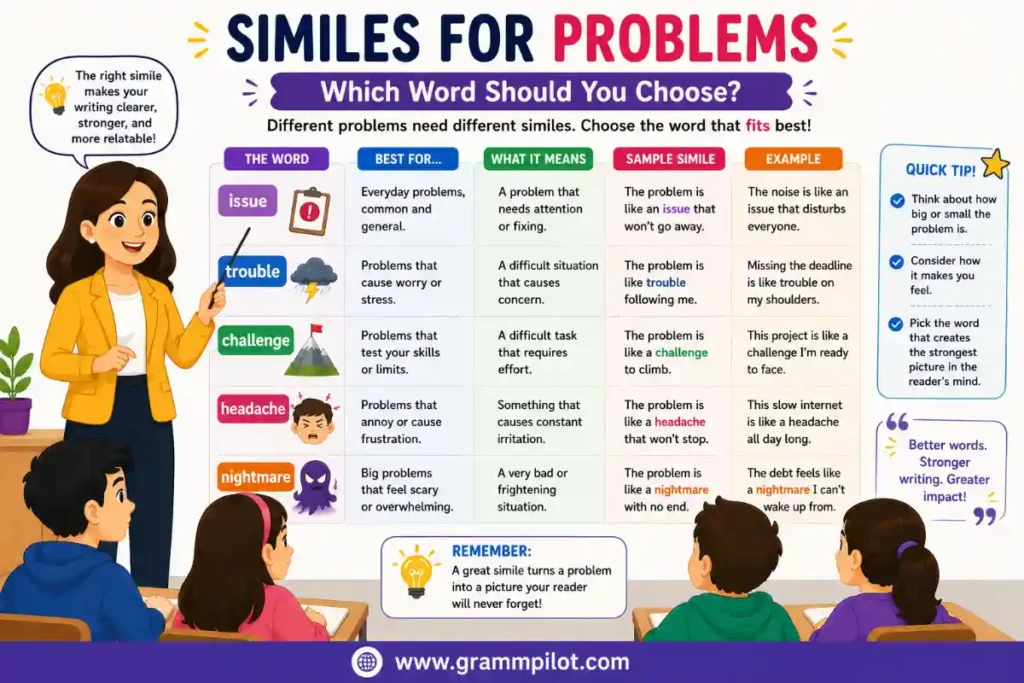
Use this quick guide when deciding.
| Situation | Best Word |
|---|---|
| School assignment | Challenge |
| Work email | Issue |
| Business report | Concern |
| Scientific paper | Complication |
| Casual conversation | Problem |
| Family discussion | Difficulty |
| Financial discussion | Obstacle |
| Personal story | Struggle |
| News article | Crisis |
| Friendly text | Hassle |
Choosing the right word helps your writing sound more precise and professional. Think about your audience, your purpose, and how serious the situation is before selecting the best synonym.
Similes Inspired by Nature
Nature provides powerful comparisons for difficult situations.
- Like a storm that won’t end.
- As rough as the open sea.
- Like a volcano ready to erupt.
- As tangled as jungle vines.
- Like crossing a frozen river.
- As steep as a cliff.
- Like surviving a hurricane.
- As dry as a desert.
- Like climbing an icy mountain.
- As unpredictable as the weather.
Example:
“The negotiations were as unpredictable as the weather.”
Similes Inspired by Everyday Life
Many everyday objects can create memorable comparisons.
- Like a traffic jam during rush hour.
- Like a phone with no signal.
- Like a lock without a key.
- Like a flat tire on a long trip.
- Like a broken compass.
- Like missing the last train.
- Like searching for lost keys.
- Like assembling furniture without instructions.
- Like a computer that keeps freezing.
- Like trying to untie tiny knots.
These comparisons are easy for most readers to understand because they come from daily life.
Similes for Problems: Real-Life Example Sentences
Here are examples of {Similes for Problems} in real situations.
- The homework was as confusing as a maze.
- Finding the mistake was like finding a needle in a haystack.
- Managing two jobs felt like climbing a mountain.
- Paying every bill was like carrying a heavy backpack.
- Learning the new language felt like crossing a desert.
- The broken computer became a headache like a traffic jam during rush hour.
- Solving the mystery was as puzzling as a riddle.
- The paperwork looked as tangled as a ball of yarn.
- The project felt like moving a mountain.
- Her schedule was as busy as a highway at noon.
- Recovering after surgery felt like climbing endless stairs.
- Running the company was like balancing on a tightrope.
- The instructions were as cloudy as a foggy morning.
- The repair work felt as slow as pushing a boulder uphill.
- Their financial struggles were like walking through a never-ending storm.
Like Finding a Needle in a Haystack vs. Like Looking for a Needle in the Dark
These similes are similar but not identical.
| Finding a Needle in a Haystack | Looking for a Needle in the Dark |
|---|---|
| Focuses on something almost impossible to find | Focuses on searching without enough information |
| A well-known English idiom | Less common and more creative |
| Used in everyday speech | Better suited to creative writing |
Example:
“Finding the correct document was like finding a needle in a haystack.”
“The detective worked like someone looking for a needle in the dark.”
Like Carrying a Heavy Backpack vs. Like Carrying the World on Your Shoulders
Both describe emotional burdens.
| Carrying a Heavy Backpack | Carrying the World on Your Shoulders |
|---|---|
| Suggests manageable pressure | Suggests overwhelming responsibility |
| Often describes daily stress | Often describes extreme emotional pressure |
| Mild to moderate | Very strong |
Example:
“Homework felt like carrying a heavy backpack.”
“After becoming the family provider, he felt like he was carrying the world on his shoulders.”
Common Mistakes People Make “Similes for Problems”
Many writers make these mistakes when using similes.
Using Too Many Similes
One or two similes strengthen your writing. Using one in every sentence can make your work sound repetitive.
Choosing Unclear Comparisons
A simile should compare a problem to something readers already recognize.
Poor example: ❌ Like eating popcorn.
Better example: p✅ Like climbing a mountain.
Mixing Different Images
Avoid combining unrelated comparisons.
Incorrect: “The project was like a storm climbing a mountain.”
Choose one clear comparison instead.
Using Similes in Formal Reports
Creative comparisons are great for stories and speeches. Business reports, research papers, and legal documents usually need straightforward language.
Instead of: “The budget problem was like a hurricane.”
Write: “The budget problem was severe.”
Antonyms of Problem
Sometimes you need words that express the opposite idea.
| Word | Meaning |
|---|---|
| Solution | An answer to a problem |
| Answer | A correct response |
| Success | A positive result |
| Advantage | A helpful benefit |
| Benefit | Something useful |
| Opportunity | A favorable situation |
| Improvement | A positive change |
| Breakthrough | An important discovery |
| Progress | Forward movement |
| Resolution | The act of solving a problem |
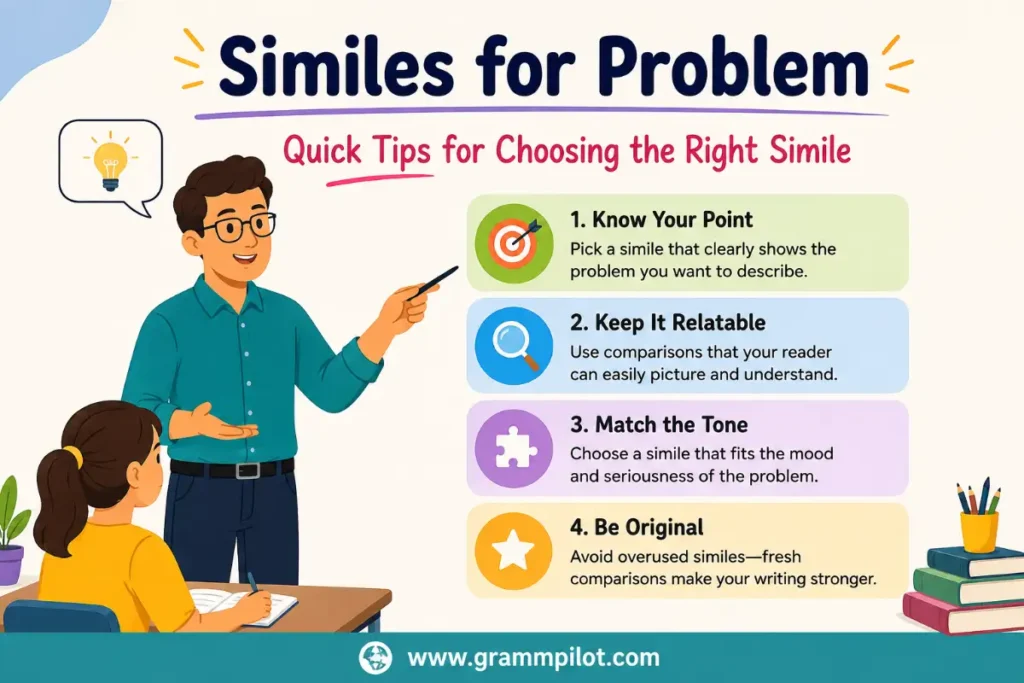
Quick Tips for Choosing the Right Simile
- Match the simile to the type of problem.
- Use nature similes for large challenges.
- Use everyday comparisons for common situations.
- Keep your comparisons easy to understand.
- Don’t mix several similes in one sentence.
- Choose familiar images whenever possible.
- Avoid overusing the same comparison.
- Think about your audience before choosing a creative simile.
- Read your sentence aloud to check if it sounds natural.
- Pick the comparison that best matches the emotion you want to express.
A good simile doesn’t just describe a problem—it helps readers experience it through a clear and memorable image.
Conclusion
Learning {Similes for Problems} is a simple way to make your writing more descriptive and engaging. Instead of repeating the word problem, you can compare a challenge to something familiar, such as climbing a mountain, finding a needle in a haystack, or walking through a storm. These comparisons help readers picture the situation and understand how difficult, confusing, or stressful it really is.
The best similes are easy to understand and fit the context. Use them in stories, essays, speeches, emails, or everyday conversations to make your ideas more memorable. As you continue reading and writing, you’ll naturally discover even more creative comparisons that make your English stronger and more expressive.
Frequently Asked Questions
1. What are similes for problems?
Similes for problems compare a challenge or difficulty to something familiar by using like or as. They make writing more vivid by helping readers picture the situation more clearly.
2. What is the most common simile for a difficult problem?
One of the most common similes is “like finding a needle in a haystack.” It describes a task that is extremely difficult or almost impossible to complete.
3. What’s another way to describe a problem in writing?
You can use words like challenge, obstacle, difficulty, issue, complication, or hurdle. You can also use similes such as as confusing as a maze or like carrying a heavy backpack for more descriptive writing.
4. Can I use similes in school essays?
Yes. Similes make essays, stories, and creative writing more interesting by creating clear mental images. However, avoid using too many in formal academic or technical writing.
5. What’s the difference between a simile and a metaphor?
A simile compares two things using like or as, while a metaphor says one thing is another.
Simile: The project was like climbing a mountain.
Metaphor: The project was a mountain.
6. Are similes only used for serious problems?
No. Similes can describe both small everyday troubles and major life challenges. The comparison should match the seriousness of the situation.
7. How do I choose the best simile for a problem?
Think about the type of challenge you’re describing. Use finding a needle in a haystack for something almost impossible, walking through a storm for emotional hardship, or as confusing as a maze for situations that are difficult to understand.