
Have you ever been writing an essay, a story, a social media post, or even a text message and wanted a better way to describe someone as powerful? That’s where Similes for Strong can help. A good simile makes your writing more interesting and helps readers picture exactly what you mean. Instead of saying someone is simply “strong,” you can compare them to something famous for its power. This creates a vivid image that is easier to remember and more enjoyable to read.
Answer Box:
Similes for strong compare a person, animal, or object to something known for great strength by using the words “like” or “as.” For example, “as strong as an ox” is one of the most common English similes.
In this guide, you’ll learn what strong similes are, where they came from, what they mean, when to use them, and dozens of examples that can improve your writing and speaking.
For another collection of creative expressions, explore [Similes for Problems].
What Are Similes for Strong?
A simile is a figure of speech that compares two different things using the words like or as. When talking about strength, a simile compares someone or something to another person, animal, object, or force that is widely known for being powerful.
For example:
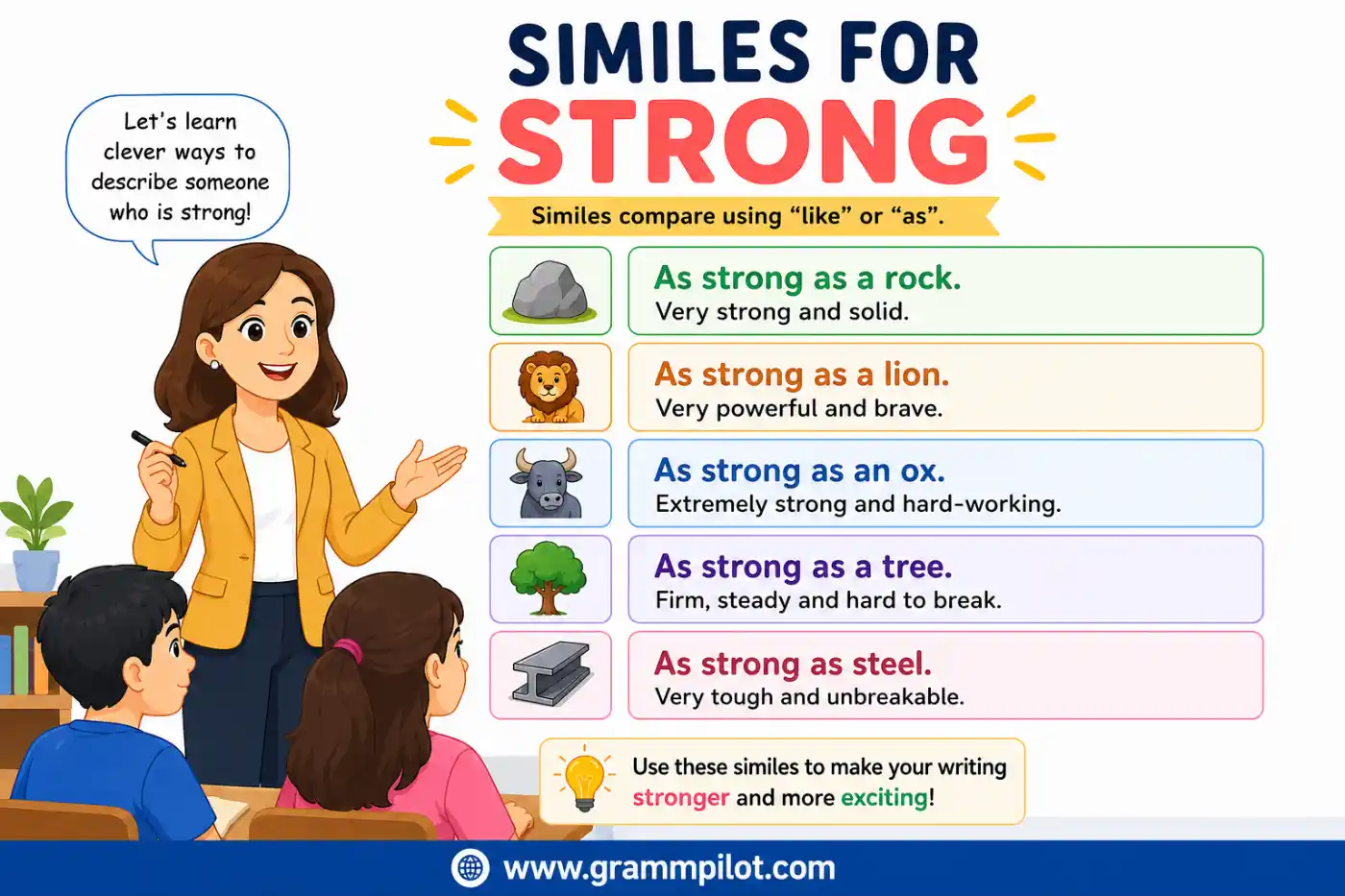
- As strong as an ox.
- Strong like steel.
- As strong as a bear.
These comparisons help readers imagine strength instead of simply reading the word “strong.” That’s why similes are common in books, speeches, advertisements, movies, and everyday conversations.
What Does “Strong” Mean?
The word strong has several meanings. Most people think of physical strength first, but English uses the word in many different ways.
Someone can be:
- physically strong
- mentally strong
- emotionally strong
- financially strong
- morally strong
- spiritually strong
Likewise, an object can be strong because it is difficult to break. An argument can be strong because it has good evidence. A relationship can be strong because it lasts a long time. Understanding the type of strength helps you choose the best simile.
Word Origin of “Strong”
Most articles jump straight to examples. Knowing where the word comes from makes it easier to understand. The English word strong comes from Old English strang, which meant powerful, firm, mighty, or able to resist force. Its roots go back even further to ancient Germanic languages, where similar words described power, endurance, and toughness. Over time, English speakers began using strong in many different ways.
Today it can describe:
- muscles
- buildings
- emotions
- friendships
- opinions
- coffee
- winds
- smells
- personalities
Although the meaning has expanded, the basic idea remains the same. Something strong has power, durability, or the ability to resist pressure.
Why Do We Use Similes Instead of Just Saying “Strong”?
Imagine reading these two sentences.
“The firefighter was strong.”
Now read this. “The firefighter was as strong as an ox.”
The second sentence creates a much clearer picture. Readers immediately imagine someone with great physical power. That’s why writers use similes. They turn ordinary descriptions into memorable images.
Good similes also:
- make stories more interesting
- help readers visualize characters
- create stronger emotions
- improve creative writing
- make speeches more engaging
- keep essays from sounding repetitive
Similes for Strong: What Makes a Good Simile for Strength?
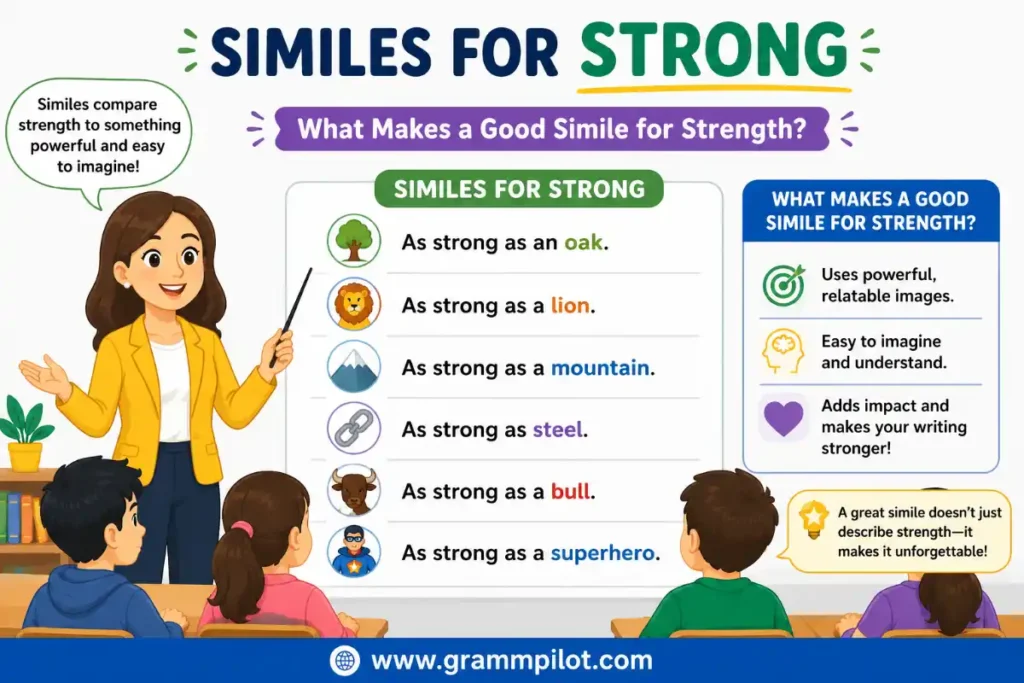
A strong simile should compare your subject to something that people already connect with power. Good comparisons are familiar, clear, and easy to picture.
For example: ✅ As strong as an ox.
Almost everyone knows oxen are powerful working animals.
✅ Strong like steel.
Steel is famous for its durability.
✅ As strong as a lion.
Lions represent courage and physical power. Poor similes usually compare strength with something that isn’t naturally associated with power.
For example: ❌ As strong as a pillow.
Readers don’t normally connect pillows with strength, so the comparison feels confusing unless it’s used for humor.
Similes for Strong: Most Popular Similes for Strong
These are some of the best-known similes in English.
| Simile | Meaning | Common Use |
|---|---|---|
| As strong as an ox | Extremely powerful | Everyday speech |
| As strong as a bull | Very muscular | Conversation |
| Strong like steel | Tough and durable | Writing and speaking |
| As strong as a bear | Powerful and fearless | Stories |
| As strong as a horse | Great physical power | Everyday English |
| As strong as a giant | Extraordinary strength | Fiction |
| Strong like a machine | Never seems to tire | Informal speech |
| As strong as iron | Very tough | Literature |
| As solid as a rock | Reliable and firm | Everyday conversation |
| As tough as nails | Very resilient | Casual English |
These similes work well because most people already understand the comparison.
Similes for Strong: Similes for Physical Strength
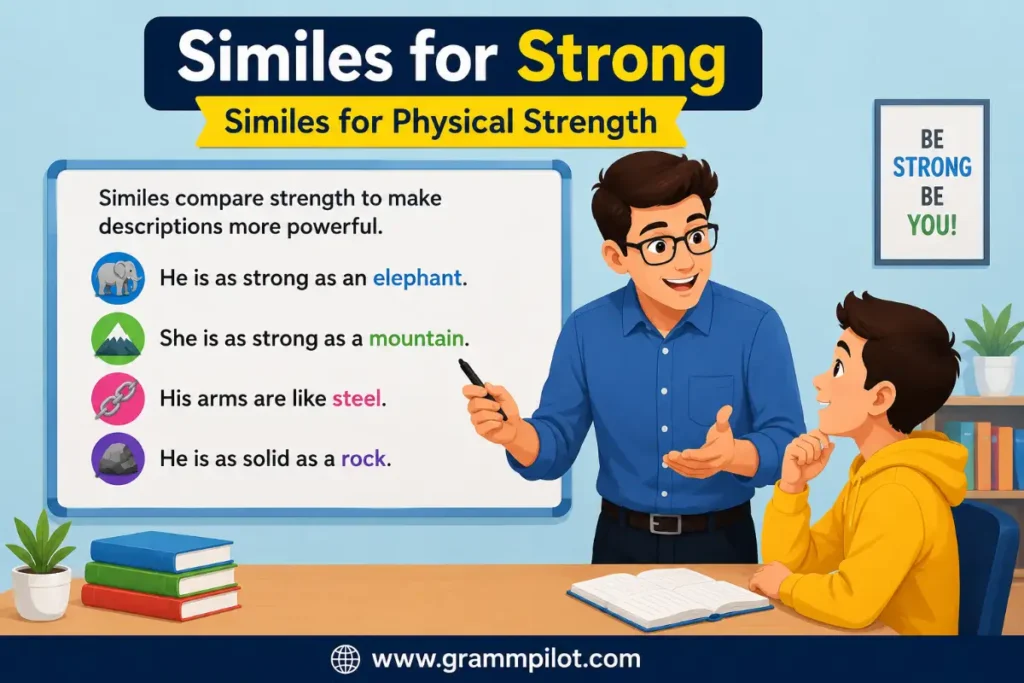
Physical strength is the most common type of strength. Here are some excellent comparisons.
As Strong as an Ox
This is probably the most famous English simile for strength.
Example: “The farmer was as strong as an ox and lifted the heavy bags without help.”
As Strong as a Bull
Bulls symbolize raw power.
Example: “The wrestler looked as strong as a bull.”
As Strong as a Bear
Bears combine size with incredible muscle.
Example: “The lumberjack was as strong as a bear.”
Strong Like Steel
Steel represents durability and resistance.
Example: “Her grip was strong like steel.”
As Strong as Iron
Iron has represented strength for centuries.
Example: “The old bridge remained as strong as iron.”
Similes for Mental Strength
Strength isn’t always about muscles. Sometimes it means staying calm during difficult times.
As Strong as a Mountain
Mountains remain standing through storms.
Example: “He stayed as strong as a mountain despite the challenges.”
As Steady as a Rock
This simile describes emotional stability.
Example: “My grandmother remained as steady as a rock during the emergency.”
Like an Oak Tree
Oak trees survive strong winds.
Example: “She stood like an oak tree through every hardship.”
As Unshakable as a Fortress
Fortresses are built to withstand attacks.
Example: “His confidence was as unshakable as a fortress.”
Similes for Emotional Strength
Some people stay positive even during life’s hardest moments. These similes describe that kind of strength.
- As brave as a lion
- As fearless as an eagle
- As steady as the sunrise
- Like a lighthouse in a storm
- As dependable as the earth beneath your feet
Example: “After losing her job, she remained like a lighthouse in a storm for her family.”
These comparisons emphasize courage rather than muscles.
Similes for Powerful Objects
Objects can also represent strength. Some of the most common include:
- Strong like concrete
- As hard as granite
- As solid as a brick wall
- As firm as stone
- Strong as reinforced steel
Example: “The new bridge is as solid as concrete.”
These similes often appear in engineering, construction, and descriptive writing.
Similes for Strong: Which Simile Should You Choose?
The best simile depends on what kind of strength you’re describing.
| Situation | Best Simile |
|---|---|
| Physical power | As strong as an ox |
| Courage | As brave as a lion |
| Mental strength | As steady as a rock |
| Reliability | As solid as a rock |
| Durability | Strong like steel |
| Determination | Like an oak tree |
| Emotional strength | Like a lighthouse in a storm |
| Endurance | As tireless as a machine |
Choosing the right comparison makes your writing clearer and more engaging. Instead of using the same simile every time, think about the exact type of strength you want your reader to imagine.
Similes for Strong: Master Synonym List for “Strong”
Sometimes, using the word strong again and again can make your writing feel repetitive. Choosing a synonym helps your sentences sound more natural and interesting. The best synonym depends on what kind of strength you’re describing. Some words describe physical power, while others describe courage, determination, or durability.
Simple Words
| Word | Meaning | Tone | Example |
|---|---|---|---|
| Strong | Having great power | Simple | She is strong enough to lift the box. |
| Powerful | Having great force | Simple | The engine is powerful. |
| Tough | Able to handle difficulty | Simple | He’s tough during hard times. |
| Solid | Firm and dependable | Simple | The table is solid wood. |
| Sturdy | Strongly built | Simple | The chair is sturdy. |
| Firm | Not soft or weak | Simple | Give me a firm handshake. |
| Hard | Difficult to break | Simple | This rock is hard. |
| Durable | Lasting a long time | Simple | These boots are durable. |
Everyday Words
| Word | Meaning | Tone | Example |
|---|---|---|---|
| Muscular | Having large muscles | Everyday | The athlete is muscular. |
| Robust | Healthy and strong | Everyday | She has a robust immune system. |
| Fit | Physically healthy | Everyday | He stays fit by exercising. |
| Healthy | In good condition | Everyday | A healthy body stays strong. |
| Reliable | Can be trusted | Everyday | He’s a reliable teammate. |
| Dependable | Always performs well | Everyday | She’s dependable under pressure. |
| Hardy | Able to survive difficult conditions | Everyday | Hardy plants grow in cold weather. |
| Resilient | Quickly recovers from problems | Everyday | Children are often resilient. |
Formal Words
| Word | Meaning | Tone | Example |
|---|---|---|---|
| Mighty | Extremely powerful | Formal | The mighty river flowed quickly. |
| Formidable | Inspiring respect through strength | Formal | They faced a formidable opponent. |
| Vigorous | Full of energy | Formal | He made a vigorous effort. |
| Resilient | Able to recover quickly | Formal | A resilient economy grows after setbacks. |
| Enduring | Lasting a long time | Formal | Their enduring friendship inspired everyone. |
| Tenacious | Never giving up | Formal | She is a tenacious leader. |
| Unbreakable | Impossible to break | Formal | Their trust seemed unbreakable. |
| Indestructible | Impossible to destroy | Formal | The material feels almost indestructible. |
Informal and Slang Words
| Word | Meaning | Tone | Example |
|---|---|---|---|
| Buff | Very muscular | Slang | He’s getting buff at the gym. |
| Ripped | Having visible muscles | Slang | The actor looked ripped. |
| Built | Muscular body | Informal | She’s really built for sports. |
| Beast | Extremely powerful person | Slang | He lifted that weight like a beast. |
| Tank | Very large and strong person | Informal | Their goalkeeper is a tank. |
| Rock-solid | Extremely dependable | Informal | Her confidence is rock-solid. |
| Ironclad | Extremely strong or secure | Informal | They have an ironclad agreement. |
| Superman | Beyond normal strength | Informal | She showed superman determination. |
These words help you avoid repeating strong while keeping your writing fresh.
Synonyms by Intensity “Similes for Strong”
Not every situation calls for the same level of strength. Some words suggest a little strength, while others describe extraordinary power.
| Intensity | Synonyms |
|---|---|
| Mild | Fit, healthy, sturdy, firm |
| Moderate | Strong, solid, reliable, tough |
| High | Powerful, muscular, robust, hardy |
| Very High | Mighty, formidable, resilient, tenacious |
| Extreme | Unbreakable, indestructible, superhuman, unstoppable |
Choosing the right level makes your writing more accurate.
Similes for Strong: Synonyms by Part of Speech
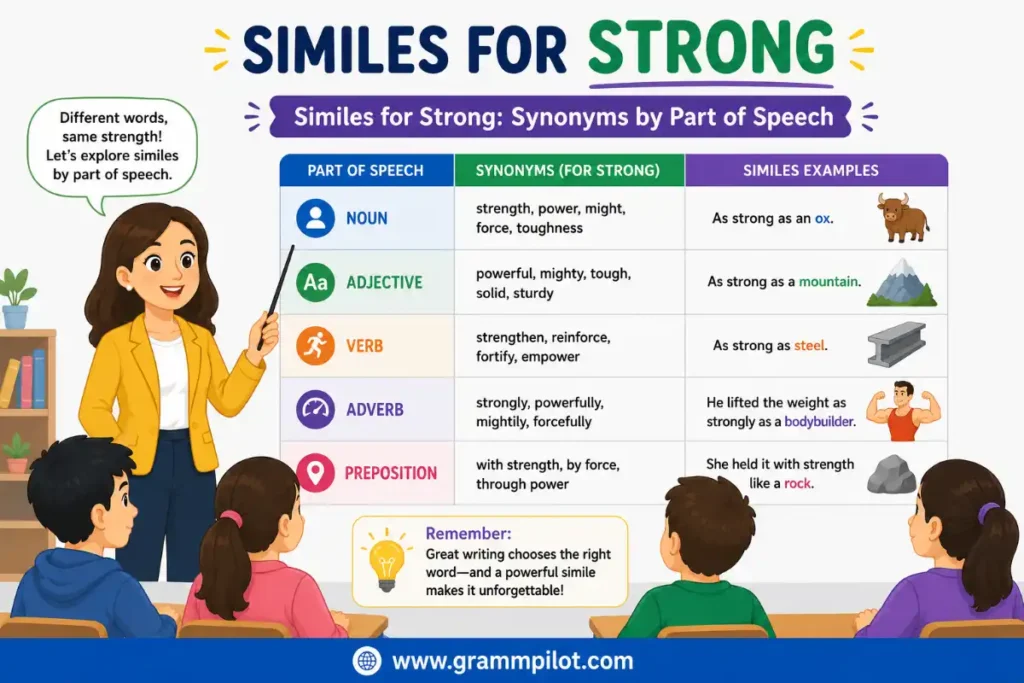
The idea of strength appears in different parts of speech.
| Part of Speech | Examples |
|---|---|
| Noun | strength, power, force, toughness, resilience |
| Adjective | strong, powerful, sturdy, muscular, mighty |
| Verb | strengthen, reinforce, support, protect, empower |
| Adverb | strongly, firmly, powerfully, confidently |
Examples:
Noun
Her strength amazed everyone.
Adjective
The bridge is incredibly sturdy.
Verb
Regular exercise strengthens your muscles.
Adverb
He argued strongly for the new plan.
Using different word forms makes your writing smoother and less repetitive.
Do American and British English Use These Words Differently?
Most words related to strong have the same meaning in American and British English.
For example:
- strong
- powerful
- sturdy
- durable
- resilient
- mighty
These words are common in both varieties of English. However, a few informal words differ in popularity.
In American English, people often say:
- buff
- ripped
- built
In British English, you may hear:
- well-built
- solid
- sturdy
The meaning stays the same, even if the most common informal expression changes.
Similes for Strong: Which Word Fits Best in Different Situations?
Choosing the right word depends on where you’re writing or speaking.
Best Word for a Resume
Resumes should sound professional and specific.
Good choices include:
- resilient
- dependable
- reliable
- capable
- determined
Example:
“Built strong relationships with clients through dependable customer service.”
Another example:
“Demonstrated resilient leadership during challenging projects.”
These words highlight professional qualities instead of physical strength.
Best Word for an Essay
Essays often require more formal vocabulary.
Good choices include:
- powerful
- resilient
- formidable
- enduring
- robust
Example:
“The country developed a robust economy over several decades.”
Or: “The novel presents a powerful message about hope.”
These words sound polished without being difficult to understand.
Best Word for Text Messages
Friends usually prefer simple language.
Examples:
- strong
- tough
- solid
- buff
- beast
Example messages:
“You’re stronger than you think.”
“That workout made me feel like a beast.”
“You’ve been really tough through all of this.”
Short, familiar words sound more natural in casual conversations.
Best Word for Emails
Professional emails should be clear and respectful.
Examples:
“Our team has built strong partnerships with local businesses.”
“The report provides strong evidence supporting the proposal.”
Change block type or style Move Paragraph block from position 158 up to position 157 Move Paragraph block from position 158 down to position 159 Change alignment .Change text alignment. Displays more block tools
“We appreciate your continued support and strong commitment.”
These phrases sound confident without being overly formal.
Best Word for Speaking
Everyday conversations usually use simple words.
Examples:
“He’s really strong.”
“She’s mentally tough.”
“They have a strong friendship.”
“That bridge looks solid.”
Native speakers generally choose clear, familiar words unless the situation is formal.
Similes Inspired by Nature
Nature gives us many powerful images for describing strength.
- As strong as a mountain
- As solid as granite
- Like an ancient oak
- As steady as the ocean
- As powerful as a waterfall
- Like rolling thunder
- As deep as the sea
- Like an endless river
- As rooted as a tree
- As enduring as the desert
Example: “The old castle stood as strong as a mountain despite centuries of storms.”
Similes Inspired by Animals
Animals are among the most popular sources of similes.
- As strong as an ox
- As fierce as a tiger
- As brave as a lion
- As mighty as an elephant
- As quick as a wolf
- As fearless as a hawk
- Like a charging bull
- Like a hunting eagle
- As determined as an ant
- As hardworking as a beaver
Example: “The rescue dog worked as tirelessly as a beaver all day.”
Similes Inspired by Objects
Everyday objects can also represent strength.
- Strong like steel
- As hard as iron
- As solid as concrete
- As firm as stone
- As tough as leather
- Like reinforced steel
- As secure as a lock
- Like a brick wall
- As sharp as a blade
- Like an anchor
Example: “The bridge was as solid as concrete.”
Real-Life Example Sentences “Similes for Strong”
These examples show how similes naturally fit into everyday English.
- My grandfather is still as strong as an ox.
- The firefighter remained as brave as a lion.
- She handled criticism like a champion.
- The old tree stood as firm as a mountain.
- His determination was like an unstoppable river.
- Their friendship is as solid as a rock.
- The athlete trained like a machine every day.
- She became as resilient as an oak after many challenges.
- The bridge is as sturdy as steel.
- He protected his family like a shield.
- Our coach is as tough as nails.
- The volunteers worked like busy bees all afternoon.
- The soldier stood as fearless as an eagle.
- The little boy was as determined as an ant carrying food.
- Their team remained as united as a fortress.
Common Mistakes People Make About “Similes for Strong”
Many learners make these mistakes when using similes.
Using Too Many Similes
One or two similes improve writing. Using one in every sentence can make your work feel repetitive.
Choosing an Unclear Comparison
Good similes compare strength with something naturally powerful.
Poor example: ❌ As strong as a feather.
Better example: ✅ As strong as an ox.
Mixing Similes
Avoid combining different comparisons in one sentence.
Incorrect: “He was as strong as an ox and like a mountain of steel.”
Choose one clear image instead.
Using Similes in Formal Reports
Creative comparisons work well in stories and speeches. In scientific reports or legal documents, plain language is usually better.
Instead of: “The machine was as strong as an elephant.”
Write: “The machine was extremely powerful.”
Antonyms of Strong
Sometimes you need the opposite idea.
Here are some useful antonyms.
| Word | Meaning |
|---|---|
| Weak | Lacking strength |
| Fragile | Easily broken |
| Frail | Physically weak |
| Delicate | Easily damaged |
| Powerless | Without strength or influence |
| Soft | Not hard or firm |
| Feeble | Very weak |
| Helpless | Unable to defend oneself |
| Brittle | Breaks easily |
| Unstable | Not firm or secure |
Using antonyms creates stronger contrast in your writing.
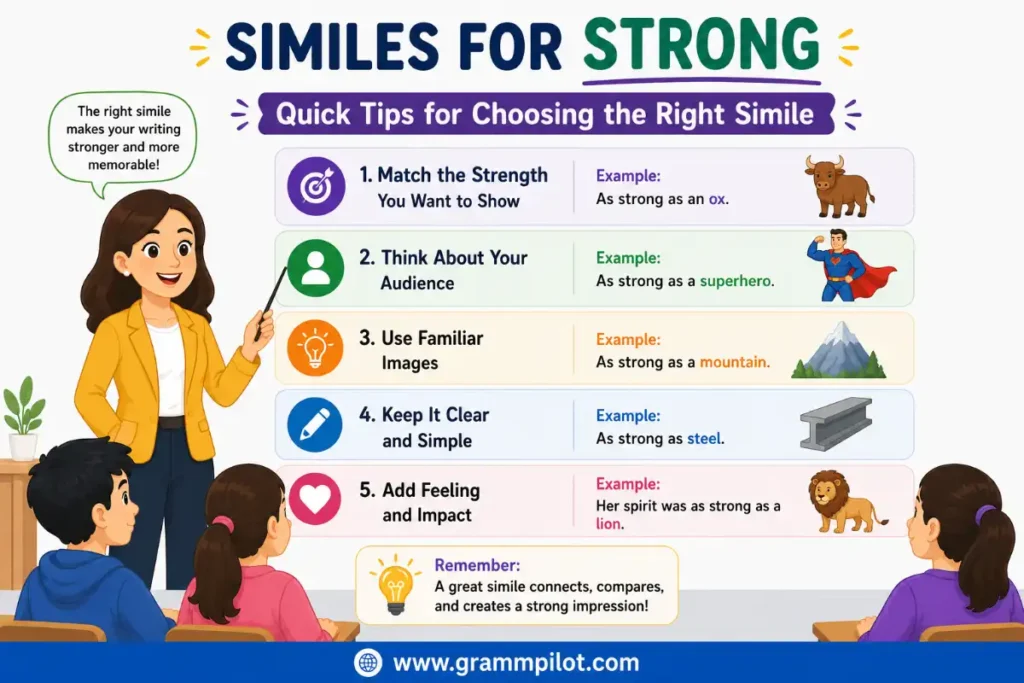
Similes for Strong: Quick Tips for Choosing the Right Simile
- Match the simile to the type of strength.
- Use animal similes for physical power.
- Use nature similes for stability and endurance.
- Use object similes for toughness.
- Don’t overuse similes in one paragraph.
- Choose comparisons your readers will recognize.
- Keep your writing simple and natural.
- Read the sentence aloud to see if the comparison sounds smooth.
- Use different similes to avoid repetition.
- Pick the image that best matches your message.
A well-chosen simile doesn’t just describe strength—it helps your readers see it clearly and remember it long after they’ve finished reading.
Conclusion
Choosing the right {Similes for Strong} can make your writing more vivid, engaging, and memorable. Instead of repeating the word strong, use comparisons that help readers clearly picture the kind of strength you’re describing. If it’s physical power, mental toughness, emotional resilience, or lasting durability, a well-chosen simile adds life and meaning to your sentences.
Keep practicing these similes in essays, stories, emails, and everyday conversations. The more you use them, the more natural they’ll become. With the right comparison, you can turn simple writing into descriptive writing that captures your reader’s attention and leaves a lasting impression.
Frequently Asked Questions
1. What is the most common simile for strong?
The most common simile is “as strong as an ox.” It has been used for centuries to describe someone with great physical strength and is widely recognized in everyday English.
2. What are some good Similes for Strong in writing?
Some excellent choices include as strong as a bear, strong like steel, as tough as nails, as solid as a rock, and like an oak tree. Choose the one that best matches the type of strength you want to describe.
3. What’s another way to say someone is very strong?
You can say they are as strong as an ox, built like a tank, strong like steel, as tough as nails, or use words like powerful, mighty, sturdy, or robust, depending on the context.
4. Can I use similes in school essays?
Yes. Similes make descriptive writing more interesting and help readers create clear mental images. Just avoid using too many in formal or academic writing.
5. What’s the difference between a simile and a metaphor?
A simile compares two things using like or as, while a metaphor says one thing is another without using those words.
Simile: She is as strong as an ox.
Metaphor: She is an ox in the gym.
6. Are similes only used for physical strength?
No. Similes can describe emotional strength, mental toughness, courage, determination, patience, and even strong friendships or relationships.
7. How do I choose the best simile?
Think about the type of strength you’re describing. Animal similes work well for physical power, while nature-based similes like as steady as a mountain or like an oak tree are better for emotional or mental strength.