
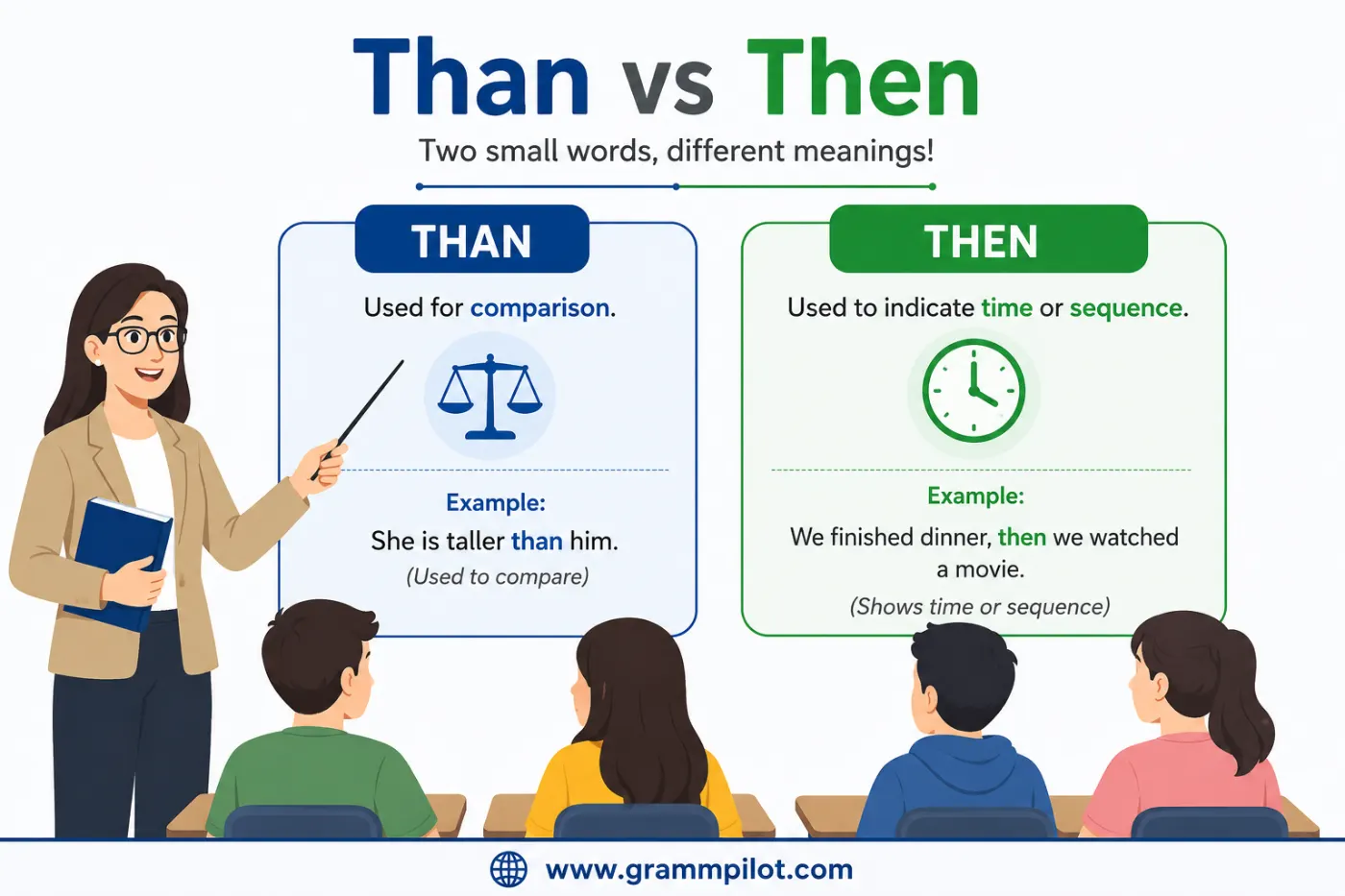
Have you ever paused while writing an email, essay, or text message because you weren’t sure whether to use {Than vs Then}? You’re not alone. These two small words are among the most commonly confused words in English because they look similar and differ by only one letter. The good news is that once you learn what each word does, choosing the correct one becomes easy. You don’t need to memorize complicated grammar rules. A few simple tricks can help you get it right every time.
Answer Box:
“Than” is used to compare things, while “then” is used to talk about time, order, or what happens next. If you’re making a comparison, use “than.” If you’re talking about time or sequence, use “then.”
In this guide, you’ll learn the meaning of each word, where they came from, how to remember the difference, common mistakes to avoid, and plenty of real-life examples that make the rules easy to understand.
You can find more examples of figurative language in [Similes for Strong].
What’s the Difference Between Than vs Then?
Although than and then look alike, they have completely different jobs in a sentence.
Here’s the simplest way to remember them.
| Word | Main Use | Example |
|---|---|---|
| Than | Used for comparisons | Sarah is taller than Emma. |
| Then | Used for time or sequence | Finish your homework, then watch TV. |
If you’re comparing two people, places, things, or ideas, choose than.
If you’re talking about what happens next or referring to a point in time, choose then.
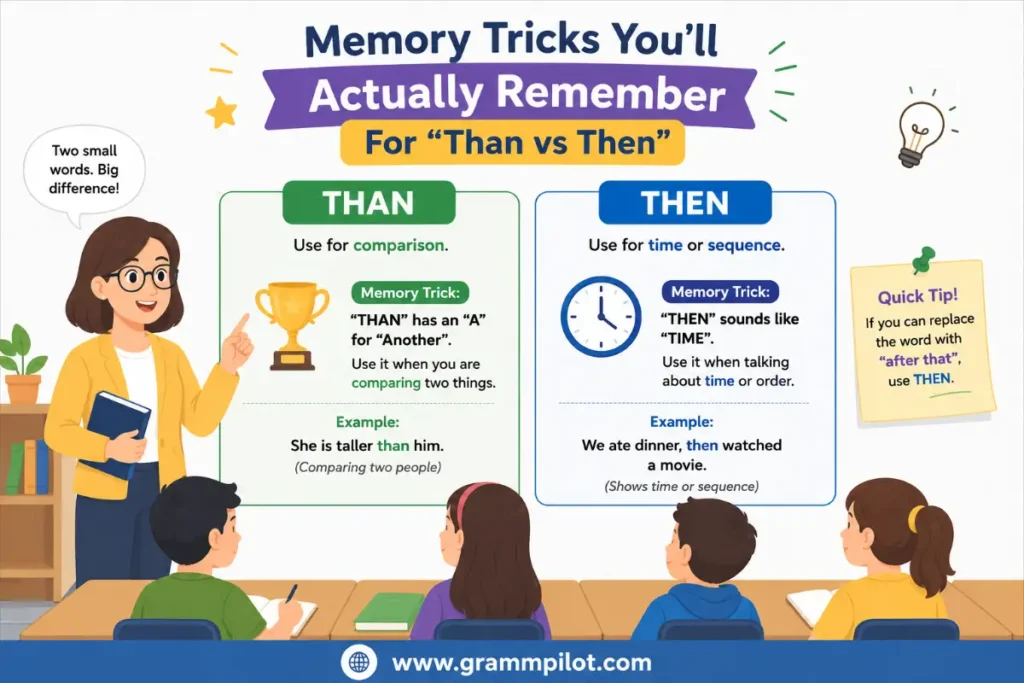
A Quick Memory Trick “Than vs Then”
Think about these two clues:
- Than = Comparison
- Then = Time
That’s the easiest rule most English learners need.
For example:
✅ My car is faster than yours.
✅ We ate dinner, then we watched a movie.
Each sentence follows one simple rule.
What Does “Than” Mean?
Than is a conjunction and sometimes a preposition used to compare two or more things.
It answers questions like:
- Which is bigger?
- Which is smaller?
- Which is better?
- Which happened more often?
- Which costs less?
You’ll usually see than after comparative words.
Examples include:
- bigger than
- smaller than
- better than
- older than
- younger than
- more than
- less than
- faster than
- slower than
- easier than
Here are some examples.
- My brother is taller than me.
- This book is more interesting than the last one.
- Winter is colder than summer.
- Coffee costs more than tea.
- She studies harder than her classmates.
Every sentence compares one thing with another.
That’s the main job of than.
What Does “Then” Mean?
Then is an adverb that usually refers to time, order, or the next step. It tells readers when something happens.
Examples:
- We finished lunch, then we went shopping.
- Turn left, then drive two miles.
- I was younger then.
- If you’re ready, then let’s begin.
- First mix the flour, then add the eggs.
Notice that no comparison is happening. Instead, the sentences describe time or sequence. Think of then as a word that helps events move forward.
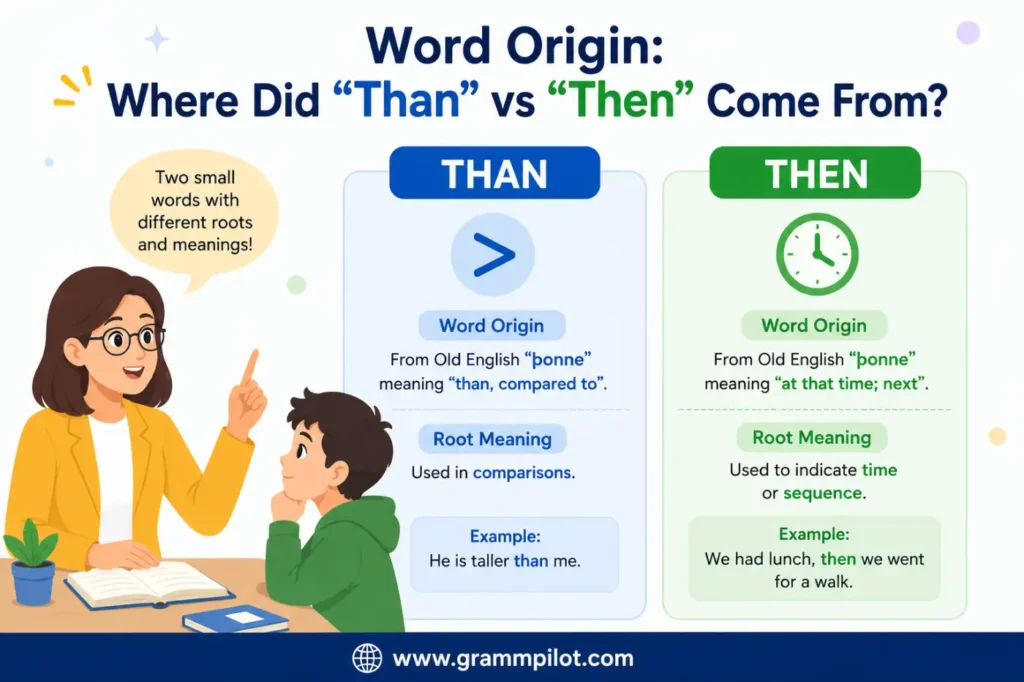
Word Origin: Where Did “Than” vs “Then” Come From?
Most articles simply tell you which word to use. Understanding where they came from makes them easier to remember.
The Origin of “Than”
The word than comes from Old English þonne and later developed into its modern spelling. Over hundreds of years, English speakers began using it mainly for comparisons. That’s why today you’ll almost always see it after comparative words like:
- bigger
- stronger
- happier
- more
- less
- better
Its meaning has stayed surprisingly consistent.
The Origin of “Then”
The word then also comes from Old English and originally referred to time.
It answered questions such as:
- When?
- At that time?
- What happened next?
Although the spellings eventually became different, both words share ancient roots. Today they serve two completely separate purposes. One compares. The other tells time.
Why Do People Confuse Than and Then?
There are several reasons.
They Look Almost Identical
Only one letter is different.
than
then
When you’re typing quickly, it’s easy to hit the wrong key.
They Sound Similar
Many English speakers pronounce them very similarly in casual conversation. That makes it difficult for learners to hear the difference.
Autocorrect Doesn’t Always Help
Both are correctly spelled English words. Your phone or computer often won’t recognize that you’ve chosen the wrong one.
For example: ❌ She is smarter then me.
Every word is spelled correctly. But the sentence is wrong because a comparison needs than.
People Focus on Spelling Instead of Meaning
The easiest way to choose correctly isn’t by looking at the letters.
Instead, ask yourself one question.
Am I comparing something?
If yes, choose than. If not, ask another question.
Am I talking about time or what happens next?
If yes, choose then.
When Should You Use “Than”?
Use than whenever you’re comparing two or more things.
Comparing Size
- My house is bigger than yours.
- An elephant is larger than a horse.
- This phone is thinner than my old one.
Comparing Age
- Emma is younger than Olivia.
- My grandfather is older than my grandmother.
- The puppy is smaller than the adult dog.
Comparison in Ability
- She sings better than I do.
- He runs faster than anyone in class.
- They work harder than most employees.
Comparing Quantity
- We have more apples than oranges.
- There were fewer people than expected.
- She drinks less coffee than her brother.
Comparing Opinions
- I like pizza more than burgers.
- He prefers reading than watching television. (In modern English, “prefers reading to watching television” is usually better.)
- Most students enjoyed science more than history.
Whenever your sentence compares one thing with another, than is usually the correct choice.
When Should You Use “Then”?
Choose then when you’re talking about time, sequence, or the next action.
Showing Order
- First wash your hands, then eat.
- Read the instructions, then begin.
- Finish the report, then send it.
Talking About Time
- Life was different back then.
- I didn’t know her then.
- Things were much quieter then.
Giving Instructions
- Click Save, then close the window.
- Turn off the power, then unplug the cable.
- Sign the form, then return it to the office.
Showing Results
Sometimes then introduces what happens because of something else.
Examples:
- If everyone agrees, then we’ll start.
- If it rains, then we’ll stay inside.
- If you’re finished, then you may leave.
In these sentences, then connects one event to the next.
Can Than vs Then Ever Replace Each Other?
No.
Although they look similar, they almost never replace each other.
Compare these sentences.
❌ She is taller then me.
✅ She is taller than me.
Now look at another example.
❌ We finished dinner than went home.
✅ We finished dinner then went home.
Changing one word completely changes the grammar.
A Simple Test You Can Use Every Time
Whenever you’re unsure, ask yourself these questions.
Question 1
Are you comparing two things?
If yes, use than.
Example: This exam is easier than the last one.
Question 2
Are you talking about time or what happens next?
If yes, use then.
Example: We finished class, then we walked home.
These two questions solve almost every than and then mistake.
Why Learning This Difference Matters “Than vs Then”
Using the wrong word doesn’t usually stop people from understanding you. However, it can make your writing look careless. Teachers often notice the mistake. Employers notice it in resumes and business emails. Readers notice it in blog posts and articles. Learning this small difference helps your writing appear more polished and professional. It also builds confidence because you’ll no longer stop to guess which word belongs in your sentence.
Master List of Related Words and Expressions “Than vs Then”
Unlike words such as happy or big, than and then do not have true synonyms because they serve different grammar functions. However, several words and expressions can perform similar jobs depending on the sentence.
The tables below group related words by tone and usage so you can choose the most natural option.
Simple Words
| Word | Meaning | Tone | Example |
|---|---|---|---|
| Than | Used for comparison | Simple | This book is better than that one. |
| Then | Refers to time or sequence | Simple | Finish your work, then relax. |
| Next | Following in order | Simple | Next, open the file. |
| After | Later in time | Simple | We went home after dinner. |
| Before | Earlier in time | Simple | Finish this before lunch. |
| Later | At a future time | Simple | I’ll call you later. |
| Earlier | At a previous time | Simple | She arrived earlier today. |
| More | Greater amount | Simple | We need more chairs. |
| Less | Smaller amount | Simple | Drink less soda. |
| Better | Higher quality | Simple | This option is better. |
Everyday Expressions
| Word or Phrase | Meaning | Tone | Example |
|---|---|---|---|
| Compared with | Shows comparison | Everyday | Compared with last year, sales improved. |
| Compared to | Makes a comparison | Everyday | Her smile was compared to sunshine. |
| Instead of | In place of | Everyday | Walk instead of driving. |
| After that | Following an event | Everyday | After that, we went shopping. |
| At that time | During that moment | Everyday | I lived in Texas at that time. |
| Following | Coming next | Everyday | Read the following instructions. |
| Next step | The action that follows | Everyday | The next step is to submit the form. |
| Afterwards | Later | Everyday | We celebrated afterwards. |
| Subsequently | Later in sequence | Everyday | The meeting ended. Subsequently, everyone left. |
| In comparison | When comparing | Everyday | In comparison, the newer model is lighter. |
Formal Alternatives
| Word | Meaning | Tone | Example |
|---|---|---|---|
| Subsequently | Happening afterward | Formal | Subsequently, the company expanded overseas. |
| Thereafter | After that | Formal | Thereafter, the policy changed. |
| Consequently | As a result | Formal | Consequently, production increased. |
| Comparatively | In relation to something else | Formal | The costs were comparatively low. |
| Likewise | In the same way | Formal | Likewise, the second study found similar results. |
| Conversely | Showing contrast | Formal | Conversely, rural areas grew more slowly. |
| Relatively | Compared with something | Formal | The process is relatively simple. |
| Accordingly | As a result | Formal | Accordingly, the schedule was updated. |
Informal or Slang Expressions
| Expression | Meaning | Tone | Example |
|---|---|---|---|
| Afterward | Later | Casual | We’ll eat afterward. |
| Next up | Coming next | Casual | Next up is dessert. |
| Right after | Immediately following | Casual | Call me right after class. |
| Way better | Much better | Informal | This pizza is way better. |
| Much bigger | Considerably larger | Informal | The new office is much bigger. |
| Back then | At that earlier time | Informal | Back then, phones had buttons. |
| From then on | Beginning at that point | Informal | From then on, everything changed. |
Although these words are related, remember that none of them can replace than or then in every sentence.
Related Words by Intensity
Comparison words can show different levels of difference.
| Intensity | Examples |
|---|---|
| Very Small Difference | slightly more, slightly less, almost as |
| Small Difference | a little more, a bit less, somewhat better |
| Medium Difference | better than, larger than, faster than |
| Strong Difference | much better than, far more, significantly greater |
| Very Strong Difference | vastly greater than, dramatically better than, infinitely more |
Examples:
“This phone is slightly lighter than my old one.”
“This laptop is much faster than the previous model.”
“The new bridge is significantly stronger than the old bridge.”
These words help make comparisons more accurate.
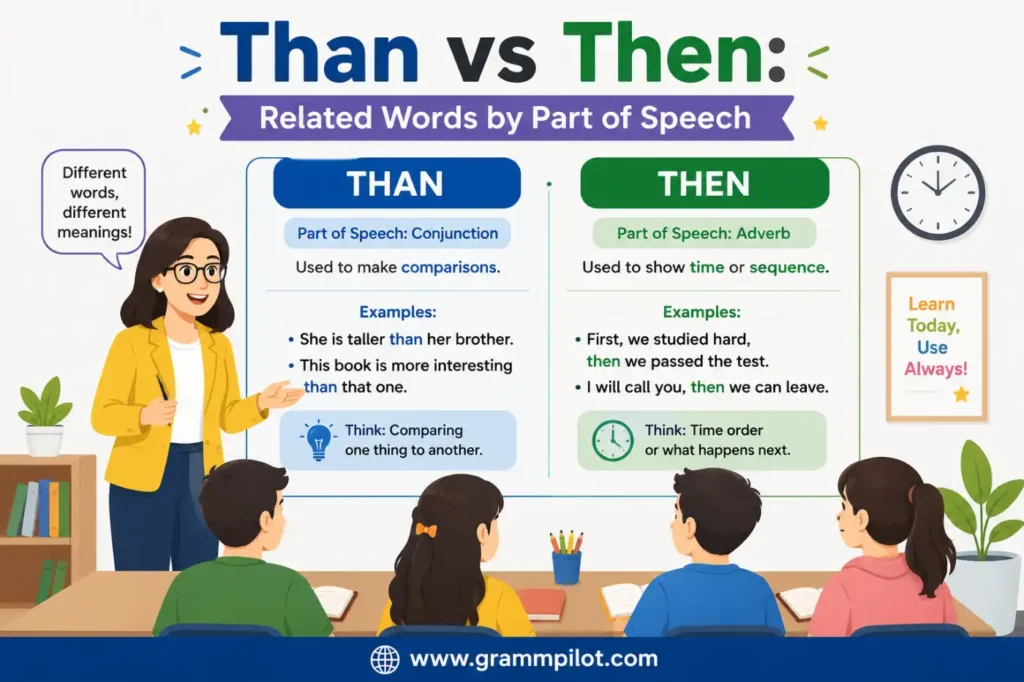
Than vs Then: Related Words by Part of Speech
Understanding the grammar behind these words makes them easier to use.
| Part of Speech | Examples |
|---|---|
| Conjunction | than, after, before, while |
| Adverb | then, later, afterwards, previously |
| Preposition | after, before, unlike |
| Comparative adjective | bigger, smaller, stronger, better |
| Comparative adverb | faster, more quickly, more carefully |
Examples:
Conjunction
She is taller than her sister.
Adverb
We ate lunch, then returned to work.
Preposition
Before dinner, everyone washed their hands.
Comparative adjective
This puzzle is easier than the last one.
Is There a Difference Between American and British English?
Not really. Both American English and British English use than and then in exactly the same way. The grammar does not change between the two varieties of English.
American English: “My car is newer than yours.”
British English: “My car is newer than yours.”
Likewise: “We finished lunch, then visited the museum.”
This sentence works naturally in both countries. The only differences you might notice are pronunciation and surrounding vocabulary, not the use of than or then.
Than vs Then: Which Word Fits Best in Different Situations?
Best Choice for a Resume
Resumes should use clear, professional language.
Examples:
“My sales results were higher than company expectations.”
“Managed projects more efficiently than previous methods.”
Avoid casual phrases like: “My work was way better.”
Professional comparisons sound stronger.
Best Choice for an Essay
Academic writing often includes comparisons.
Examples:
“The second experiment produced better results than the first.”
“The newer policy proved more effective than the previous one.”
When discussing events, use then carefully.
Example: “The researchers collected the data, then analyzed the results.”
Best Choice for Text Messages
Texting usually uses shorter, natural sentences.
Examples:
“I’m taller than him.”
“See you then!”
“I’ll finish work, then I’ll call.”
“That movie was better than I expected.”
Simple wording feels more natural in casual conversations.
Best Choice for Emails
Professional emails often include both words.
Examples:
“Please compare the updated report with the previous version rather than the draft.”
“I’ll review the proposal, then send you my feedback.”
“The new schedule works better than the old one.”
These sentences are polite and easy to understand.
Best Choice for Speaking
In everyday conversations, native speakers use both words constantly.
Examples:
“This restaurant is cheaper than the one downtown.”
“We’ll eat first, then go shopping.”
“I liked the first movie more than the sequel.”
“Back then, we didn’t have smartphones.”
Keeping the sentences short makes your speech sound natural and confident.
Than vs Then: Which Word Should You Choose?
Use this quick guide whenever you’re unsure.
| Situation | Correct Word |
|---|---|
| Comparing two people | Than |
| Comparing prices | Than |
| Comparing sizes | Than |
| Comparing opinions | Than |
| Talking about what happened next | Then |
| Giving step-by-step instructions | Then |
| Referring to the past | Then |
| Talking about a future step | Then |
A simple question can usually solve the problem.
Ask yourself: Am I comparing?
If yes, choose than.
If not, ask: Am I talking about time or sequence?
If yes, choose then.
This two-step method works for nearly every sentence and helps you avoid one of the most common grammar mistakes in English.
Real-Life Example Sentences Using “Than” vs “Then”
The best way to master these words is to see them in real situations. The examples below show how native English speakers use than and then every day.
Examples with Than
- My younger brother is taller than I expected.
- This laptop is lighter than my old one.
- She speaks English better than her cousin.
- Running is healthier than sitting all day.
- We finished the project faster than planned.
- Coffee is stronger than tea for me.
- Their house is bigger than ours.
- This road is safer than the highway.
- I enjoyed the second book more than the first.
- Summer is usually hotter than spring.
Examples with Then
- Finish your breakfast, then brush your teeth.
- We visited the museum, then walked to the park.
- Back then, I didn’t know how to swim.
- First save your work, then close the program.
- If you’re ready, then let’s begin.
- She packed her bags, then left for the airport.
- The rain stopped, then the sun appeared.
- We watched a movie, then ordered dinner.
- He smiled, then shook my hand.
- I lived in New York then.
Mixed Examples
These examples include both words in the same sentence.
- My sister is older than me, but then she has more experience.
- This phone is cheaper than that one, so then I decided to buy it.
- I’d rather walk than drive, and then I’ll get some exercise.
- The blue shirt costs less than the black one, then you can spend the extra money elsewhere.
- We finished earlier than expected, then celebrated with dinner.
Seeing both words together helps you notice that each has a different job.
Than vs. Compared With
Many learners wonder whether than and compared with mean the same thing.
They are related, but they are used differently.
| Than | Compared with |
|---|---|
| Used directly after comparative words | Used to compare complete ideas or situations |
| Short and simple | Slightly more formal |
| Common in speech and writing | More common in reports and essays |
Examples:
Than
“This camera is better than the old one.”
Compared with
“Compared with last year’s model, this camera is lighter and faster.”
If you’re making a simple comparison, than is usually the better choice.
If you’re discussing larger differences or analyzing information, compared with often sounds more natural.
Then vs. Afterwards
These words are also closely related.
| Then | Afterwards |
|---|---|
| Shows the next step | Refers to something happening later |
| Common in speaking | Slightly more formal in writing |
| Works in instructions | Usually describes completed events |
Examples:
“Wash the vegetables, then cut them.”
“We finished dinner. Afterwards, we watched a movie.”
Both are correct, but then usually sounds smoother when giving instructions.
Then vs. Later
People often confuse these two time words.
| Then | Later |
|---|---|
| Refers to the next event or a past time | Means sometime after now or after another event |
| Often shows sequence | Often refers to an unspecified future time |
Examples:
“We ate lunch, then went shopping.”
“I’ll call you later.”
If you’re describing the next action, use then.
If you’re talking about a future time that isn’t specific, later is usually the better choice.
Common Mistakes People Make “Than vs Then”
Even fluent English speakers sometimes mix up these words.
Here are the mistakes you’ll see most often.
Mistake 1: Using “Then” for Comparisons
❌ My car is faster then yours.
✅ My car is faster than yours.
Remember: Comparisons always use than.
Mistake 2: Using “Than” for Time
❌ Finish your homework than go outside.
✅ Finish your homework then go outside.
When something happens next, use then.
Mistake 3: Depending on Spell Check
Both words are spelled correctly. That means spell check often won’t catch the mistake. Always read the sentence for meaning.
Mistake 4: Forgetting the Comparison
Some learners focus only on the spelling.
Instead, ask yourself: Am I comparing?”
If yes, choose than.
Mistake 5: Forgetting the Sequence
When giving directions or describing events, many writers accidentally choose than. Think about time. If one event follows another, choose then.
Mistake 6: Mixing Both Words in One Sentence
Incorrect: “We arrived then expected.”
Correct: “We arrived earlier than expected.”
Incorrect: “This phone is better then the old one.”
Correct: “This phone is better than the old one.”
Reading your sentence aloud often helps you notice these mistakes.
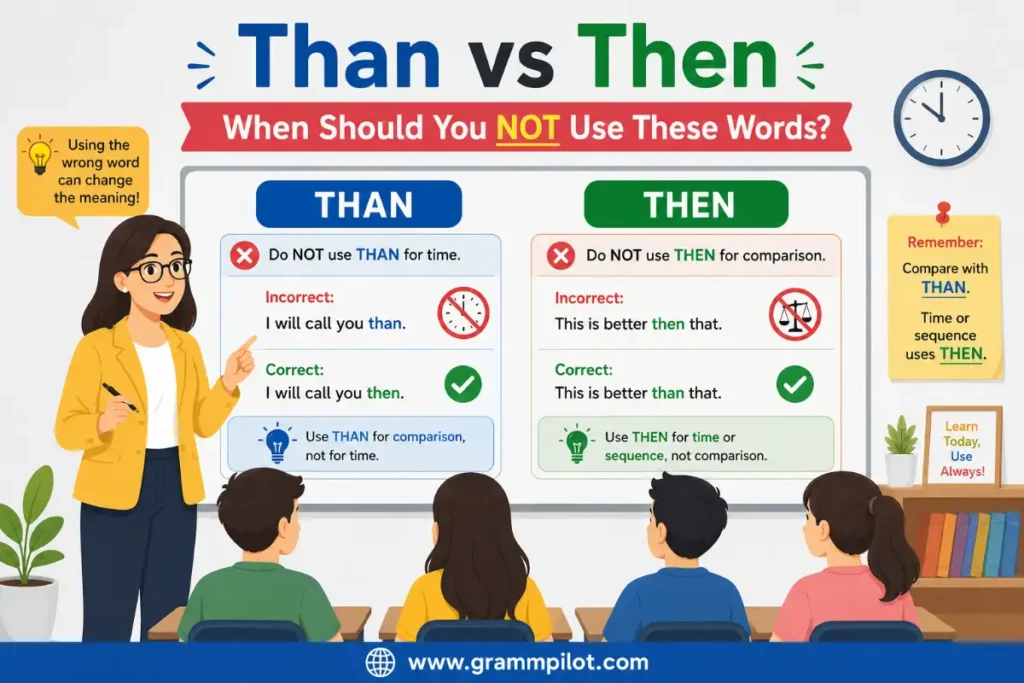
Than vs Then: When Should You NOT Use These Words?
Knowing when not to use them is just as important.
Don’t Use “Than” Without a Comparison
Incorrect: “I’ll call you than.”
Correct: “I’ll call you then.”
Don’t Use “Then” to Compare Things
Incorrect: “This movie is longer then the first one.”
Correct: “This movie is longer than the first one.”
Don’t Replace Other Linking Words
Sometimes another word fits better.
Instead of: “He prefers coffee than tea.”
Write: He prefers coffee to tea.”
Some verbs naturally use different prepositions. Learning these patterns makes your English sound more natural.
Than vs Then: Antonyms and Opposite Ideas
Neither than nor then has a direct antonym because they perform grammar functions rather than expressing opposite meanings.
However, related opposite ideas can help you understand their use.
Opposites Related to Comparisons
| Word | Opposite Idea |
|---|---|
| More | Less |
| Better | Worse |
| Higher | Lower |
| Bigger | Smaller |
| Faster | Slower |
| Earlier | Later |
Opposites Related to Time
| Word | Opposite Idea |
|---|---|
| Then | Now |
| Before | After |
| Earlier | Later |
| First | Last |
| Beginning | End |
These pairs help you understand how comparisons and sequences work in English.
Than vs Then: Quick Tips for Choosing the Right Word
Keep these simple tips in mind whenever you write.
- Than compares.
- Then tells time.
- Look for words like better, more, less, bigger, or smaller. They almost always need than.
- Look for steps or instructions. They usually need then.
- Read your sentence slowly before sending it.
- Don’t trust spell check alone.
- Ask yourself whether you’re comparing something or describing what happens next.
- Practice using both words in short sentences every day.
Memory Tricks You’ll Actually Remember For “Than vs Then”
Grammar rules can be hard to remember, but these tricks are much easier.
Trick 1: The Letter “A”
The word than contains the letter A.
Think of: A = Comparison
You’re comparing A with B.
Trick 2: The Letter “E”
The word then contains the letter E.
Think of: E = Events
One event happens, then another event happens.
Trick 3: Compare or Time?
Ask two quick questions.
- Am I comparing two things? → Than
- Am I talking about time? → Then
You’ll get the correct answer almost every time.
Trick 4: Use Simple Reminder Sentences
Than compares.
Then happens.
They’re short enough to remember even during an exam.
Trick 5: Think of a Recipe
Recipes are full of time words.
“Mix the ingredients, then bake for 30 minutes.”
Recipes almost never compare things, so then is the natural choice.
On the other hand: “This cake is sweeter than the last one.”
Now you’re making a comparison, so than is correct.
By practicing these memory tricks and using the examples above, you’ll quickly stop confusing these two common English words.
Final Teacher Explanation About “Than vs Then”
If there’s one rule you should remember, it’s this: Use than to compare. Use then to talk about time or the next step. These two words may look almost identical, but they do completely different jobs in a sentence. Than appears when you’re comparing people, places, things, or ideas. Then appears when you’re describing time, order, or what happens next.
A simple way to avoid mistakes is to pause before writing and ask yourself one question: “Am I making a comparison?”
If the answer is yes, choose than.
If the answer is no, ask: “Am I talking about time or sequence?”
If yes, choose then.
This simple habit works much better than trying to memorize long grammar rules. With enough practice, you’ll naturally choose the correct word without even thinking about it.
Final Answer (Quick Recap)
If you’re deciding between {Than vs Then}, remember this easy rule:
- Than is used for comparisons.
- Then is used for time, order, or the next event.
Think of it this way:
Compare = Than
Time = Then
Once you connect each word to its purpose instead of its spelling, you’ll avoid one of the most common mistakes in English writing.
Conclusion
Learning {Than vs Then} doesn’t have to be difficult. The key is to focus on the meaning instead of the spelling. Whenever you’re comparing two people, objects, ideas, or amounts, use than. Whenever you’re talking about time, order, or the next event, use then. This simple rule will help you write more clearly and avoid one of the most common grammar mistakes in English.
As you continue reading, writing, and speaking English, you’ll begin to recognize these words automatically. Before long, choosing the correct one will become a habit rather than a guess. A few seconds of careful proofreading can make your emails, essays, blog posts, and professional writing look more polished and confident.
Frequently Asked Questions
1. Is it “better than” or “better then”?
The correct phrase is better than because than is used for comparisons. “Better then” is a common spelling mistake.
2. What’s the easiest way to remember Than vs Then?
Remember this simple trick: Than compares. Then tells time. If you’re comparing two things, use than. If you’re talking about what happens next, use then.
3. Can I use “then” instead of “than”?
No. These words are not interchangeable. Than compares things, while then refers to time or sequence.
4. Is “than” a conjunction or a preposition?
In modern English, than is mainly used as a conjunction, although it can also function as a preposition in some sentences. Its job is always to introduce a comparison.
5. Why do people confuse than and then?
They look very similar, differ by only one letter, and are often pronounced almost the same in everyday speech. Since both are correctly spelled words, spell check may not catch the mistake.
6. What’s another way to say “then”?
Depending on the sentence, you can use words like afterward, later, next, after that, or subsequently. Choose the one that best matches the meaning and tone.
7. Do American and British English use these words differently?
No. Both American English and British English use than and then in the same way. The grammar and spelling are identical in both varieties of English.