
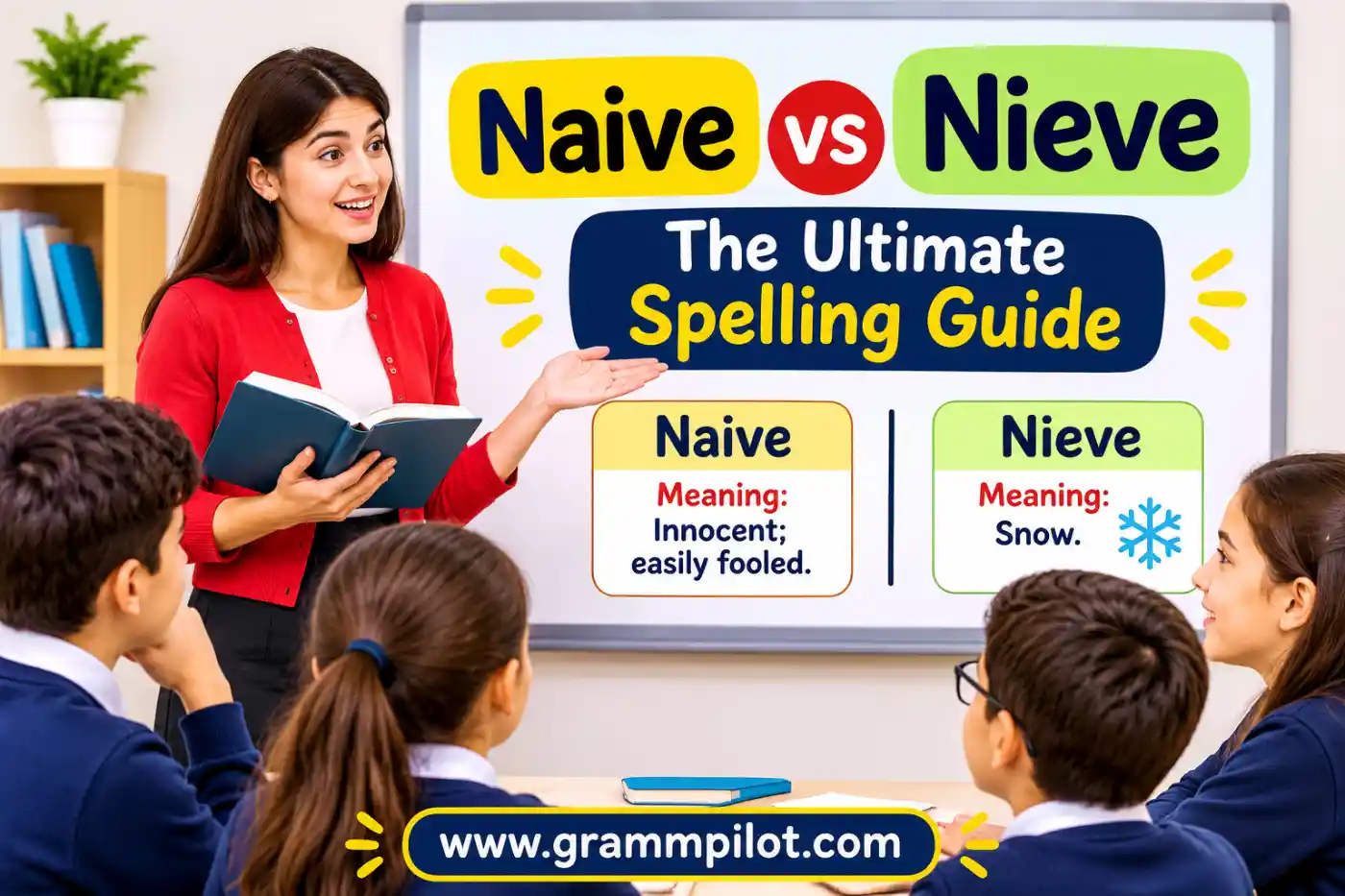
Have you ever written an email, school assignment, or social media post and paused because you weren’t sure about to write naive or nieve? These two spellings look similar, but only one is a correct English word with the meaning most people intend. The confusion is understandable. English has many words with unusual spelling patterns, and a small change in letters can make a big difference. If you’ve searched for Naive vs Nieve, you’re probably trying to find out which spelling is correct, what the word means, and how to use it naturally. The correct spelling is naive. It describes someone who lacks experience, knowledge, or judgment about a situation. Nieve is not the standard English spelling of this word.
Understanding the difference will help you avoid spelling mistakes and choose better words when describing someone’s behavior, attitude, or level of experience. In this guide, we’ll cover the origin and meaning of the word, useful synonyms, differences between similar expressions, real-life examples, common mistakes, and the best alternatives for professional and everyday writing.
What Is the Correct Spelling: Naive or Nieve?
The correct English spelling is naive. The spelling nieve is incorrect when you want to describe someone who is inexperienced, overly trusting, or lacking practical knowledge.
| Spelling | Correct? | Explanation |
|---|---|---|
| Naive | Yes | Standard English word |
| Nieve | No | Common spelling mistake |
| Naïve | Yes | Traditional spelling with a diaeresis |
Both naive and naïve are accepted spellings. The second version includes two dots over the letter i, called a diaeresis.
Examples:
- She was too naive to recognize the dishonest offer.
- His naive attitude made the situation more difficult.
- It was a naive decision to trust a stranger.
- The young student had a naive understanding of business.
Remember that the word has an i before the v. Writing it as nieve changes the correct spelling.
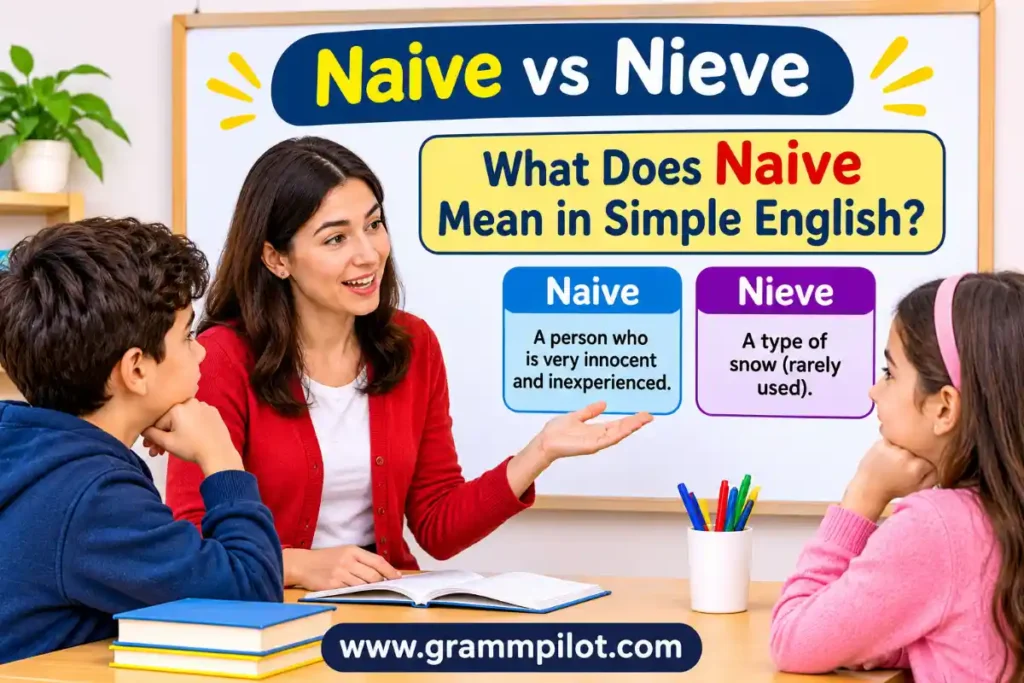
What Does Naive Mean in Simple English?
Naive describes a person who doesn’t have enough experience or knowledge to understand how a situation really works. A naive person may believe everything they hear, trust people too quickly, or fail to recognize possible problems. However, the word doesn’t always mean someone is unintelligent. A person can be intelligent, educated, and talented but still lack experience in a particular situation.
For example:
- A teenager may be naive about managing money.
- A new employee may be naive about office politics.
- Someone who believes every online advertisement may seem naive.
The word can describe different situations, depending on the context.
What Is the Origin of the Word Naive?
The word naive comes from the French word naïf, which means natural, innocent, or inexperienced. It has roots in the Latin word nativus, meaning native, natural, or inborn. The word entered English through French and gradually developed its modern meaning. Originally, it was closely connected with natural simplicity and innocence. Over time, English speakers began using it to describe people who lacked experience or practical judgment. Today, it can describe:
- A person who trusts others too easily.
- Someone who doesn’t understand a complicated situation.
- An innocent or inexperienced attitude.
- An unrealistic belief about how the world works.
This history explains why the word can have both positive and negative meanings.
What Are the Best Synonyms for Naive?
Choosing a synonym depends on what you want to communicate. Some alternatives describe innocence, while others suggest poor judgment or a lack of experience. Here are 32 useful alternatives grouped by tone.
1. Simple Synonyms
These words are easy to understand and work well in everyday conversations.
| Word | Meaning | Tone | Example |
|---|---|---|---|
| Innocent | Free from wrongdoing or guilt | Gentle | The innocent child trusted everyone. |
| Young | Lacking experience because of age or time | Neutral | He was young and inexperienced. |
| Simple | Not complicated or sophisticated | Neutral | She had a simple view of the problem. |
| Trusting | Ready to believe others | Positive | He was trusting with new friends. |
| Unaware | Not knowing about something | Neutral | They were unaware of the risks. |
| Inexperienced | Lacking practical knowledge | Neutral | The inexperienced worker needed help. |
| Unsuspecting | Not expecting danger or dishonesty | Neutral | The unsuspecting customer believed the story. |
| Gullible | Easily tricked or persuaded | Negative | Gullible buyers believed the fake advertisement. |
2. Everyday Synonyms
These words are useful in conversations, emails, and general writing.
| Word | Meaning | Tone | Example |
|---|---|---|---|
| Credulous | Too willing to believe things | Negative | He was credulous about online claims. |
| Childlike | Having qualities associated with children | Positive | Her childlike excitement was lovely. |
| Green | New or inexperienced | Informal | I’m still green at this job. |
| Unseasoned | Lacking experience | Neutral | The unseasoned player made several mistakes. |
| Unsophisticated | Lacking worldly knowledge | Neutral | His unsophisticated approach surprised everyone. |
| Impressionable | Easily influenced by others | Neutral | Young people can be impressionable. |
| Sheltered | Protected from difficult experiences | Neutral | She grew up in a sheltered environment. |
| Unworldly | Lacking knowledge of practical life | Neutral | His unworldly attitude seemed unusual. |
3. Formal Synonyms
These alternatives are more suitable for essays, reports, academic discussions, and professional writing.
| Word | Meaning | Tone | Example |
|---|---|---|---|
| Injudicious | Showing poor judgment | Formal | It was an injudicious financial decision. |
| Unsuspecting | Lacking awareness of a possible problem | Formal | The unsuspecting investor lost money. |
| Uninformed | Lacking necessary information | Formal | The uninformed decision created problems. |
| Unpracticed | Lacking practice or experience | Formal | The unpracticed speaker appeared nervous. |
| Artless | Natural, simple, or lacking sophistication | Formal | Her artless response showed honesty. |
| Uncritical | Not examining information carefully | Formal | An uncritical reader may accept false claims. |
| Callow | Immature or inexperienced | Formal | His callow behavior disappointed the team. |
| Naïf | An innocent or inexperienced person | Formal | The story follows a young naïf. |
4. Informal and Slang Alternatives
These expressions work better in casual conversations than in formal essays.
| Word | Meaning | Tone | Example |
|---|---|---|---|
| Greenhorn | A beginner with little experience | Informal | The greenhorn struggled during training. |
| Rookie | Someone new to an activity | Informal | The rookie made a simple mistake. |
| Wet behind the ears | Very inexperienced | Slang | He’s still wet behind the ears. |
| Clueless | Having little understanding | Informal | I was completely clueless about the rules. |
| Wide-eyed | Innocent and easily impressed | Informal | The wide-eyed tourist admired everything. |
| Easy mark | Someone easily tricked | Slang | The scammer searched for an easy mark. |
| Sucker | Someone easily fooled | Slang | Don’t be a sucker for fake promises. |
| Soft touch | Someone easily persuaded or taken advantage of | Informal | He was known as a soft touch. |
Important: These alternatives aren’t perfect replacements in every sentence. For example, innocent can sound positive, while gullible usually suggests that someone is easily fooled.
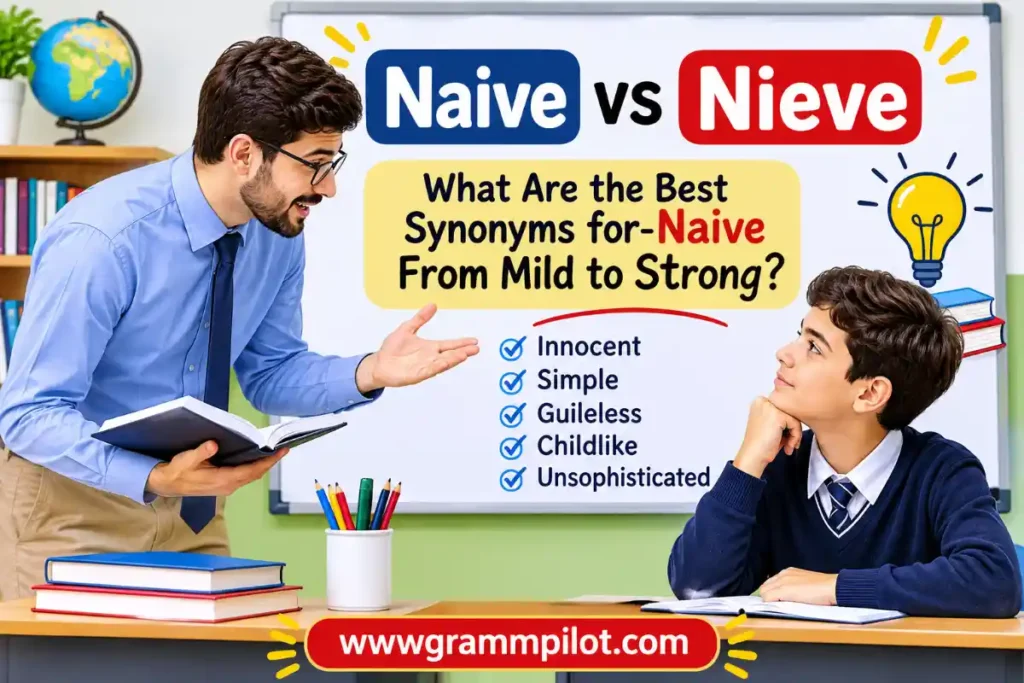
What Are the Best Synonyms for Naive From Mild to Strong?
Not every alternative expresses the same level of inexperience. Some sound gentle, while others strongly criticize someone’s judgment. Understanding this difference helps you select a word that matches your intended meaning.
Mild Alternatives
Use these words when you want to describe someone without sounding too critical.
- Innocent
- Trusting
- Childlike
- Unaware
- Open-hearted
- Sheltered
Example: “She had an innocent belief that every person wanted to help.”
Moderate Alternatives
These words suggest that someone needs more knowledge or practical experience.
- Inexperienced
- Unsophisticated
- Unseasoned
- Impressionable
- Unworldly
- Uninformed
Example: “His inexperienced approach caused a few problems during the project.”
Strong Alternatives
These words communicate poor judgment or an inability to recognize dishonesty.
- Gullible
- Credulous
- Clueless
- Foolish
- Injudicious
- Uncritical
Example: “It was foolish to believe the stranger without checking the facts.”
Very Strong or Critical Alternatives
These expressions can sound insulting, so use them carefully.
- Easily deceived
- Extremely gullible
- Thoughtless
- Foolhardy
- Simple-minded
Example: “His foolhardy decision put the entire team at risk.”
The strongest words should be used only when the situation truly supports that meaning.
What Part of Speech Is Naive?
Naive is an adjective. An adjective describes a person, place, thing, or idea. This word describes someone’s attitude, behavior, belief, or level of experience.
Examples:
- She is naive.
- That was a naive assumption.
- His naive approach created confusion.
- They made a naive decision.
Is Naivety a Noun?
Yes. Naivety is a noun that describes the quality or condition of being naive. Example: “His naivety made him an easy target for dishonest people.” Another accepted spelling is naiveté.
Is Naively an Adverb?
Yes. Naively is an adverb that describes an action performed in an inexperienced or overly trusting way. Example: “She naively believed the stranger’s explanation.”
What Is the Difference Between Naive, Naivety, and Naively?
| Word | Part of Speech | Meaning | Example |
|---|---|---|---|
| Naive | Adjective | Lacking experience or judgment | He is naive. |
| Naivety | Noun | The quality of being naive | His naivety was obvious. |
| Naively | Adverb | In an inexperienced way | She naively trusted him. |
These forms are related, but they have different grammatical roles.
How Do You Use Naive in Different Situations?
The best word depends on your audience and purpose. A synonym that works in a casual text may sound inappropriate in a professional document.
Naive vs Nieve in a Resume
When writing a resume, avoid describing yourself as naive. It can make employers question your professional judgment. Instead, use positive expressions that show you’re still learning.
Better alternatives include:
- Entry-level
- Developing
- Early-career
- Eager to learn
- Building practical experience
Example:
Instead of: “I am naive about professional communication.“
Write: “I am developing my professional communication skills and eager to gain practical experience.”
This sounds more confident and professional.
Naive vs Nieve in an Essay
In academic writing, naive can be useful when discussing unrealistic beliefs, assumptions, or limited understanding. However, choose a more precise alternative when possible.
Example: “Assuming that every online source provides accurate information is a naive approach to research.”
Other useful choices include:
- Uninformed assumption
- Unrealistic expectation
- Oversimplified belief
- Inexperienced perspective
Naive vs Nieve in Texting
In casual messages, the word is often used to describe someone who trusts others too easily.
Examples:
- “Don’t be so naive!”
- “I was naive to believe that story.”
- “That sounds like a pretty naive idea.”
You can also use gullible, clueless, or too trusting, depending on the situation.
Naive vs Nieve in an Email
Professional emails should communicate criticism politely.
Instead of writing: “Your idea is naive.”
Try: “I believe this approach may overlook a few important challenges.”
Other alternatives include:
- The plan may be unrealistic.
- We may need more information before proceeding.
- This approach could benefit from further consideration.
These expressions communicate disagreement without making the reader feel personally attacked.
Naive vs Nieve in Speaking
In everyday speech, people commonly use naive to describe inexperienced behavior.
Examples:
- “I was naive when I first started working.”
- “That’s a naive way to look at the situation.”
- “He isn’t stupid; he’s just inexperienced.”
When speaking, consider your tone. Calling someone naive directly can sound judgmental.
What Are 12 Examples of Naive in Real-Life Situations?
Examples make it easier to understand how a word works in different situations. Here are original sentences from everyday life.
1. School: The new student was naive about how difficult the final examination would be.
2. Friendship: She was naive to believe that every person who smiled at her was a true friend.
3. Business: The young entrepreneur made a naive assumption about how quickly the company would grow.
4. Online safety: It is naive to share personal information with strangers on the internet.
5. Relationships: He had a naive belief that love would solve every problem.
6. Travel: The inexperienced traveler was naive about the risks of carrying too much cash.
7. Workplace: Her naive understanding of office politics changed after her first month at work.
8. Money: It was naive to invest all his savings without researching the company.
9. Technology: Don’t be naive about online security; even familiar websites can have risks.
10. Family: His parents worried that his trusting nature made him naive.
11. Education: The student’s naive question helped the teacher explain the topic more clearly.
12. Personal growth: I was naive when I believed success would come without effort.
Notice that the word doesn’t always describe a person’s intelligence. It often describes their experience, expectations, or understanding of a particular subject.
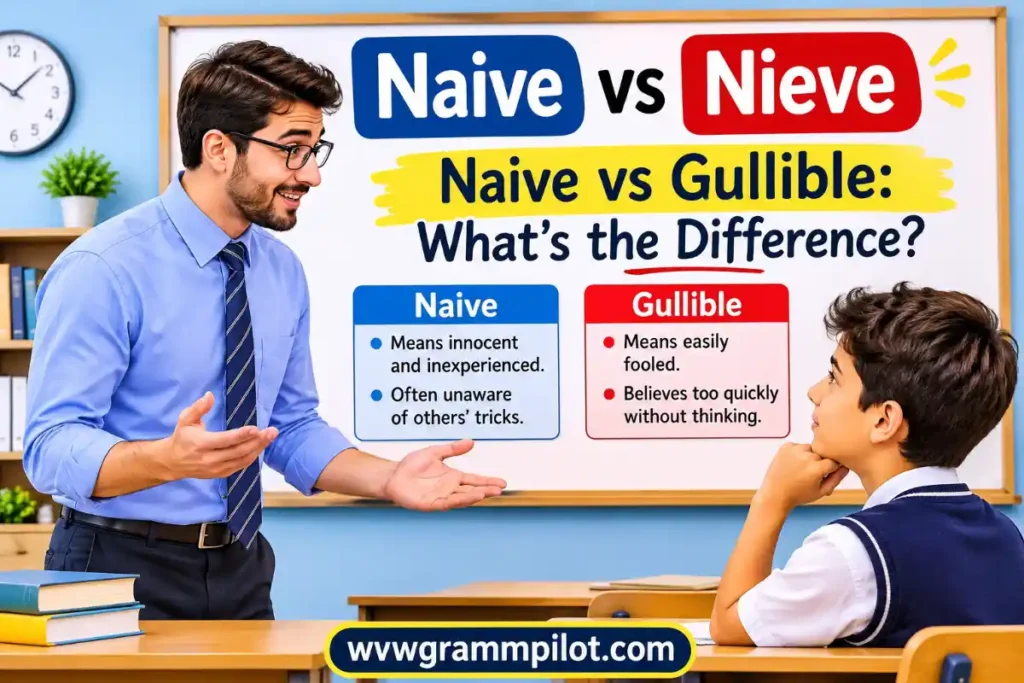
Naive vs Gullible: What’s the Difference?
Naive and gullible are related, but they don’t have exactly the same meaning.
It describes someone who lacks experience or practical understanding.
Gullible describes someone who is easily tricked because they believe things too readily.
| Naive | Gullible |
|---|---|
| Lacks experience or knowledge | Easily believes false information |
| Can be innocent or inexperienced | Usually has a negative meaning |
| Doesn’t always involve deception | Often involves being fooled |
| Can describe an idea or assumption | Commonly describes a person |
Examples:
- “He was naive about starting a business.”
- “He was gullible enough to believe the fake investment offer.”
A person can be naive without being gullible. However, a gullible person may also be naive about certain situations.
Is Naive Different in American and British English?
The meaning of naive is generally the same in American and British English. Both varieties accept the spellings naive and naïve. There are no major differences in the word’s basic meaning, although pronunciation and writing preferences may vary slightly between speakers and publications.
Here are some useful points:
- American English commonly uses naive without the accent marks.
- British English also accepts naive and naïve.
- Formal publications may prefer naïve.
- Everyday digital writing often uses naive because it is easier to type.
The incorrect spelling nieve does not become correct in British English.
What Are the Antonyms of Naive?
Antonyms are words with opposite meanings. The opposite of naive depends on the context. If you’re describing someone with practical experience, use experienced. If you’re describing someone who understands people and situations, use worldly or street-smart.
| Antonym | Meaning | Example |
|---|---|---|
| Experienced | Having practical knowledge | She is an experienced manager. |
| Wise | Showing good judgment | He made a wise decision. |
| Knowledgeable | Having useful information | She is knowledgeable about finance. |
| Sophisticated | Understanding complex situations | He has a sophisticated approach. |
| Cautious | Careful about possible risks | Be cautious with online offers. |
| Street-smart | Good at handling practical situations | She is street-smart and confident. |
| Skeptical | Not accepting claims without evidence | He remained skeptical of the offer. |
| Discerning | Able to judge things well | A discerning reader checks the facts. |
What Are the Most Common Mistakes When Using Naive?
Even though the word is simple, writers sometimes make spelling and grammar mistakes. Here are the most common ones to avoid.
1. Writing Nieve Instead of Naive
Incorrect: “He was nieve about the situation.”
Correct: “He was naive about the situation.”
The correct spelling contains the letters a, i, v, and e in that order.
2. Thinking Naive Means Stupid
Naive doesn’t automatically mean unintelligent. A person may be highly educated but inexperienced in a particular area.
For example: “She is a talented scientist but naive about business.” This sentence describes a gap in practical experience, not a lack of intelligence.
3. Using Naive When You Mean Innocent
These words are not interchangeable in every situation.
Incorrect: “The innocent man was naive of the crime.”
Better: “The innocent man had no involvement in the crime.”
Use innocent when discussing guilt or wrongdoing.
4. Using It to Insult Someone
Calling someone naive can sound disrespectful.
Instead of: “You’re naive if you think this plan will work.”
Write: “This plan may overlook some practical challenges.”
The second sentence is more constructive.
5. Confusing the Adjective and Noun
Incorrect: “His naive was obvious.”
Correct: “His naivety was obvious.”
Use naive to describe a person or idea and naivety to name the quality.
6. Assuming Every Trusting Person Is Gullible
Trusting someone doesn’t automatically mean they are easily fooled. A person can be trusting while still recognizing warning signs. Choose the word that accurately describes the behavior.
How Can You Choose the Right Word Instead of Naive?
Before choosing a synonym, think about the exact message you want to communicate.
Use these quick tips:
- For innocence: Choose innocent or childlike.
- For limited experience: Choose inexperienced or unseasoned.
- For excessive trust: Choose gullible or credulous.
- For a professional setting: Choose inexperienced or lacking practical knowledge.
- For poor judgment: Choose unwise or injudicious.
- For a beginner: Choose rookie or greenhorn.
- For a lack of awareness: Choose unaware or uninformed.
- For positive qualities: Choose open-hearted or trusting.
A good writer doesn’t simply replace one word with another. A good writer chooses the word that expresses the intended meaning most clearly.
Quick Memory Tricks: How Do You Remember the Correct Spelling?
If you frequently confuse the two spellings, try these simple techniques.
1. Remember the letter A.
The correct word begins with N-A-I. Think of the letter A as a reminder that naive is the accepted spelling.
2. Connect it with the word natural.
The word has historical connections with naturalness and innocence. This can help you remember its meaning.
3. Practice a short sentence.
Write this sentence a few times: “She was naive about the situation.”
4. Check the spelling before publishing.
If you’re writing an essay, article, or professional email, use a spellchecker to catch mistakes.
5. Remember the simple rule.
Naive is correct. Nieve is incorrect for the intended English meaning.
Final Teacher Explanation: What Should You Remember About Naive?
The most important thing to remember is that naive is the correct spelling when describing someone who lacks experience, knowledge, or practical judgment. The word can communicate innocence and honesty, but it can also suggest poor judgment or excessive trust. Its meaning depends on the situation.Use inexperienced when you want a neutral description, innocent when you want to highlight purity or lack of wrongdoing, and gullible when someone is easily fooled. Avoid writing nieve in essays, emails, reports, and everyday communication. Once you understand the spelling, meaning, and related words, choosing the right expression becomes much easier.

Conclusion
Understanding Naive vs Nieve is a simple but useful step toward better English writing. The correct spelling is naive, while nieve is a common spelling error when referring to someone who lacks experience or practical judgment. Remember that being naive doesn’t necessarily mean being unintelligent. It can describe innocence, limited knowledge, or excessive trust, depending on the situation. You can also choose more precise alternatives such as inexperienced, trusting, gullible, innocent, or unsophisticated. The best word depends on what you want your reader to understand. Pay attention to spelling, tone, and context, and your writing will become clearer and more natural. Keep practicing these differences, and you’ll feel more confident using English in everyday conversations and professional writing.
Frequently Asked Questions
1. Is it spelled naive or nieve?
The correct spelling is naive. Nieve is a common misspelling of the English word.
2. What does naive mean in simple English?
Naive means lacking experience, knowledge, or practical judgment. It can also describe someone who trusts others too easily.
3. Is naïve the same as naive?
Yes, both spellings are correct. The version with two dots over the i is the traditional spelling.
4. What’s another word to use instead of naive?
You can use inexperienced, innocent, trusting, gullible, or unsophisticated. Choose the alternative that best matches your intended meaning.
5. Is being naive a bad thing?
Not always. It can describe innocence and honesty, but it may also suggest poor judgment or a lack of awareness.
6. What is the noun form of naive?
The noun form is naivety or naiveté. Both describe the quality of being naive.
7. What is the opposite of naive?
Common opposites include experienced, wise, knowledgeable, cautious, worldly, and discerning.