
Have you ever stopped while writing an email or text and wondered whether you should write Piece of Mind vs Peace of Mind? You’re not alone. Many people type the wrong phrase because both expressions sound exactly the same. Spell check may even miss the mistake. The good news is that the correct choice is easy once you understand what each word means. After that, you’ll probably never confuse them again.
Answer Box:
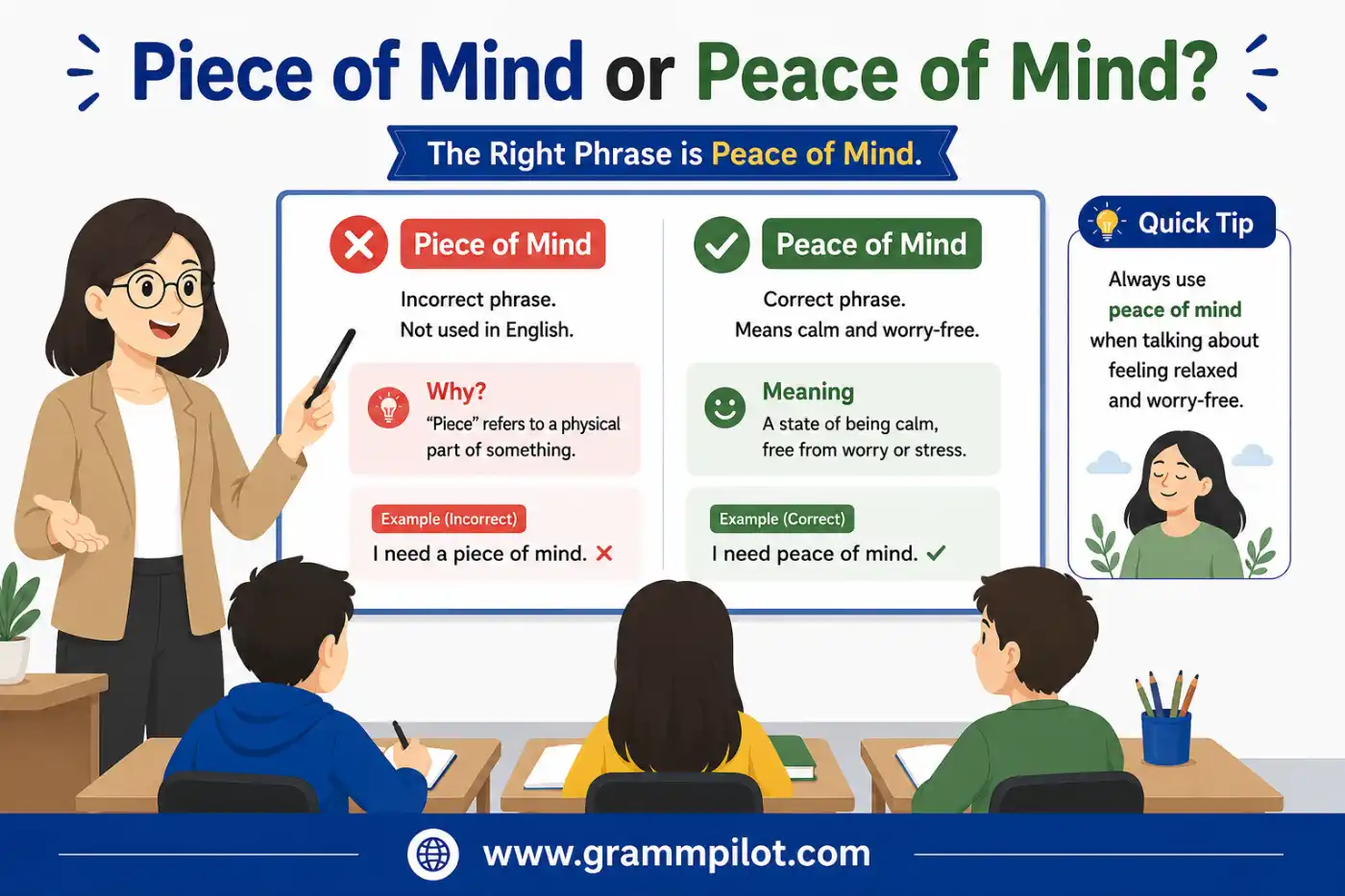
“Peace of mind” is the correct English expression. It means a feeling of calm, safety, or freedom from worry. “Piece of mind” is almost always a spelling mistake unless you’re talking about an actual piece or part of a mind in a very unusual context.
You can also compare this with the words discussed in [Than vs Then].
Is It “Peace of Mind” or “Piece of Mind”?
The correct expression is peace of mind. The phrase piece of mind is considered incorrect in almost every situation.
Here’s the difference at a glance:
| Phrase | Correct? | Meaning |
|---|---|---|
| Peace of mind | ✅ Yes | A feeling of calm, comfort, or freedom from worry |
| Piece of mind | ❌ No | Usually a spelling mistake with no accepted meaning |
Piece of Mind vs Peace of Mind: Why Do People Mix Them Up?
The answer is simple. The words peace and piece are homophones. That means they sound exactly alike but have different spellings and meanings.
- Peace = calm, quiet, no worry
- Piece = a part of something
Because they sound the same, many writers accidentally choose the wrong spelling.
For example:
❌ I finally have piece of mind after buying insurance.
✅ I finally have peace of mind after buying insurance.
The second sentence is the one native English speakers use.
What Does “Peace of Mind” Mean?
Peace of mind means you feel calm because you are not worried about something anymore. It describes a mental state where stress, fear, or uncertainty has gone away. You might experience peace of mind after:
- Locking your front door before leaving.
- Saving money for emergencies.
- Finishing a difficult exam.
- Backing up important files.
- Seeing your family arrive home safely.
- Buying travel insurance.
- Paying off a loan.
- Solving a problem that kept you awake.
Think of it as the opposite of anxiety. Instead of wondering what might go wrong, you feel confident that everything is under control.
Simple Definition
Peace of mind = freedom from worry.
That’s the easiest way to remember it.
What Does “Piece” Mean?
The word piece has a completely different meaning. A piece is one part of a whole.
Examples include:
- a piece of cake
- a piece of paper
- a piece of furniture
- a puzzle piece
- a piece of chocolate
- a piece of music
Notice that all of these describe physical objects or separate parts. Since mind is not something you normally divide into pieces in everyday English, the phrase piece of mind doesn’t make sense.
Word Origin: Where Did “Peace of Mind” Come From?
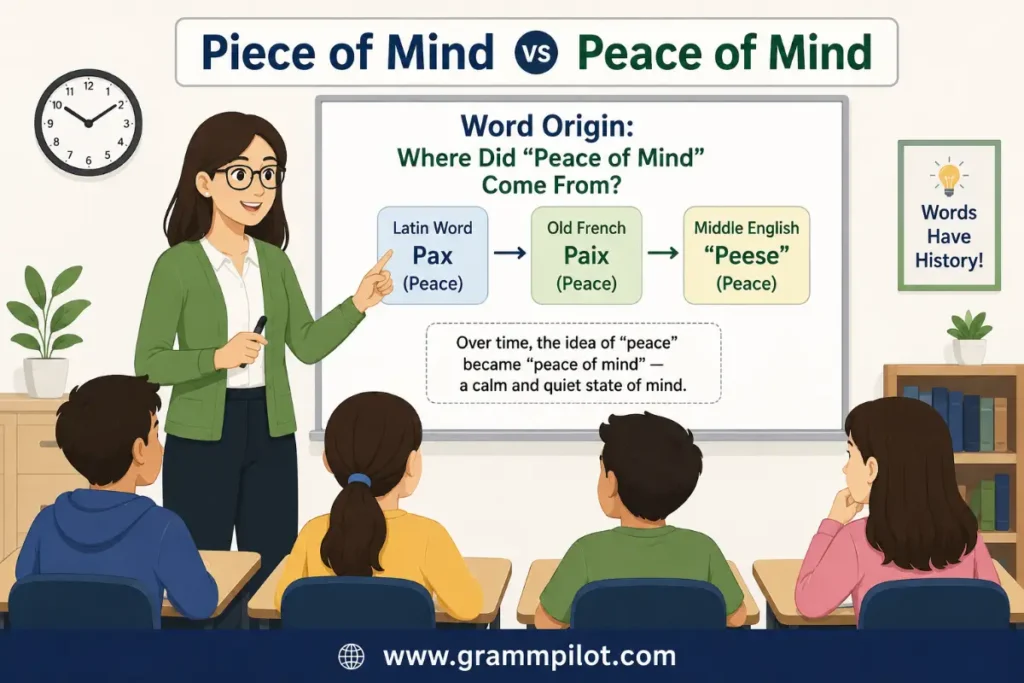
Many websites simply tell you which spelling is correct. Few explain why the phrase exists. The word peace comes from the Latin word pax, meaning calm, agreement, or freedom from conflict. Over time, English adopted the idea of peace not only between countries or people but also inside a person’s thoughts. The word mind comes from Old English and refers to your thoughts, memory, understanding, and emotions. When these two words came together, peace of mind described a calm mental state. Instead of worrying, you feel secure. Instead of feeling nervous, you feel relaxed. Today, the phrase is common in everyday English around the world.You’ll hear it in conversations, advertisements, books, news articles, business writing, and even legal documents. Companies often promise products that provide peace of mind because people value feeling safe and protected.
For example:
- Home security systems offer peace of mind.
- Health insurance gives families peace of mind.
- Password managers provide peace of mind online.
- Emergency savings bring peace of mind during difficult times.
The meaning has stayed almost the same for hundreds of years.
Is “Piece of Mind” Ever Correct?
Almost never.
In everyday English, you should avoid writing it. There are only a few rare situations where the words might appear together naturally.
For example:
- The scientist imagined each memory as a piece of mind in a science fiction story.
- The artist created a sculpture representing a piece of the human mind.
These are creative or literary uses. They are not the common English expression. If your goal is normal communication, always write peace of mind.
How Can You Remember the Correct Spelling?
A simple memory trick can save you from making this mistake again.
Think About the Meaning
Ask yourself: Are you talking about feeling calm?
If yes, the answer is peace. Peace means calm. Calm belongs in your mind.
So: Peace → Calm → Mind
Remember This Sentence
Peace brings peace of mind. Both words use the same spelling.
Another Easy Trick for Piece of Mind vs Peace of Mind
Imagine sitting quietly at a beach. The waves are gentle. The wind is soft. You feel relaxed.
That’s peace, not a piece. Whenever you think about feeling relaxed, think of the spelling peace.
Why This Mistake Is So Common Online
Search engines receive thousands of searches every month for piece of mind because many people type what they hear instead of what they know. This happens because English has many homophones.
Some common examples include:
| Incorrect Confusion | Correct Choice |
|---|---|
| Your / You’re | Depends on the sentence |
| Their / There / They’re | Different meanings |
| Brake / Break | Different words |
| Compliment / Complement | Different meanings |
| Principal / Principle | Different meanings |
| Peace / Piece | Different meanings |
Even experienced writers occasionally type the wrong version when writing quickly. That’s why proofreading is important. If you’re talking about feeling safe, calm, or free from worry, the correct phrase is always peace of mind.
Why “Peace of Mind” Matters in Everyday English
This phrase appears in many situations because everyone understands the feeling it describes.
You might hear it:
- At a doctor’s office.
- In a bank advertisement.
- During a job interview.
- In customer service emails.
- In travel guides.
- While shopping for insurance.
- During conversations with friends.
- In school writing.
- In business presentations.
It works because it’s short, clear, and easy to understand. Native speakers use it naturally without thinking about its grammar. If you learn this one phrase correctly, your writing will immediately sound more natural.
When Should You Use “Peace of Mind”?
Use the phrase whenever you want to describe relief, comfort, confidence, or emotional security.
Here are a few common situations:
| Situation | Example |
|---|---|
| Money | Having an emergency fund gives me peace of mind. |
| Health | The doctor’s report gave her peace of mind. |
| Travel | Travel insurance offers peace of mind during vacations. |
| Technology | Backing up my files gives me peace of mind. |
| Family | Calling my parents every evening gives me peace of mind. |
| Home | Locking every window before bed gives us peace of mind. |
| School | Finishing my homework early gives me peace of mind. |
| Work | Double-checking the report gave me peace of mind. |
Notice that every example involves feeling less worried after taking some action. That is the heart of the expression.
Master Synonym List for “Peace of Mind”
Sometimes you don’t want to repeat the same phrase. While peace of mind is often the best choice, there are many related words and expressions that fit different situations. Some sound casual, while others are better for formal writing.
Remember that none of these synonyms mean exactly the same thing in every sentence. The best choice depends on the context.
| Word or Phrase | Meaning | Tone | Example |
|---|---|---|---|
| Comfort | A feeling of safety | Everyday | Her advice brought comfort. |
| Ease | Freedom from stress | Everyday | The news put everyone at ease. |
| Serenity | Deep calm | Formal | The quiet lake gave her serenity. |
| Tranquility | Peaceful state | Formal | The garden offered tranquility. |
| Assurance | Confidence that all is well | Formal | The guarantee gave customers assurance. |
| Confidence | Trust that things will work out | Everyday | Practice gave him confidence. |
| Safety | Freedom from danger | Everyday | Helmets improve safety. |
| Certainty | Knowing something is true | Formal | The results gave us certainty. |
| Stability | A secure condition | Formal | A steady income creates stability. |
| Well-being | Healthy and comfortable life | Formal | Exercise supports well-being. |
| Emotional balance | Stable emotions | Formal | Therapy improved her emotional balance. |
| Harmony | Things working together peacefully | Formal | Family harmony is important. |
| Restfulness | A peaceful state | Formal | The quiet room created restfulness. |
| Calmness | Lack of stress | Everyday | Her calmness impressed everyone. |
| Relaxation | Reduced stress | Everyday | Reading helps with relaxation. |
| Mental comfort | Emotional ease | Formal | Honest communication creates mental comfort. |
| Emotional security | Feeling emotionally safe | Formal | Trust builds emotional security. |
| Stability of mind | Steady thinking | Formal | Good habits encourage stability of mind. |
| Rest | Mental or physical recovery | Everyday | A weekend off gave him rest. |
| Quiet mind | Thoughts free from stress | Everyday | A walk gave me a quiet mind. |
These alternatives help make your writing more interesting without changing your message.
Synonyms by Intensity
Some words express only a little relief, while others suggest complete calm.
| Intensity | Synonyms |
|---|---|
| Very Mild | Ease, comfort, calm |
| Mild | Relief, reassurance, security |
| Medium | Confidence, certainty, satisfaction |
| Strong | Serenity, tranquility, contentment |
| Very Strong | Inner peace, emotional balance, complete peace, total calm |
Choose the strength that matches your situation.
For example:
- Finishing today’s homework may give you relief.
- Paying off your house might bring peace of mind.
- Spending a quiet week in nature could create serenity.
Synonyms by Part of Speech
Although peace of mind is a noun phrase, related words appear in different forms.
| Part of Speech | Examples |
|---|---|
| Nouns | peace, calm, comfort, reassurance, relief, tranquility, confidence, serenity, certainty |
| Adjectives | peaceful, calm, secure, confident, relaxed, comfortable, reassured |
| Verbs | reassure, comfort, calm, relax, settle, encourage, protect |
| Adverbs | peacefully, calmly, confidently, comfortably |
Examples:
Noun
The safety plan gave everyone peace of mind.
Adjective
She felt peaceful after hearing the good news.
Verb
The teacher reassured the students before the exam.
Adverb
He slept peacefully through the night.
Using different parts of speech keeps your writing smooth and natural.
Is There a Difference Piece of Mind vs Peace of Mind Between US and UK English?
Not really. Both American English and British English use peace of mind in exactly the same way. The spelling is also identical. You do not need to change the phrase for different English-speaking countries.
Examples from both regions:
American English: “The warranty gives buyers peace of mind.”
British English: “Having travel insurance provides peace of mind.”
The phrase sounds natural everywhere English is spoken.
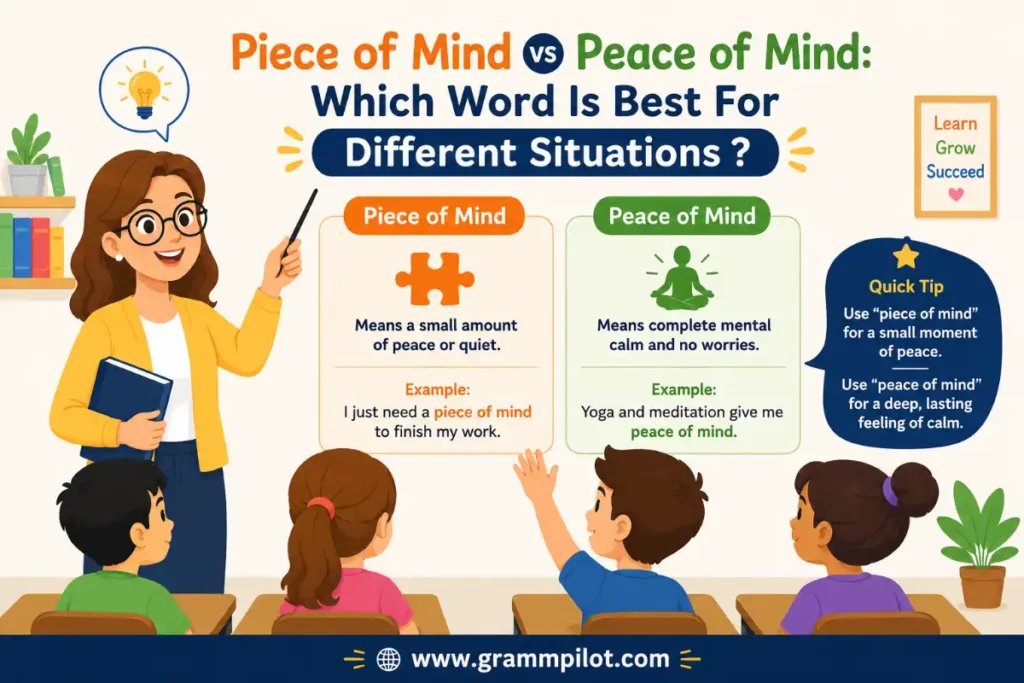
Piece of Mind vs Peace of Mind: Which Word Is Best For Different Situations ?
Different situations call for different wording.
Best Word for a Resume
A resume usually focuses on skills and achievements.
Instead of saying: “I give customers peace of mind.”
You can write: “I provide reassurance through excellent customer service.”
Other good choices include:
- confidence
- assurance
- reliability
- trust
Example: “My attention to detail gave clients confidence in every project.”
Best Word for an Essay
Essays often sound better with slightly more formal vocabulary.
Good choices include:
- reassurance
- certainty
- confidence
- serenity
- emotional security
Example: “Financial planning gives many families a greater sense of security.”
Best Word for Text Messages
Friends usually use simple language.
Examples:
- Don’t worry.
- Everything’s okay.
- That makes me feel better.
- What a relief!
- Now I can relax.
- I finally feel at ease.
These sound more natural than using formal vocabulary.
Best Word for Emails
Professional emails should sound polite and clear.
Examples:
“Please let me know once you receive the documents. It will give me peace of mind.”
“The confirmation email provided reassurance that my order was successful.”
“Receiving your reply would help put my mind at ease.”
These phrases sound professional without being stiff.
Best Word for Speaking
In conversations, people often choose short, natural expressions.
Common choices include:
- I feel better now.
- That’s a relief.
- I can finally relax.
- Everything is under control.
- I don’t have to worry anymore.
- That puts my mind at ease.
These expressions appear in everyday American English much more often than formal alternatives.
Piece of Mind vs Peace of Mind: Which Expression Sounds Most Natural?
Native speakers usually choose based on the situation.
| Situation | Best Choice |
|---|---|
| Everyday conversation | Peace of mind |
| Family discussion | Relief |
| Business email | Reassurance |
| Academic essay | Assurance or security |
| Customer service | Peace of mind |
| Advertisement | Peace of mind |
| Healthcare | Reassurance |
| Financial writing | Security |
| Legal writing | Assurance |
| Public speaking | Confidence or peace of mind |
There is no single synonym that replaces peace of mind every time.
The original phrase remains the clearest choice whenever you’re talking about feeling free from worry.
Why Do Companies Love the Phrase “Peace of Mind”?
You’ll notice this expression in advertisements because it connects with something almost everyone wants. People don’t just buy products.
They buy confidence.
They buy reassurance.
For example:
- Security companies promise peace of mind through home protection.
- Insurance companies promise peace of mind during emergencies.
- Banks promise peace of mind by protecting your money.
- Software companies promise peace of mind by keeping your files safe.
- Car manufacturers promise peace of mind with long warranties.
The phrase appeals to emotions rather than just facts. Instead of saying a product is “good,” companies show how it helps customers worry less. That’s one reason the expression has remained popular for decades.
Real-Life Example Sentences Using “Piece of Mind vs Peace of Mind”
The best way to remember a phrase is to see it in real situations. These examples show how peace of mind fits naturally into everyday English.
- Buying travel insurance gave us peace of mind during our vacation.
- I always back up my computer files for peace of mind.
- Locking the front door before bed gives my family peace of mind.
- The doctor’s phone call gave her peace of mind after a stressful week.
- Saving a little money each month brings peace of mind for unexpected expenses.
- The company offers a two-year warranty for customers’ peace of mind.
- Knowing my children arrived safely gave me peace of mind.
- He checked his homework twice for peace of mind before turning it in.
- Installing smoke detectors gave the homeowners peace of mind.
- Receiving the acceptance email gave the student peace of mind.
- A regular health checkup can give you peace of mind.
- Keeping copies of important documents provides peace of mind while traveling.
- She called her grandparents every evening because it gave her peace of mind.
- Wearing a seat belt gives drivers and passengers peace of mind.
- Double-checking the report before sending it gave the manager peace of mind.
Notice that the phrase usually follows an action that reduces worry.
What Are Some Common Expressions with Piece of Mind vs Peace of Mind?
English speakers often use this phrase in predictable patterns.
Here are the most common ones.
| Expression | Example |
|---|---|
| Give someone peace of mind | The security system gave us peace of mind. |
| Bring peace of mind | Good planning brings peace of mind. |
| Enjoy peace of mind | Customers enjoy peace of mind with the warranty. |
| Have peace of mind | You’ll have peace of mind after finishing the project. |
| Find peace of mind | Many people find peace of mind through meditation. |
| Offer peace of mind | The guarantee offers peace of mind. |
| Provide peace of mind | Insurance provides peace of mind. |
| Gain peace of mind | She gained peace of mind after talking to her doctor. |
Learning these patterns will make your English sound more natural.
Peace of Mind vs. Relief
These words are closely related, but they are not identical.
| Peace of Mind | Relief |
|---|---|
| A lasting feeling of calm | A feeling after stress ends |
| Often continues for a long time | Often happens immediately |
| Focuses on emotional security | Focuses on the end of worry |
| Can describe an ongoing condition | Usually describes a moment |
Examples:
Relief
“I felt relief when I passed the driving test.”
The stressful event is over.
Peace of Mind
“Having my driver’s license gives me peace of mind.”
The calm feeling continues after the event.
Think of relief as the moment the pressure disappears.
Think of peace of mind as the calm that follows.
Peace of Mind vs. Confidence
These two ideas are also different.
| Peace of Mind | Confidence |
|---|---|
| Feeling free from worry | Believing in your ability |
| Emotional comfort | Self-belief |
| Focuses on calm | Focuses on trust in yourself or others |
Example:
“I studied every day, so I felt confident during the exam.”
“I checked my answers twice, which gave me peace of mind.”
Confidence comes before or during an action. Peace of mind often comes after you’ve done something to reduce worry.
Peace of Mind vs. Security
People often use these words together, but they have different meanings.
| Peace of Mind | Security |
|---|---|
| A feeling | A condition or protection |
| Emotional state | Physical or financial safety |
| Happens inside your mind | Often comes from outside protection |
Example:
“A home alarm system improves security.”
“The alarm system gives homeowners peace of mind.”
Security is the cause. Peace of mind is the result.
When Should You NOT Use “Peace of Mind”?
Even though it’s a useful phrase, it doesn’t fit every situation.
Avoid using it when you’re talking about physical objects.
Incorrect: “I found a peace of mind on the table.”
Correct: “I found a piece of paper on the table.”
Don’t use it when you mean only a small part of something.
Incorrect: “Can I have a peace of cake?”
Correct: “Can I have a piece of cake?”
Avoid replacing words like confidence, ability, or success with peace of mind.
Incorrect: “She has peace of mind in math.”
Correct: “She has confidence in math.”
The phrase only works when you’re talking about feeling calm or free from worry.
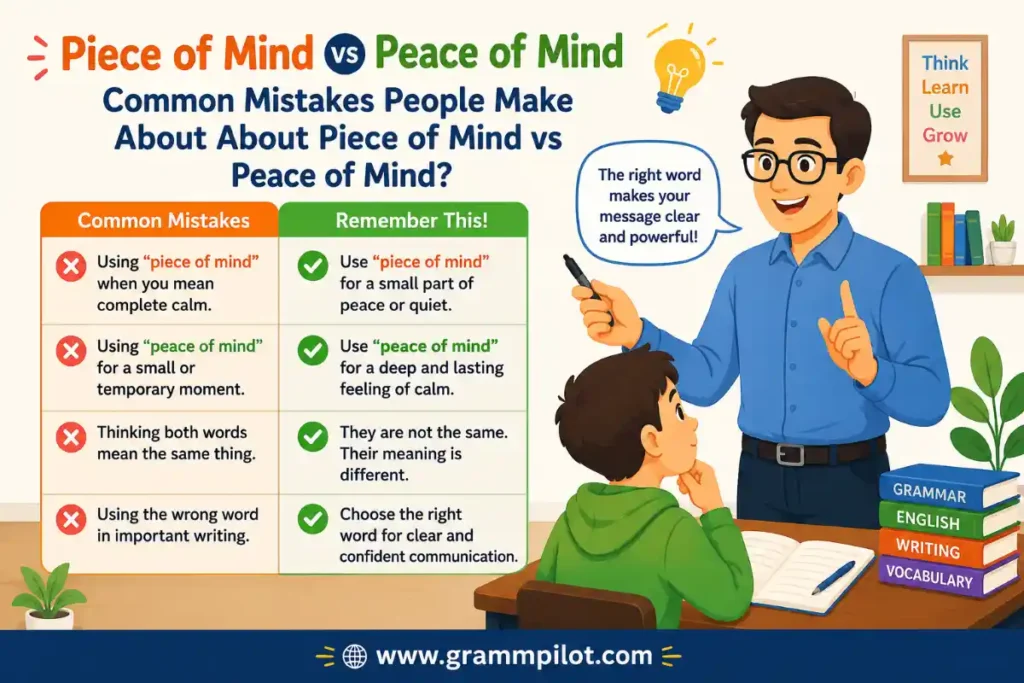
Common Mistakes People Make About About Piece of Mind vs Peace of Mind
Many English learners make the same mistakes.
Here are the most common ones.
Mistake 1: Writing “Piece of Mind”
❌ Piece of mind
✅ Peace of mind
This is the biggest mistake because the words sound the same.
Mistake 2: Thinking Spell Check Will Catch It
Most spell checkers accept both peace and piece because each is a correctly spelled English word. That means the software may not notice you’ve chosen the wrong one. Always proofread carefully.
Mistake 3: Using It Too Often
Instead of repeating the phrase in every paragraph, vary your language.
You can use:
- relief
- reassurance
- confidence
- calm
- security
- certainty
- comfort
This makes your writing smoother.
Mistake 4: Using It for Physical Things
Remember that peace is an idea. Piece is something you can count or hold. Keeping this difference in mind makes choosing the correct spelling much easier.
Mistake 5: Confusing It with “Speak Your Mind”
These expressions have different meanings.
Peace of mind
Feeling calm.
Speak your mind
Say exactly what you think.
Examples:
“I finally have peace of mind after paying the bill.”
“You should speak your mind during the meeting.”
Don’t mix these expressions.
What Are the Antonyms of “Peace of Mind”?
Antonyms express the opposite idea.
Here are some common opposites.
| Antonym | Meaning |
|---|---|
| Worry | Feeling concerned |
| Anxiety | Strong nervousness |
| Stress | Mental pressure |
| Fear | Feeling afraid |
| Panic | Sudden extreme fear |
| Uneasiness | Feeling uncomfortable |
| Doubt | Lack of confidence |
| Concern | Something causing worry |
| Distress | Great emotional pain |
| Tension | Mental strain |
Examples:
“Instead of peace of mind, she felt anxiety before the interview.”
“Without enough preparation, many students experience stress.”
These words are useful when describing negative emotions.
Quick Tips for Choosing the Right Word Piece of Mind vs Peace of Mind
If you’re unsure which spelling to use, these simple tips can help.
- If you mean calm, choose peace.
- If you mean part of something, choose piece.
- Remember that peace relates to emotions.
- Remember that piece relates to objects.
- Read the sentence aloud and ask what you’re actually describing.
- Think about whether you’re talking about worry or about a physical part.
- Don’t rely only on spell check.
- Proofread emails, essays, and reports before sending them.
- Practice using the phrase in your own sentences until it becomes natural.
Simple memory tricks often work better than grammar rules.
Trick 1: Peace Means Calm
Peace equals calm. Calm belongs in your thoughts. So the phrase is peace of mind.
Trick 2: Piece Means Part
A piece is something you can count. A piece of pizza. A bite of chocolate. Not a feeling.
Trick 3: Think About the Word “Mind”
Your mind isn’t something you normally divide into pieces.
Instead, you want your mind to be peaceful.
Trick 4: Remember the Letter “A”
The word peace contains the letter A. Think of A = At ease. If you’re at ease, you have peace of mind.
Trick 5: Use This Simple Sentence
“Peace brings peace of mind.”
Reading this sentence a few times makes the correct spelling much easier to remember. By using these tips and practicing the phrase in real situations, you’ll avoid one of the most common homophone mistakes in English.
Final Teacher Explanation
If you only remember one thing from this guide, remember this:
Peace of mind is the correct expression whenever you mean a feeling of calm, comfort, or freedom from worry. The phrase has been part of English for centuries and is used in everyday conversations, business writing, advertisements, books, and formal communication.
The confusion happens because peace and piece sound exactly the same. They are homophones, but they have completely different meanings. Peace is about calm and emotional comfort, while piece means a part of something. Once you connect the meaning with the spelling, choosing the correct phrase becomes much easier.
Whenever you write an email, school assignment, social media post, or business document, take a second to think about what you want to say. If you’re talking about feeling less worried, the answer is always peace of mind.
The more you read and use the phrase correctly, the more natural it will become.
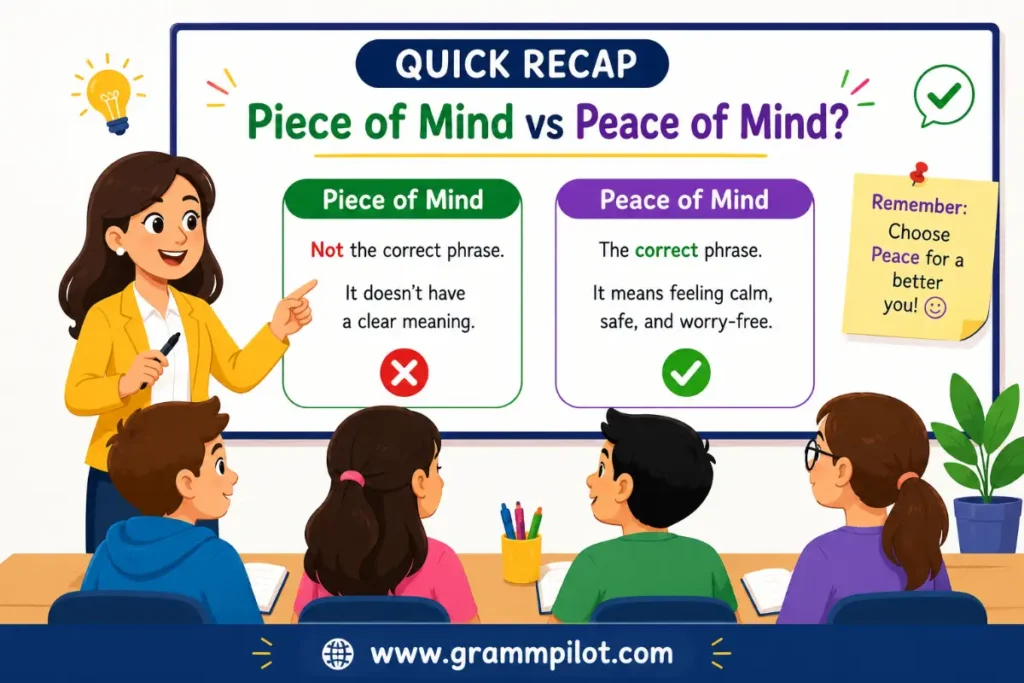
Quick Recap Piece of Mind vs Peace of Mind
If you’re wondering whether to write {Piece of Mind or Peace of Mind}, the correct choice is peace of mind. It means feeling calm, safe, or free from worry. The spelling piece of mind is almost always a mistake because piece refers to a part of something, not an emotional state.
Remember this simple rule: Peace means calm. Piece means part. If you’re talking about your feelings, choose peace every time.
Conclusion
Choosing between {Piece of Mind or Peace of Mind} becomes easy once you understand the meaning behind each word. Peace of mind is the only correct expression when you mean feeling calm, secure, or free from worry. Since peace and piece sound alike, it’s easy to make the mistake, but remembering that peace is connected with calm will help you avoid it every time.
Whether you’re writing an email, an essay, a social media post, or an important business document, using the correct phrase makes your writing look more profes
Frequently Asked Questions
1. Is “piece of mind” ever correct?
In normal English, no.Piece of Mind or Peace of Mind has only one correct expression for everyday use, and that is peace of mind. The version with piece appears only in very rare creative or fictional writing.
2. Why do people confuse Piece of Mind vs Peace of Mind?
Because they are homophones. They sound exactly the same but have different spellings and meanings, making them one of the most common English spelling mistakes.
3. What’s another way to say “peace of mind”?
Some good alternatives include relief, reassurance, calm, comfort, security, confidence, serenity, tranquility, and freedom from worry. The best choice depends on your sentence and tone.
4. Can I use “peace of mind” in professional emails?
Yes. It is a common and professional phrase in business emails, customer service, finance, healthcare, and legal writing. It clearly communicates that something reduces worry or provides reassurance.
5. Is “peace of mind” formal or informal?
It works in both. You can use it in casual conversations, essays, business documents, presentations, and professional emails without sounding unnatural.
6. How can I remember the correct spelling?
Think of this simple rule: Peace brings calm. If you’re talking about feeling calm or relaxed, use peace. If you’re talking about a part of something, use piece.
7. Is “peace of mind” used in American and British English?
Yes. The phrase is common in both American English and British English, and the spelling is exactly the same in both varieties of English.