
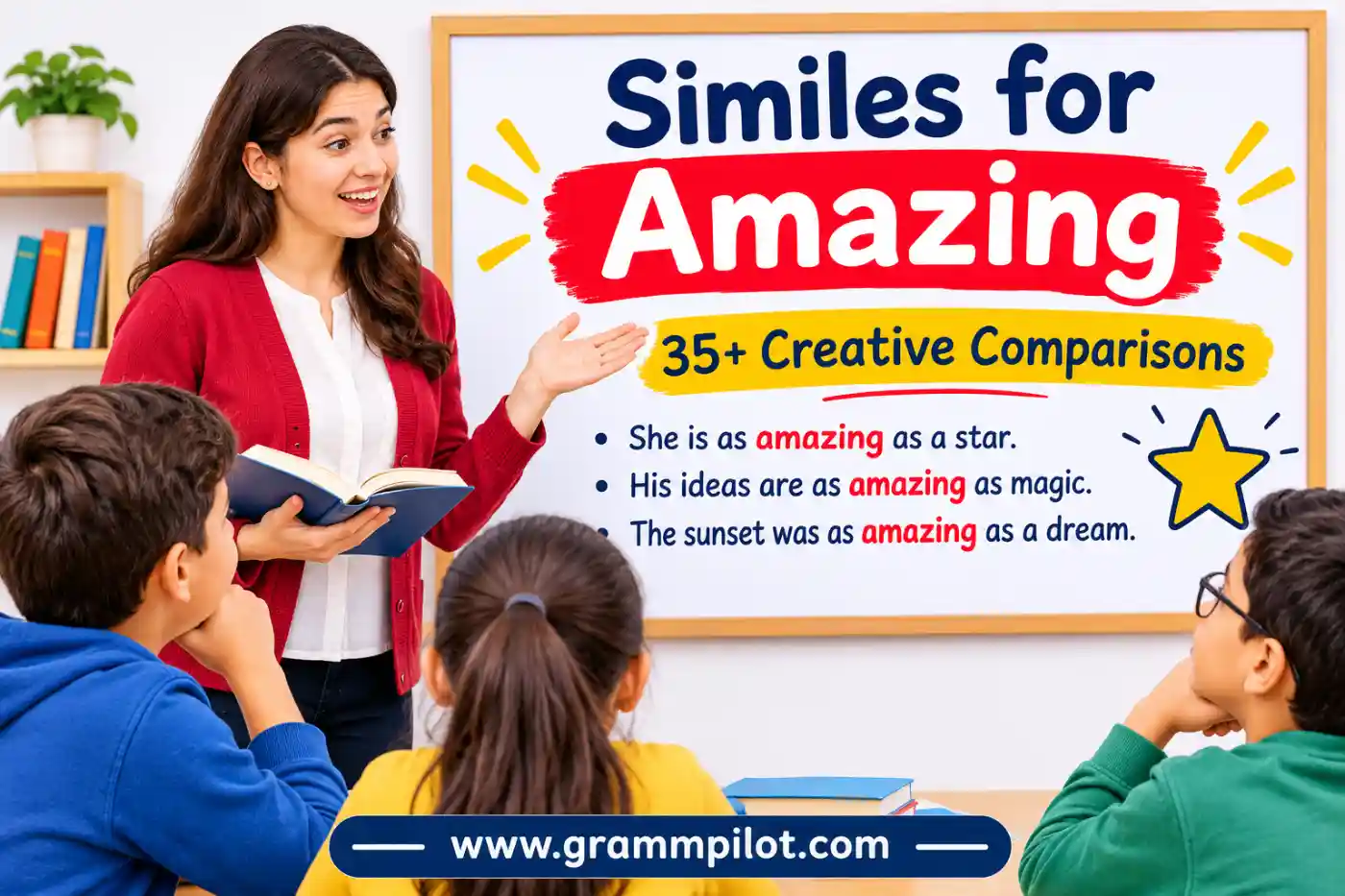
Imagine you’re writing a school essay about a beautiful sunset. You type, “The sunset was amazing.” It sounds fine, but it doesn’t help readers picture what you saw. Now imagine writing, “The sunset spread across the sky like a painting filled with fire.” The second sentence feels more alive because it uses a simile. Similes for Amazing help you describe something impressive, beautiful, exciting, or unforgettable. They compare an amazing person, place, event, or experience with something familiar. This makes your writing more colorful and easier to imagine.
Quick Answer: A simile for amazing compares something wonderful or impressive to another thing using words such as like or as. For example, “Her voice was as beautiful as a song” makes the quality of her voice easier to picture. You can use these comparisons in stories, essays, poems, conversations, and everyday messages. Below, you’ll find creative examples, meanings, useful alternatives, common mistakes, and tips for choosing the right expression. Another useful figurative-language technique is explained in Similes for Beauty.
1. What Does Amazing Mean in Simple English?
The word amazing describes something that makes you feel surprised, impressed, excited, or full of admiration. It can describe a person, achievement, place, performance, idea, or experience.
For example:
- The magician performed an amazing trick.
- We had an amazing time at the beach.
- Her artwork was amazing.
- The mountain view was amazing.
In each sentence, amazing tells readers that something is special or impressive.
What Is the Origin of the Word Amazing?
The word amazing comes from the verb amaze, which has roots in older English words connected with wonder, surprise, and confusion. Over time, its meaning developed to describe something that causes great surprise or admiration. Today, people use amazing in both casual and formal situations. It can describe something beautiful, unusually good, exciting, or difficult to believe.
What Is a Simile?
A simile is a figure of speech that compares two different things using like or as.
For example:
- Her smile was as bright as the morning sun.
- The fireworks burst like colorful stars.
- His performance was like magic.
These comparisons help readers understand an idea through familiar images. A simile doesn’t mean that two things are actually the same. It highlights a shared quality, such as beauty, brightness, strength, speed, or excitement.

2. What Are the Best Similes for Amazing?
Here are 35 creative comparisons you can use to describe something wonderful or impressive. Each group focuses on a different quality.
Similes for Amazing Beauty
Use these comparisons when describing nature, artwork, people, or special places.
- As beautiful as a blooming rose: The garden was as beautiful as a blooming rose.
- Like a painting come to life: The valley looked like a painting come to life.
- As bright as a thousand stars: Her smile was as bright as a thousand stars.
- Like a jewel in the sunlight: The lake sparkled like a jewel in the sunlight.
- As lovely as a spring morning: The little village was as lovely as a spring morning.
- Like a dream made real: The wedding decorations looked like a dream made real.
- As graceful as a dancing flame: The dancer moved as gracefully as a dancing flame.
Similes for Amazing Talent and Skill
These comparisons work well when describing a talented person, a great performance, or an impressive achievement.
- As sharp as a razor: Her mind was as sharp as a razor.
- Like a master at work: The artist painted like a master at work.
- As smooth as silk: His piano performance was as smooth as silk.
- Like a shooting star: The young singer performed like a shooting star.
- As precise as a clock: Her movements were as precise as a clock.
- Like a magician at work: The chef worked like a magician, turning simple ingredients into a wonderful meal.
- As powerful as a thunderstorm: His speech was as powerful as a thunderstorm.
Similes for Amazing Experiences
Use these to describe exciting trips, celebrations, surprises, and unforgettable moments.
- Like riding a roller coaster: The concert felt like riding a roller coaster.
- As exciting as a grand adventure: Our camping trip was as exciting as a grand adventure.
- Like fireworks in the sky: The celebration burst with energy like fireworks in the sky.
- As unforgettable as a first kiss: Our first trip together was as unforgettable as a first kiss.
- Like stepping into another world: Visiting the museum felt like stepping into another world.
- As thrilling as a championship game: The final match was as thrilling as a championship game.
- Like a dream come true: Meeting my favorite author was like a dream come true.
Similes for Amazing Ideas and Achievements
These comparisons help explain impressive plans, discoveries, inventions, and results.
- As brilliant as a flash of lightning: Her solution was as brilliant as a flash of lightning.
- Like opening a door to a new world: The invention was like opening a door to a new world.
- As groundbreaking as the first flight: Their discovery was as groundbreaking as the first flight.
- Like a spark that starts a fire: His idea was like a spark that starts a fire.
- As strong as an iron bridge: Their teamwork was as strong as an iron bridge.
- Like climbing to the top of a mountain: Finishing the project felt like climbing to the top of a mountain.
- As impressive as a world record: Her achievement was as impressive as a world record.
Short and Catchy Similes for Amazing
These simple comparisons work well in texts, captions, and everyday conversations.
- Like pure magic: The surprise party was like pure magic.
- As cool as ice: He stayed as cool as ice during the competition.
- Like a burst of sunshine: Her cheerful message was like a burst of sunshine.
- As rare as a diamond: An opportunity like this is as rare as a diamond.
- Like a star on stage: The young performer shone like a star on stage.
- As sweet as honey: Her kind words were as sweet as honey.
- Like lightning in motion: The athlete moved like lightning in motion.
3. What Are Some Synonyms for Amazing?
Sometimes, you may want to replace amazing instead of using a comparison. These alternatives help you avoid repeating the same adjective.
Simple Synonyms
- Great: Very good. Example: We had a great day.
- Wonderful: Extremely pleasing. Example: She gave a wonderful performance.
- Lovely: Beautiful or enjoyable. Example: It was a lovely evening.
- Excellent: Very high in quality. Example: He did an excellent job.
- Fantastic: Extremely good. Example: The food was fantastic.
- Beautiful: Very attractive. Example: The view was beautiful.
- Awesome: Very impressive. Example: That was an awesome idea.
Everyday Synonyms
- Impressive: Makes people admire it. Example: Her progress was impressive.
- Incredible: Hard to believe. Example: The result was incredible.
- Outstanding: Better than most. Example: He gave an outstanding speech.
- Remarkable: Worth noticing. Example: She made remarkable progress.
- Brilliant: Exceptionally clever or good. Example: That was a brilliant solution.
- Spectacular: Very striking or exciting. Example: The fireworks were spectacular.
- Magnificent: Extremely beautiful or grand. Example: The palace was magnificent.
- Extraordinary: Far beyond ordinary. Example: They achieved something extraordinary.
Formal Synonyms
- Exceptional: Unusually good. Example: Her work was exceptional.
- Phenomenal: Extremely impressive. Example: The team made phenomenal progress.
- Astounding: Very surprising. Example: The results were astounding.
- Breathtaking: Extremely beautiful or impressive. Example: The scenery was breathtaking.
- Marvelous: Wonderful or excellent. Example: It was a marvelous achievement.
- Exquisite: Beautifully made or detailed. Example: The artist created an exquisite design.
- Unparalleled: Having no equal. Example: The company delivered unparalleled service.
Slang and Informal Alternatives
- Mind-blowing: Extremely surprising. Example: That science experiment was mind-blowing.
- Epic: Extremely exciting or impressive. Example: The final scene was epic.
- Insane: Extremely impressive in casual speech. Example: The concert was insane.
- Next-level: Better or more advanced than usual. Example: Her cooking skills are next-level.
- Out of this world: Exceptionally good. Example: The dessert was out of this world.
- Lit: Exciting or excellent in slang. Example: The party was lit.
- The best ever: Better than anything else. Example: That was the best performance ever.
Tip: Use spectacular, breathtaking, and magnificent for impressive sights. Use brilliant for clever ideas and outstanding for excellent work.
4. Which Similes for Amazing Work From Mild to Strong?
Not every impressive thing deserves the strongest description. A small success and a life-changing achievement need different language.
Mild: Pleasant and Enjoyable
Use these comparisons when something is nice, attractive, or better than expected.
- As lovely as a spring morning
- Like a burst of sunshine
- As sweet as honey
- As beautiful as a blooming rose
- Like a peaceful garden
Example: The little café was as lovely as a spring morning.
Moderate: Very Impressive
These similes describe something that clearly stands out.
- Like a painting come to life
- As bright as a thousand stars
- Like a star on stage
- As smooth as silk
- Like a dream come true
Example: Her singing was as smooth as silk.
Strong: Extraordinary and Unforgettable
Use these when something creates a powerful impression.
- Like fireworks in the sky
- As powerful as a thunderstorm
- Like pure magic
- As brilliant as a flash of lightning
- Like stepping into another world
Example: The opening ceremony was like fireworks in the sky.
Extremely Strong: Unbelievable and Outstanding
These comparisons suggest something rare, exceptional, or difficult to forget.
- As rare as a diamond
- Like a shooting star
- As impressive as a world record
- Like a dream made real
- Like a once-in-a-lifetime adventure
Example: Winning the international competition felt like a dream made real.
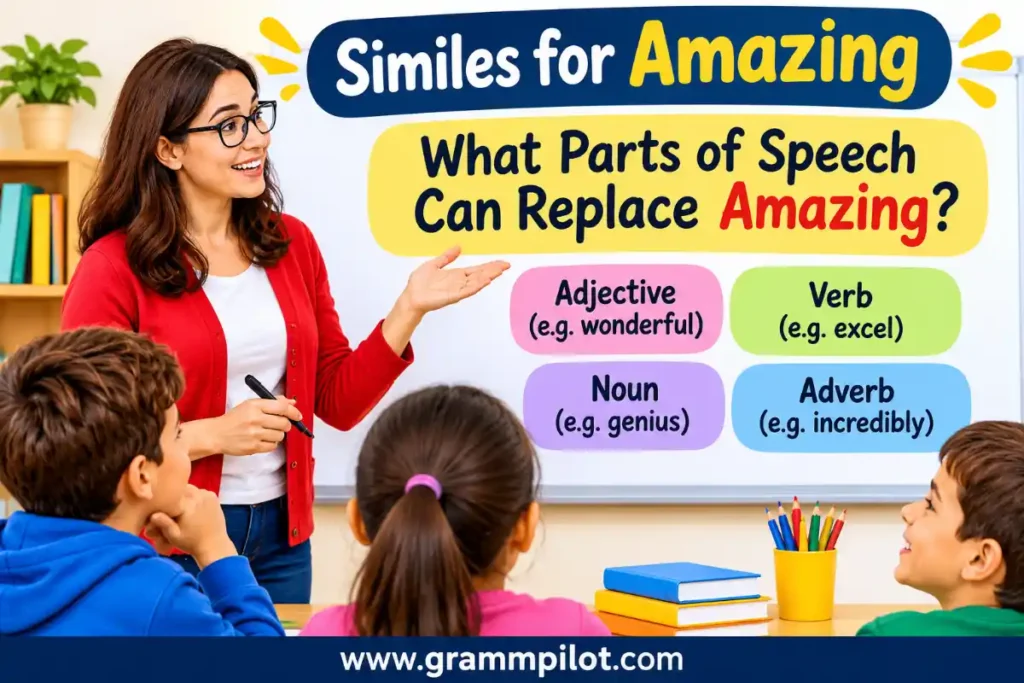
5. What Parts of Speech Can Replace Amazing?
The word amazing is an adjective. It describes a noun, such as a person, place, event, or achievement. You can also use nouns, verbs, and adverbs to express the same idea in different ways.
Adjectives
Adjectives describe something impressive. Examples include wonderful, spectacular, incredible, extraordinary, brilliant, magnificent, and breathtaking.
Sentence: The dancers gave a spectacular performance.
Nouns
Nouns name the quality or feeling created by something amazing. Examples include wonder, excellence, brilliance, beauty, marvel, inspiration, and achievement.
Sentence: The beauty of the waterfall filled us with wonder.
Verbs
Verbs explain how something creates a strong impression. Examples include amaze, impress, inspire, astonish, delight, surprise, and excite.
Sentence: The young artist’s work impressed everyone.
Adverbs
Adverbs explain how an action is performed. Examples include amazingly, wonderfully, brilliantly, remarkably, spectacularly, and exceptionally.
Sentence: The students performed brilliantly in the competition.
6. Are Similes for Amazing Different in American and British English?
Most similes in this guide work in both American and British English. Comparisons such as like a dream come true, as bright as a star, and as smooth as silk are widely understood.
However, some informal words differ by region:
- Awesome: Common in American English, but also used in the UK. It means very impressive.
- Brilliant: Especially common in British English, though Americans use it too. It can mean excellent or clever.
- Ace: An informal expression used especially in British English to mean very good.
- Epic: Common in both varieties. It describes something extremely exciting or impressive.
- Wicked: Informal in some regions, where it can mean excellent.
- Mind-blowing: Common in both varieties. It describes something extremely surprising.
For formal writing, choose words such as excellent, remarkable, exceptional, or outstanding. For casual speech, awesome, brilliant, and epic are natural choices.
7. Which Simile or Synonym Should You Use in Different Situations?
The best expression depends on your audience and purpose. A phrase that works in a text message may not be suitable for a resume or academic essay.
What Should You Use Instead of Amazing on a Resume?
A resume should describe skills and achievements clearly. Avoid casual expressions such as awesome or mind-blowing.
Better choices include exceptional, outstanding, excellent, remarkable, and highly effective.
Examples:
- Delivered outstanding customer service to more than 100 clients.
- Developed an effective system that improved team performance.
- Achieved remarkable results through careful planning.
- Demonstrated exceptional problem-solving skills.
Best tip: Use measurable results whenever possible. Instead of saying your work was amazing, explain what you achieved.
What Should You Use in an Essay?
In an essay, choose descriptive language that supports your main point.
Examples:
- The historic building stood like a magnificent castle.
- Her scientific discovery was as remarkable as the first successful space mission.
- The sunset looked like a painting come to life.
- The author’s writing was brilliant and thought-provoking.
Good choices include remarkable, extraordinary, magnificent, breathtaking, and brilliant.
What Should You Use in Texting?
Texts usually sound better with short, friendly expressions.
Examples:
- “That concert was epic!”
- “Your new photos look amazing!”
- “The view was out of this world.”
- “Your idea is pure genius!”
- “That was like magic!”
Good choices include awesome, epic, fantastic, mind-blowing, and out of this world.
What Should You Use in an Email?
Professional emails should sound positive without being overly dramatic.
Examples:
- “Your presentation was outstanding.”
- “Thank you for your excellent work on this project.”
- “The results were remarkable.”
- “Your creative solution made a significant difference.”
Good choices include excellent, impressive, exceptional, and remarkable.

What Should You Use in Everyday Speaking?
In conversation, choose words that match your feelings.
Examples:
- “The food was fantastic.”
- “That view was breathtaking.”
- “Your performance was brilliant.”
- “The whole experience was like a dream.”
- “That was an incredible surprise.”
Good choices include wonderful, fantastic, brilliant, incredible, and awesome.
8. What Are 15 Original Examples of Similes for Amazing?
Here are examples from different parts of everyday life. They show how comparisons can make ordinary descriptions more interesting.
- A beautiful sunset: The sunset spread across the horizon like a river of gold.
- A talented singer: Her voice was as smooth as silk, filling the room with warmth.
- A school achievement: Winning the spelling contest felt like reaching the top of the world.
- A wonderful teacher: Our teacher explained difficult ideas like a guide lighting a path through darkness.
- A memorable holiday: Our vacation was like stepping into a colorful storybook.
- A creative painting: The artwork looked like a garden of dreams brought to life.
- A thrilling football match: The final minutes moved like lightning across the field.
- A delicious meal: The dessert tasted like a little piece of heaven.
- A bright smile: Her smile shone like the first sunlight after a rainy day.
- A clever invention: The new device worked like magic, solving a problem in seconds.
- A wonderful friendship: Their friendship was as strong as an ancient oak tree.
- A beautiful garden: The flowers looked like colorful jewels scattered across green velvet.
- A powerful speech: His words struck the audience like a wave of thunder.
- A great performance: The dancers moved like flowing water across the stage.
- A special celebration: The party burst with energy like fireworks lighting up the night.
9. What Is the Difference Between Amazing, Wonderful, and Incredible?
These adjectives are similar, but each one has a slightly different feeling.
Amazing creates surprise or admiration. It’s a flexible word for impressive events, people, and achievements. Example: Her progress was amazing.
Wonderful often carries a warm, positive feeling. It works well for pleasant experiences and kind people. Example: We had a wonderful evening.
Incredible puts more focus on surprise or disbelief. It often describes something unusually impressive. Example: The athlete made an incredible recovery.
Choose the word that best matches the feeling you want to express.
10. Simile vs. Metaphor: What’s the Difference?
Similes and metaphors both compare things, but they use different structures.
A simile uses like or as to make a comparison.
- Her smile was like sunshine.
- The performance was like magic.
- His ideas were as bright as stars.
A metaphor says that one thing is another to create a direct comparison.
- Her smile was sunshine.
- The performance was magic.
- His ideas were shining stars.
A simile makes the comparison clear by using like or as. A metaphor presents the comparison directly. Both can make writing more creative.
11. What Are the Common Mistakes When Using Similes?
Similes can improve your writing, but an unclear or poorly chosen comparison can confuse readers.
Mistake 1: Forgetting Like or As
Incorrect: Her voice was a beautiful song.
This is a metaphor, not a simile.
Correct simile: Her voice was like a beautiful song.
Mistake 2: Comparing Things That Don’t Share a Clear Quality
Weak: The building was as amazing as a sandwich.
The comparison doesn’t explain what makes the building impressive.
Better: The building was as magnificent as a royal palace.
Mistake 3: Using Too Many Similes in One Sentence
Too many comparisons can make a sentence feel crowded.
Weak: Her dress was like a rainbow, her smile was like sunshine, and her walk was like a dancing flame.
Better: Her colorful dress looked like a rainbow against the dark evening sky.
Mistake 4: Choosing a Comparison That Doesn’t Match the Feeling
If you’re describing a peaceful garden, a comparison to a thunderstorm may create the wrong mood.
Better: The garden was as peaceful as a quiet morning.
Mistake 5: Repeating the Same Comparison
Using like a star in every paragraph makes your writing predictable. Try alternatives such as like a shining jewel, as bright as the morning sun, or like a painting come to life.
When Should You Avoid Using a Simile?
Don’t force a comparison into every sentence. Sometimes a direct description is clearer.
Direct: The scientist discovered a new treatment.
Unnecessary comparison: The scientist discovered a new treatment like a shining star in the sky.
The first sentence communicates the achievement more clearly. Save creative comparisons for moments when they add meaning or help readers imagine something.
12. What Are the Antonyms of Amazing?
Antonyms are words with opposite meanings. The right opposite depends on what you’re describing.
- Ordinary: Not special. Example: It was an ordinary day.
- Average: Around the usual level. Example: His performance was average.
- Mediocre: Not very good. Example: The movie received mediocre reviews.
- Dull: Not interesting or exciting. Example: The lecture felt dull.
- Boring: Not enjoyable. Example: The event was boring.
- Unimpressive: Fails to create admiration. Example: The results were unimpressive.
- Disappointing: Less good than expected. Example: The final performance was disappointing.
- Poor: Low in quality. Example: The service was poor.
An amazing performance may be spectacular or outstanding. An unimpressive performance may be ordinary, weak, or disappointing.
13. How Can You Choose the Best Simile for Amazing?
Use these practical tips to make your descriptions more natural and meaningful.
- Think about the quality: Is the subject beautiful, powerful, clever, exciting, or unusual?
- Choose a matching image: Compare beauty to flowers, brightness to stars, or strength to mountains.
- Consider your audience: Use simple comparisons for young readers and more detailed ones for creative writing.
- Avoid exaggeration: A small achievement doesn’t always need a comparison to a world-changing event.
- Use familiar objects: Readers understand comparisons more quickly when they recognize the image.
- Change your vocabulary: Don’t repeat amazing, wonderful, or fantastic in every sentence.
- Read your sentence aloud: If the comparison sounds unnatural, choose a simpler one.
- Keep the meaning clear: A simile should make your description easier to understand, not harder.
How Can You Create Your Own Simile?
Use this simple pattern:
Subject + is/was + like/as + familiar image.
For example:
- The singer’s voice was like a gentle breeze.
- The invention was as clever as a puzzle with a perfect solution.
- The city looked like a sea of shining lights.
- Her performance was as graceful as a bird in flight.
Start with the quality you want to describe. Then choose an image that shares that quality.
Conclusion: How Can You Describe Something Amazing?
Strong descriptions help readers see why something deserves admiration. Instead of repeating the word amazing, choose a comparison that shows the beauty, skill, excitement, or importance of the subject. Similes for Amazing can turn a simple sentence into a memorable picture, whether you’re describing a wonderful performance, a beautiful place, or an unforgettable experience. Use familiar images, keep your comparisons clear, and choose words that match the feeling you want to express. You don’t need complicated language to make your writing creative. A thoughtful comparison can make even a short sentence stand out. Practice using different similes, and your descriptions will become more natural, colorful, and interesting.
Frequently Asked Questions
1. What are some good similes for amazing?
Good examples include like a dream come true, as bright as a thousand stars, and like a painting come to life. Each comparison describes something impressive in a memorable way.
2. How do you describe something amazing without using the word amazing?
Use words such as wonderful, spectacular, incredible, remarkable, or breathtaking. You can also create a simile, such as “The view was like a painting come to life.”
3. What is a short simile for amazing?
“Like pure magic” is a short and catchy simile. It describes something surprising, wonderful, or difficult to believe.
4. What’s another way to say something is amazing?
You can say it’s fantastic, outstanding, extraordinary, brilliant, or out of this world. Choose an expression that fits the situation and your audience.
5. What is a simile for an amazing person?
“She is as bright as a thousand stars” is a creative simile for someone who stands out. You could also say, “He is like a shining light in a dark room.”
6. Can I use similes for amazing in an essay?
Yes. Similes can make essays more descriptive and engaging, especially when discussing people, places, experiences, and achievements. Use them naturally rather than adding a comparison to every sentence.
7. What is the difference between a simile and a metaphor?
A simile compares two things using like or as, while a metaphor says one thing is another. For example, “Her smile is like sunshine” is a simile, while “Her smile is sunshine” is a metaphor.
Meta Description: Similes for Amazing: Explore 35+ creative comparisons, meanings, and examples to make your descriptions more colorful and memorable.