
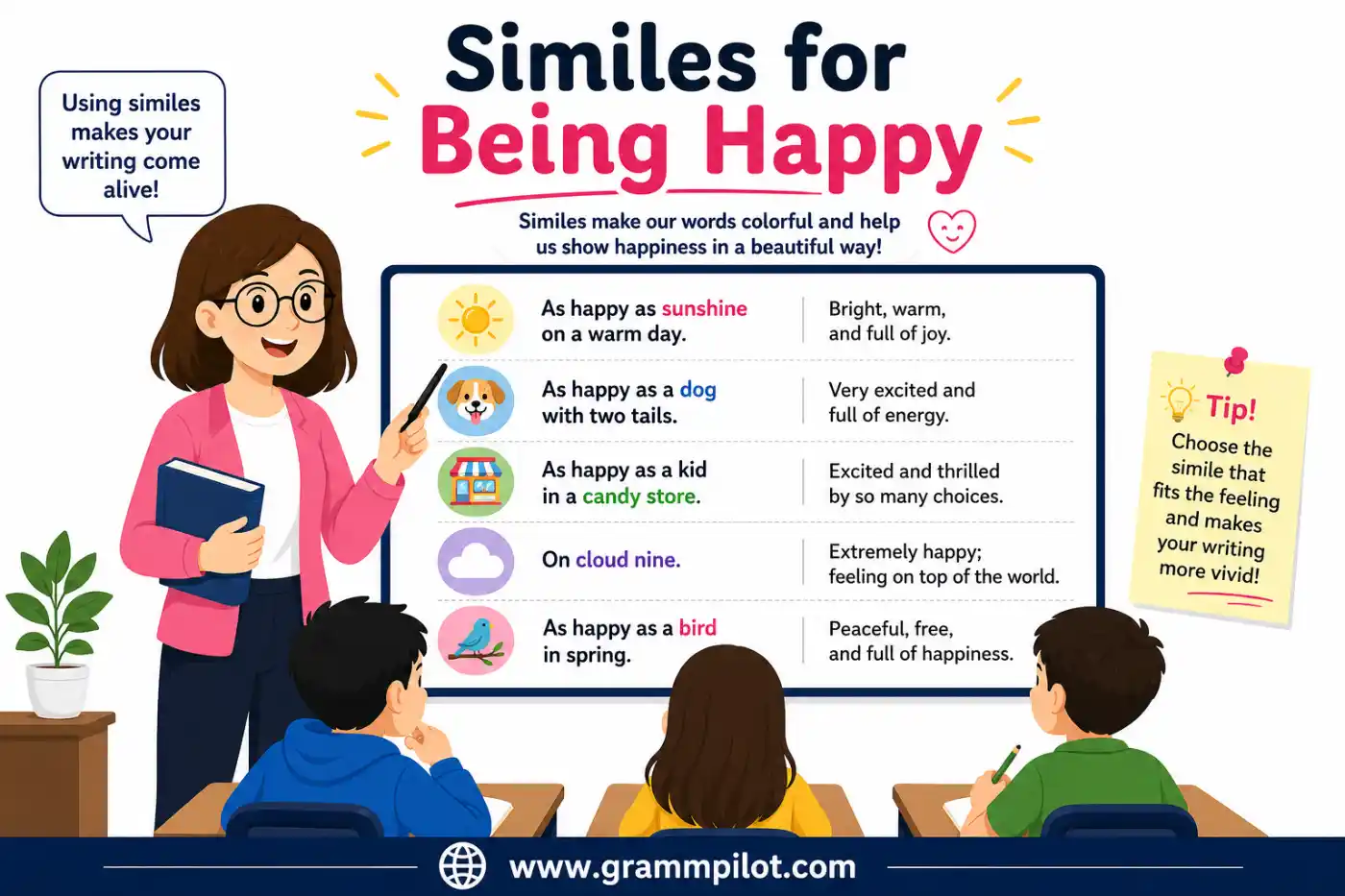
Have you ever been writing an email, school essay, social media post, or text message and wanted a better way to describe happiness? Instead of saying someone was “very happy,” you can use Similes for Being Happy to make your writing more colorful and memorable. A good simile paints a picture in the reader’s mind. It compares one thing to another using the words like or as. The right comparison can make a sentence feel alive instead of plain.
Answer Box
Similes for Being Happy are comparisons that describe happiness by using like or as. They help readers imagine how joyful, excited, pleased, or delighted someone feels in a clear and creative way.
Whether you’re a student, writer, teacher, or someone who simply loves English, this guide will help you find the best happy similes, understand what they mean, learn when to use them, and avoid common mistakes.
For more examples of natural English expressions, see our guide to [Piece of Mind or Peace of Mind].
What Are Similes for Being Happy?
A simile compares two different things using the words like or as.
Instead of saying: She was happy.
You could say: She was as happy as a child on Christmas morning.
The second sentence creates a stronger image. Readers can easily imagine the excitement and joy. Here are a few simple examples:
- As happy as a clam
- As happy as a dog with two tails
- As happy as a kid in a candy store
- Like the sun breaking through the clouds
- As cheerful as spring sunshine
These comparisons make your writing sound more natural and interesting.
Similes for Being Happy: Where Does the Idea of Similes Come From?
The word simile comes from the Latin word similis, which means similar or like. People have used similes for thousands of years. Ancient storytellers, poets, and speakers used them to make ideas easier to understand and remember.
Today, similes appear everywhere:
- Books
- Movies
- Songs
- Speeches
- School writing
- Everyday conversations
When people talk about happiness, they often compare it to bright sunshine, playful animals, celebrations, or exciting moments because those things naturally remind us of joy.
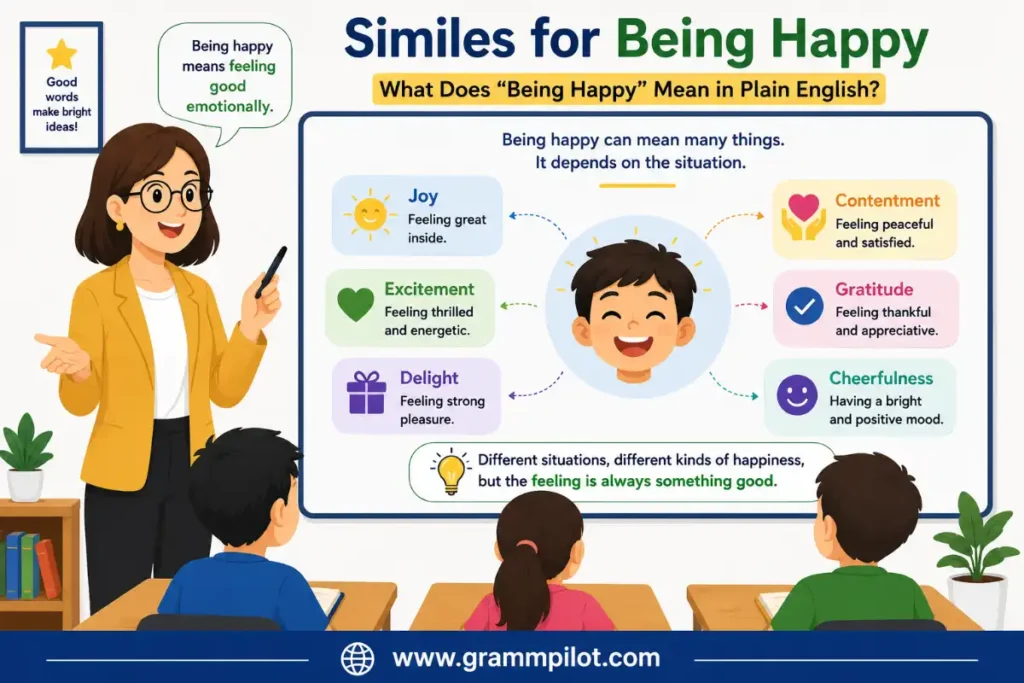
Similes for Being Happy : What Does “Being Happy” Mean in Plain English?
Being happy means feeling good emotionally.
Depending on the situation, happiness can mean:
- Joy
- Excitement
- Contentment
- Delight
- Pleasure
- Cheerfulness
- Satisfaction
- Gratitude
- Optimism
- Peacefulness
Not every happy feeling is equally strong. Someone who smiles after getting a compliment feels different from someone who wins the lottery. That’s why English has many different words and similes to describe different levels of happiness.
Why Use Similes Instead of Just Saying “Happy”?
Simply saying “happy” is fine. But similes help readers see the feeling instead of only reading about it.
Compare these sentences.
Plain
Mia looked happy.
Better
Mia looked as happy as a bird set free.
Now the reader imagines joy, freedom, and excitement all at once.
Good similes also:
- Make stories more interesting.
- Add emotion to essays.
- Improve creative writing.
- Keep readers engaged.
- Help avoid repeating the word happy too often.
Master List of Words Related to Happiness
The English language offers many ways to describe happiness. Some work in everyday conversation, while others sound more formal or are mostly used in casual speech.
| Word | Meaning | Tone | Example |
|---|---|---|---|
| Happy | Feeling good | Neutral | I’m happy to help. |
| Joyful | Full of joy | Warm | She felt joyful after the ceremony. |
| Cheerful | Bright and positive | Everyday | He stayed cheerful all day. |
| Glad | Pleased | Everyday | I’m glad you came. |
| Delighted | Very pleased | Formal | We were delighted to hear the news. |
| Pleased | Satisfied | Neutral | She looked pleased with her work. |
| Content | Peacefully satisfied | Formal | He felt content with his life. |
| Ecstatic | Overwhelmingly happy | Formal | She was ecstatic after winning. |
| Elated | Very happy after success | Formal | He felt elated after graduation. |
| Merry | Cheerfully happy | Seasonal | Everyone was merry at the party. |
| Sunny | Bright and cheerful | Casual | He has a sunny personality. |
| Lighthearted | Carefree and cheerful | Neutral | They enjoyed a lighthearted afternoon. |
| Grateful | Thankful and happy | Neutral | I felt grateful for the support. |
| Satisfied | Happy with the result | Neutral | Customers were satisfied. |
| Beaming | Smiling with happiness | Everyday | She was beaming with pride. |
| Smiling | Showing happiness | Neutral | The child kept smiling. |
| Radiant | Glowing with happiness | Formal | The bride looked radiant. |
| Walking on air | Feeling joyful | Idiom | He was walking on air after the interview. |
| In high spirits | Feeling cheerful | Formal | Everyone arrived in high spirits. |
| Pumped | Very excited | Slang | I’m pumped for the concert. |
| Psyched | Excited and eager | Slang | She’s psyched about college. |
| Stoked | Very excited | Slang | They’re stoked for vacation. |
| Buzzing | Full of excitement | Informal | He was buzzing after the game. |
| On top of the world | Feeling unbeatable | Idiom | She felt on top of the world. |
Synonyms Grouped by Style “Similes for Being Happy”
Choosing the right word depends on your audience and situation.
Simple Words
- Happy
- Glad
- Nice
- Good
- Cheerful
- Smiling
- Pleased
- Bright
- Joyful
These are easy to understand and work well in school writing.
Everyday Words
- Delighted
- Thrilled
- Excited
- Grateful
- Content
- Beaming
- Upbeat
- Sunny
- Lighthearted
These sound natural in conversations and emails.
Formal Words
- Elated
- Jubilant
- Ecstatic
- Blissful
- Radiant
- Satisfied
- Optimistic
- In high spirits
These fit professional writing, speeches, and formal essays.
Informal and Slang
- Pumped
- Psyched
- Stoked
- Buzzing
- Tickled
Use these with friends or in casual conversations instead of business writing.
Synonyms by Intensity For “Similes for Being Happy”
Not every happy feeling has the same strength. Here’s a helpful scale.
| Intensity | Words |
|---|---|
| Very Mild | Okay, Fine, Content |
| Mild | Happy, Glad, Pleased |
| Moderate | Cheerful, Joyful, Upbeat, Lighthearted |
| Strong | Delighted, Thrilled, Overjoyed, Elated |
| Very Strong | Ecstatic, Jubilant, Blissful, On cloud nine |
| Extreme | Walking on air, On top of the world, Over the moon |
Knowing the intensity helps you choose the most accurate word.
For example:
- Getting a compliment might make you pleased.
- Finishing a difficult exam might make you thrilled.
- Winning a championship could leave you ecstatic.
Synonyms by Part of Speech “Similes for Being Happy”
Sometimes you need a noun, adjective, verb, or adverb instead of an adjective. English offers plenty of choices.
Adjectives
These describe a person or thing.
- Happy
- Joyful
- Cheerful
- Glad
- Delighted
- Thrilled
- Ecstatic
- Elated
- Jubilant
- Blissful
- Radiant
- Content
- Optimistic
- Upbeat
- Lighthearted
- Merry
Examples
- She looked joyful.
- They felt delighted.
- The students were thrilled.
Nouns
These name the feeling itself.
- Happiness
- Joy
- Delight
- Cheer
- Pleasure
- Excitement
- Bliss
- Contentment
- Satisfaction
- Gratitude
- Jubilation
- Elation
Examples
- Her happiness was easy to see.
- Their joy filled the room.
- The team celebrated with great jubilation.
Verbs
These describe becoming or showing happiness.
- Smile
- Laugh
- Rejoice
- Celebrate
- Cheer
- Beam
- Grin
- Delight
- Enjoy
Examples
- The children laughed together.
- Everyone celebrated the good news.
- She beamed with pride.
Adverbs
These explain how an action is done.
- Happily
- Cheerfully
- Joyfully
- Gladly
- Brightly
- Merrily
- Eagerly
Examples
- He happily accepted the invitation.
- She cheerfully greeted everyone.
- They joyfully sang together.
Using the correct part of speech makes your writing smoother and more natural while giving you more ways to express happiness without repeating the same word over and over.
Are Similes for Being Happy Used Differently in the US and UK?
Most Similes for Being Happy are understood in both American and British English. However, some expressions are heard more often in one region than another.
| Simile or Expression | More Common In | Notes |
|---|---|---|
| As happy as a clam | United States | One of the most popular American similes. |
| Over the moon | United Kingdom | Very common in British English but widely understood elsewhere. |
| Walking on air | US & UK | Natural in both regions. |
| On cloud nine | US & UK | Common in everyday conversation. |
| As pleased as Punch | United Kingdom | More common in British English because of the Punch puppet character. |
| Happy as Larry | Australia, New Zealand, UK | Less common in the United States. |
Even if a simile started in one country, English speakers around the world usually understand it through books, movies, television, and social media.
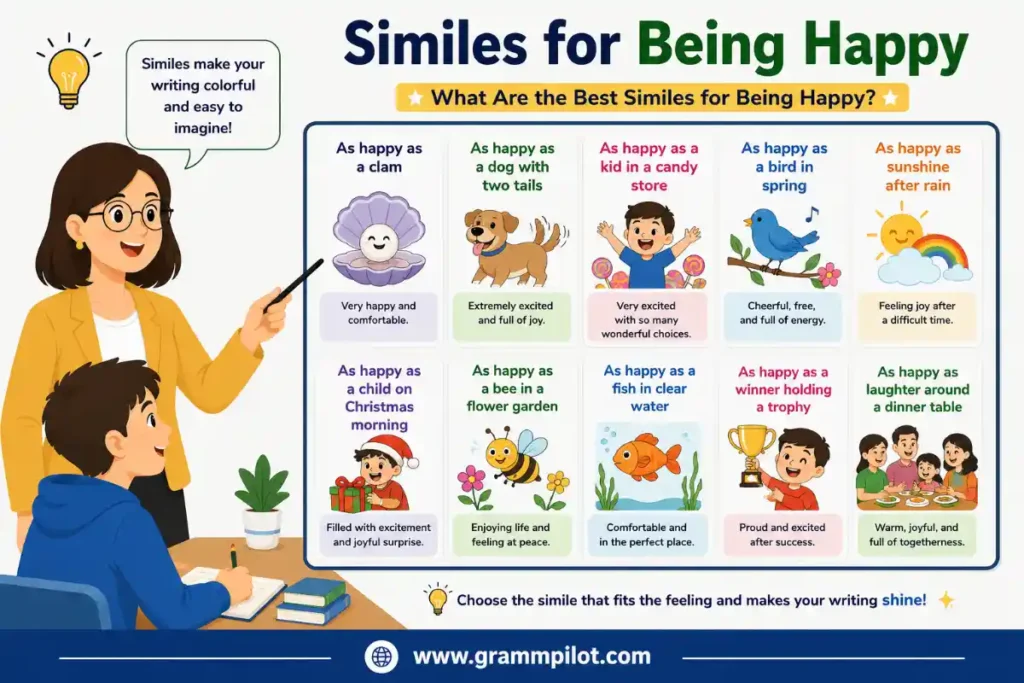
Similes for Being Happy: What Are the Best Similes for Being Happy?
Here are some of the most natural and widely used similes. Each one creates a slightly different picture.
As happy as a clam
Meaning: Extremely happy and comfortable.
Example: The kids were as happy as a clam during their beach vacation.
This is one of the best-known American similes.
As happy as a dog with two tails
Meaning: Overflowing with excitement.
Example: Jake was as happy as a dog with two tails after getting his driver’s license.
This simile suggests happiness that is impossible to hide.
As happy as a kid in a candy store
Meaning: Very excited because there are many fun choices.
Example: Emma looked as happy as a kid in a candy store while shopping for books.
This comparison works well for children and adults alike.
As happy as a bird in spring
Meaning: Cheerful, free, and full of energy.
Example: Grandma seemed as happy as a bird in spring after spending time with her grandchildren.
As happy as sunshine after rain
Meaning: Relief after difficult times.
Example: After weeks of stress, the good news felt like sunshine after rain.
Although less common, this simile creates beautiful imagery.
As happy as a child on Christmas morning
Meaning: Filled with excitement and joyful anticipation.
Example: She was as happy as a child on Christmas morning when the acceptance letter arrived.
As happy as a bee in a flower garden
Meaning: Busy, peaceful, and enjoying life.
Example: The gardener looked as happy as a bee in a flower garden.
As happy as a fish in clear water
Meaning: Comfortable in the perfect place.
Example: After changing careers, Daniel felt as happy as a fish in clear water.
As happy as a winner holding a trophy
Meaning: Proud and excited after success.
Example: The students were as happy as winners holding trophies after hearing the competition results.
As happy as laughter around a dinner table
Meaning: Warm family happiness.
Example: The house felt as happy as laughter around a dinner table during the holidays.
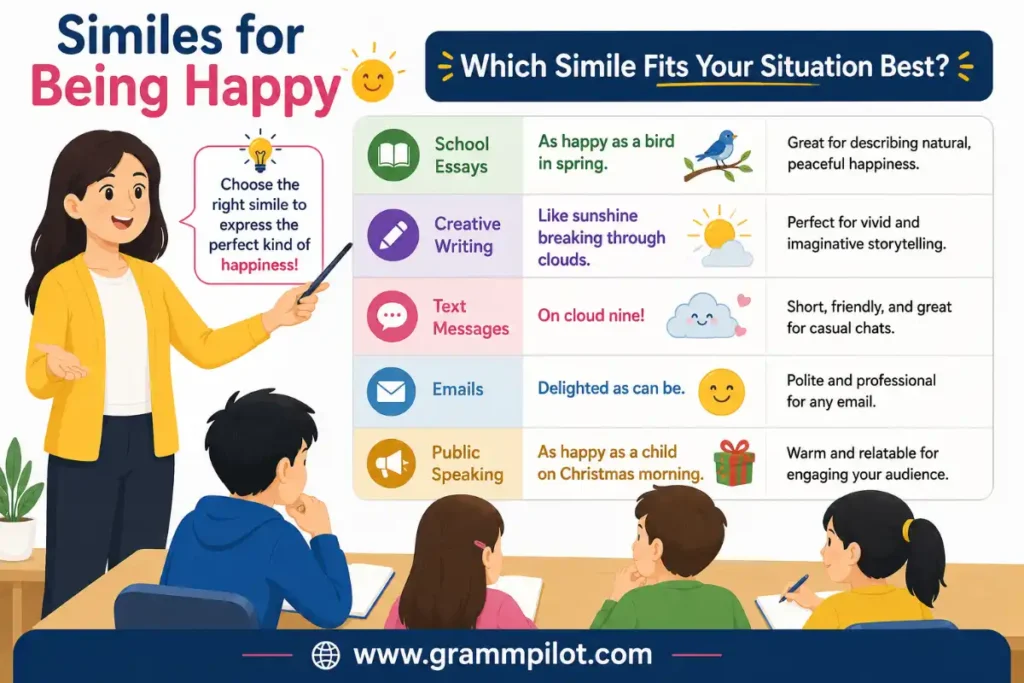
Similes for Being Happy: Which Simile Fits Your Situation Best?
Not every simile works everywhere. Some sound perfect in a story but awkward in a business email.
Choosing the right comparison makes your writing feel natural.
Best Similes for School Essays
Teachers usually prefer comparisons that are easy to understand.
Good choices include:
- As happy as a clam
- As happy as a bird in spring
- As happy as sunshine after rain
- As happy as a child on Christmas morning
Example: The villagers were as happy as sunshine after rain when the river returned.
Best Similes for Creative Writing
Creative stories allow stronger imagery.
Good choices include:
- Like fireworks lighting the night sky
- Like sunlight breaking through clouds
- As happy as a butterfly in a flower field
- As happy as music filling the room
Example: Her smile spread across her face like sunlight breaking through clouds.
Best Similes for Text Messages
Friends usually prefer short, natural expressions.
Examples:
- On cloud nine
- Walking on air
- Over the moon
- Like I won the lottery
Example: I’m walking on air today!
Best Similes for Emails
Professional emails should avoid exaggerated comparisons.
Good choices include:
- Delighted
- Pleased
- Glad
- Happy to
Example: I’m delighted to accept your invitation.
Best Similes for Public Speaking
When giving a speech, clear imagery helps the audience connect.
Examples:
- As happy as a child opening a gift
- Like the first warm day of spring
- As happy as sunshine after a storm
These comparisons are vivid without sounding childish.
Example Sentences Using Similes for Being Happy
Learning from real examples is one of the easiest ways to improve your English.
Here are different situations where these comparisons sound natural.
- Lily was as happy as a clam after passing her driving test.
- My little brother looked as happy as a kid in a candy store at the toy shop.
- Grandpa was as happy as a bird in spring after seeing the whole family together.
- We felt like sunshine after rain when the power finally came back.
- The team was as happy as winners holding trophies after the championship game.
- She smiled like flowers opening in the morning.
- The children ran outside as happy as puppies at the park.
- I walked home feeling like I was floating on a cloud.
- Dad looked as happy as a fisherman with a record catch.
- They laughed together like old friends meeting again.
- Maya was as happy as a butterfly in a flower garden during her vacation.
- The class cheered like fans watching their favorite team win.
- My parents were as happy as newlyweds celebrating their anniversary.
- Ben felt as happy as sunshine filling an empty room after hearing the good news.
- Everyone left the concert as happy as birds singing at sunrise.
Notice that each sentence creates a picture instead of simply saying someone was happy.
Happy Similes for Different Types of Happiness
Not all happiness feels the same.
Sometimes you feel peaceful.
sometimes you feel excited.
Matching the simile to the feeling makes your writing stronger.
Quiet Happiness
These work when someone feels calm and satisfied.
- As peaceful as a calm lake
- As happy as a cat sleeping in the sun
- Like gentle rain after a hot day
- As content as a bird in its nest
Example: After finishing her book, she felt as content as a bird in its nest.
Excited Happiness
These describe energetic joy.
- As happy as a kid in a candy store
- Like fireworks in the night sky
- As happy as a puppy getting a new toy
- Like jumping for joy
Example: The children were as happy as puppies getting new toys.
Proud Happiness
These show success and achievement.
- As proud as a champion
- Like a winner crossing the finish line
- As happy as a graduate receiving a diploma
- Like an artist finishing a masterpiece
Example: She stood as proud as a champion after receiving the award.
Family Happiness
These focus on love and togetherness.
- As happy as children at a birthday party
- Like laughter around the dinner table
- As warm as a family hug
- Like a home filled with music
Example: The house felt like laughter around the dinner table during Thanksgiving.
Holiday Happiness
These create joyful seasonal images.
- As happy as a child on Christmas morning
- Like fireworks on New Year’s Eve
- As cheerful as holiday lights
- Like opening the perfect gift
Example: The cousins were as happy as children on Christmas morning when they saw the presents.
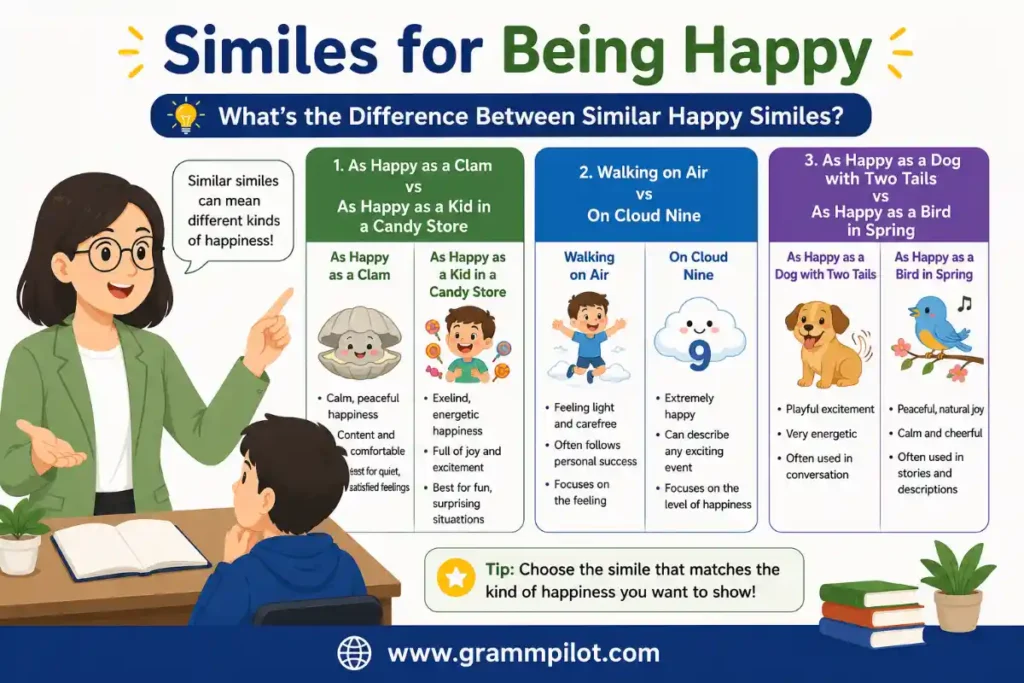
What’s the Difference Between Similar Happy Similes?
Some happy expressions seem alike, but they don’t always mean the same thing. Understanding these small differences helps you choose the best one for your writing.
As Happy as a Clam vs As Happy as a Kid in a Candy Store
| As Happy as a Clam | As Happy as a Kid in a Candy Store |
|---|---|
| Calm, comfortable happiness | Excited, energetic happiness |
| Focuses on contentment | Focuses on excitement |
| Works for peaceful situations | Works for fun or surprising situations |
| Common in American English | Understood almost everywhere |
Example
After moving into her new home, Sarah was as happy as a clam.
The children were as happy as kids in a candy store at the amusement park.
The first simile suggests comfort. The second suggests excitement and wonder.
Walking on Air vs On Cloud Nine
These two expressions both describe great happiness, but they create different images.
| Walking on Air | On Cloud Nine |
|---|---|
| Feeling light and carefree | Feeling extremely happy |
| Often follows personal success | Can describe any exciting event |
| Focuses on emotion | Focuses on the level of happiness |
Example
Jake was walking on air after his first job interview.
Emma has been on cloud nine since she got engaged.
Both are correct, but “walking on air” often suggests someone feels almost weightless because of their joy.
Happy as a Dog with Two Tails vs Happy as a Bird in Spring
These similes also have different feelings.
| Happy as a Dog with Two Tails | Happy as a Bird in Spring |
|---|---|
| Playful excitement | Peaceful, natural joy |
| Very energetic | Calm and cheerful |
| Often used in conversation | Often used in stories and descriptions |
Example
The puppy was as happy as a dog with two tails when its owner came home.
The garden looked as happy as a bird in spring.
One is lively and playful. The other feels gentle and refreshing.
Similes for Being Happy: When Should You Avoid Certain Similes?
Even the best similes do not fit every situation. Avoid using playful comparisons in serious or emotional writing.
Instead of writing: “The doctor was as happy as a kid in a candy store.”
You could write: “The doctor was pleased with the patient’s recovery.”
Professional writing usually sounds better with simple, direct language.
Similes for Being Happy: Common Mistakes People Make
Many English learners make small mistakes when using similes. Here are the most common ones.
Forgetting “Like” or “As”
A simile almost always uses like or as.
Incorrect: She was happy a butterfly.
Correct: She was as happy as a butterfly in a flower garden.
Correct: She smiled like sunshine after rain.
Mixing Two Similes Together
Don’t combine different comparisons.
Incorrect: He was as happy as a clam on cloud nine.
Correct: He was as happy as a clam.
Correct: He was on cloud nine.
Choose one expression at a time.
Using Too Many Similes
One strong comparison is enough.
Instead of writing: She was as happy as a clam, like sunshine after rain, like fireworks, like a bird in spring.
Write: She was as happy as sunshine after rain.
Simple writing is usually stronger.
Choosing the Wrong Mood
Some similes sound playful. Others sound elegant. Match your comparison to your audience.
A formal report should not say: “The manager was as happy as a puppy with a new toy.”
A better choice would be: “The manager was delighted with the results.”
Using Old-Fashioned Similes Too Often
Some comparisons still work well, but repeating them can make writing feel predictable. Try mixing familiar expressions with fresh, natural ones.
Instead of always using: As happy as a clam.
You could also use:
- Like sunshine after a storm
- As cheerful as spring mornings
- Like a garden full of flowers
- As bright as a rainbow after rain
Antonyms of Happy
Sometimes the best way to understand happiness is by knowing its opposite.
| Word | Meaning |
|---|---|
| Sad | Feeling unhappy |
| Miserable | Extremely unhappy |
| Depressed | Deeply unhappy |
| Gloomy | Looking or feeling down |
| Heartbroken | Emotionally hurt |
| Upset | Disturbed or unhappy |
| Disappointed | Not getting what you hoped for |
| Unhappy | General opposite of happy |
| Discouraged | Losing confidence |
| Blue | Informal word for feeling sad |
| Downhearted | Feeling low in spirit |
| Melancholy | Quiet, thoughtful sadness |
Using opposites can create stronger contrast in your writing.
Example: At first, Mia felt disappointed. Later, she was as happy as a child on Christmas morning when she heard the good news.
Quick Tips for Choosing the Right Word
Choosing the best expression is easier when you think about the situation first.
Remember these simple tips.
- Use happy for everyday conversations.
- Use delighted in professional emails.
- Use thrilled when someone is very excited.
- Use content for peaceful satisfaction.
- Use ecstatic only for extremely joyful moments.
- Use similes in stories and creative writing.
- Keep business writing simple and direct.
- Don’t use several similes in one sentence.
- Pick comparisons your readers will understand.
- Read your sentence aloud to see if it sounds natural.
Similes for Being Happy: How Can You Create Your Own Happy Similes?
You don’t always have to use well-known expressions. Creating your own similes can make your writing more original.
Think about things that naturally remind people of happiness.
Good ideas include:
- Sunshine
- Rainbows
- Flowers
- Birds
- Music
- Laughter
- Balloons
- Birthdays
- Celebrations
- Fireworks
- Fresh spring mornings
- Children playing
- Puppies
- Butterflies
Now compare your feeling to one of those images.
Examples:
- She smiled like the first sunrise of summer.
- He was as cheerful as birds greeting the morning.
- They laughed like children chasing bubbles.
- Her heart felt as light as a feather in the breeze.
- The classroom became as bright as sunshine after rain.
These original comparisons sound fresh while still being easy to understand.
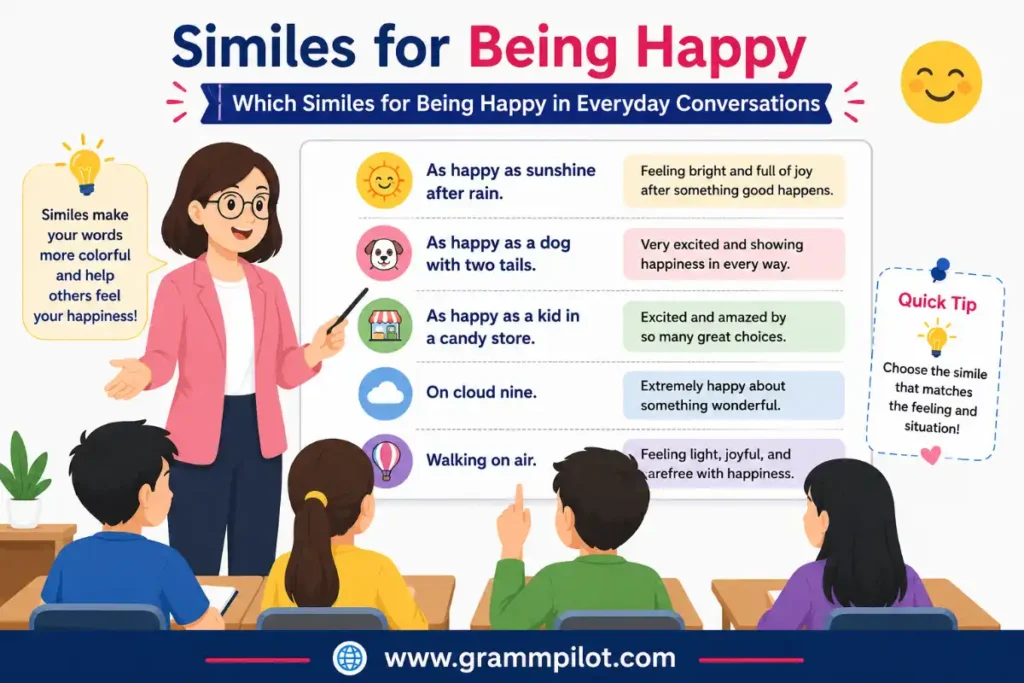
Similes for Being Happy in Everyday Conversations
Native English speakers often use similes naturally without thinking about them.
Here are some examples you might hear.
At school
“I’m as happy as a kid in a candy store because we don’t have homework tonight.”
At work
“Our whole team is on cloud nine after winning the project.”
At home
“Dad looked as happy as a clam after fixing the old car.”
At a wedding
“The bride was glowing like sunshine.”
After good news
“I’ve been walking on air all day.”
Using these naturally helps your English sound more fluent and expressive.
Practice Exercise “Similes for Being Happy”
Choose the best simile for each sentence.
- Emma received a full scholarship.
- As happy as a clam
- On cloud nine
- As gloomy as rain
Answerr: On cloud nine
- Grandpa relaxed in his favorite chair after dinner.
- As happy as a clam
- Like fireworks
- As nervous as a cat
Answer: As happy as a clam
- The children entered the toy store.
- As happy as a kid in a candy store
- As quiet as snow
- As sleepy as a bear
Answer: As happy as a kid in a cradle
These short exercises help you remember which comparison fits each situation best.
Conclusion
Using Similes for Being Happy is one of the easiest ways to make your English more colorful and expressive. Instead of repeating the word happy, you can choose a comparison that matches the exact feeling you want to describe. Whether someone feels calm, excited, proud, or thankful, there’s a simile that paints a clear picture for your reader.
The best writing sounds natural, not forced. Pick a simile that fits the situation, avoid using too many in the same paragraph, and keep your audience in mind. With a little practice, these comparisons will become a natural part of your speaking and writing, helping you communicate joy in a more memorable way.
Frequently Asked Questions
1. What are the best Similes for Being Happy?
Some of the most popular Similes for Being Happy include as happy as a clam, as happy as a kid in a candy store, walking on air, on cloud nine, and as happy as a dog with two tails. Each one describes a different kind of joyful feeling.
2. What’s another way to say someone is very happy?
You can say someone is thrilled, delighted, overjoyed, ecstatic, or elated. If you want a more colorful expression, try on cloud nine or walking on air.
3. Are similes better than adjectives?
Not always. Adjectives like happy or cheerful are simple and direct, while similes create stronger images. Use similes when you want your writing to be more vivid and descriptive.
4. Can I use Similes for Being Happy in school essays?
Yes. Similes for Being Happy work well in stories, descriptive essays, and creative writing. Choose clear and easy-to-understand comparisons that match the tone of your assignment.
5. Which simile means someone is quietly happy?
Expressions like as happy as a clam, as content as a bird in its nest, or like gentle sunshine after rain describe peaceful and quiet happiness rather than excitement.
6. Which happy similes should I avoid in formal writing?
Very playful comparisons such as as happy as a puppy with a new toy or as happy as a kid in a candy store may sound too informal for business reports or professional emails. In those cases, words like pleased, delighted, or satisfied are usually better.
7. How can I remember happy similes more easily?
Practice using one or two new similes each week in your conversations or writing. Reading stories, novels, and articles also helps you see how native English speakers naturally use these expressions.