
When writing a story, school essay, or nature article, you might wonder about to use serpent or snake. Both words describe a long, legless reptile, but they can create different feelings in a sentence. One sounds mysterious or ancient, while the other feels natural and familiar. Understanding Serpent vs Snake helps you choose the word that best fits your meaning. If you’re describing a snake in your garden, explaining a wildlife fact, or writing about a mythical creature, the right word can make your message clearer.
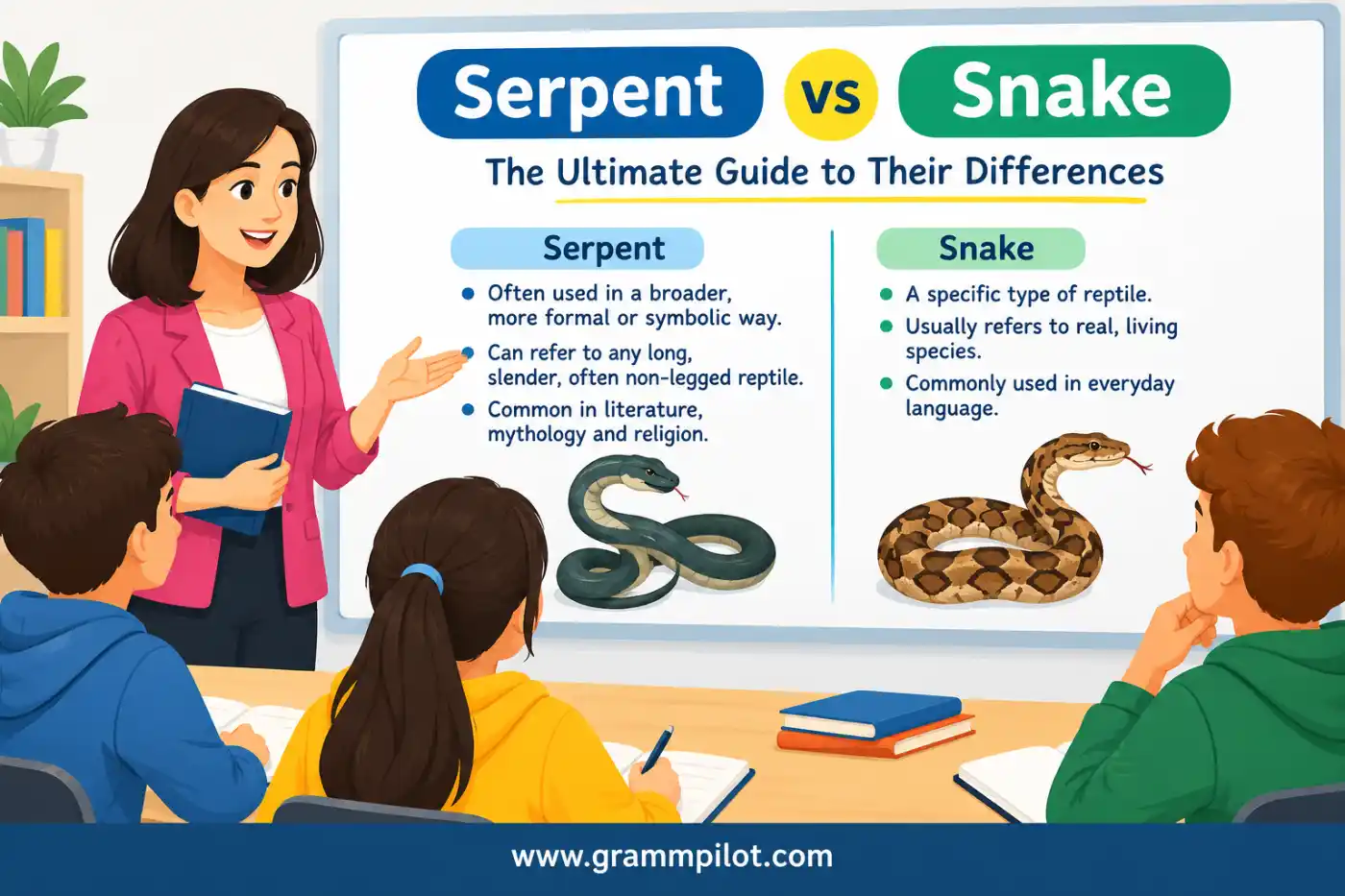
Serpent and snake usually refer to the same type of animal, but they differ in tone and usage. Snake is the common, everyday word, while serpent often sounds formal, literary, symbolic, or mythological. The difference isn’t mainly about the animal’s body or species. It’s about how people use these two words in different situations. In this guide, you’ll learn where both words come from, how their meanings compare, which alternatives you can use, and how to choose the best word for essays, emails, stories, and everyday conversation.
What Is the Difference Between Serpent and Snake?
The main difference between serpent and snake is their style and context, not the animal they describe. A snake is a legless reptile with a long body. It may live in forests, deserts, grasslands, wetlands, or even near human homes. The word is common in science, everyday speech, and general writing. A serpent is also a snake, but the word often appears in myths, religious stories, poetry, fantasy, and formal descriptions. It can suggest mystery, danger, wisdom, power, or an ancient creature.
Consider these examples:
- Everyday use: A snake crossed the path.
- Literary use: A serpent moved silently through the ancient temple.
- Scientific use: The researcher studied how the snake responded to changes in temperature.
- Mythological use: The hero faced a giant serpent guarding a hidden treasure.
All four sentences can describe a snake-like reptile. However, the word serpent gives the final example a more legendary feeling.
Is a Serpent a Different Animal From a Snake?
No. In ordinary English, a serpent is a snake, not a separate group of reptiles. The word serpent doesn’t automatically mean that an animal is larger, more dangerous, more poisonous, or more intelligent than an ordinary snake. For example, a small garden snake can be called a serpent in a poem if the writer wants a dramatic tone. A large python can simply be called a snake in a wildlife report.
The context determines which word sounds appropriate.
| Feature | Snake | Serpent |
|---|---|---|
| Basic meaning | A legless reptile | A snake |
| Everyday use | Very common | Less common |
| Scientific writing | Usually preferred | Used less often |
| Storytelling | Natural and direct | Dramatic or mysterious |
| Religious texts | Used in some translations | Common in many traditional passages |
| Fantasy writing | Clear and familiar | Often grand or legendary |
| Emotional effect | Neutral or direct | May suggest danger, mystery, or power |
| Best general choice | Everyday communication | Literary or symbolic descriptions |
Quick rule: Use snake when you mean the animal in ordinary conversation. Choose serpent when its literary, symbolic, or mythological tone adds something useful.
Where Do the Words Serpent and Snake Come From?
Understanding the origins of these words helps explain why they sound different today.
What Is the Origin of the Word Snake?
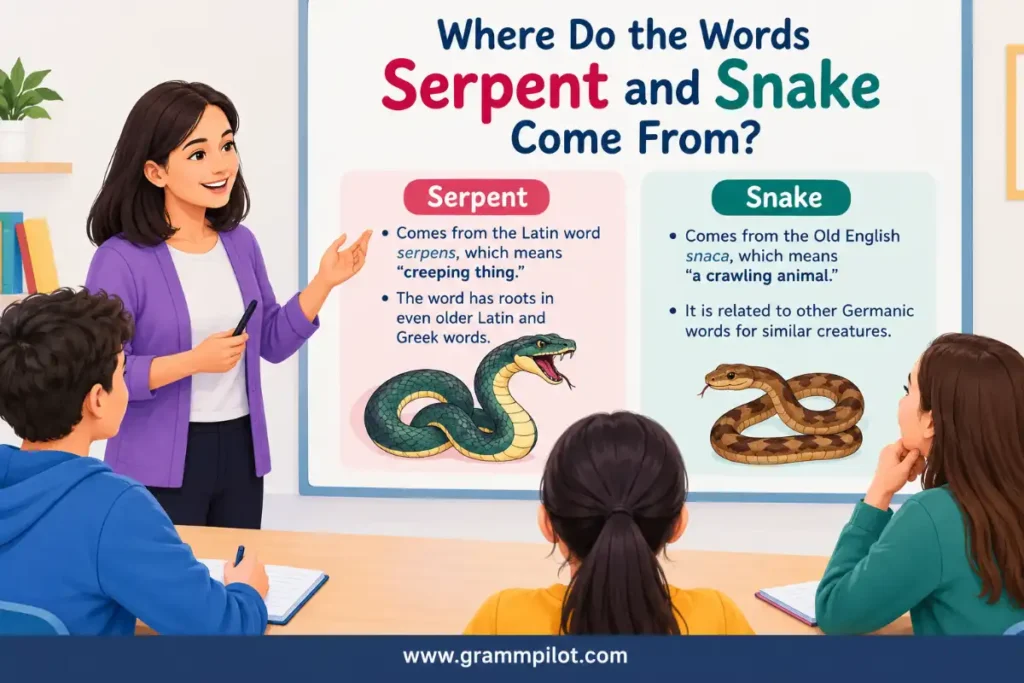
The English word snake developed from Old English snaca, a word for a snake or serpent. It belongs to an older family of Germanic words connected with snakes and creeping or crawling creatures. Over time, snake became the normal English word for the animal. Today, you’ll find it in conversations, school textbooks, wildlife guides, news reports, children’s books, and scientific discussions.
Examples:
- The snake rested on a warm rock.
- We learned how snakes shed their skin.
- A snake appeared near the garden wall.
- The wildlife expert explained how snakes hunt their prey.
The word is direct and easy to understand. It doesn’t require special knowledge of literature or mythology.
What Is the Origin of the Word Serpent?
The English word serpent came through Old French from Latin serpens, meaning a creeping or crawling creature. The Latin word is related to serpere, meaning to creep or crawl. The word has a long history in literary, religious, and symbolic writing. It often appears in traditional stories and translations of ancient texts. For example, a writer might describe a serpent guarding a sacred place or appearing as a mysterious creature in a legend.
Examples:
- A serpent guarded the entrance to the forgotten palace.
- The ancient story described a serpent with magical powers.
- The poet compared the river’s winding path to a serpent.
The word’s history helps explain its traditional and elevated tone. However, it still refers to a snake in ordinary usage.
What Are the Best Synonyms for Serpent and Snake?
The best synonym depends on if you’re talking about an actual reptile, describing its movement, or using it as a symbol. Not every word in the following list is a accurate substitute for snake or serpent. Some describe specific kinds of snakes, while others work only in figurative or informal language. The table groups useful alternatives by tone and explains where each one fits.
Simple and Everyday Alternatives
| Word | Meaning | Tone | Example |
|---|---|---|---|
| Snake | A legless reptile | Neutral | A snake crossed the road. |
| Reptile | An animal group that includes snakes | General or scientific | The snake is a reptile. |
| Viper | A member of a particular snake family | Specific | A viper rested beneath the rock. |
| Cobra | A type of snake, often able to spread a hood | Specific | The cobra raised its hood. |
| Python | A type of nonvenomous constricting snake | Specific | The python rested in its enclosure. |
| Boa | A group of constricting snakes | Specific | The boa wrapped around a branch. |
| Rattlesnake | A snake with a rattle at the end of its tail | Specific | A rattlesnake moved through the dry grass. |
| Adder | A name for certain snakes, especially in British usage | Regional | The walker spotted an adder. |
These words aren’t interchangeable in every sentence. A cobra is a kind of snake, but not every snake is a cobra. Likewise, reptile is broader than snake because it includes animals such as turtles and lizards.
Everyday Descriptive and Figurative Alternatives
| Word | Meaning | Tone | Example |
|---|---|---|---|
| Slitherer | An animal that moves by slithering | Informal or descriptive | The slitherer disappeared into the grass. |
| Crawler | Something that crawls | Informal | The crawler moved beneath the leaves. |
| Creeper | Something that creeps or moves slowly | Descriptive | The creeper slipped into the dark opening. |
| Coil | A curled or looped shape; also a verb | Descriptive | The snake formed a tight coil. |
| Serpentine | Having a winding, snake-like shape or movement | Literary or descriptive | A serpentine path crossed the hill. |
| Snake-like | Resembling a snake | Neutral | The creature had a snake-like body. |
| Slithering creature | An animal that moves by sliding along a surface | Descriptive | A slithering creature emerged from the bushes. |
| Reptilian creature | A creature resembling or belonging to reptiles | Formal or descriptive | A reptilian creature appeared in the story. |
These expressions work well when you want to describe movement or appearance instead of naming a particular species.
For instance, serpentine can describe a winding road. It doesn’t mean that the road is literally a snake.
Formal and Literary Alternatives
| Word | Meaning | Tone | Example |
|---|---|---|---|
| Serpent | A snake, often in elevated or symbolic writing | Literary | The serpent guarded the temple. |
| Ophidian | Relating to snakes | Technical or literary | The researcher examined an ophidian specimen. |
| Ophidian creature | A snake or snake-like creature | Technical or literary | An ophidian creature appeared in the legend. |
| Serpentine creature | A creature with a long, winding, snake-like form | Literary | A serpentine creature rose from the water. |
| Great serpent | A large or powerful snake-like creature | Mythological | The great serpent protected the mountain. |
| Mythical serpent | A snake-like being from a legend or myth | Mythological | The mythical serpent challenged the hero. |
| Guardian serpent | A serpent that protects a place or object | Literary | A guardian serpent watched over the gate. |
| Sacred serpent | A serpent associated with religious or spiritual meaning | Religious or symbolic | The tale featured a sacred serpent. |
Some of these are descriptive phrases rather than single-word synonyms. They’re useful when writing fantasy, mythology, historical fiction, or symbolic descriptions.
Slang and Informal Alternatives
Informal expressions require extra care because some describe an actual animal, while others insult a person.
| Word | Meaning | Tone | Example |
|---|---|---|---|
| Sneaky snake | A snake or a figurative description of a dishonest person | Informal | He called the dishonest character a sneaky snake. |
| Snake | A dishonest or treacherous person, figuratively | Informal and negative | She felt betrayed by someone she had trusted. |
| Slitherer | A creature that moves by slithering | Playful or descriptive | The little slitherer vanished under the log. |
| Danger noodle | A humorous internet nickname for a snake | Playful slang | The post called the harmless pet a danger noodle. |
| Nope rope | A humorous slang term for a snake | Playful slang | The hiker jokingly called it a nope rope. |
| Sneak | A person who acts secretly or dishonestly | Informal | He thought the character was a sneak. |
Slang varies by community and situation. Danger noodle and nope rope are humorous expressions, not standard scientific terms. They may work in a casual post but are usually unsuitable for a formal essay. Also, calling someone a snake can be insulting. Use that figurative meaning only when the context supports it.
How Do Snake Synonyms Change From Mild to Strong?
The words you choose can make a description feel calm, vivid, threatening, or dramatic. The following scale shows how you can adjust your wording. The intensity refers to the impression created by the phrase, not the animal’s actual danger.
| Intensity | Word or phrase | Effect | Example |
|---|---|---|---|
| Mild | Reptile | Broad and neutral | A reptile rested in the enclosure. |
| Mild | Snake | Direct and neutral | A snake crossed the path. |
| Mild | Small snake | Gives a simple size detail | A small snake hid beneath a leaf. |
| Moderate | Serpent | More formal or literary | A serpent appeared in the garden. |
| Moderate | Slithering snake | Highlights movement | A slithering snake crossed the stone floor. |
| Strong | Large serpent | Suggests size and drama | A large serpent guarded the entrance. |
| Strong | Venomous snake | Gives a factual risk detail | The guide warned visitors about venomous snakes. |
| Dramatic | Giant serpent | Creates a fantasy or legendary image | A giant serpent rose from the lake. |
| Dramatic | Monstrous serpent | Suggests a frightening fictional creature | A monstrous serpent blocked the hero’s path. |
| Mythological | Ancient serpent | Suggests age and mystery | An ancient serpent appeared in the prophecy. |
Does Serpent Sound More Dangerous Than Snake?
It can sound more threatening in a story, but it doesn’t necessarily describe a more dangerous animal.
For example:
- Neutral: A snake rested beside the wall.
- Dramatic: A serpent waited beside the ancient wall.
- More dramatic: A monstrous serpent guarded the abandoned castle.
The final sentence creates a stronger impression because of monstrous, guarded, and abandoned castle. The noun serpent supports that mood, but it doesn’t create the entire effect on its own. In factual writing, describe the actual risk rather than relying on dramatic wording. A venomous snake can be dangerous if you call it a snake or a serpent.
Which Word Forms Are Related to Serpent and Snake?
Both words appear in related expressions, but they don’t form identical word families.
What Words Come From Serpent?
| Word or phrase | Part of speech | Meaning | Example |
|---|---|---|---|
| Serpent | Noun | A snake | The serpent moved into the cave. |
| Serpentine | Adjective | Winding or snake-like | The road followed a serpentine route. |
| Serpentine | Noun | A mineral name in geology | The museum displayed a serpentine rock. |
| Serpent-like | Adjective | Resembling a serpent | The creature had a serpent-like body. |
| Serpentinely | Adverb, rare | In a winding or serpent-like manner | The term is uncommon in everyday English. |
Serpentine is especially useful because it can describe something that has a winding shape or movement. A road, river, or trail can be serpentine without having anything to do with an actual snake.
What Words Come From Snake?
| Word or phrase | Part of speech | Meaning | Example |
|---|---|---|---|
| Snake | Noun | A legless reptile | The snake rested in the shade. |
| Snake | Verb | To move in a winding way | The path snaked through the forest. |
| Snakelike | Adjective | Resembling a snake | The river formed a snakelike curve. |
| Snaky | Adjective | Winding or resembling a snake; sometimes figurative | A snaky trail climbed the hillside. |
| Snake-shaped | Adjective | Having the shape of a snake | The artist made a snake-shaped ornament. |
| Snakebite | Noun | A bite caused by a snake | The clinic treated the snakebite. |
| Snake charmer | Noun | A performer associated with making snakes appear to respond to music or movement | The story featured a snake charmer. |
Can Snake Be Used as a Verb?
Yes. Snake can be a verb when something moves in a winding or twisting path.
Examples:
- The narrow road snaked through the mountains.
- A line of people snaked around the building.
- The cable snaked behind the desk.
- The river snaked across the plain.
In these sentences, snake describes movement or shape rather than naming an animal. The word serpent is mainly a noun. Its related adjective, serpentine, is more useful when describing winding movement.
Is Serpent or Snake More Common in American and British English?
Both American and British English use snake and serpent. The main difference is context, not a strict national rule.
How Do Americans Use Snake and Serpent?
In the United States, snake is the normal word in everyday speech, wildlife education, and general writing.
Examples:
- We saw a snake on the hiking trail.
- The park provides information about local snakes.
- The teacher explained how snakes shed their skin.
American writers often choose serpent when they want a literary, religious, historical, or fantasy tone.
Example: The ancient serpent appeared in the legend as a guardian of hidden knowledge.
How Do British People Use Snake and Serpent?
British English also uses snake as the ordinary word for the animal. The word serpent is more common in literary or symbolic contexts than in everyday conversation. One regional difference is the word adder, which commonly refers to the European adder, a venomous snake found in parts of Britain and elsewhere in Europe.
Example: The walkers were advised to leave the adder alone and keep their distance.
The term adder names a particular kind of snake. It isn’t a general substitute for every snake.
Is There a Difference in Australian English?
Australian English also uses snake as the everyday term. Australia has many snake species, and common names such as brown snake, tiger snake, and carpet python identify particular kinds. The word serpent may appear in fiction, poetry, religious discussion, or dramatic descriptions, but it isn’t the usual name for an Australian snake in a wildlife guide. Regional takeaway: In American, British, and Australian English, snake is the safest everyday choice. Use serpent when the style or subject calls for it.
Which Word Is Best for a Resume, Essay, Email, Text, or Conversation?
Choosing between serpent and snake becomes easier when you think about your audience and purpose.
Which Word Should You Use in a Resume?
For most resumes, neither word is likely to be relevant unless you’re applying for a job involving wildlife, zoology, conservation, animal care, or writing. If you need to describe your experience with reptiles, use specific and professional language.
Example: “I assisted with the care and observation of snakes in a supervised wildlife facility.”
This sentence is clear and factual. Serpent would usually sound unnecessarily dramatic in a resume. If you’re applying for a creative writing position and describing a piece of fiction, you might mention that you wrote a story featuring a mythical serpent. In that case, the literary meaning matters.
Which Word Should You Use in an Essay?
Use snake in a general science essay or an explanation of animal behavior. Choose serpent when discussing literature, mythology, religious symbolism, or an author’s word choice.
Examples:
- Science essay: Snakes use different methods to capture prey.
- Literature essay: The serpent represents temptation and hidden knowledge in the story.
The second sentence discusses symbolism rather than zoology. The more formal word fits that purpose. If you’re writing about a specific religious text, check the translation you’re discussing. Different translations may use different terms.
Which Word Should You Use in an Email?
Use snake when writing a practical email about an actual animal.
Example: “Hello, I noticed a snake near the storage shed. Could someone from the wildlife team check the area?”
The message gives clear information and requests an action.
Using serpent might make the email sound theatrical: “I noticed a serpent near the storage shed.”
That sentence isn’t grammatically wrong, but it may sound unusual unless you’re writing in a deliberately dramatic style.
Which Word Should You Use in Text Messages?
Use snake in ordinary texting. It is familiar, short, and clear.
Examples:
- “There’s a snake near the gate!”
- “I saw a tiny snake on the trail today.”
- “That character is such a snake.”
The final example uses snake as an insult for a dishonest person.
In a joke about a fictional creature, you could use serpent to sound dramatic: “The ancient serpent has entered the chat.” That expression is playful because the wording resembles a fantasy story.
Which Word Should You Use When Speaking?
Use snake in most conversations. It sounds natural when talking about wildlife, pets, hiking, or something you saw outdoors.
Examples:
- “I think that was a snake.”
- “Are snakes common in this area?”
- “We learned about snakes at school.”
Use serpent when telling a legend, discussing a poem, or describing a creature in a dramatic way.
Example: “The hero entered the cave and came face to face with a giant serpent.” The word suits storytelling because it helps create a sense of mystery.
What Are 12 Real-Life Examples of Serpent and Snake?
Examples make the difference easier to understand. The following sentences show how both words work in everyday situations, schoolwork, wildlife discussions, and creative writing.
1. Seeing an Animal Outdoors
Sentence: A snake crossed the hiking trail, so we stopped and gave it space.
Why it works: Snake is the ordinary name for the animal. The sentence is direct and practical.
2. Reporting a Wildlife Sighting
Sentence: The park ranger identified the snake from a safe distance.
Why it works: Wildlife reports usually favor clear, familiar terms.
3. Writing a Science Assignment
Sentence: Snakes use their tongues to collect chemical information from their surroundings.
Why it works: The common word fits factual and educational writing.
4. Describing a Myth
Sentence: A golden serpent guarded the entrance to the lost city.
Why it works: Serpent makes the creature sound legendary and mysterious.
5. Writing Fantasy Fiction
Sentence: The ancient serpent awoke when the moon rose above the mountains.
Why it works: The word supports the magical atmosphere of the story.
6. Discussing a Religious Story
Sentence: The serpent plays an important role in the version of the story discussed in class.
Why it works: Serpent often appears in traditional religious language, though exact wording depends on the translation.
7. Describing a Winding Road
Sentence: The narrow road snaked between the hills before reaching the village.
Why it works: Here, snaked is a verb. It describes the road’s winding shape.
8. Writing a Nature Blog
Sentence: The snake slipped beneath a fallen branch and disappeared from view.
Why it works: The familiar word keeps the description easy to follow.
9. Creating a Suspenseful Scene
Sentence: A dark serpent stirred beneath the ruins as the travelers approached.
Why it works: Serpent gives the scene a literary tone, while dark and ruins add suspense.
10. Describing a Dishonest Character
Sentence: The villagers called the merchant a snake after discovering his betrayal.
Why it works: Snake is being used figuratively to suggest dishonesty. It doesn’t refer to a real animal.
11. Writing a Children’s Story
Sentence: The friendly snake helped the lost rabbit find its way home.
Why it works: Snake sounds familiar and accessible to young readers. The adjective friendly makes the character’s personality clear.
12. Comparing Two Literary Characters
Sentence: While the snake in the first story is an ordinary animal, the serpent in the second represents hidden power.
Why it works: The contrast shows that a writer can use the two words to create different impressions, even when both refer to snake-like creatures.
Serpent vs Snake: What Are the Closest Differences?
Some word choices are tricky because the words share a meaning but aren’t identical in tone or use.
Snake vs Serpent: Which Sounds More Natural?
| Feature | Snake | Serpent |
|---|---|---|
| Main purpose | Names an animal directly | Names a snake with a more literary tone |
| Everyday speech | Natural | Less common |
| Scientific explanation | Usually suitable | Often unnecessary |
| Fantasy and mythology | Suitable | Often especially effective |
| Example | A snake entered the cave. | A serpent guarded the ancient cave. |
The difference is mainly stylistic. Both sentences can describe the same event, but the second sounds more like a legend or fantasy scene.
Choose snake for clarity. Choose serpent when its tone helps create the mood you want.
Serpent vs Viper: What’s the Difference?
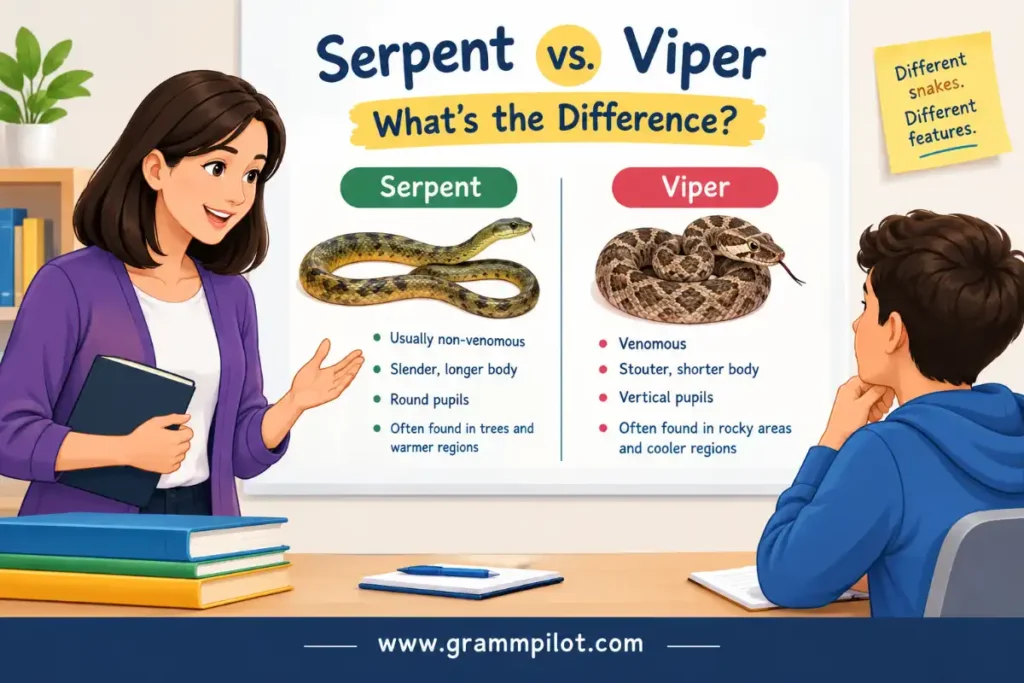
A serpent is a general word for a snake, especially in literary or symbolic writing. A viper refers to a member of a particular snake family.
| Feature | Serpent | Viper |
|---|---|---|
| Type of word | General name for a snake | Name for a specific group of snakes |
| Biological precision | Broad | More specific |
| Literary use | Common | Possible, but more concrete |
| Can it identify a family? | No | Yes |
| Example | The serpent moved through the grass. | The viper rested near the rocks. |
Not every serpent is a viper. A python, cobra, and many other snakes may be called serpents in a story, but they aren’t all vipers. Use viper when the species group matters. Use serpent when you’re naming a snake generally or aiming for a literary effect.
Serpent vs Python: Which Word Is More Specific?
A python is a particular kind of snake. A serpent is a broader term.
For example:
- General: A serpent rested in the cave.
- Specific: A python rested in the cave.
The second sentence gives the reader more biological information. If you know the animal is a python, that word is more precise. However, don’t call an animal a python unless you have a reliable reason to identify it as one.
What Are the Common Mistakes When Using Serpent and Snake?
Although the two words overlap in meaning, writers sometimes use them in ways that create confusion.
Mistake 1: Assuming a Serpent Is Always Huge
Incorrect assumption: Every serpent is larger than an ordinary snake.
Correction: Serpent doesn’t specify size. A writer can describe a small serpent in a poem or a giant snake in a scientific discussion.
Better example: A small serpent rested beneath the ancient statue.
Mistake 2: Assuming Every Serpent Is Venomous
Incorrect assumption: A serpent must be poisonous or dangerous.
Correction: The word doesn’t identify if a snake is venomous. Some snakes are venomous, while others kill prey through constriction or use other methods.
Better example: The wildlife expert explained that the snake’s risk depended on its species.
For accuracy, use venomous when you mean an animal that injects venom. Poisonous usually refers to something harmful when eaten, touched, or otherwise absorbed, although everyday speech sometimes uses the terms loosely.
Mistake 3: Treating Serpent as a Scientific Category
Incorrect: Serpents belong to a separate biological group from snakes.
Correction: In ordinary English, serpent is another word for a snake. It doesn’t identify a separate scientific category.
Better example: Snakes belong to the reptile group, and serpent is a common literary term for them.
Mistake 4: Using Serpent in Every Sentence
A paragraph can sound unnatural if you repeat serpent when snake would be clearer.
Overly dramatic: The serpent crossed the yard. The serpent entered the shed. The serpent then moved beneath the fence.
More natural: The snake crossed the yard, entered the shed, and disappeared beneath the fence.
Use varied wording when it improves readability, but don’t replace a simple word with an obscure one just to avoid repetition.
Mistake 5: Calling Every Snake a Viper or Cobra
A viper and a cobra are specific kinds of snakes. They aren’t general replacements for the word snake.
Incorrect: A cobra crossed the trail, when the animal’s species is unknown.
Better: A snake crossed the trail.
In factual writing, accurate identification matters more than dramatic language.
What Are the Antonyms of Serpent and Snake?
Neither serpent nor snake has one exact antonym. They name a kind of animal, and there isn’t a single opposite animal that always contrasts with them.
However, you can use words that contrast with a snake in a particular context.
| Word | Type of contrast | Example |
|---|---|---|
| Mammal | Different animal group | A fox is a mammal, while a snake is a reptile. |
| Bird | Different animal group | The eagle flew above the snake. |
| Prey | Relationship in a food chain | The mouse became prey for the snake. |
| Predator | Opposite role in a particular relationship | The snake was the predator, while the mouse was its prey. |
| Harmless | Contrasts with dangerous in a particular context | The story described a harmless snake. |
| Friendly | Contrasts with hostile in a figurative description | The friendly creature helped the hero. |
Be careful with words such as harmless. A snake’s risk depends on its species, behavior, and circumstances. Don’t assume that an unfamiliar snake is safe to approach.
What Are the Best Quick Tips for Choosing Between Serpent and Snake?
Use these simple checks before choosing a word.
- For everyday conversation: Choose snake.
- For science and wildlife information: Usually choose snake, followed by the species name if known.
- For mythology and legends: Consider serpent.
- For poetry and fantasy: Use serpent when you want a mysterious or dramatic effect.
- For a formal report: Prefer the clearest and most accurate term.
- For a winding road or river: Use snaked as a verb or serpentine as an adjective.
- For a specific snake family: Use the correct term, such as viper.
- For an unknown species: Use snake instead of guessing.
- For figurative writing about betrayal: Snake is a familiar informal expression, but remember that it can sound insulting.
- For a young audience: Snake is usually easier to understand.
One final test is to read the sentence aloud. If serpent sounds overly dramatic for the situation, snake will probably work better. If you’re writing a legend and want an ancient, mysterious feeling, serpent may be the stronger choice.
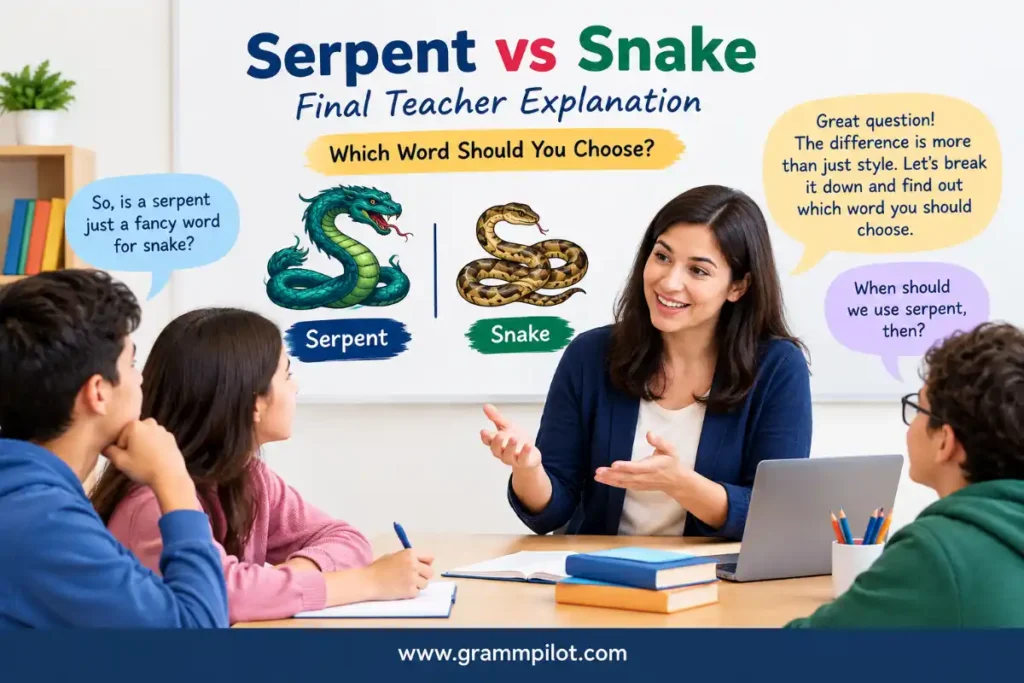
Final Teacher Explanation: Which Word Should You Choose?
The simplest way to understand Serpent vs Snake is to separate meaning from tone. Both words can describe the same animal, but they don’t always create the same impression. Snake is the standard everyday word. It works in conversations, science lessons, wildlife reports, and most practical writing. Serpent is useful when a writer wants a more formal, literary, symbolic, or mythological effect. Neither word automatically tells you the animal’s size, species, or level of danger. Those details require more precise descriptions. When you’re unsure, start with snake. It’s clear, natural, and widely understood. Then consider serpent if the subject is a legend, poem, or dramatic scene. A strong writer doesn’t always choose the fanciest word. A strong writer chooses the word that helps the reader understand the meaning and feel the intended mood.
Conclusion
Choosing between Serpent vs Snake is easier when you focus on the purpose of your sentence. Both words generally refer to the same kind of reptile, but they suit different writing styles. Snake is the best everyday choice because it is familiar, direct, and easy to understand. Serpent works well in mythology, poetry, fantasy, and symbolic descriptions where a more dramatic tone is useful.
Remember that neither word automatically identifies a species or tells you if an animal is dangerous. If you are writing a scientific report, use the common name or exact species when you know it. If you’re creating a story, think about the atmosphere you want your words to create.
You don’t need complicated vocabulary to write well. Start with the clearest word, consider your audience, and use a more expressive alternative only when it adds meaning.
Frequently Asked Questions
1. What is the main difference between a serpent and a snake?
A snake is the common everyday term for the reptile, while a serpent often sounds more literary, formal, or mythological. Both words generally refer to the same kind of animal.
2. Is a serpent a real animal or a mythical creature?
A serpent can refer to a real snake or a snake-like creature in mythology. The meaning depends on the context in which the word appears.
3. Is a serpent more dangerous than a snake?
No, the word serpent doesn’t mean that an animal is more dangerous. The actual risk depends on its species and behavior, not on which word someone uses.
4. What’s another word for a snake or serpent?
Common alternatives include reptile, viper, cobra, python, and serpent, but they don’t all mean exactly the same thing. Viper, cobra, and python identify particular kinds of snakes, while reptile is a broader animal category.
5. Should I use serpent or snake in an essay?
Use snake in most science essays and factual explanations. Choose serpent when discussing mythology, literature, symbolism, or an author’s deliberate word choice.
6. Is serpent a synonym for snake in American English?
Yes, serpent can be used as a synonym for snake in American English. However, it is less common in everyday conversation and often has a more formal or literary tone.
7. Can the word snake describe a dishonest person?
Yes, snake can informally describe someone who is dishonest or betrays another person. This figurative use is negative and may sound insulting, so consider your audience before using it.