
Imagine writing an email to your teacher or manager. You want to explain that a website is not working, a building cannot be entered, or important information is difficult to find. You type, “The website is unaccessible,” but then you wonder whether inaccessible is the correct word. Both spellings may look reasonable, so which one should you use? The difference matters when you want your writing to sound clear, natural, and professional. Choosing the right word can help you avoid spelling mistakes in school assignments, business emails, reports, and everyday conversations.
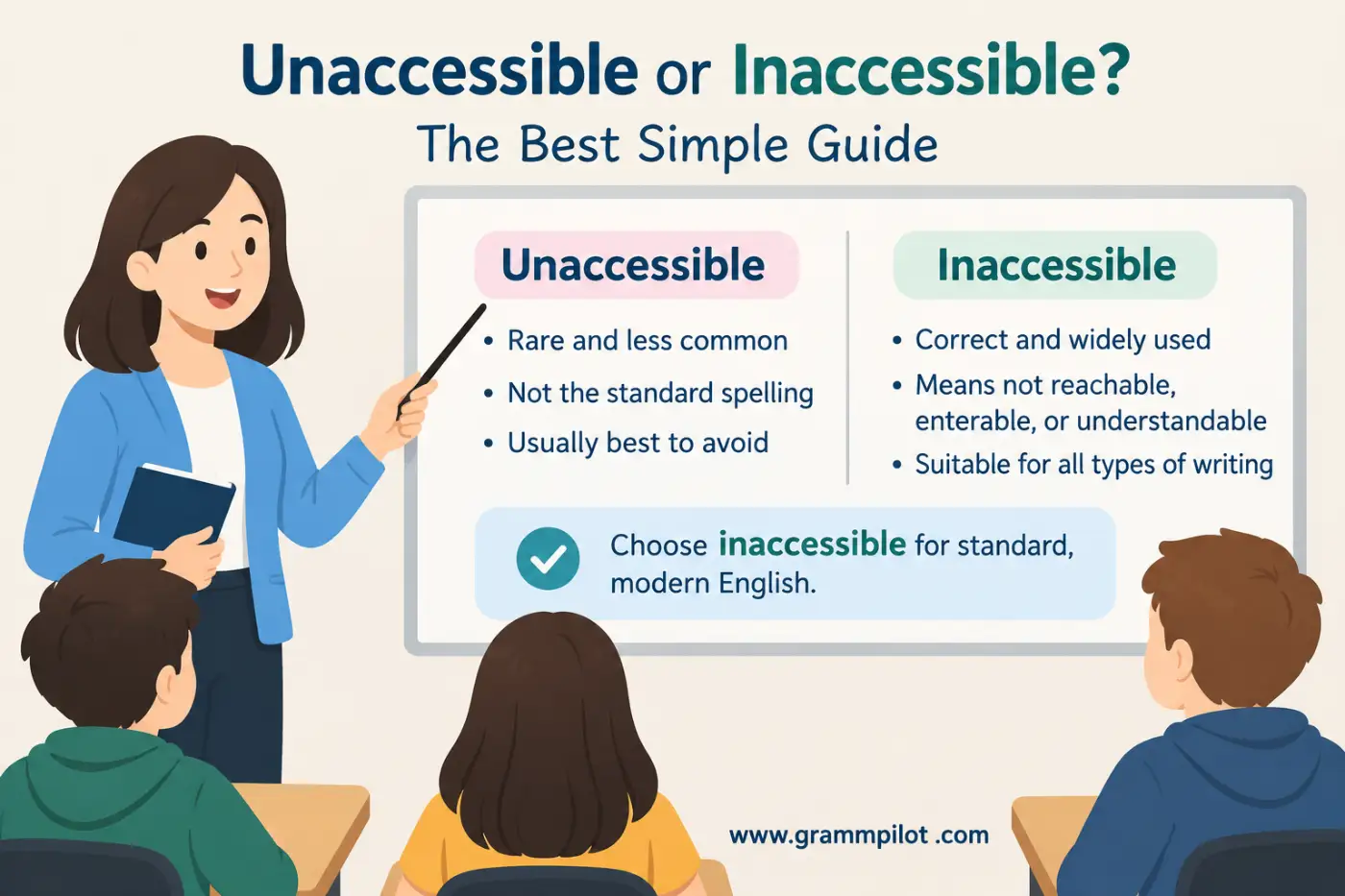
The correct and preferred word in modern English is “inaccessible.” It means that something cannot be reached, entered, used, or understood easily. “Unaccessible” is a rare variant, but it is generally best to avoid it in standard American English.
Although the two forms look similar, they are not equally common or equally suitable for everyday writing. Understanding their meanings, origins, synonyms, and uses will help you choose the right expression without second-guessing yourself.
This guide explains the difference between Unaccessible or Inaccessible, provides practical examples, compares more than 30 alternatives, and shows which word works best in emails, essays, resumes, conversations, and other situations.
To keep improving your English grammar, explore [Run or Ran].
What Is the Difference Between Unaccessible and Inaccessible?
The main difference is standard usage. Inaccessible is the established spelling used in modern English. Unaccessible is much less common and is usually treated as a nonstandard or less-preferred alternative.
Both forms suggest that something is not accessible. However, when you want to follow standard American English, choose inaccessible.
Consider these examples:
- Correct: The mountain village became inaccessible after the heavy snowfall.
- Better to avoid: The mountain village became unaccessible after the heavy snowfall.
- Correct: The website is inaccessible because the server is down.
- Better to avoid: The website is unaccessible because the server is down.
The first versions sound natural and follow common writing conventions. They are suitable for academic work, workplace communication, and professional documents.
What Does Inaccessible Mean in Plain English?
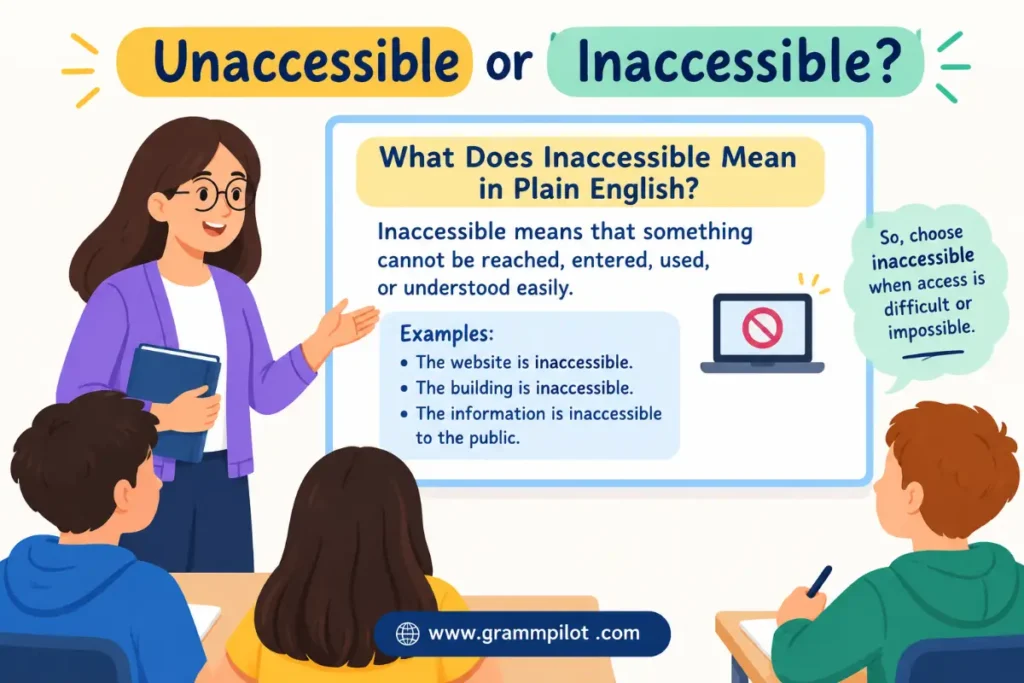
Inaccessible means that someone or something cannot be reached, entered, obtained, used, or understood under the circumstances.
The exact meaning depends on the situation.
| Situation | Meaning | Example |
|---|---|---|
| Physical location | Difficult or impossible to reach | The cabin is inaccessible by car. |
| Building | Cannot be entered | The office remained inaccessible during repairs. |
| Website | Cannot be opened or used | The website is inaccessible this morning. |
| Information | Difficult or impossible to obtain | The records are inaccessible to the public. |
| Language | Difficult to understand | The textbook uses inaccessible language. |
| Service | Cannot be used by certain people | The service is inaccessible to people without internet access. |
| Person | Difficult to contact or approach | The director was inaccessible during the meeting. |
| Technology | Cannot be accessed or operated | The file became inaccessible after the system crashed. |
Notice that the word does not always mean something is physically locked. A place may be open but difficult to reach. A document may exist but be unavailable to you. A lesson may be available online but too complicated for a beginner to understand.
In each case, inaccessible describes a barrier between a person and something they want or need to reach.
Is Unaccessible a Real Word?
Unaccessible does appear in English, but it is uncommon and is not the usual choice in contemporary standard writing.
You may encounter it in older texts, unusual word choices, or writing produced by people who assume that adding un- to accessible creates the expected opposite. However, modern readers generally expect inaccessible.
If you are writing an essay, application, report, article, or business email, use inaccessible. It is the safer and more widely accepted option.
Remember that a word can appear in dictionaries or historical texts without being the best choice for everyday communication. Frequency, accepted usage, and the expectations of your audience all matter.
Where Do Inaccessible and Unaccessible Come From?
Understanding word origins makes spelling choices easier to remember.
The Origin of Accessible
The word accessible comes through French from Latin roots associated with approaching or coming near. The Latin verb accedere means to approach or come toward.
Over time, accessible developed the meaning of being easy to approach, enter, reach, obtain, or understand.
For example:
- An accessible entrance is easy to reach or enter.
- Accessible information is available to the people who need it.
- An accessible explanation is easy to understand.
- An accessible teacher is approachable and willing to help.
The word can describe physical access, practical availability, or ease of understanding.
Why Does Inaccessible Use the Prefix In-?
The prefix in- can express a negative meaning. In this word, it changes accessible into its opposite.
Accessible means reachable or available.
Inaccessible means not reachable or not available.
The spelling follows an established English word rather than the most obvious spelling pattern a writer might invent.
Compare these examples:
| Positive word | Negative form | Example |
|---|---|---|
| Accessible | Inaccessible | The road is inaccessible. |
| Accurate | Inaccurate | The report contains inaccurate figures. |
| Active | Inactive | The account is inactive. |
| Appropriate | Inappropriate | That comment was inappropriate. |
| Adequate | Inadequate | The evidence was inadequate. |
These examples show why it is useful to learn common negative forms individually. English does not always let you create the standard opposite by adding the same prefix to every word.
Why Do Some People Write Unaccessible?
English has more than one negative prefix. Common examples include un-, in-, im-, ir-, and dis-.
Writers often learn that un- means “not.” They may therefore assume that unaccessible is the natural opposite of accessible.
That assumption is understandable, but established usage does not always follow a simple rule. In this case, inaccessible is the normal choice.
A useful memory trick is to connect the word with familiar expressions such as inaccurate, inadequate, and inappropriate. This does not mean that every word beginning with a takes in-. It simply gives you a practical reminder of this particular spelling.
What Are the Best Synonyms for Inaccessible?
The best synonym depends on what makes something inaccessible. A locked building, an unavailable document, a difficult lesson, and a remote village do not all need the same replacement word.
The following lists provide 32 useful alternatives grouped by tone and purpose. Some are direct substitutes in certain contexts, while others express a more specific kind of difficulty.
What Are Simple Synonyms for Inaccessible?
These words are easy to understand and work well in everyday English.
| Word | Meaning | Tone | Example |
|---|---|---|---|
| Unreachable | Impossible or difficult to reach | Simple | The cabin was unreachable by road. |
| Unavailable | Not ready or able to be used | Simple | The service is unavailable today. |
| Closed | Not open for entry or use | Simple | The entrance is closed. |
| Blocked | Prevented from being reached | Simple | The path is blocked by fallen trees. |
| Out of reach | Too far away or difficult to obtain | Simple | The top shelf is out of reach. |
| Hard to reach | Difficult to get to | Simple | The clinic is hard to reach in winter. |
| Hidden | Not easy to see or find | Simple | The settings are hidden in the menu. |
| Locked | Secured against entry or use | Simple | The office door is locked. |
Best choice: Use unreachable when distance is the problem, unavailable when something cannot be used, and locked when a physical or digital barrier prevents entry.
What Are Everyday Synonyms for Inaccessible?
These expressions are natural in conversation, emails, and general writing.
| Word | Meaning | Tone | Example |
|---|---|---|---|
| Hard to access | Difficult to reach or use | Everyday | The records are hard to access. |
| Difficult to reach | Not easy to contact or approach | Everyday | The manager is difficult to reach. |
| Out of the way | Located far from common routes | Everyday | Their house is out of the way. |
| Remote | Far from populated areas | Everyday | The team works in a remote location. |
| Cut off | Separated from normal access | Everyday | The town was cut off by flooding. |
| Restricted | Limited to certain people or uses | Everyday | The folder has restricted access. |
| Unobtainable | Impossible or very difficult to get | Everyday | The rare item was unobtainable locally. |
| Impassable | Impossible to travel through | Everyday | The road became impassable after the storm. |
Best choice: Use restricted when rules limit access, remote when distance is the issue, and impassable when a route cannot be crossed.
What Are Formal Synonyms for Inaccessible?
These terms can help make reports, academic assignments, and professional documents more precise.
| Word | Meaning | Tone | Example |
|---|---|---|---|
| Inapproachable | Difficult to approach or speak to | Formal | The official seemed inapproachable. |
| Unattainable | Impossible or difficult to achieve | Formal | The target was unattainable within the deadline. |
| Unobtainable | Not possible to acquire | Formal | The original document was unobtainable. |
| Impervious | Not allowing something to pass through or affect it | Formal | The barrier was impervious to water. |
| Incomprehensible | Impossible or very difficult to understand | Formal | The instructions were incomprehensible. |
| Obscure | Not clear or easy to understand | Formal | The reference was obscure. |
| Secluded | Private or separated from others | Formal | The house stood in a secluded valley. |
| Isolated | Separated from others or from services | Formal | The community remained isolated. |
These words are not interchangeable in every sentence. Impervious, for example, describes resistance to something passing through or having an effect. It does not normally mean that a website cannot be opened.
What Informal Words Can Replace Inaccessible?
Informal alternatives are useful in casual speech and texting, but some are too vague for professional writing.
| Word or phrase | Meaning | Tone | Example |
|---|---|---|---|
| Out of bounds | Not allowed to enter or use | Informal | That room is out of bounds. |
| Off-limits | Not permitted to enter or access | Informal | The staff area is off-limits. |
| Locked out | Prevented from entering an account or place | Informal | I got locked out of my account. |
| Out of reach | Not available or easy to obtain | Informal | The price is out of reach for me. |
| A dead end | A route or attempt that leads nowhere | Informal | The search turned into a dead end. |
| A no-go | Something that cannot be done or entered | Informal | The road is a no-go after the storm. |
| Not getting through | Unable to connect or gain access | Informal | I’m not getting through to the website. |
| Can’t get in | Unable to enter a place or account | Informal | I can’t get in to check my email. |
These expressions sound natural in conversation, but choose more precise wording for formal documents. For example, off-limits usually suggests a rule, while inaccessible can describe a barrier even when no rule exists.
Which Synonym Should You Choose Based on Intensity?
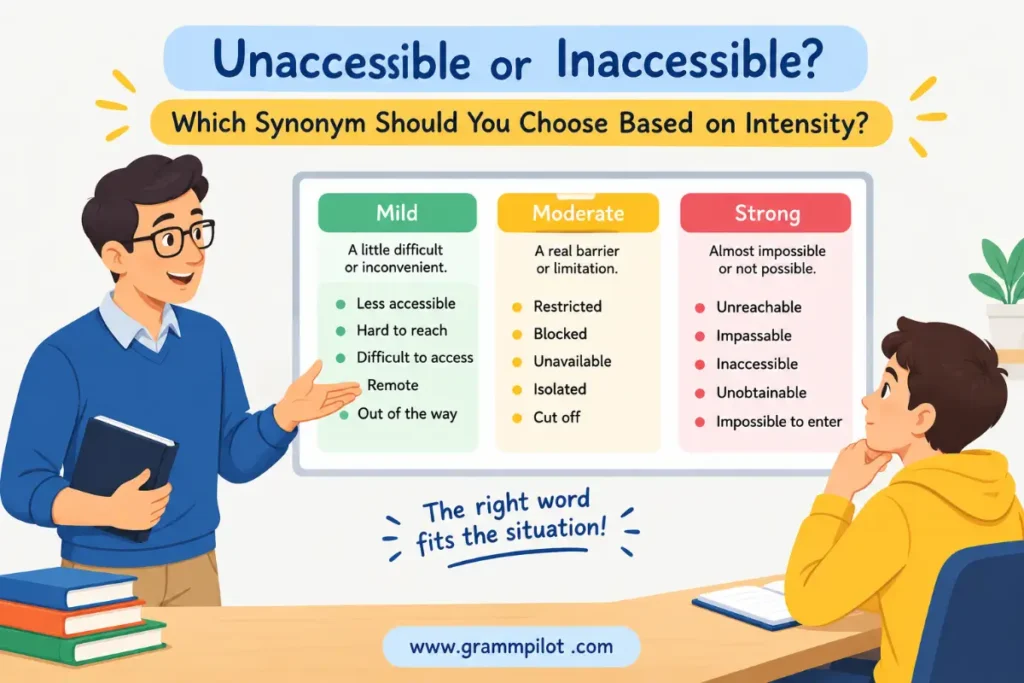
Not every situation requires the strongest possible word. Sometimes something is merely inconvenient to reach. In other cases, access is completely impossible.
Choosing the right level of intensity helps your reader understand the actual problem.
What Are Mild Synonyms for Inaccessible?
Use these when access is possible but inconvenient.
- Less accessible: Not as easy to reach or use as something else.
- Hard to reach: Requires extra time or effort.
- Difficult to access: Requires special steps or additional effort.
- Remote: Far from ordinary routes or services.
- Out of the way: Not conveniently located.
Example: The new parking area is less accessible than the old one.
This sentence suggests a problem without claiming that the parking area is impossible to reach.
What Are Moderate Synonyms for Inaccessible?
Use these when a meaningful barrier prevents easy access.
- Restricted: Access is limited by rules or permissions.
- Blocked: Something physically or digitally prevents access.
- Unavailable: Something cannot currently be used.
- Isolated: Separated from other places or services.
- Cut off: Normal access has been interrupted.
Example: The online portal is temporarily unavailable while technicians repair the system.
This wording tells readers that the problem may be temporary.
What Are Strong Synonyms for Inaccessible?
Use these when access is impossible or nearly impossible.
- Unreachable: Cannot be reached under the circumstances.
- Impassable: Cannot be crossed or traveled through.
- Inaccessible: Cannot be reached, entered, used, or understood.
- Unobtainable: Cannot be acquired.
- Impossible to enter: Physical entry cannot be completed.
Example: Rescue teams could not reach the village because the only road was impassable.
Avoid words such as impossible unless the situation supports that level of certainty. A route that is difficult today may become usable tomorrow.
How Does Inaccessible Work as Different Parts of Speech?
Understanding the related forms can help you avoid awkward sentences.
Is Inaccessible an Adjective?
Yes. Inaccessible is an adjective. It describes a noun by explaining that something cannot be reached, entered, obtained, or understood easily.
Examples:
- The building is inaccessible.
- We found an inaccessible webpage.
- The village became inaccessible after the storm.
- The instructions were inaccessible to beginners.
The adjective often appears after linking verbs such as is, was, became, and seems. It can also appear before a noun, as in an inaccessible entrance.
What Is the Noun Form of Inaccessible?
The related noun is inaccessibility.
It describes the condition or quality of being inaccessible.
Examples:
- The inaccessibility of the road delayed the delivery.
- The report discusses the inaccessibility of public services in rural areas.
- Website inaccessibility can prevent customers from completing purchases.
In everyday writing, the noun may sound heavy. You can often use a simpler phrase instead.
Instead of “The inaccessibility of the entrance caused a problem,” write “The entrance was difficult to reach.”
What Is the Opposite of Inaccessible?
The direct opposite is accessible.
Other opposites include:
- Reachable
- Available
- Open
- Obtainable
- Approachable
- Understandable
- Easy to use
- Easy to enter
Choose the opposite that matches the situation. Understandable is a good opposite when the issue concerns difficult language. Open works when the issue concerns a closed door or building.
Is Inaccessible Different in American and British English?
The spelling inaccessible is standard in both American and British English. There is no major regional spelling difference between the two varieties for this word.
American and British writers use it to describe places, information, services, and ideas that cannot be reached or understood easily.
Examples:
- American English: The trail is inaccessible during winter.
- British English: The trail is inaccessible during winter.
The sentence works in both varieties.
There can be differences in the surrounding vocabulary. British writers may use car park where American writers use parking lot, for example. However, the choice between unaccessible and inaccessible is not a meaningful US-versus-UK spelling distinction.
If you are writing for an international audience, inaccessible is the clearest choice.
Which Word Should You Use in Different Situations?
The most suitable word depends on your audience and the point you want to make. The following examples show how to choose wording for common writing tasks.
Should You Use Inaccessible in a Resume?
Yes, when you need to describe an access problem clearly. However, a resume often benefits from positive, action-focused language.
For example:
Weak: The company’s files were inaccessible.
Stronger: Restored access to files that employees could not open.
Another example:
Weak: The old system was inaccessible to staff.
Stronger: Improved system access for staff across three departments.
If you are describing a problem you solved, explain the action and result rather than simply labeling something inaccessible. This approach makes your contribution clearer to employers.
Should You Use Inaccessible in an Essay?
Yes. Inaccessible is appropriate for academic writing when it accurately describes the issue.
Examples:
- Public transportation remains inaccessible to some residents.
- Complex academic language can make research inaccessible to general readers.
- The study examines why healthcare services are inaccessible in rural communities.
In an essay, explain the reason for the lack of access whenever possible. A statement such as “The service is inaccessible” is clear, but “The service is inaccessible to residents who live far from the nearest clinic” provides more useful information.
Avoid using unaccessible just because it seems to match the negative prefix un-.
Should You Use Inaccessible in an Email?
Yes. It works well in professional emails, especially when explaining a technical problem or a physical barrier.
Example:
“Hello, I cannot open the shared document because it appears to be inaccessible. Could you please check the permissions or send me another copy?”
This message identifies the problem and suggests a practical solution.
For a less formal email, you could write:
“I can’t access the file right now. Could you resend it?”
The second version sounds more conversational and may be easier to understand. Both are correct, but can’t access often feels more direct than inaccessible in routine communication..
Should You Use Inaccessible When Speaking?
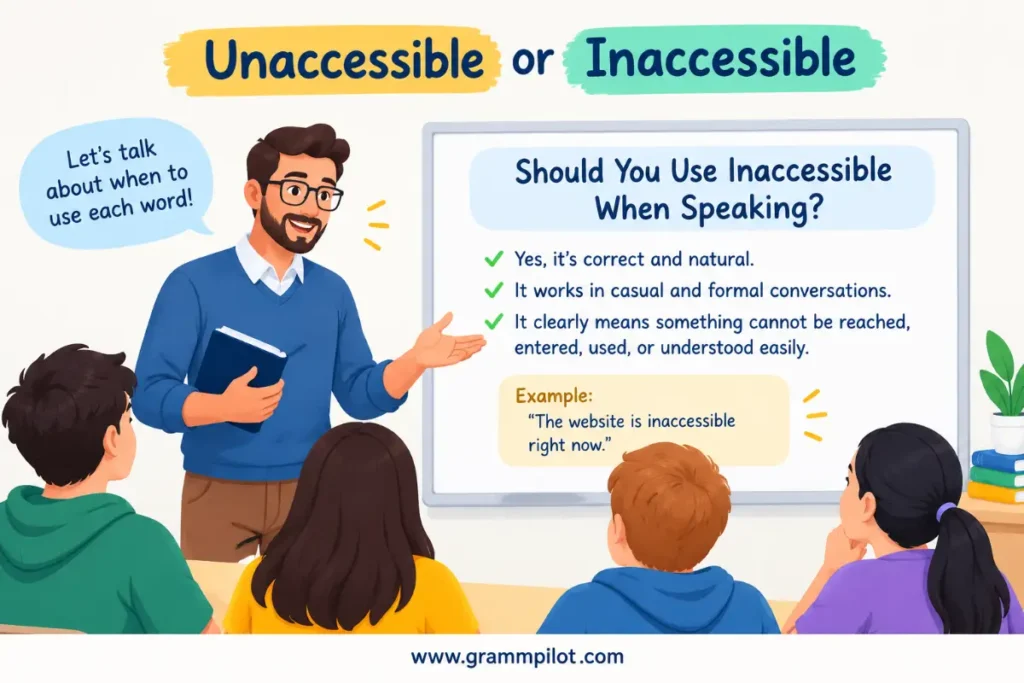
Yes. The word is useful in presentations, meetings, and everyday discussions. However, a shorter phrase may communicate the point faster.
For example, during a meeting, you could say, “The shared folder is inaccessible to the new employees.”
In casual conversation, you might say, “The new employees can’t open the shared folder.”
Both sentences explain the problem. The second is more direct, while the first may suit a formal report or presentation.
When speaking to a broad audience, prefer words your listeners can understand immediately.
What Are 10 Correct Example Sentences Using Inaccessible?
Examples help you see how a word works in different situations. Here are 12 original sentences from school, work, travel, technology, and daily life.
- The mountain road became inaccessible after heavy rain washed away part of the bridge.
- Students found the online assignment inaccessible because the teacher had shared the wrong link.
- The museum’s upper floor was inaccessible while workers repaired the staircase.
- Some public buildings remain inaccessible to visitors who use wheelchairs.
- The customer support team was temporarily inaccessible during the system outage.
- The report contains technical language that makes the findings inaccessible to ordinary readers.
- We discovered that the archived photographs were inaccessible without the correct account permissions.
- The remote village became inaccessible when the river flooded.
- The company updated its website to make the information less inaccessible to new users.
- The emergency exit must never be blocked or made inaccessible.
Sentence 9 is grammatically possible, but it illustrates an important point: a double negative-style construction such as less inaccessible can sound awkward. A clearer version would be “The company updated its website to make the information easier for new users to access.”
What Is the Difference Between Inaccessible and Unavailable?
These words overlap, but they do not mean exactly the same thing.
Inaccessible focuses on the difficulty or impossibility of reaching, entering, using, or understanding something. Unavailable means that something cannot currently be obtained or used.
| Inaccessible | Unavailable |
|---|---|
| Focuses on access or a barrier | Focuses on whether something is available |
| May describe physical or digital access | Often describes temporary absence or lack of supply |
| The building is inaccessible during repairs. | The meeting room is unavailable until noon. |
| The file is inaccessible because permissions are incorrect. | The file is unavailable because it has not been uploaded. |
| The text is inaccessible to beginners. | The tutor is unavailable this afternoon. |
A website can be unavailable because its servers are down. It can be inaccessible because a firewall or permission setting prevents a particular person from opening it.
The words may overlap, but the reason matters. Use inaccessible when access is the central issue. Use unavailable when the item or service cannot be supplied or used at that time.
What Is the Difference Between Inaccessible and Restricted?
Restricted means that access is limited, often by a rule, permission, or policy. Inaccessible means that access is not possible or is difficult under the circumstances.
Examples:
- The employee records are restricted to authorized staff.
- The employee records are inaccessible because the database is offline.
In the first sentence, the organization deliberately limits access. In the second, a technical problem prevents access.
A place can also be both restricted and inaccessible. For example, a secure laboratory may be restricted to trained staff, and a broken entrance system may make it temporarily inaccessible even to authorized workers.
Use restricted when permission or rules are the main issue. Use inaccessible when the actual ability to reach or use something is the main issue.
What Are the Most Common Mistakes With Inaccessible?
Several mistakes can make sentences unclear or less professional. Knowing what to avoid will help you use the word confidently.
Mistake 1: Writing Unaccessible in Formal Work
Incorrect or less preferred: The database is unaccessible to employees.
Better: The database is inaccessible to employees.
The second version follows standard modern usage and is the best choice for academic and professional writing.
Mistake 2: Using Inaccessible When You Mean Closed
Not every closed place is inaccessible.
For example, a shop may be closed for the night but accessible during business hours. A locked staff-only room may be inaccessible to visitors but accessible to employees.
If you simply mean that a business is not open, use closed. Reserve inaccessible for situations where access is the key issue.
Mistake 3: Confusing Inaccessible With Impossible
These words are related but not identical.
“Inaccessible” describes a barrier to reaching, entering, using, or understanding something. “Impossible” describes something that cannot be done or achieved.
Example:
- The trail is inaccessible without special equipment.
- It is impossible to complete the task without the required information.
The first sentence describes access. The second describes the ability to complete an action.
Mistake 4: Forgetting to Explain Who Cannot Access Something
The sentence “The website is inaccessible” may be correct, but it does not explain who is affected.
A clearer version might be: “The website is inaccessible to users who do not have an approved account.”
Adding the affected group makes your message more useful. This is especially important when discussing public services, technology, education, and accessibility needs.
Mistake 5: Assuming Inaccessible Always Means Physically Difficult to Reach
The word also applies to information, technology, services, and ideas.
For example, an online form may be inaccessible because it does not work with a screen reader. A scientific article may be inaccessible to beginners because it uses specialized language.
Always consider the context before choosing a synonym.
What Are the Antonyms of Inaccessible?
Antonyms are words with opposite meanings. The best opposite of inaccessible depends on the type of access being discussed.
| Antonym | Meaning | Example |
|---|---|---|
| Accessible | Easy to reach, enter, use, or understand | The building is accessible to visitors. |
| Available | Ready to be used or obtained | The report is available online. |
| Reachable | Possible to reach | The village is reachable by bus. |
| Open | Allowing entry or use | The library is open to the public. |
| Obtainable | Possible to get | The information is obtainable from the office. |
| Approachable | Easy to speak to | The teacher is approachable and helpful. |
| Understandable | Easy to understand | The instructions are understandable. |
| Usable | Suitable for use | The website is usable on mobile devices. |
Remember that these words are not exact opposites in every context. Approachable is suitable for a person, while obtainable is suitable for something that can be acquired.
What Are the Quick Tips for Choosing the Right Word?
Use these practical tips whenever you are unsure which expression fits your sentence.
- Choose inaccessible when something cannot be reached, entered, used, or understood easily.
- Choose unavailable when a service, person, or item cannot currently be used or obtained.
- Choose unreachable when a destination cannot be reached or a person cannot be contacted.
- Choose restricted when rules or permissions limit access.
- Choose blocked when an obstacle directly prevents access.
- Choose closed when a place is simply not open.
- Choose incomprehensible when the problem is understanding difficult language or ideas.
- Choose off-limits when entry or use is not permitted.
- Use can’t access when you want a direct, conversational expression.
- Use inaccessible rather than unaccessible in standard American English.
Before submitting an essay or email, ask yourself two questions: What is preventing access, and who is affected? The answers will help you select the most precise expression.
Final Teacher Explanation: Unaccessible or Inaccessible?
The safest spelling for modern English writing is inaccessible. Although unaccessible appears occasionally, it is rare and is not the usual form expected in standard American English. Remember that inaccessible is an adjective. It describes something that cannot be reached, entered, used, obtained, or understood easily. It can refer to a mountain road, a locked building, an online account, a public service, or a difficult academic text. Do not automatically replace it with unavailable, unreachable, or restricted. Each word has its own meaning. A service may be unavailable, a road may be impassable, and a file may be inaccessible because of incorrect permissions. For the clearest writing, identify the actual problem before choosing a word. If you mean that access is difficult or impossible, inaccessible is usually the best option.
Conclusion
When deciding between Unaccessible or Inaccessible, choose inaccessible for standard modern English. It is the established spelling used in American and British English, and it works in academic assignments, professional emails, reports, presentations, and everyday communication. The word describes something that cannot be reached, entered, obtained, used, or understood easily. Its meaning can apply to physical locations, digital files, public services, and complicated information.
You can also choose a more specific synonym when the situation calls for it. Use unreachable for something that cannot be reached, unavailable for something that cannot currently be used, and restricted when rules limit access. These distinctions make your writing more precise. The best way to remember the spelling is to practice it in real sentences. Whenever you need to describe a barrier to access, write inaccessible. With regular use, the correct form will become easier to recognize and remember.
Frequently Asked Questions
1. Is Unaccessible or Inaccessible correct?
Inaccessible is the preferred and standard form in modern English. Although unaccessible appears occasionally, use inaccessible in essays, emails, reports, and professional documents.
2. Why is Inaccessible spelled with in- instead of un-?
English uses different negative prefixes, and their choice depends on established word usage. Inaccessible is the conventional form derived from accessible, so adding un- is not the preferred choice.
3. What does inaccessible mean in simple words?
It means that something cannot be reached, entered, used, or understood easily. For example, a road may be inaccessible after a flood, or a file may be inaccessible because you lack permission.
4. What’s another way to say inaccessible?
You can say unreachable, unavailable, hard to access, blocked, or restricted, depending on the context. Use unreachable for places and people, and unavailable when something cannot currently be used.
5. Is inaccessible the correct spelling in American English?
Yes. Inaccessible is the standard spelling in American English and is also used in British English. You should use it in schoolwork, business communication, and formal writing.
6. What is the opposite of inaccessible?
The most direct opposite is accessible. Depending on the situation, other opposites include available, reachable, open, obtainable, and understandable.
7. Can I use inaccessible in a professional email?
Yes. It is appropriate when explaining that a file, website, building, or service cannot be reached or used. For example, “The shared document appears to be inaccessible. Could you please check the access permissions?”