
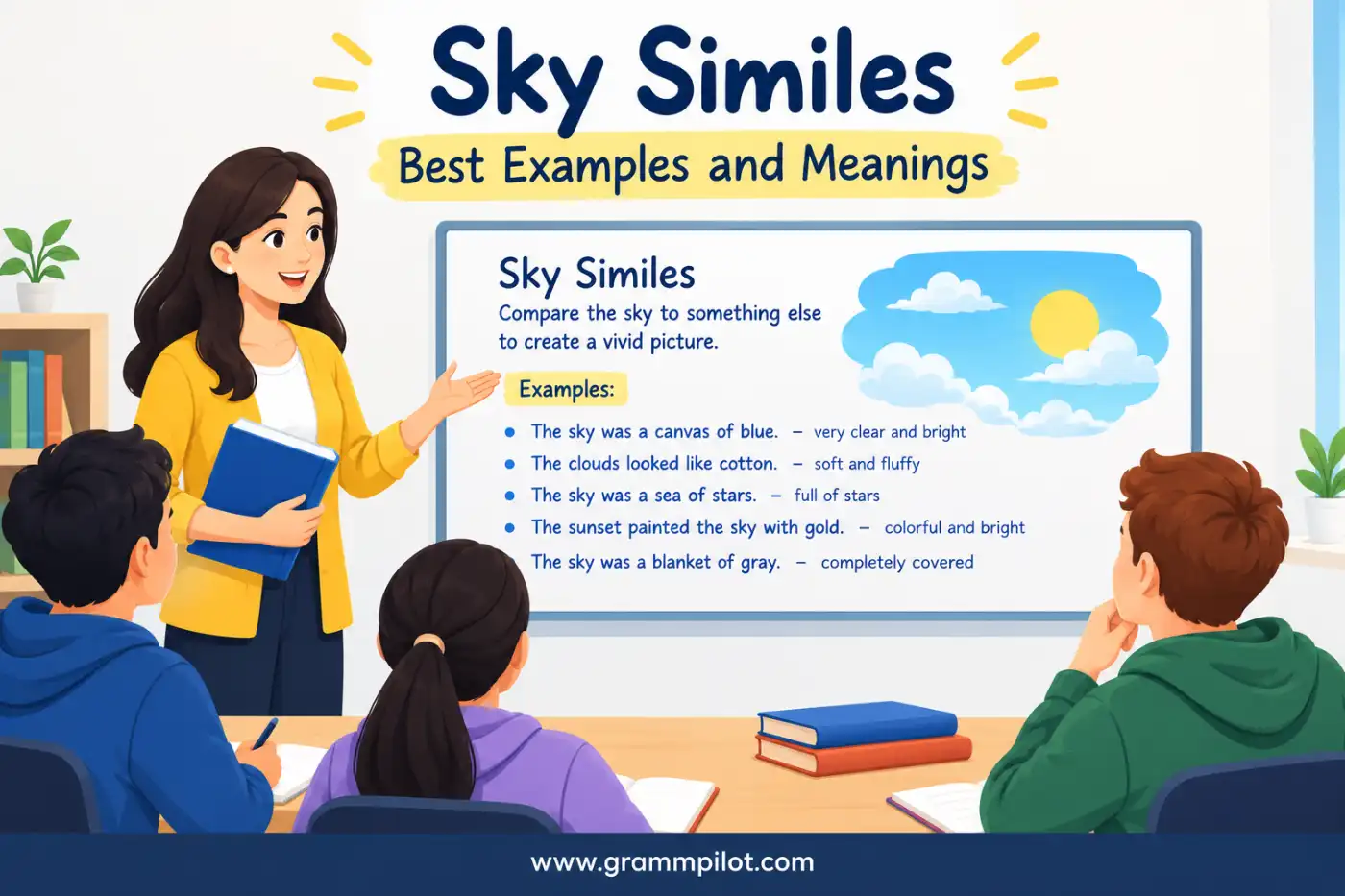
Have you ever stared out the window while writing an essay, text, story, or even an email and struggled to describe the sky? Saying “the sky was blue” works, but it doesn’t create a strong picture. Sky Similes can make your writing more colorful, emotional, and memorable. A good comparison helps readers see the scene in their minds. The sky can look soft, angry, endless, dark, bright, heavy, or peaceful. The right simile can capture those feelings in just a few words.
Answer: Sky similes compare the sky to something familiar by using words such as like or as. For example, “The sky was as blue as the ocean” creates a clear mental picture.
This guide explains what sky comparisons mean, where the word comes from, the best words to use, common types of comparisons, examples for different situations, common mistakes, related words, and helpful writing tips.
For more creative descriptions and comparisons, read [Ourselves vs Ourself].
What Are Sky Similes?
A simile is a figure of speech that compares two different things. It usually uses like or as.
For example:
- The sky was like a blue blanket.
- The clouds were as soft as cotton.
- The evening sky glowed like a painting.
- The storm clouds were as dark as charcoal.
The purpose is simple: help the reader imagine what you are describing. When you use a comparison for the sky, you are not saying the sky literally is a blanket, painting, or ocean. You are borrowing a familiar image to describe its color, shape, movement, size, or mood.
That is what makes Sky Similes useful in:
- Creative writing
- School essays
- Poetry
- Stories
- Journals
- Social media captions
- Travel writing
- Descriptive paragraphs
- Speeches
- Personal narratives
A simple description gives information. A strong simile gives information and creates an image.
Compare these:
Plain: The sky was dark.
More descriptive: The sky was as dark as a closed room.
The second sentence gives the reader something more to imagine.
Where Does the Word “Simile” Come From?
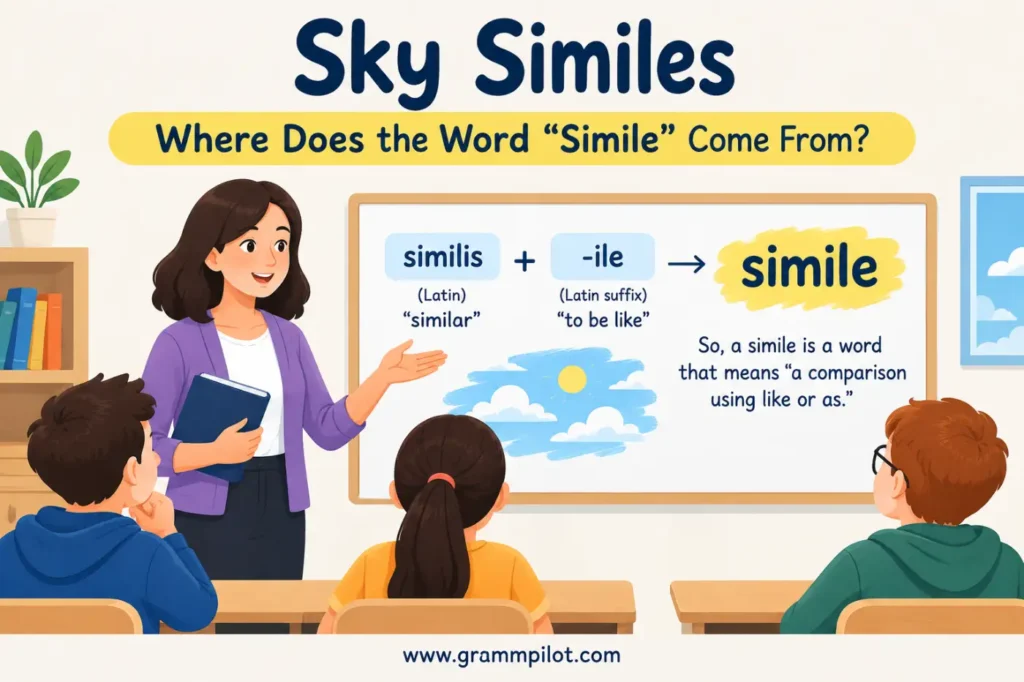
The word simile comes from the Latin word similis, meaning similar or like. That origin explains exactly how a simile works. It shows that one thing is similar to another thing in a particular way.
For example: The sky was like a sheet of glass.
The sky is not actually glass. The comparison may suggest that it looked:
- Smooth
- Clear
- Still
- Shiny
The reader understands the intended similarity. The English language has used comparisons for centuries. Writers, poets, storytellers, and everyday speakers have all used them to make ideas easier to understand.
Sky descriptions are especially common because almost everyone has seen:
- Bright blue skies
- Dark storm clouds
- Pink sunsets
- Orange sunrises
- Gray rainy days
- Star-filled nights
- Foggy mornings
Because these scenes can look so different, the sky gives writers many chances to compare it with familiar objects and experiences.
Similes for a Sunset
Sunsets are known for strong colors. You can compare them with fire, paint, gold, flowers, or other colorful objects.
Examples:
- The sunset glowed like a burning ember.
- The sky looked like it had been painted with fire.
- Orange light spread across the sky like melted gold.
- The clouds were as pink as rose petals.
- The horizon glowed like a furnace.
- The evening sky looked like a colorful watercolor painting.
Be careful with overused comparisons. “Like a painting” is simple and effective, but adding specific details can make your writing feel more original.
Similes for a Night Sky
A night sky can feel peaceful, mysterious, lonely, or magical.
Examples:
- The night sky was as dark as velvet.
- Stars glittered like tiny diamonds.
- The moon shone like a silver coin.
- The sky looked like a black blanket covered in sparks.
- The stars were scattered like grains of sugar.
- The night stretched above us like an endless dark ocean.
The best choice depends on whether your scene is peaceful, romantic, frightening, or mysterious.
Master List of Words for Describing the Sky
Sometimes you don’t need a simile right away. First, you may need the right descriptive word.
Here is a broad vocabulary list grouped by tone and use.
| Word | Meaning | Tone | Example |
|---|---|---|---|
| Blue | Having a blue color | Simple | The sky was blue and clear. |
| Clear | Free from clouds or haze | Simple | We enjoyed a clear sky. |
| Dark | Having little light | Simple | The dark sky warned of rain. |
| Cloudy | Full of clouds | Everyday | It was a cloudy afternoon. |
| Sunny | Full of sunshine | Everyday | We had a sunny morning. |
| Stormy | Having storms | Everyday | The weather turned stormy. |
| Overcast | Completely covered by clouds | Everyday/Formal | The sky remained overcast all day. |
| Hazy | Slightly unclear because of mist or smoke | Everyday | The mountains faded into the hazy sky. |
| Misty | Full of light mist | Everyday | A misty sky covered the valley. |
| Gloomy | Dark and depressing | Everyday | The gloomy sky matched his mood. |
| Endless | Seeming to have no end | Everyday | The endless sky stretched above us. |
| Turbulent | Violent or disturbed | Formal | A turbulent sky formed before the storm. |
| Brooding | Dark and threatening | Literary | A brooding sky hung above the town. |
| Glowing | Giving off warm light | Everyday | The glowing sky marked the sunset. |
| Fiery | Looking like fire | Everyday | A fiery sky filled the west. |
| Murky | Dark and unclear | Everyday | A murky sky appeared before the rain. |
| Moody | Changing or showing strong atmosphere | Informal | The moody sky made the photo dramatic. |
Sky Description Words by Intensity
Sometimes you need a mild description. Other times, you want something powerful.
Mild descriptions
These are useful for calm, simple writing:
- Blue
- Clear
- Light
- Pale
- Soft
- Cloudy
- Bright
- Gray
Example: The pale sky slowly became brighter.
Medium-strength descriptions
These add more emotion or detail:
- Glowing
- Golden
- Gloomy
- Hazy
- Dramatic
- Vast
- Stormy
- Fiery
Example: A dramatic sky appeared above the mountains.
Strong descriptions
Use these when you want a powerful image:
- Violent
- Turbulent
- Ominous
- Brooding
- Blazing
- Boundless
- Pitch-black
- Explosive
Example: An ominous sky rolled over the empty field.
Strong words can be effective, but too many powerful words in one paragraph can make writing feel exaggerated.
What Part of Speech Are Sky Description Words?
Most sky description words are adjectives because they describe a noun.
Examples:
- blue sky
- stormy sky
- golden sky
- cloudy sky
Some related words can also work as nouns or verbs.
Nouns
- Sky
- Cloud
- Storm
- Sunshine
- Horizon
- Sunset
- Sunrise
- Twilight
- Atmosphere
Example: The horizon glowed with orange light.
Verbs
These can help describe movement:
- Drift
- Gather
- Spread
- Glow
- Shine
- Darken
- Brighten
- Roll
- Stretch
- Hover
Example: Dark clouds gathered above the town.
Adverbs
Adverbs can change the feeling of the action:
- Slowly
- Brightly
- Softly
- Suddenly
- Quietly
- Dramatically
Example: The clouds slowly drifted across the sky.
Combining strong verbs with good comparisons can improve your writing without adding too many adjectives.
Are Sky Words Different in American and British English?
Most common sky and weather words are understood in both the United States and the United Kingdom.
For example:
- Cloudy
- Stormy
- Clear
- Overcast
- Hazy
- Sunny
These words generally mean the same thing.
However, style and word choice can vary by region. Gray is the standard American spelling, while grey is more common in British English.
Examples:
US: The sky was gray.
UK: The sky was grey.
Both are correct. If you are writing for an American audience, use gray consistently. If you are writing for a British audience, grey may feel more natural. Some poetic words, such as azure and cerulean, are understood in both places, but they are less common in everyday conversation.
What Is the Best Word for a Resume?
In most cases, you probably should not use poetic sky language in a resume. A resume should be direct and professional. If you are describing outdoor work, photography, aviation, weather research, or environmental experience, use precise terms instead.
Better choices include:
- Clear
- Atmospheric
- Environmental
- Meteorological
- Weather-related
Example: Photographed outdoor environments in changing weather conditions.
Avoid sentences such as: I captured skies as blue as a magical ocean.
That may work in a creative portfolio, but it usually does not belong in a standard resume.
What Is the Best Word for an Essay?
The best choice depends on the type of essay.
For a school essay
Use clear and natural language.
Example: The stormy sky made the afternoon feel colder and darker.
For a descriptive essay
Use more imagery.
Example: The clouds gathered like dark waves across the horizon.
For an academic essay
Avoid unnecessary poetic comparisons unless they support your point.
Example: The region experienced several days of overcast weather.
The main rule is simple: match the language to the purpose.
What Is the Best Sky Description for Texting?
Text messages usually sound more natural with short, simple language.
Examples:
- The sky is so blue today!
- Crazy sunset tonight.
- The clouds look like cotton.
- The sky looks so dramatic right now.
- It’s getting super dark outside.
- The sunset looks like the whole sky is on fire.
You can use informal phrases in casual messages because texting does not require formal grammar in the same way as an academic essay.
What Is the Best Word for an Email?
Professional emails usually need clear, direct language.
Example: The outdoor event may be affected by cloudy and stormy conditions.
For a friendly email, you can be more descriptive: The morning sky was so beautiful that it made me think of our trip last summer.
A poetic comparison should fit the relationship and purpose of the email.

What Should You Say When Speaking About the Sky?
In conversation, natural phrases are often better than overly formal vocabulary.
You might say:
- The sky is really clear today.
- Look at those dark clouds.
- The sunset is beautiful.
- The sky looks like it’s glowing.
- Those clouds look like cotton balls.
- It looks like a storm is coming.
Speaking naturally is usually more important than trying to sound poetic.
Original Examples of Sky Similes in Real Situations
Here are original examples you can use as models.
At school
- As we walked home from school, the sky looked like a giant blue ceiling above the neighborhood.
- Before the science fair began, dark clouds gathered like a crowd outside the window.
During travel
- From the airplane, the clouds looked like mountains made of cotton.
- The evening sky stretched like a glowing ribbon over the highway.
At the beach
- The sky was as blue as the water near the shore.
- At sunset, orange light spread across the sky like melted gold.
During a storm
- The clouds rolled toward us like a wall of smoke.
- Lightning flashed across the sky like a camera going off in the darkness.
a personal story
- After the difficult week, the clear morning sky felt like a fresh start.
- The night sky was as dark as velvet, with stars shining like tiny pieces of glass.
Blue Sky vs. Clear Sky: What’s the Difference?
These phrases are related, but they are not identical.
| Phrase | Main Focus | Example |
|---|---|---|
| Blue sky | Color | The blue sky looked beautiful. |
| Clear sky | Lack of clouds or haze | We could see the stars because of the clear sky. |
A sky can be clear but not strongly blue. For example, near sunset, the sky may be clear and orange. A sky can also appear blue while still having a few clouds.
Use blue when color matters.
Use clear when visibility or the lack of clouds matters.
Cloudy vs. Overcast: What’s the Difference?
These words are also close in meaning.
| Word | Meaning | Strength |
|---|---|---|
| Cloudy | Having many or some clouds | Mild |
| Overcast | Completely or mostly covered by clouds | Stronger |
Example:It was cloudy in the morning, but by noon the sky became completely overcast.
“Cloudy” is more general.
“Overcast” gives a stronger picture of a sky covered by clouds.
Gloomy vs. Stormy: What’s the Difference?
These words can describe similar scenes, but they focus on different things.
Gloomy describes mood or appearance.
Example: The gloomy sky made the afternoon feel quiet.
Stormy describes weather conditions or the presence of a storm.
Example: The stormy sky brought heavy rain an hour later.
A gloomy sky does not always mean a storm is coming.
A stormy sky usually suggests stronger weather.
What Are Some Creative Sky Similes for Different Colors?
The color of the sky can guide your comparison.
Blue
- As blue as a deep lake
- Like a polished sapphire
- As bright as a summer pool
- Like an endless blue canvas
White and pale
- As soft as milk
- Like a sheet of silk
- As pale as morning light
- Like a faded watercolor
Gray
- Like a blanket of ash
- As gray as wet stone
- Like smoke spreading overhead
- As dull as old metal
Orange
- Like melted gold
- As bright as a flame
- Like glowing copper
- As warm as firelight
Red
- Like a burning ember
- As red as a rose
- Like paint spilled across a canvas
- As bright as a glowing coal
Purple
- Like crushed velvet
- As purple as ripe plums
- Like ink spreading through water
- As rich as royal fabric
Black
- As dark as coal
- Like an empty tunnel
- As black as midnight
- Like a heavy curtain
Can You Use Sky Similes in Formal Writing?
Sometimes, yes.
The key is purpose.
A formal scientific report usually needs literal descriptions.
Better’: Thick cloud cover reduced visibility.
Less suitable: The clouds covered the sky like a giant monster.
The second sentence is vivid, but it is not appropriate for most scientific or technical writing.
A descriptive essay, speech, personal narrative, or literary article gives you more freedom.
Ask yourself:
- Who will read this?
- Why am I writing it?
- Do I need facts or imagery?
- Will the comparison make the idea clearer?
If the simile helps your audience understand or imagine something, it may be useful.
Common Mistakes When Writing Sky Comparisons
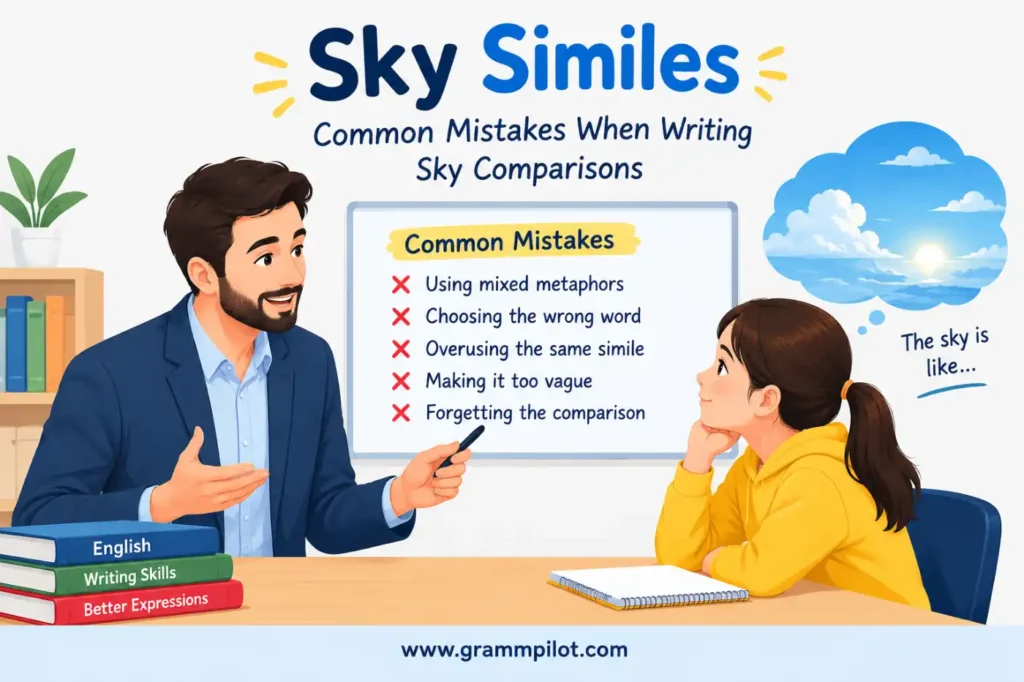
1. Choosing a comparison that doesn’t match
A comparison should fit the image.
Weak: The dark stormy sky was like a fluffy pillow.
That creates conflicting images unless you are intentionally trying to be humorous.
Better: The dark stormy sky looked like a wall of smoke.
2. Using too many similes
One strong comparison can be better than five average ones.
Overloaded: The sky was like an ocean, like a blanket, like glass, like a painting, and like a dream.
This feels crowded.
Better: The sky stretched above us like a calm blue ocean.
Choose the strongest image and move on.
3. Using clichés without adding detail
Some common comparisons are still useful:
- As blue as the ocean
- As dark as night
- Like cotton
However, these may feel familiar.
You can make them more specific:
Instead of: The clouds were like cotton.
Try: Thin clouds drifted across the sky like torn pieces of cotton.
The extra detail creates a fresher image.
4. Mixing confusing images
Be careful when combining unrelated descriptions.
Confusing: The sky was a quiet explosion of frozen fire.
This might work in experimental poetry, but most readers will struggle to understand it.
Clear writing should create a picture, not force readers to solve a puzzle.
5. Forgetting the mood
The same sky can feel different depending on the story.
A dark sky may feel:
- Scary
- Peaceful
- Lonely
- Romantic
- Mysterious
Choose language that supports the emotion you want.
6. Making every sentence poetic
Readers need variety.
A paragraph full of dramatic comparisons can become tiring.
Mix descriptive sentences with simple ones.
Example: The wind became colder. Dark clouds moved across the hills. The sky looked like a heavy curtain closing over the town. Everyone hurried inside.
The simple sentences make the simile stand out.
When Should You Not Use a Sky Simile?
A comparison is not always necessary.
Avoid one when:
- A simple description is clearer.
- You are writing a technical document.
- The comparison distracts from the main point.
- The image does not fit the audience.
- You have already used several comparisons nearby.
- You are repeating the same idea.
For example:
Simple and effective: The sky was cloudy, and rain began at noon.
That may be better than: The sky was like a mysterious gray kingdom preparing to cry millions of drops.
The second sentence is much longer, but not always better.
Good writing uses imagery when imagery helps.
What Are the Antonyms of Common Sky Description Words?
There is no single opposite for “sky simile,” but many descriptive words have useful opposites.
| Word | Possible Opposite |
|---|---|
| Bright | Dark |
| Clear | Cloudy |
| Sunny | Overcast |
| Calm | Stormy |
| Pale | Vivid |
| Gloomy | Cheerful |
| Dark | Light |
| Hazy | Clear |
| Quiet | Turbulent |
| Gray | Colorful |
These opposites can help when you want to create contrast.
Example: The morning began with a gloomy gray sky, but by afternoon it had turned bright and clear.
Quick Tips for Choosing the Right Sky Description
Use these simple rules.
Match the color
Ask what the sky actually looks like.
- Blue → ocean, sapphire, glass
- White → cotton, silk, snow
- Orange → fire, gold, copper
- Gray → ash, smoke, stone
- Black → coal, velvet, midnight
Match the weather
- Calm → lake, blanket, silk
- Windy → waves, racing horses
- Stormy → smoke, walls, armies
- Foggy → mist, curtains, shadows
Match the mood
- Happy → bright, golden, open
- Sad → gray, heavy, pale
- Scary → dark, threatening, boiling
- Peaceful → soft, calm, endless
- Romantic → glowing, golden, velvet
Keep the reader in mind
A children’s story can use playful comparisons.
Example: The clouds looked like giant marshmallows.
A serious novel may need something less playful.
Example Heavy clouds gathered over the city like a dark curtain.
How Do You Make Your Own Original Sky Simile?
You don’t have to memorize hundreds of examples. You can create your own. Try this simple four-step method.
Step 1: Look closely at the sky
Notice:
- Color
- Shape
- Light
- Movement
- Size
- Weather
Step 2: Choose the strongest feature
Suppose the clouds are long and thin.
Your strongest feature might be their shape.
Step 3: Think of something familiar
Long and thin things might include:
- Ribbons
- Brushstrokes
- Threads
- Scratches
- Trails
Step 4: Build the comparison
Thin clouds stretched across the sky like white brushstrokes. Now you have an original image.
Try another one.
The sky is dark, low, and heavy.
Possible familiar objects:
- A ceiling
- A blanket
- A curtain
Result: The storm clouds hung low like a heavy ceiling.
This method works for almost any scene.
How Can You Describe the Sky Without Using a Simile?
You can still write a strong description without comparing the sky to something else.
Use:
- Specific colors
- Active verbs
- Sensory details
- Emotional language
Example:
The pale blue sky slowly turned orange as the sun dropped behind the hills.
That sentence creates a picture without using like or as.
You can also use metaphor, but remember that a metaphor works differently.
Simile
The sky was like a blanket.
Metaphor
The sky was a blanket.
A simile makes the comparison more direct by using like or as.
A metaphor says one thing is another for effect.
Both can improve creative writing.
What Are Some Sky Similes for Poetry?
Poetry often gives you more freedom to experiment with language.
Examples:
- The sky opened like a forgotten book.
- Morning spread across the clouds like golden dust.
- The moon floated like a quiet lantern.
- Clouds moved like slow thoughts across the horizon.
- The sunset burned like a secret no one could keep.
- The stars trembled like tiny lights on black water.
In poetry, sound also matters.
Read the sentence aloud.
Ask:
- Does it flow smoothly?
- Does the image feel clear?
- Does the comparison create emotion?
- Is the language too complicated?
A simple image can often be more powerful than a complicated one.
Final Teacher Explanation
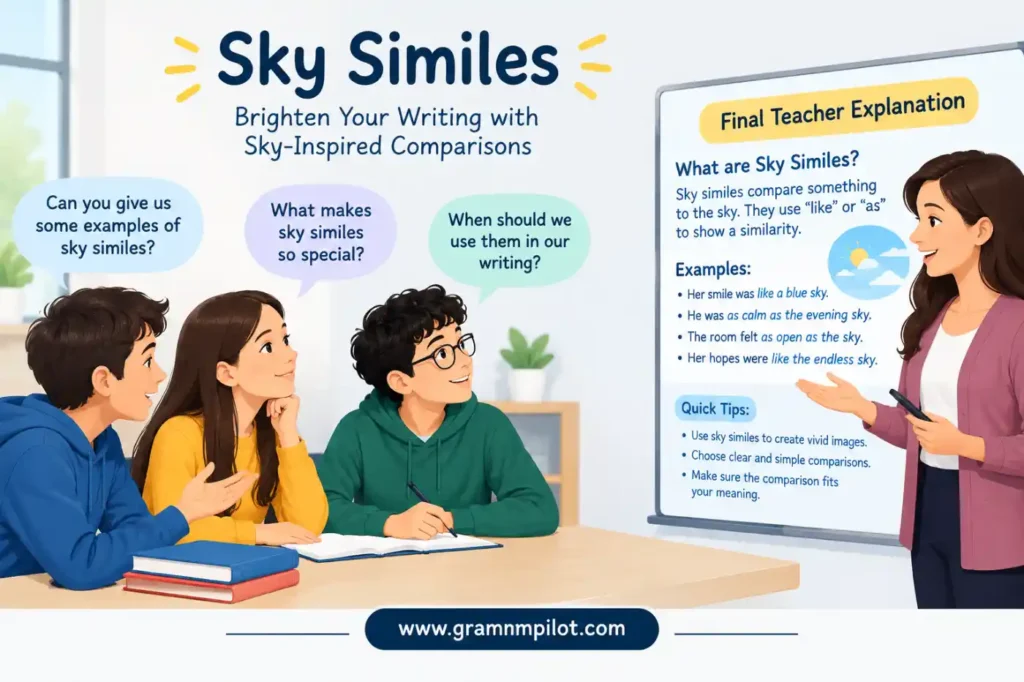
The easiest way to understand a sky comparison is to remember one rule: compare what you see with something your reader already knows. If the clouds are soft, think of soft objects. If the sky is dark, think of dark places or materials.
You don’t need difficult vocabulary to write well. A clear image is more useful than a complicated word.
For example: The clouds floated like cotton.
This is simple, but readers immediately understand the picture.
Now compare it with: The stratiform atmospheric formations presented a textile-like visual appearance.
That may sound technical, but it is less natural for creative writing. Choose words based on your purpose.
Conclusion
Sky Similes can turn an ordinary weather description into a clear and memorable image. The best comparison depends on the sky’s color, movement, weather, and mood. A calm blue morning may remind you of an ocean, while dark storm clouds may look like smoke, a curtain, or a warning.
Don’t feel pressured to make every sentence poetic. Choose one strong image when it adds meaning, then let the rest of your writing stay natural and clear. With practice, you’ll start noticing details in the sky and creating comparisons that feel fresh instead of copied. Look up, observe carefully, and let the scene guide your words.
Frequently Asked Questions
1. What are some common Sky Similes?
Common examples include “as blue as the ocean,” “clouds like cotton,” “as dark as charcoal,” and “a sunset like fire.” The best choice depends on the weather and mood.
2. What’s another way to say the sky was beautiful?
You could say “the sky was glowing,” “the horizon looked like a painting,” or “the sunset spread like melted gold.” Choose a phrase that matches the exact colors and feeling you see.
3. What is a simple simile for a blue sky?
A simple example is: “The sky was as blue as the ocean.” It is easy to understand and works well in school writing and everyday descriptions.
4. Can I use Sky Similes in an essay?
Yes, especially in descriptive, narrative, or creative essays. Use them naturally and avoid adding too many comparisons in one paragraph.
5. What is a good simile for storm clouds?
You might say, “The storm clouds rolled in like a wall of smoke” or “The dark clouds gathered like angry giants.” Use the comparison that best matches the mood of your scene.
6. What is the difference between a simile and a metaphor?
A simile compares things using words such as like or as. A metaphor makes a direct comparison without those words.
7. How can I make my own sky comparison?
First, notice the sky’s strongest feature, such as its color, shape, or movement. Then compare that feature with something familiar, like cotton, glass, fire, smoke.