
Neither vs Either can be confusing . Have you ever stopped while writing an email, school essay, text message, or social media post because you weren’t sure whether to use neither or either? You’re not alone. These two words look similar, but they have different meanings. Using the wrong one can change what your sentence says. Many English learners, students, and even native speakers search for Neither vs Either because both words often appear in the same situations. Once you understand one simple rule, you’ll know exactly when to use each word with confidence.
Quick Answer:
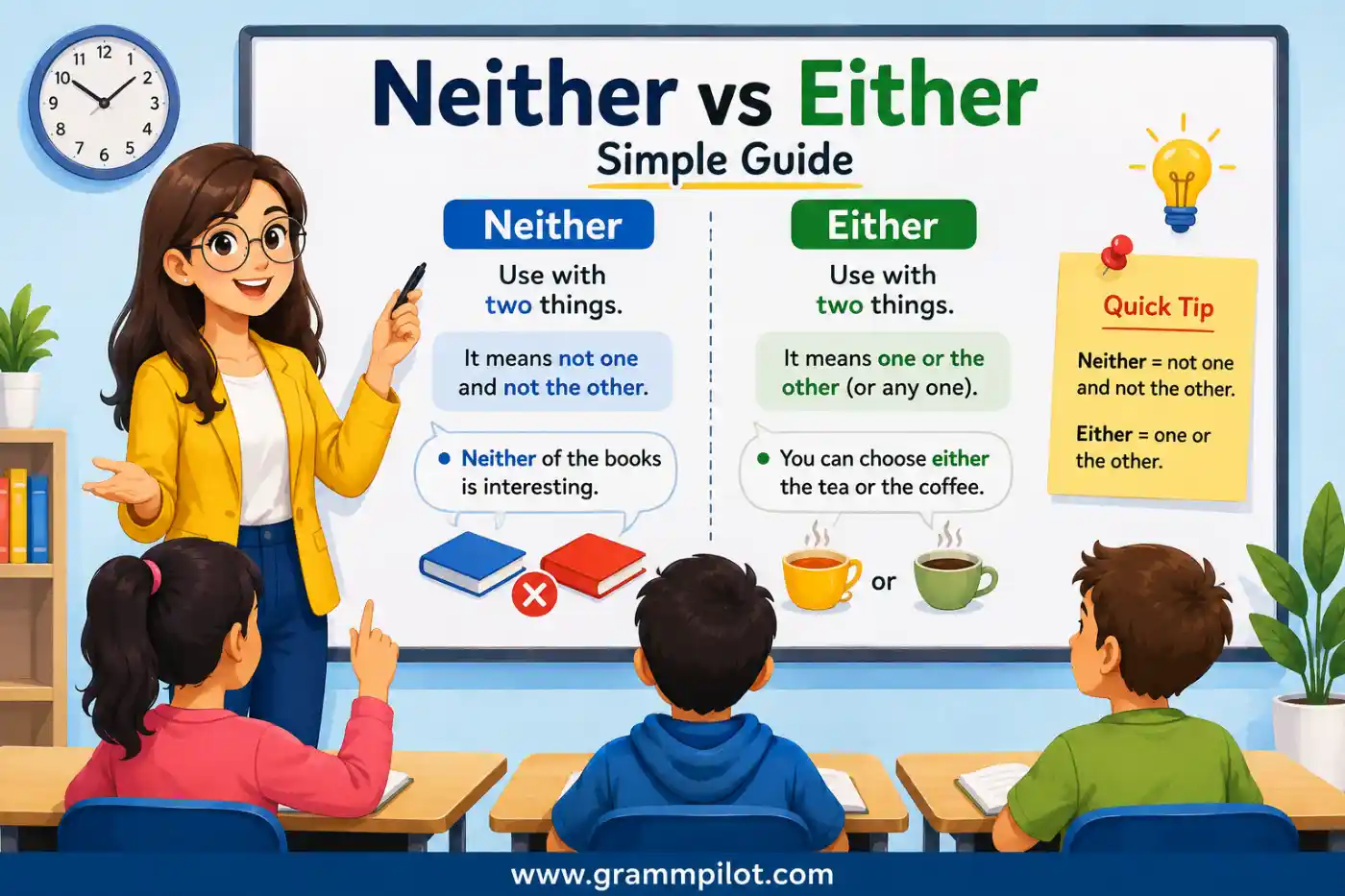
Either means “one or the other.” Neither means “not one and not the other.” If the sentence is positive, you often use either. If you want to reject both choices, you use neither.
This guide explains the meaning, history, grammar rules, real-life examples, common mistakes, synonyms, and easy tips so you’ll never confuse these two words again.
For more examples of correct grammar, check out [Assume vs Presume vs Infer].
What Does “Neither vs Either” Mean?
The difference between neither and either is simple.
- Either talks about one choice out of two.
- Neither means both choices are rejected.
Think of it this way:
| Word | Meaning | Example |
|---|---|---|
| Either | One of the two | You can choose either pizza or pasta. |
| Neither | Not one and not the other | Neither pizza nor pasta sounds good today. |
A quick trick is to remember this:
- Either = One
- Neither = Zero
That’s the easiest way to keep them straight.
Word Origin: Where Do “Neither” and “Either” Come From?
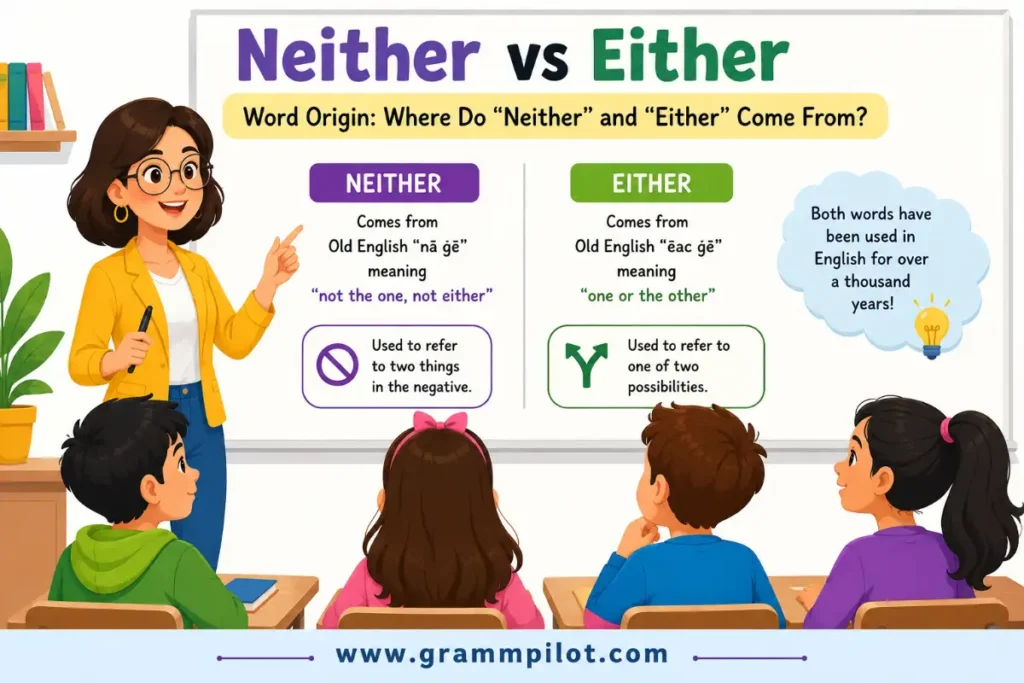
Most grammar articles explain how to use these words, but very few explain where they came from. Knowing their history makes them easier to remember.
Origin of “Either”
The word either comes from Old English. It originally meant each of two or one or the other. Over hundreds of years, English speakers shortened and simplified its pronunciation, but the meaning stayed almost the same.
Today, either still refers to two possible choices.
Examples:
- Either answer is acceptable.
- You may sit on either side.
- We can travel either by train or by car.
The idea has always been about choosing from two options.
Origin of “Neither”
The word neither also comes from Old English. It developed by adding a negative meaning to the idea behind either.
Instead of meaning “one of two,” it came to mean not one of the two.
Examples:
- Neither option works.
- Neither road leads to the town.
- Neither student knew the answer.
Over time, its meaning has remained remarkably consistent.
Neither vs Either: Why Are These Words So Often Confused?
People confuse these words because they:
- Look almost identical.
- Often appear together.
- Are both used when talking about two things.
- Can work as pronouns, adjectives, conjunctions, and adverbs in different sentences.
The biggest difference is the idea of choice versus rejection.
Compare these examples:
- You may choose either movie.
- I want neither movie.
The first sentence allows a choice. The second sentence rejects both choices.
The Plain-English Meaning of Either
The easiest definition is: Either means one or the other.
You use it when two options exist and at least one is possible.
Examples:
- Either answer is correct.
- Either road will get you there.
- Either child can help.
- You may wear either shirt.
- Either plan sounds good.
Notice something important.
The speaker is not rejecting both options. Instead, they are saying that one choice is acceptable.
The Plain-English Meaning of Neither
The easiest definition is: Neither means not one and not the other.
It completely rejects both choices.
Examples:
- Neither answer is correct.
- Neither road is safe.
- Neither child finished the homework.
- Neither shirt fits.
- Neither plan will work.
Here, both options are rejected.
The One Rule You’ll Always Remember about “Neither vs Either”
If you only remember one thing from this guide, remember this.
| Situation | Correct Word |
|---|---|
| One choice is acceptable | Either |
| Both choices are rejected | Neither |
Question: Tea or coffee?
Possible answers:
- Either is fine.
- Neither sounds good.
Question: Should we leave today or tomorrow?
Possible answers:
- Either day works.
- Neither day works.
That single idea solves most grammar questions involving these words.
When Do You Use “Either”?
Use either whenever you’re talking about two possibilities and at least one can happen.
Common situations include:
Choosing Between Two Things
- Either book is interesting.
- Either restaurant has good reviews.
- Either road leads downtown.
Giving Someone a Choice
- You can sit in either chair.
- Pick either color.
- Either answer will receive full credit.
Talking About Two People
- Either player can start the game.
- Either teacher can help you.
- Either candidate has enough experience.
Talking About Time
- We can meet either today or tomorrow.
- Either weekend works for me.
When Do You Use “Neither”?
Use neither when both options are false, impossible, unwanted, or unavailable.
Examples:
Rejecting Two Choices
- Neither answer is right.
- Neither hotel has available rooms.
- Neither dress fits.
Talking About People
- Neither student passed the exam.
- Neither brother lives nearby.
- Neither employee was late.
Talking About Ideas
- Neither suggestion solves the problem.
- Neither explanation makes sense.
- Neither plan fits our budget.
A Simple Memory Trick
Many students remember these words with numbers.
Imagine two boxes.
📦 Box A
📦 Box B
Now think about your answer.
Either
You choose one box.
Neither
You choose zero boxes.
This picture is easy to remember because English uses these words exactly that way.
How “Either vs Neither” Change the Meaning of a Sentence
Look at these sentence pairs.
Example 1
Either movie is worth watching.
Meaning: At least one choice is acceptable.
Neither movie is worth watching.
Meaning: Both choices are rejected.
Example 2
Either solution will work.
Meaning: Choose whichever you like.
Neither solution will work.
Meaning: You need another solution.
Example 3
Either route is fast.
Meaning: Both are acceptable options.
Neither route is fast.
Meaning: Both routes are slow.
Notice that changing just one word completely changes the meaning.
Are “Either vs Neither” Always Used With Two Things?
Most of the time, yes.
These words are mainly used when discussing two people, places, ideas, or objects.
Examples:
- Either student may answer.
- Neither student answered.
- Either road works.
- Neither road works.
When there are more than two choices, English often prefers words like:
- any
- none
- all
- every
For example:
Instead of: ❌ Either of the five books
Better: ✅ Any of the five books
Instead of: ❌ Neither of the five books
Better: ✅ None of the five books
Modern English speakers sometimes break this guideline in casual conversation, but formal writing usually follows it.
Can Either vs Neither Be Different Parts of Speech?
Yes. This is one reason they confuse many learners.
Both words can play several grammar roles depending on the sentence.
They can act as:
- Pronouns
- Determiners
- Conjunctions
- Adverbs
Don’t worry if those grammar names sound difficult. The important part is understanding how they work in real sentences.
Either as a Pronoun
A pronoun replaces a noun.
Examples:
- Either is acceptable.
- I don’t mind either.
- Either would be helpful.
Here, either stands alone.
Neither as a Pronoun
Examples:
- Neither is correct.
- Neither was available.
- Neither worked.
Again, the word replaces the noun.
Either as a Determiner
A determiner comes before a noun.
Examples:
- Either answer is fine.
- Either road works.
- Either player can start.
Neither as a Determiner
Examples:
- Neither answer is correct.
- Neither door is open.
- Neither option fits.
Either in a Pair
One of the most common structures is:
either…or
Examples:
- Either Mom or Dad will drive.
- Either we leave now or we stay home.
- Either study tonight or wake up early tomorrow.
Neither in a Pair
The matching structure is:
neither…nor
Examples:
- Neither Mom nor Dad is home.
- Neither rain nor snow stopped the game.
- Neither the teacher nor the students were ready.
These paired expressions are among the most common uses in everyday English.
Neither vs Either: Why Learning This Difference Matters?
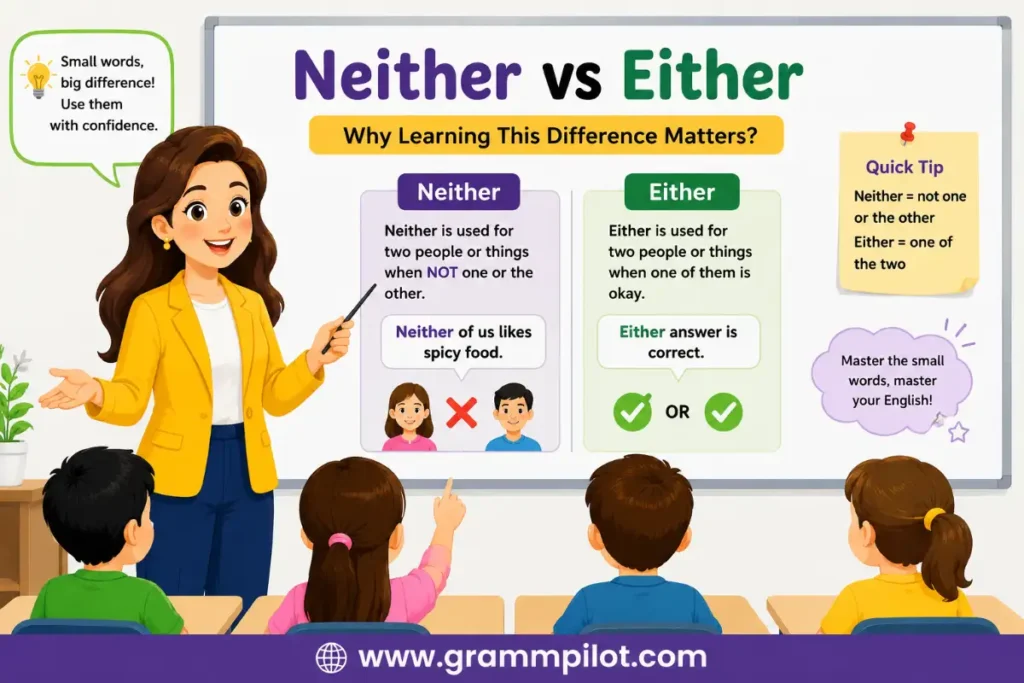
Small grammar mistakes can change the meaning of your sentence.
Imagine writing: “I like neither option.”
Instead of: “I like either option.”
These two sentences mean completely opposite things.
That’s why understanding Neither vs Either is useful for:
- School assignments
- Business emails
- Job applications
- College essays
- Everyday conversations
- Professional writing
- English tests
- Social media posts
Using the correct word makes your writing clear, natural, and easy to understand.
Master Synonym List: Related Words and Expressions
Unlike many English words, either and neither don’t have perfect one-word synonyms. Their meaning depends on the sentence. Still, several words and phrases express similar ideas.
The table below groups the closest alternatives and explains when to use them.
| Word or Phrase | Meaning | Tone | Example |
|---|---|---|---|
| Either | One of two choices | Neutral | Either answer is correct. |
| Neither | Not one of two choices | Neutral | Neither answer is correct. |
| One | A single option | Simple | Pick one book. |
| One or the other | One choice from two | Everyday | Choose one or the other. |
| Any | No preference among choices | Everyday | You can pick any seat. |
| Any one | One item from a group | Neutral | Any one of these works. |
| Both | The two together | Everyday | Both students passed. |
| None | Not any | Neutral | None of the answers fit. |
| Not one | Zero choices | Formal | Not one option succeeded. |
| One alternative | One possible choice | Formal | Select one alternative. |
| Alternative | Another option | Formal | We need an alternative. |
| Choice | Something you may select | Neutral | You have a choice. |
| Whatever | Any thing | Everyday | Choose whatever works. |
| Any of the two | Either one | Formal | Any of the two is acceptable. |
| None of the two | Neither one | Formal | None of the two was available. |
| One candidate | One person | Neutral | One candidate qualified. |
| No candidate | Nobody qualified | Neutral | No candidate met the requirements. |
| Single option | Only one possibility | Formal | There’s a single option left. |
| One possibility | One possible outcome | Neutral | That’s one possibility. |
| No possibility | Impossible | Formal | There’s no possibility now. |
| Either one | One of the two | Everyday | Either one looks nice. |
| Neither one | Not either one | Everyday | Neither one fits me. |
| One choice | One selection | Neutral | Make one choice. |
Remember that these words are related, not exact replacements. Always check whether your sentence is about choosing one option or rejecting both.
Synonyms by Intensity “Neither vs Either”(Mild → Strong)
Some expressions sound softer, while others are more direct.
When Talking About “Either”
| Intensity | Expression | Example |
|---|---|---|
| Mild | Either | Either road works. |
| Mild | Either one | Either one is okay. |
| Medium | One or the other | Pick one or the other. |
| Medium | Whichever | Take whichever you prefer. |
| Strong | Any one | Any one of these will do. |
When Talking About “Neither”
| Intensity | Expression | Example |
|---|---|---|
| Mild | Neither | Neither answer is correct. |
| Medium | Neither one | Neither one fits. |
| Medium | Not either | I don’t want either. |
| Strong | None | None of the choices worked. |
| Very Strong | No choice at all | We had no choice. |
The stronger phrases often sound firmer or more final.
Neither vs Either: Related Words by Part of Speech
Although either and neither can play several grammar roles, related expressions also fit into different categories.
Pronouns
These replace a noun.
- Either
- Neither
- One
- None
Examples:
- Either is acceptable.
- Neither worked.
- One was broken.
- None survived.
Determiners
These come before a noun.
- Either book
- Neither answer
- Any student
- Both players
Examples:
- Either movie is fine.
- Neither teacher agreed.
- Any chair is available.
- Both teams practiced.
Conjunctions
These connect ideas.
- either…or
- neither…nor
Examples:
- Either you apologize or you leave.
- Neither Tom nor Sara attended.
Adverbs
Sometimes these words change the meaning of the whole sentence.
Examples:
- I don’t like it either.
- She doesn’t sing either.
Notice that neither is less common as an adverb in everyday American English than either.
US vs. UK Usage Notes
American English and British English generally follow the same grammar rules for either and neither. However, there are a few small differences.
Pronunciation
Americans usually say:
Either
- EE-ther
- EYE-ther
Both pronunciations are accepted. British speakers also use both, although regional accents may favor one pronunciation over the other. The same pattern applies to neither.
Singular or Plural Verb?
This question causes a lot of confusion. Traditional grammar prefers a singular verb.
Examples:
- Neither answer is correct.
- Either student is welcome.
However, when using neither…nor or either…or, the verb usually agrees with the noun closest to it.
Examples:
- Neither the teacher nor the students are ready.
- Neither the students nor the teacher is ready.
- Either my brother or my parents are coming.
- Either my parents or my brother is coming.
This rule is common in both US and UK English.
Everyday Conversation
American speakers sometimes replace neither with simpler wording.
Instead of saying: “Neither answer is correct.”
Many people naturally say: “Both answers are wrong.”
Both versions are correct. The second simply sounds more conversational.
When Should You Use Either Instead of Any?
Many learners mix up these words. Here’s the easy rule.
Use either when there are two choices.
Use any when there are three or more choices.
Compare these examples.
Correct:
- You may choose either jacket.
- Either bus will take you downtown.
Correct:
- You may choose any jacket in the store.
- Any route will get you there.
Using either for many choices usually sounds unnatural in formal English.
When Should You Use Neither Instead Of None?
These words also confuse many writers.
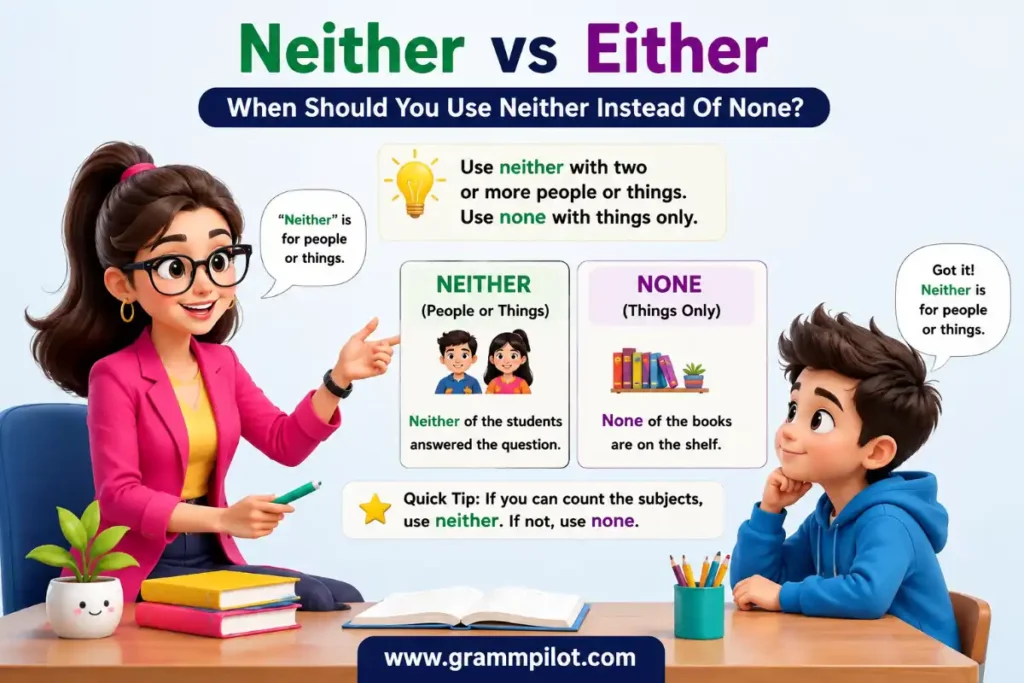
Use neither for two things.
Use none for three or more things.
Examples:
Two books: Neither book is mine.
Five books: None of the books are mine.
Although some people casually use none for two items, careful writing usually keeps this distinction.
Can Either Mean “Also”?
Yes.
This surprises many learners.
Look at this conversation.
“I don’t like coffee.”
“I don’t like it either.”
Here, either means also, but only after a negative statement.
More examples:
- I can’t swim.
- I can’t either.
- She wasn’t invited.
- He wasn’t either.
Notice that this meaning is completely different from choosing between two options. Context tells the reader which meaning is intended.
Can Neither Be Used Alone?
Yes.
Sometimes neither stands by itself.
Examples:
Question: Which shirt do you want?
Answer: Neither.
Question: Which restaurant do you prefer?
Answer: Neither.
In both cases, the meaning is easy to understand because the two choices were already mentioned.
Easy Practice: Which Word Fits?
Try answering these yourself before looking at the answers.
- ______ road leads to the airport.
- I don’t want ______ dessert.
- You can borrow ______ pen.
- ______ answer is correct.
- We can leave on ______ day.
Answers:
- Either
- Either
- Either
- Neither
- Either
Notice something interesting.
Sentence 2 says: “I don’t want either dessert.”
Because the sentence already contains don’t, you use either instead of neither.
Compare these two correct sentences:
- I don’t want either dessert.
- I want neither dessert.
They have nearly the same meaning, but the grammar is different.
Mini Comparison Chart “Neither vs Either”
| Situation | Use Either | Use Neither |
|---|---|---|
| One choice is acceptable | ✔ | ✘ |
| Both choices are rejected | ✘ | ✔ |
| Positive sentence | Usually ✔ | Rarely |
| Negative idea | Sometimes | Usually ✔ |
| Refers to two choices | ✔ | ✔ |
| Means “also” after a negative sentence | ✔ | ✘ |
This chart is worth remembering because it answers most questions in seconds.
Common Patterns You’ll See Every Day
These expressions appear constantly in books, conversations, emails, and exams.
Either…or
Used when one of two choices is possible.
Examples:
- Either call me or send a message.
- Either answer will earn full credit.
- We’ll travel either by car or by train.
Neither…nor
Used when both choices are rejected.
Examples:
- Neither rain nor wind stopped the race.
- Neither Alex nor Emma knew the password.
- Neither solution nor compromise satisfied everyone.
These paired structures are among the most common grammar patterns in English.
Neither vs Either: Which Is Better for a Resume?
When writing a resume, clarity matters more than sounding formal. Use either when you’re describing flexibility or showing that you can work in different situations. Use neither only if you truly need to say that two things do not apply.
“Either” on a Resume
Examples:
- I can work either morning or evening shifts.
- I have experience with either Windows or macOS.
- Either project management or customer service roles interest me.
Avoid Negative Statements
Instead of writing: ❌ Neither certification has been completed.
Write: ✅ Certification is currently in progress.
Positive wording leaves a stronger impression on employers.
Neither vs Either: Which Is Better for an Essay?
In school essays, accuracy is important.
Use either when discussing two possible ideas.
Example: Students may support either argument if they provide enough evidence.
Use neither when rejecting two ideas.
Example: Neither explanation fully answers the question.
Essays usually follow formal grammar, so avoid mixing negative words incorrectly.
Neither vs Either: Which Is Better for Emails?
Emails should be clear and polite.
Professional Email Examples
- Either meeting time works for me.
- You can send either document first.
- Neither proposal matches our current budget.
- Neither date is available for our team.
These sentences are direct and easy to understand.

Neither vs Either: Which Is Better for Text Messages?
Text messages are casual, so people often shorten their sentences.
Examples:
Friend: Pizza or burgers?
You: Either!
Friend: Blue shirt or black shirt?
You: Neither 😂
Friend: Friday or Saturday?
You: Either works.
Short answers sound natural because everyone already knows the choices.
Neither vs Either: Which Is Better in Everyday Speaking?
Native speakers use these words every day.
Examples:
- Either one is fine.
- Neither sounds fun.
- I’ll take either.
- Neither of us remembered.
- Either way works.
These expressions are common in conversations and sound completely natural.
15 Original Example Sentences
Here are real-life examples showing how these words work in different situations.
School
- Either answer earns full credit if you explain your thinking.
- Neither student forgot to submit the assignment.
Work
- Either manager can approve the request.
- Neither report includes the latest sales numbers.
Family
- Either parent can pick me up after practice.
- Neither brother enjoys horror movies.
Shopping
- Either jacket looks great with those shoes.
- Neither store has my size.
Travel
- Either flight arrives before noon.
- Neither hotel has free parking.
Sports
- Either team deserves to win after today’s performance.
- Neither player made a serious mistake.
Technology
- Either phone supports wireless charging.
- Neither computer can run the new software.
Daily Conversation
- Either choice will make you happy.
These examples cover situations you’ll actually encounter in daily life.
Either vs Any — What’s the Difference?
These words are similar but not identical.
| Either | Any |
|---|---|
| Refers to two choices | Refers to three or more choices |
| More specific | More general |
| Often used with “or” | Often used without limits |
Examples:
Two cookies: ✅ You may have either cookie.
Five cookies: ✅ You may have any cookie.
Think of either as limited to two options.
Think of any as open to many possibilities.
Neither vs None — What’s the Difference?
Another common question is choosing between neither and none.
| Neither | None |
|---|---|
| Two choices | Three or more choices |
| Rejects both | Rejects all |
| Usually singular | Can be singular or plural depending on context |
Examples:
Two students: Neither student arrived.
Five students: None of the students arrived.
This small difference helps your writing sound more natural.
Either…Or vs Neither…Nor
These paired expressions are closely related.
| Either…or | Neither…nor |
|---|---|
| Presents two choices | Rejects both choices |
| Positive meaning | Negative meaning |
Examples:
Either Emma or Jack will call you.
Neither Emma nor Jack answered the phone.
Either we leave now or we miss the train.
Neither rain nor traffic stopped the event.
Whenever you see either…or, think about making a choice.
Whenever you see neither…nor, think about rejecting both options.
Neither vs Either: Common Mistakes People Make
Learning from mistakes is one of the fastest ways to improve your English.
Mistake 1: Using Double Negatives
Incorrect: ❌ I don’t want neither option.
Correct:
✅ I don’t want either option.
or
✅ I want neither option.
Never combine don’t with neither in the same sentence.
Mistake 2: Using Either for More Than Two Choices
Incorrect: ❌ Either of the five books is fine.
Correct:
✅ Any of the five books is fine.
Remember:
- Two choices → either
- More than two choices → any
Mistake 3: Mixing Either and Neither
Incorrect: ❌ Neither answer is acceptable, so choose either. The sentence sends mixed signals.
Correct:
✅ Either answer is acceptable.
or
✅ Neither answer is acceptable.
Choose one meaning and keep it consistent.
Mistake 4: Forgetting “Nor”
Incorrect: ❌ Neither Tom or Jerry came.
Correct:
✅ Neither Tom nor Jerry came.
The correct pair is always:
Neither…nor
Mistake 5: Confusing Either with Too
Incorrect: ❌ I like pizza either.
Correct:
✅ I like pizza too.
Remember:
Either means “also” only after a negative sentence.
Correct example: I don’t like coffee or I don’t either.
When Should You NOT Use Either vs Neither?
There are times when different words are better.
Avoid either when:
- You have more than two choices.
- You’re speaking about everyone.
- You mean “all.”
Avoid neither when:
- You’re talking about three or more items.
- You mean “none.”
- You’re creating a double negative.
Choosing the right word makes your writing clearer and easier to understand.
Antonyms
Knowing opposite words helps reinforce the meaning.
Opposites of Either
Depending on the sentence:
- Neither
- Both
- All
- Every
Example:
Either answer works.
Both answers work.
The meaning changes, but both can fit different situations.
Opposites of Neither
Common opposites include:
- Either
- Both
- All
- Every
Examples:
Neither child laughed.
Both children laughed.
Neither road is open.
Every road is open.
The best opposite depends on the sentence.
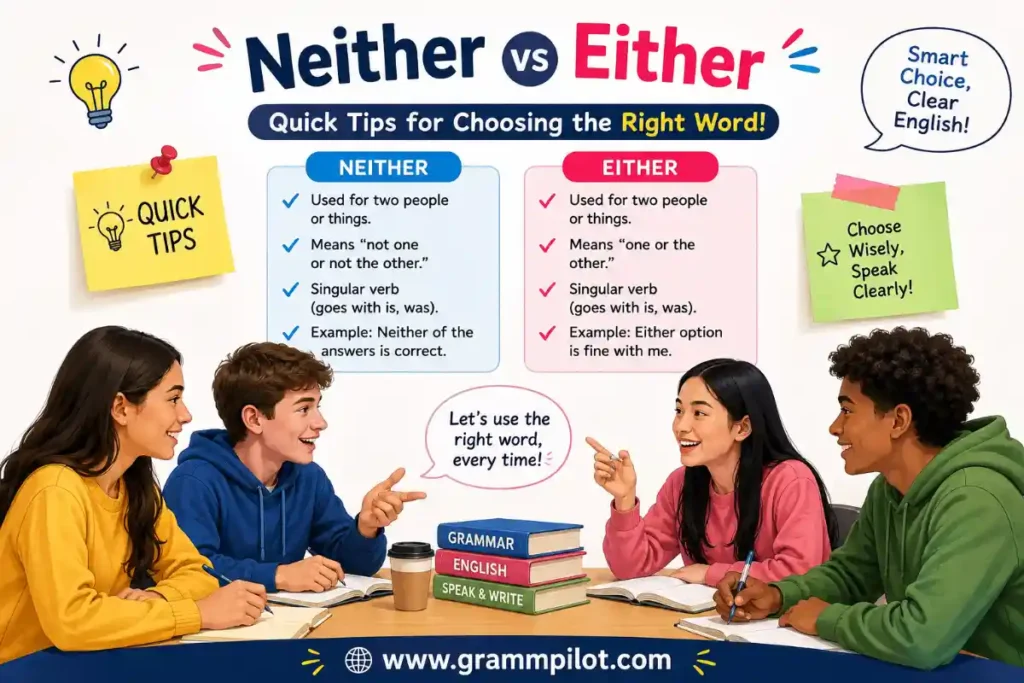
Quick Tips for Choosing the Right Word Between “Neither vs Either”
Keep these simple rules in mind whenever you write.
- Use either when one of two choices is possible.
- Use neither when both choices are rejected.
- Use either…or for choosing.
- Use neither…nor for rejecting.
- Use any instead of either when there are more than two choices.
- Use none instead of neither for three or more items.
- Avoid double negatives like “don’t…neither.”
- Remember that either can also mean “also” after a negative statement.
Decision Guide
If you’re unsure which word to choose, follow this quick guide.
| Ask Yourself | Use |
|---|---|
| Am I talking about exactly two choices? | Either or Neither |
| Is one choice possible? | Either |
| Are both choices rejected? | Neither |
| Are there more than two choices? | Any or None |
| Am I connecting two choices? | Either…or |
| Am I rejecting two choices together? | Neither…nor |
This simple checklist can help you choose the correct word in just a few seconds.
Conclusion
Understanding Neither vs Either doesn’t have to be difficult. The key is remembering one simple idea: either is used when one of two choices is possible, while neither is used when both choices are rejected. Once you keep that rule in mind, you’ll make fewer grammar mistakes and write with more confidence.
As you practice, these words will begin to feel natural. Read real English, notice how native speakers use them, and try writing your own examples. Before long, choosing between either and neither will become automatic, whether you’re writing an email, school assignment, business report, or casual text message.
Frequently Asked Questions
1. Is either always used for two choices?
Yes, either is traditionally used when talking about two choices or possibilities. If you’re talking about more than two options, words like any are usually a better choice.
2. What is the difference in Neither vs Either?
The main difference is simple. Either means one of two choices is possible, while neither means both choices are rejected. This is the easiest way to remember Neither vs Either.
3. Can I use neither by itself?
Yes. If the two choices are already understood, neither can stand alone.
Example:
A: Which jacket do you want?
B: Neither.
4. Can either mean “also”?
Yes. After a negative sentence, either can mean also.
Example: “I don’t like horror movies.”
This is a different meaning from choosing between two options.
5. Which is correct: “Neither is” or “Neither are”?
In formal English, neither is is usually correct because neither is treated as singular.
Example: “Neither answer is correct.”
However, in everyday speech, some people use plural verbs in certain situations, especially with neither…nor.
6. What’s another way to say either?
Depending on the sentence, you can use phrases such as one or the other, either one, whichever, any one, or one of the two. The best choice depends on your meaning and the context.
7. Is “either…or” the opposite of “neither…nor”?
Yes. Either…or presents two possible choices, while neither…nor rejects both choices.
Examples:
- Either Sarah or Emma will lead the meeting.
- Neither Sarah nor Emma can attend today.